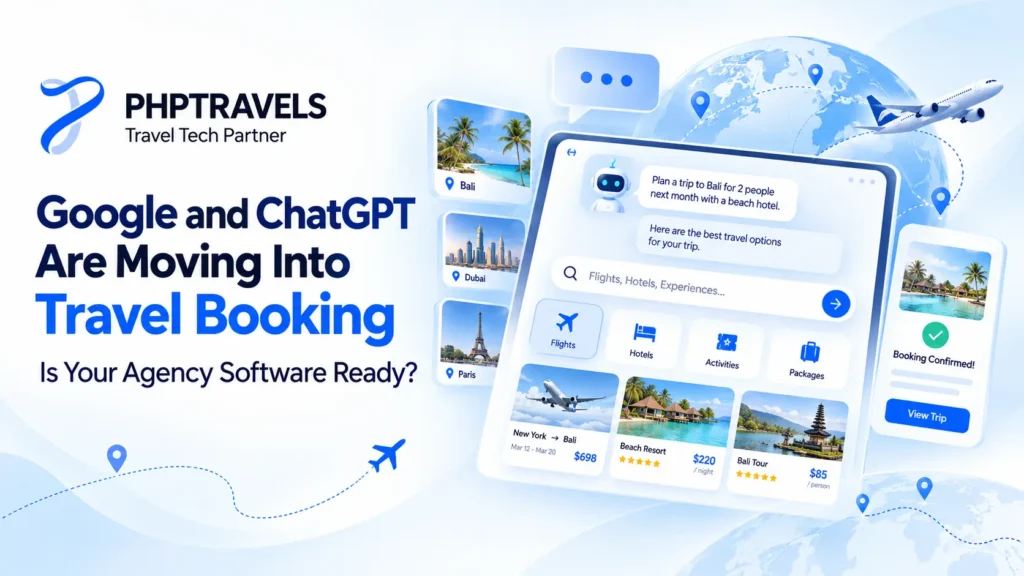
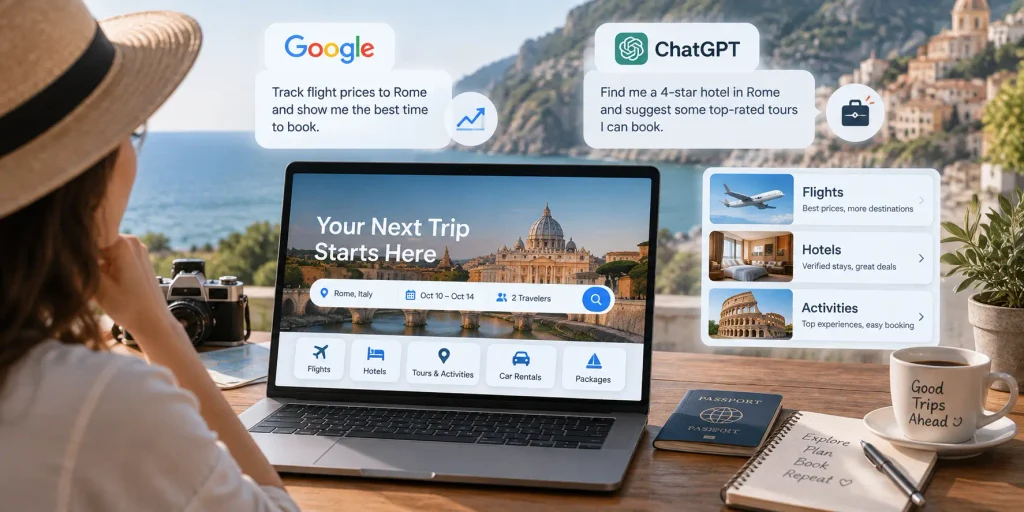
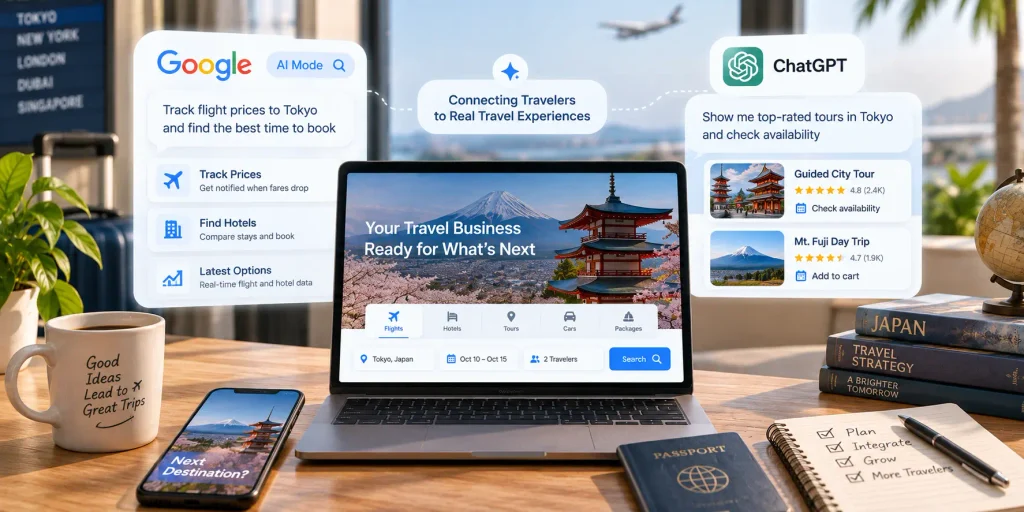
AI travel booking software is quickly becoming a real distribution question rather than a futuristic one. Travel discovery is changing. Google AI Mode can now track flight prices and assist with hotel booking, while Civitatis has connected its tours catalog to ChatGPT and Claude so travelers can discover activities, check availability, and prepare a cart through an AI conversation.
This does not mean AI has replaced travel agencies or booking websites. The bigger signal is that AI assistants are beginning to sit between traveler intent and the systems that hold inventory, pricing, and booking logic.
For agencies evaluating travel booking software, that creates a new buying question: if AI assistants become important travel distribution channels, can your software connect to them?
What Has Actually Changed in AI Travel Booking?
On August 27, 2026, Google announced new travel features for AI Mode in Search. Travelers can use conversational prompts to track flight prices, review current options, and move into an AI-assisted hotel-booking flow with integrated partners.
On September 3, Civitatis announced that its tours and activities catalog was available through ChatGPT and Claude. Users can discover experiences, ask questions, check availability, and prepare a cart inside the conversation. Checkout and payment are still completed on the Civitatis website.
The strategic importance is clear: AI is moving beyond travel inspiration and closer to live inventory and transaction workflows.
A traveler may increasingly expect an assistant not only to answer “Where should I go?” but also “What is available?”, “What does it cost?”, and “Can you help me book it?”
Quick Answer: What Should Travel Agencies Do?
Travel agencies do not need to rebuild their technology stack or rush into new AI travel booking software because of one AI announcement. They should review whether their booking platform can securely expose structured inventory, live prices, availability, and booking actions through APIs.
In practical terms, agencies should favor platforms with documented travel APIs, supplier connectivity, price revalidation, booking workflows, authentication, status updates, and customization options.
No vendor can guarantee access to every future AI channel. But flexible, API-ready infrastructure can make an agency easier to connect when a commercially useful channel appears.
What Is Agentic AI Travel Distribution?
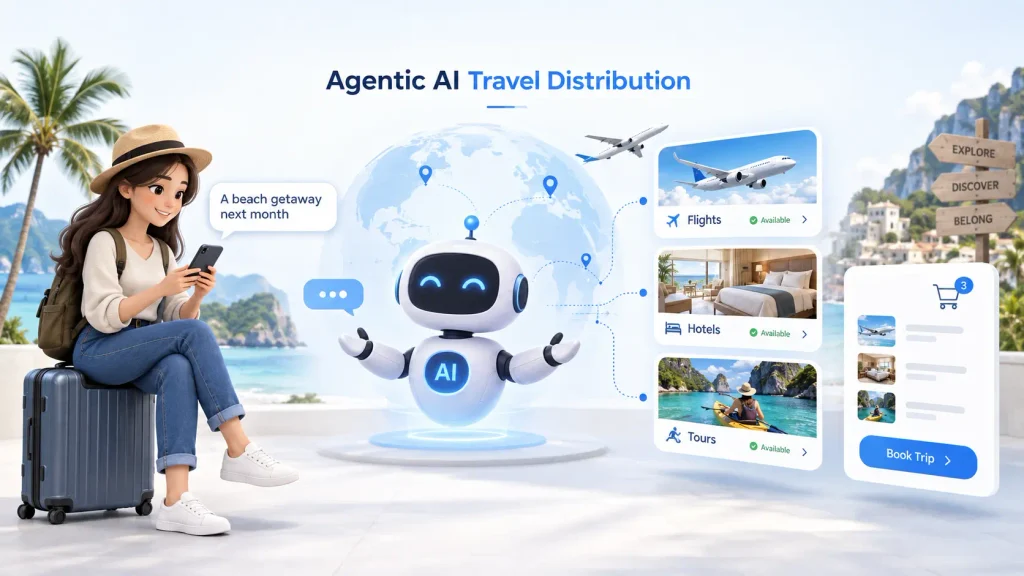
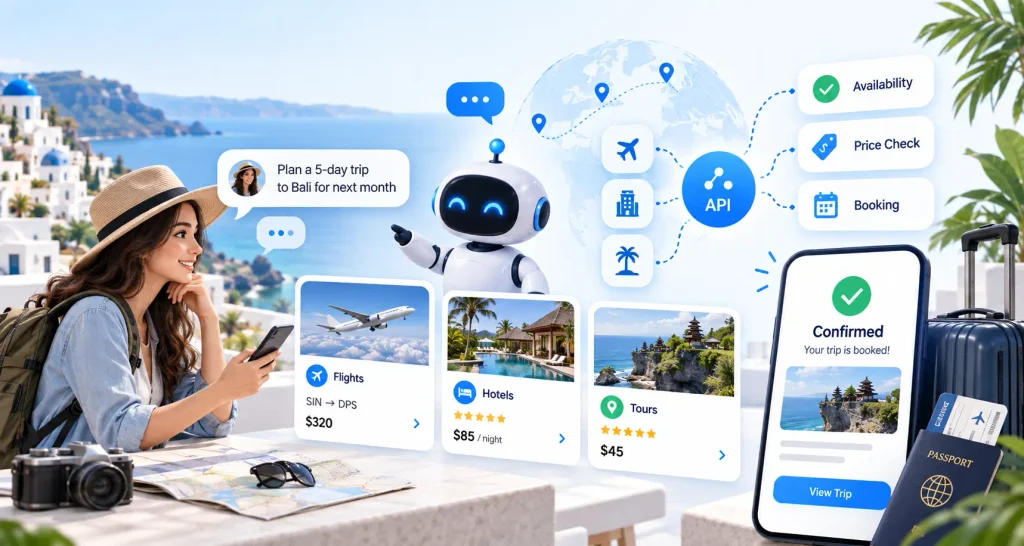
Agentic AI travel distribution is an emerging model in which an AI assistant does more than provide information. It may interpret a traveler’s request, call connected services, retrieve live inventory, compare products, check availability, prepare a transaction, and hand the traveler into an authorized booking or payment flow.
Imagine a traveler asking:
“Find me a four-star hotel in central Barcelona for three nights, with free cancellation, under my budget.”
In a traditional journey, that user may visit several websites and repeatedly enter dates, destination, and filters. In an agentic flow, an AI assistant could potentially translate the request into structured calls to connected systems and return relevant options conversationally.
The same principle could apply to flights, tours, transfers, cars, rail, and other travel products.
This market is still developing. There is no universal AI travel-distribution standard that every agency can connect to today. Platforms may require different APIs, permissions, partner approvals, and commercial agreements.
That is why agencies should focus on architectural readiness, not AI hype.
AI Does Not Remove the Booking Engine, It Changes the Front Door
An AI assistant can understand a travel request, but it still needs reliable systems behind it. That is why AI travel booking software is really a question of what sits behind the assistant.
Someone must provide live inventory, validate prices, apply business rules and markups, create reservations, process payments, issue confirmations, and handle cancellations or refunds. Those responsibilities still sit inside travel-commerce infrastructure.
A modern online booking engine for travel agencies may therefore serve more than website visitors. Its underlying booking capabilities can potentially support mobile apps, affiliates, corporate tools, and future conversational channels.
The booking engine does not disappear. The “front door” through which customers reach it may multiply.
Why API Readiness Matters for AI Travel Booking Software
APIs are the foundation of any AI travel booking software strategy. APIs let one software system request structured data or actions from another. In travel, that can include searching flights, retrieving hotel availability, revalidating a fare, creating a reservation, or checking booking status.
That is why travel API integration matters to future AI distribution.
A transactional AI channel needs more than a visually attractive website. It needs structured data and controlled actions.
| Capability | Why It Matters |
|---|---|
| Search APIs | External channels need machine-readable inventory |
| Live Availability | AI should avoid recommending unavailable products |
| Price Revalidation | Fares and rates can change before booking |
| Booking Endpoints | Authorized systems need controlled reservation actions |
| Authentication | Access must be secure and permission-based |
| Status Updates / Webhooks | Channels may need booking and payment updates |
| Cancellation / Refund Flows | Post-booking service is part of travel commerce |
| Logging / Error Handling | Agencies need to trace failures and duplicate risks |
| Custom Integration Support | New channels may require new connectors |
The Real Question: Is Your Platform Open Enough?
The useful question is not, “Does this booking system have a ChatGPT button?” The better question is whether your AI travel booking software can expose inventory and actions to outside systems safely.
Ask instead: can the platform expose the data and booking functions a new channel may require?
A closed system may meet an agency’s current needs but still limit future integrations to whatever the vendor chooses to build. An extensible platform can offer more options through APIs, modular architecture, source-code access, or custom travel solutions.
More flexibility also brings responsibility. Custom integrations must be secured, tested, monitored, and maintained. The goal is not maximum openness at any cost; it is enough technical control to support the agency’s distribution strategy.
What Should an AI-Ready Travel Platform Be Able to Expose?
Different travel products need different data, but the underlying principle is similar: machine-readable inventory plus controlled transaction actions create distribution flexibility.
For flights, an external channel may need search, fare rules, price revalidation, booking, ticketing, and post-booking actions. Agencies should assess whether their flight booking software can connect these functions without locking them into one front end.
Hotels require property content, room types, live availability, cancellation rules, taxes, rates, and reservation actions. A flexible hotel booking engine should therefore be evaluated on both user experience and structured supplier connectivity.
Tours and activities add dates, time slots, capacity, pickup information, options, and booking rules. Civitatis’ AI integration is notable because it shows how structured activity inventory can be surfaced inside conversational interfaces. Tour operators should ask whether their tour management system can make similar data available through integrations when needed.
Where PHPTRAVELS Fits Into This Shift
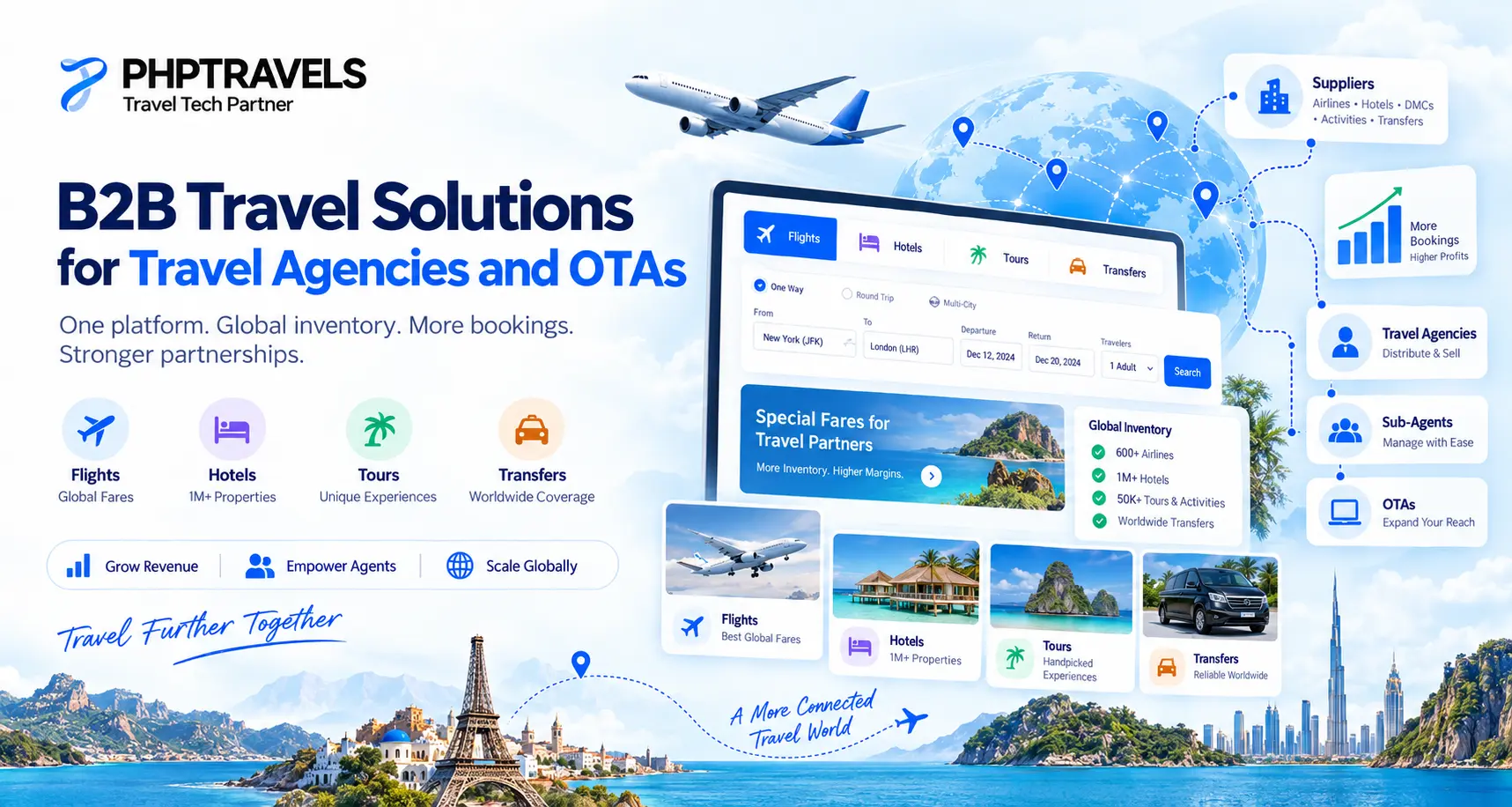
PHPTRAVELS is a self-hosted, open-source travel booking platform (and a practical base for AI travel booking software) for agencies, tour operators, and OTAs, with B2C and B2B use cases.
For this discussion, the most relevant area is connectivity.
The PHPTRAVELS API integrations marketplace lists pre-built XML and JSON connections across flight, hotel, tour, car-rental, and payment providers. PHPTRAVELS also states that supplier responses are normalized into a consistent internal model.
Its travel API offering describes RESTful API functionality, JSON/XML responses, live pricing, and structured search capabilities. Businesses needing platform-specific changes can also use PHPTRAVELS customization services.
These capabilities should not be interpreted as an automatic connection to Google AI Mode, ChatGPT, Claude, Gemini, or every future AI marketplace. Any direct connection would depend on the external platform’s technical requirements, partner access, permissions, and commercial terms.
The relevant advantage is adaptability. Software with accessible APIs and customization paths can give agencies more options when new distribution channels become commercially important.
B2B Distribution May Evolve Too
AI-assisted distribution is not limited to consumer bookings.
Travel agencies already distribute inventory to sub-agents, corporate clients, affiliates, and partners. A B2B booking engine separates inventory from one public storefront by applying different permissions, markups, and business rules to different users.
Future AI assistants could potentially become another controlled interface into that infrastructure for example, helping a corporate traveler search approved inventory or helping a sub-agent retrieve suitable options.
These scenarios remain forward-looking, but they reinforce the importance of reusable APIs and permission-based access.
Should Travel Agencies Replace Their Current Software Now?
Not necessarily, and switching to new AI travel booking software is not the first step.
Google’s and Civitatis’ developments are signals, not proof that every booking will move into AI assistants.
Start by auditing your existing platform. If it already supports supplier APIs, structured inventory, revalidation, secure booking workflows, and custom development, much of the foundation may already exist.
If you are already replacing your platform, however, add AI-channel and API readiness to the procurement checklist.
The objective is not to predict which assistant will dominate travel. It is to avoid choosing software that cannot participate in new channels without rebuilding the core booking system.
Will ChatGPT and Google Replace Travel Agency Websites?
There is no strong basis for saying they will.
Travel websites still provide branding, content, merchandising, checkout, account management, policies, support, and post-booking service.
A more realistic outcome is a multi-channel travel journey.
One customer may start on Google, another in ChatGPT, another in an agency app, and another directly on the agency website.
The stronger technology strategy is therefore not “website versus AI.” It is a booking infrastructure that can support multiple customer-entry points.
How Can Agencies Prepare Without Chasing AI Hype?
Start with practical work on your existing AI travel booking software that creates value even if agentic booking develops slowly.
Map where your flight, hotel, tour, and car inventory comes from. Review which APIs are already connected. Confirm how search, revalidation, booking, payment, cancellation, and status updates work.
Then identify areas where your business depends on a single interface or vendor-controlled roadmap. Prioritize integrations that already have commercial value, while keeping the architecture extensible enough for new channels.
The broader goal of modern travel technology solutions should be to make inventory and booking operations reusable across the channels your customers actually use.
Final Takeaway
Google AI Mode and Civitatis’ ChatGPT and Claude integrations suggest that conversational AI is moving closer to live travel inventory and transaction workflows.
That does not mean AI assistants have replaced OTAs, agencies, or booking engines. It means another distribution layer may be emerging. For agencies, that makes AI travel booking software readiness a planning topic for 2026 rather than an emergency.
Travel agencies should therefore avoid choosing software simply because it carries an “AI-powered” label. Look for structured data, reliable booking operations, secure APIs, supplier connectivity, and enough flexibility to support future channels.
The future of AI travel booking may depend less on the chatbot customers see and more on the booking infrastructure behind it.
If your agency is reviewing its technology stack, explore the PHPTRAVELS live demo to evaluate its booking modules, integrations, and customization options against both your current requirements and the channels you may need next.