Three pieces of hotel and OTA news landed between 27 and 30 October 2026, and they point the same way. Apaleo said use of its MCP server for AI agents grew 70% in the third quarter. Canary Technologies published an analysis of more than 10 million guest conversations handled by AI. Agoda rolled its AI Assistant out to 21 markets. Taken together, they show where AI in hospitality is heading: away from chatbots that answer questions and towards agents that change reservations, sell upgrades and book whole trips.
For travel agencies, OTAs, tour operators and B2B sellers that sell hotel rooms they do not own, this matters for a simple reason. The hotel and the big OTA are both building AI that talks to your customer and acts on live inventory. This article sets out what was announced, what the numbers actually say, why data access matters more than the AI model, and what to check in your own booking stack.
What happened this week: three signals from hotels and OTAs

Each announcement comes from a different part of the hotel distribution chain: the property management system (PMS), guest messaging, and the OTA storefront.
| Company | Where it sits | What it announced | Headline figure |
|---|---|---|---|
| Apaleo | Hotel PMS (the hotel’s core system) | Usage of its MCP server, which lets AI agents read and change live PMS data | +70% usage, July to September 2026 |
| Canary Technologies | Guest messaging and AI for hotels | Study of 10M+ AI guest interactions across calls, texts and web chat | 65% of conversations ask the hotel to do something, not just answer |
| Agoda | OTA (Booking Holdings group) | AI Assistant expanded from a September beta to 21 markets in its mobile app | Beta users more likely to book a “connected trip” |
Apaleo. The PMS company reported that activity on its Model Context Protocol (MCP) server rose 23% from July to August and 38% from August to September, a 70% rise over the quarter. Most use is staff-facing: revenue management, forecasting, reservations and reporting, with guest-facing agents still a minority. Its examples are concrete. One operator amended about 2,000 reservations in a single action, work Apaleo estimates would otherwise have taken about 50 hours (Apaleo announcement; also reported by Travolution, 27 October 2026).
Canary Technologies. Its report “From Answers to Actions” covers more than 10 million AI-handled guest interactions across thousands of hotels in over 100 countries. Six in ten AI replies used the guest’s own context, such as reservation details. Nearly two-thirds of conversations asked the hotel to act, and 45% of those action requests involved bookings or reservations (Canary press release, 28 October 2026; report summary).
Agoda. The assistant combines conversational planning with Agoda’s live inventory of more than six million accommodations plus flights, tours, attractions and ancillaries. It keeps preferences and trip context as the plan develops and lays the trip out on a planner canvas. Its conversation layer runs on OpenAI models, and it uses Gemini with Google Maps grounding for restaurant and attraction details. Agoda did not publish user numbers or conversion rates (Agoda release via Hospitality Lexis, 30 October 2026; eCommerceNews).
One more data point frames the week. At Skift Global Forum, Sierra CEO Bret Taylor argued that a travel company’s “new digital front door is an agent” that connects booking, service and loyalty (Skift, 29 October 2026). That piece is sponsored content, so treat it as a vendor’s view. The three announcements above are the evidence.
AI in hospitality has moved from answering to acting
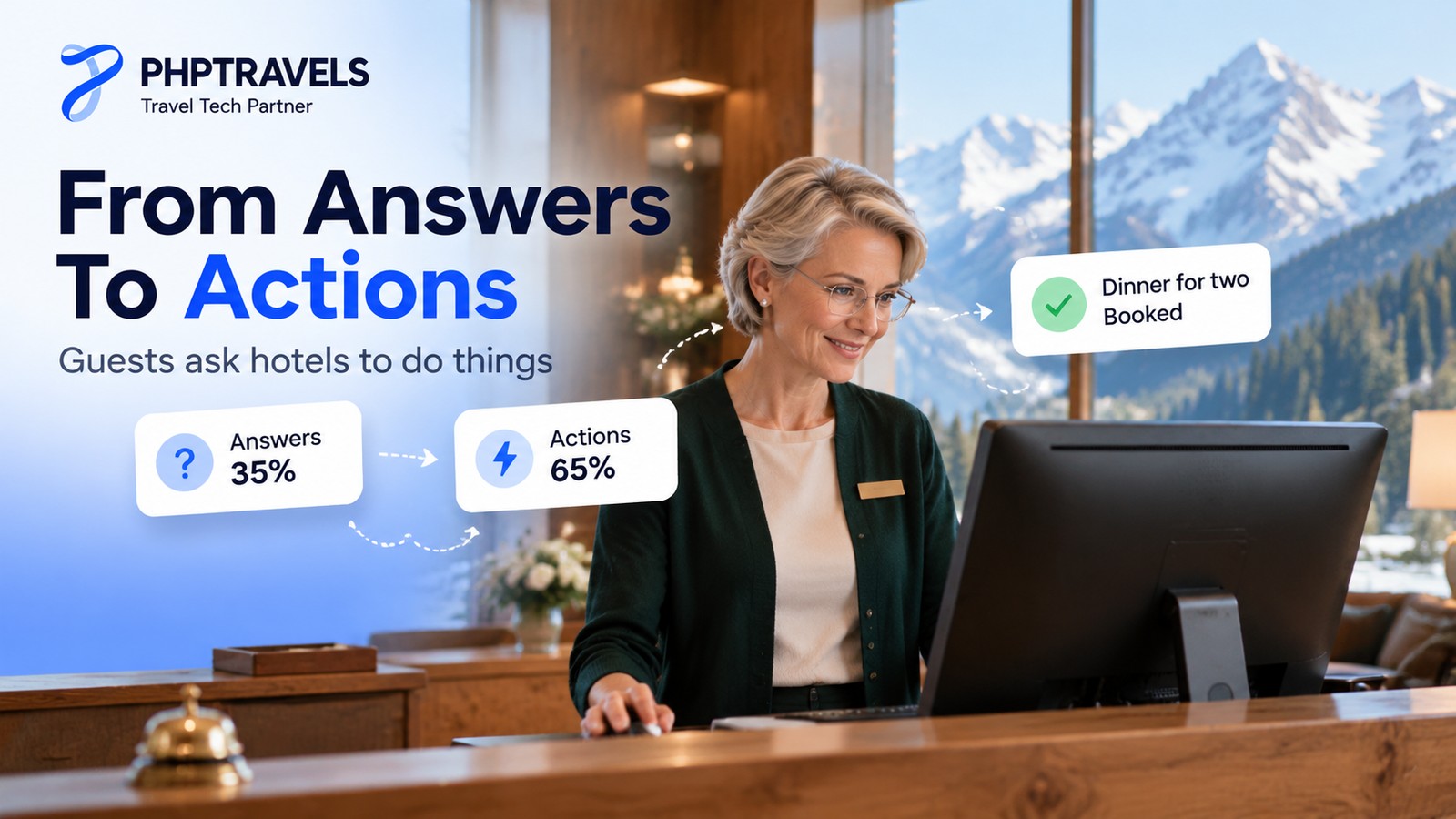
For years, AI in hotels mostly meant a website chatbot that answered “what time is check-out?” or “is there parking?”. The new numbers say that model is too small. If 65% of guest conversations are requests for action, an assistant that can only reply with information leaves most of the work for staff.
Canary’s own examples of action requests range from reserving dinner to fixing a broken air conditioner. Each one touches a different system: the restaurant book, the maintenance queue, the PMS folio. That is why both Canary and Apaleo now use the word “agentic”. An agent does not just generate text; it calls a system, changes a record, and reports back.
Staff-facing first, guest-facing second
The Apaleo data shows a sensible order of adoption. Hotels are giving agents back-office jobs first, where a staff member checks the result:
- Revenue work. Appenzeller Hotels runs a daily workflow in Claude that finds bookings that can be upgraded to free lower room categories for resale, saving about two hours a week.
- Forecasting. Brera Serviced Apartments generated a full-year forecast from last year’s balance sheet, a task that previously took three people two weeks.
- Bulk changes. The 2,000-reservation amendment above is the kind of repetitive job that eats front-office time.
The lesson for anyone selling travel is that the reliable gains today come from automating known, repeatable tasks with a human checking the output. Fully autonomous guest-facing agents are coming, but the operators getting value now started small.
The bottleneck is data access, not the AI model

The most useful figures in Apaleo’s release are not its own. It cites the h2c Hotel Chain Tech Report 2026: 91% of hotel chains now use AI, up from 78% a year earlier, but only 15% have a standardised data access layer for AI, such as MCP, and 52% have no plans to build one. Integration with existing systems is a barrier for 38% of respondents (h2c figures as cited by Apaleo).
Read those two numbers together. Almost every chain uses AI, yet very few have given it a clean, governed way into reservations, rates and guest profiles. An assistant without that access can write a polite reply but cannot move a booking. As Apaleo founder Philip von Ditfurth put it, “What changed is access.”
What MCP actually changes
The Model Context Protocol is an open standard that gives an AI application one consistent way to connect to outside tools and data. In a hotel, that means one connection to read availability or amend a reservation, instead of a custom integration for every AI tool. Apaleo says its version acts with the permissions of the user it represents and keeps a full audit trail. Those two controls matter more than the protocol name: they decide what the agent is allowed to do and let you prove what it did. We covered the protocol from the agency side in MCP for travel booking.
The h2c research also found that external tools such as ChatGPT account for 60% of day-to-day AI use in hotel chains, against 27% for AI built into vendor systems. In other words, staff have already chosen their assistant. The question for every travel system, hotel or agency, is whether that assistant can connect to the data safely.
The data an agent needs is usually already organised somewhere. Most hotels keep rates, availability and restrictions in one calendar and push them to every channel, as Travels Tech’s hotel channel manager page describes, and that calendar is exactly what an AI agent has to read before it promises a room. If the calendar is out of date, the agent will be wrong faster than a person would be. Our guide to the hotel property management system explains how the PMS, channel manager and booking engine divide that work.
Guest-facing AI is becoming a revenue channel

Canary’s report makes a commercial case, not only a service one. Hotels that added AI messaging grew upsell revenue by an average of 54% in their first six months. Guests answered by AI were 11% more likely to give a five-star rating on in-stay surveys. AI replied in a median of nine seconds, while a quarter of staff replies took 15 minutes or more and 12% took over an hour (Canary report summary).
Two cautions before you quote those figures to a client. First, they are Canary’s own data about its own product, so the hotels in the sample chose to buy AI messaging; that is not a controlled experiment. Second, “54% upsell growth” is a relative figure; a small upsell base can grow quickly. Even so, the direction is clear, and Travolution’s summary of the report adds a timing detail that agencies will recognise: 41% of calls arrive outside 9am to 6pm and 32% concern reservations (Travolution, 28 October 2026).
That is the real revenue point. Demand for help does not keep office hours, and a booking request answered in seconds at 11pm is more likely to convert than one answered the next morning. The same logic applies to an agency’s own enquiries, quotes and add-on sales, which we cover in ancillary revenue in travel booking.
Agoda’s “connected trip” signal
Agoda’s early beta finding points the same way from the OTA side: people using its assistant were more likely to book a trip that combines several products, such as a hotel, flight, attraction tickets and tours. A conversation naturally moves from “where should we stay?” to “how do we get there?” and “what should we do?”, and an assistant tied to live inventory can sell each step. That is an attractive model for an OTA, and a direct threat to agencies whose value is building the whole trip.
What this means for travel agencies and OTAs that sell hotels

Hotels are using AI to keep more of the guest relationship, from pre-arrival upgrades to in-stay dining. Large OTAs are using it to make the whole trip one conversation. Agencies, consolidators and smaller OTAs sit between the two. Three practical implications follow.
1. A chatbot that cannot see live inventory is a liability
Agoda’s approach is instructive: the assistant plans, but every bookable item comes from live inventory with real prices and availability. A generic AI chat window on an agency site that recommends hotels from its training data will quote stale prices and rooms you cannot sell. Customers notice. The safer pattern is that AI chooses from search results your booking engine has returned, and the engine prices and confirms. Price checks before payment, such as booking revalidation, stay essential.
2. Your margin rules have to apply inside the conversation
If an assistant can assemble a hotel, transfer and tour in one chat, it must apply the same markups, B2B rates and currency rules as your normal search. Otherwise the AI channel quietly sells at the wrong price. This is easier on a platform that aggregates several suppliers under one set of rules, the subject of our guide to a multi-supplier hotel booking engine.
3. Hotel-side tools and seller-side tools are different products
Apaleo and Canary build for the property: its PMS, its staff, its guests in-house. A travel business that sells rooms from bed banks and direct contracts needs a supplier-connected booking platform instead; this guide to choosing booking software for hotels sets out why the two categories should not be confused. Both sides will run AI agents. The difference is whose inventory, rules and customer record the agent works with.
There is also a supplier angle. Agoda is an OTA competing for the same traveller, but it is also a hotel supplier that sellers can connect to. The assistant war does not remove the need for good wholesale content; it raises the bar for how quickly and accurately that content reaches the customer.
A readiness checklist for AI in your booking stack
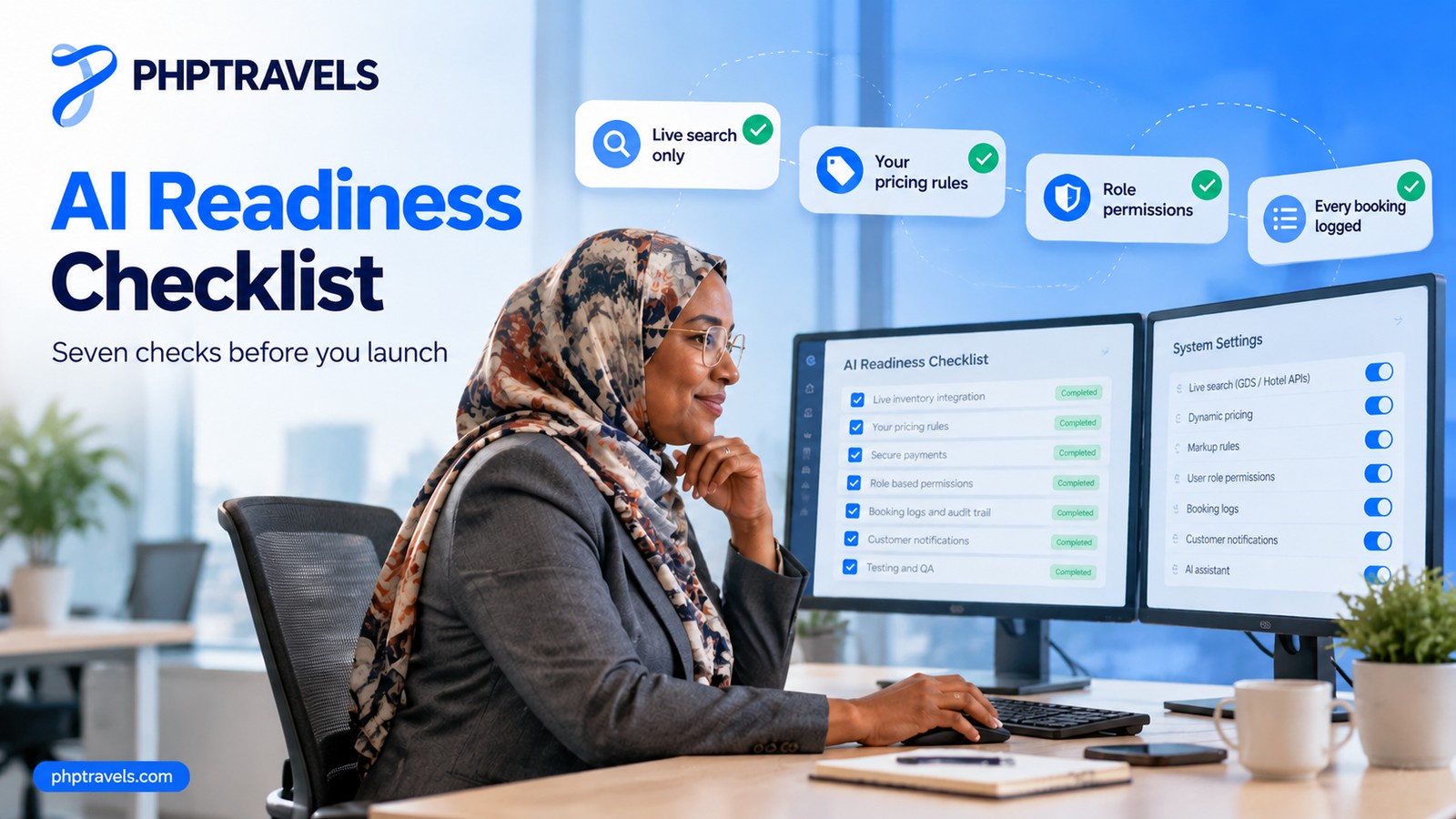
Before adding an AI assistant to a travel site or agent portal, work through these questions. They come directly from the controls Apaleo, Canary and Agoda highlight, translated to a seller’s system.
| Question | Why it matters | What good looks like |
|---|---|---|
| Does the AI only offer products returned by a live search? | Prevents invented hotels, prices and availability | Every bookable item has a supplier, a live rate and an add-to-basket action |
| Who sets the price? | An AI model should never decide margin | The booking engine applies your markups and rechecks the rate before payment |
| What is the AI allowed to change? | Agents that can act need limits | Permissions per role; changes and cancellations go to a human or to clear rules |
| Can you see what it did? | Disputes and refunds need evidence | Every prompt, plan, basket and booking is logged |
| Which AI provider runs it? | Models change quickly; lock-in is a risk | You choose the provider and can swap it without touching inventory or checkout |
| Where does customer data go? | Passport and payment data are sensitive | Clear data handling, minimal data sent to the model, secure storage |
| What happens out of hours? | 41% of hotel calls in Canary’s data came outside office hours | The assistant captures the request and the plan; staff follow up with context |
Data handling deserves extra attention because AI makes it easy to send more customer information to an outside service than you need to. Our guide on how travel businesses can secure customer data covers the basics. Start with one contained use case, measure it, then widen it. That is the pattern Apaleo describes among its own customers.
Where PHPTRAVELS fits, and where it does not

PHPTRAVELS is travel booking software for agencies, OTAs and tour operators, not a hotel PMS or a guest messaging tool. It will not run housekeeping or in-stay requests for a property. Where it is relevant is the seller’s side of this shift.
Its AI Trip Planner follows the split described above. The assistant turns a traveller’s request into a structured search and a day-by-day plan, but every product comes from a live search of the inventory the agency has connected, and the booking engine prices it with the agency’s markups and rechecks the rate before checkout. The AI does not set prices or confirm bookings. Agencies choose which suppliers and modules the planner may use, set tone and budget rules, and connect the AI service of their choice with their own key. In the B2B agent portal, sub-agents can plan for a client at net rates and send the result as a quote. We explain the workflow in more detail in AI trip planner for travel agencies.
Hotel inventory comes through the Stays module and connected suppliers listed on the integrations page, which includes bed banks and OTAs such as Hotelbeds, RateHawk and Agoda. As always, the buyer needs their own supplier contracts and API credentials; the software builds the connection but does not grant inventory.
The honest limits: PHPTRAVELS does not replace a hotel’s PMS, channel manager or guest messaging platform, and an AI planner is only as good as the inventory and rules behind it. If you want to see how the planner, booking engine and agent portal work together, try the live demo or compare plans on the pricing page.
Frequently asked questions
What is AI in hospitality?
AI in hospitality is the use of artificial intelligence by hotels and other accommodation businesses for guest messaging, upselling, revenue management, forecasting and reservation work. In 2026 the focus is shifting from chatbots that answer questions to AI agents that carry out tasks in hotel systems.
How are hotels using AI agents today?
Mostly for staff-facing work. Apaleo reports adoption concentrated in revenue management, forecasting, reservations and reporting, with guest-facing agents still in the minority. Canary’s data shows guest messaging is the main guest-facing use.
What is an MCP server in a hotel PMS?
It is a connection point, based on the open Model Context Protocol, that lets an AI agent read and update PMS data such as reservations, rates and availability through one standard interface, with the permissions of the user it acts for.
Will AI replace hotel or travel agency staff?
The current evidence points to AI taking repetitive and out-of-hours work, while people handle exceptions and judgement calls. Operators in Apaleo’s examples saved hours on specific tasks rather than replacing teams.
Does PHPTRAVELS include an AI assistant?
Yes. PHPTRAVELS includes an AI Trip Planner that plans trips from the agency’s own connected inventory and hands pricing and booking to the booking engine. It is not a hotel PMS or in-stay guest messaging tool.
This week’s news is less about which AI model wins and more about who connects it to live data with the right controls. Hotels are wiring agents into their PMS and guest channels, and OTAs are making the whole trip one conversation. For sellers, the practical response is to make sure any AI on your site works from live inventory, your pricing rules and a full log. If that is the stack you are building, book a PHPTRAVELS demo.