
Fifth freedom flights are the odd ones on a departures board: a Dubai airline flying Athens to New York, a Singapore airline flying Frankfurt to New York, an Ethiopian jet flying Lomé to Newark. None of these routes touches the airline’s home country, yet you can buy a ticket for just that sector, often on a long-haul aircraft with a long-haul cabin. For travellers they are a way to get a better product or another fare option on a busy route. For travel agents and booking platforms they are a regular source of confused customers, because the flight number, the aircraft and the “one stop” label rarely match what the traveller expected.
This guide explains what a fifth freedom flight is, where the term comes from, how airlines win the rights to operate one, real routes flying today, the trade-offs for passengers, how to find and book them, and how a booking engine should display them so nobody is surprised at the gate.
What Are Fifth Freedom Flights?
A fifth freedom flight is a scheduled international flight on which an airline carries paying passengers between two countries that are both foreign to it, as part of a service that starts or ends in its home country. The term comes from the “freedoms of the air”, the standard list of traffic rights used in aviation agreements.
The International Civil Aviation Organization (ICAO) defines the Fifth Freedom of the Air as the right “granted by one State to another State to put down and to take on, in the territory of the first State, traffic coming from or destined to a third State”. That wording comes from ICAO’s Manual on the Regulation of International Air Transport (Doc 9626), and regulators quote it directly, for example the Civil Aviation Authority of Macao’s freedoms of the air page.
A worked example: Dubai, Athens, Newark
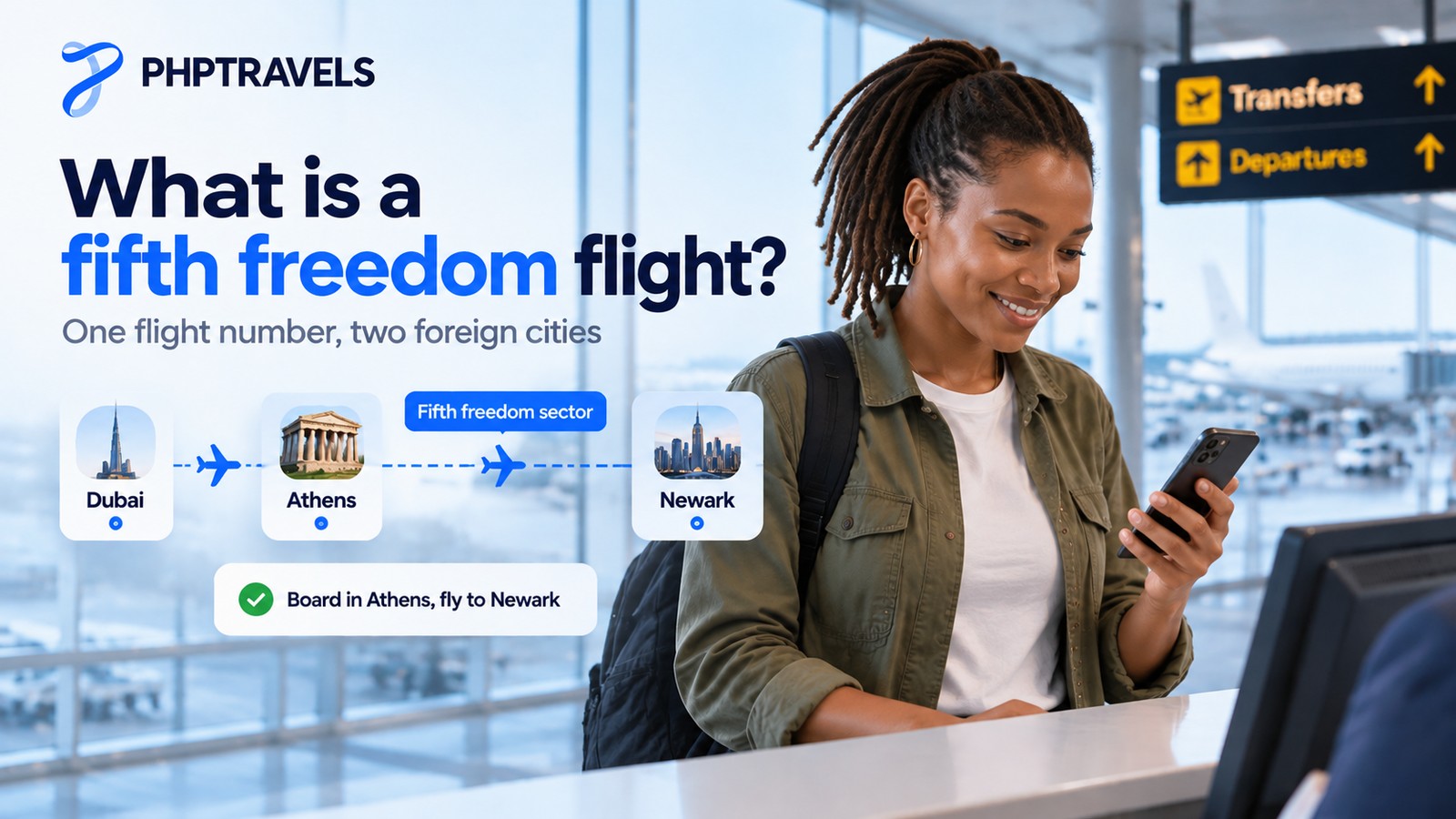
Emirates flight EK209 leaves Dubai, lands in Athens, and then continues to Newark under the same flight number. When the service started on 12 March 2017, Emirates said passengers boarding in Newark or Dubai could “disembark in Athens or continue to their final destinations”. Split the flight into its legs and the freedoms become clear:
- Dubai to Athens: an Emirati airline carrying passengers from its home country to Greece. That is a third freedom right (and fourth freedom on the way back).
- Athens to Newark: the same airline carrying passengers who board in Greece and fly to the United States. Neither country is the UAE. That sector is the fifth freedom flight.
- Dubai to Newark on the same ticket: a home-country passenger who simply stays on board in Athens. That is ordinary third and fourth freedom traffic with a stop.
So “fifth freedom” describes a sector and the passengers who travel only on it, not the whole flight number.
Why is it called the fifth freedom?
Because it is number five on ICAO’s list. The first two freedoms are about overflying and landing for fuel or maintenance, the third and fourth cover flights to and from the airline’s home country, and the fifth is the first one that lets an airline earn money between two foreign countries.
The Nine Freedoms of the Air, Explained

ICAO lists nine freedoms. Only the first five have been recognised by international treaty. ICAO calls everything beyond the fifth a “so-called” freedom, and notes that the sixth is not incorporated as such into widely recognised agreements such as the “Five Freedoms Agreement” (the International Air Transport Agreement of 1944).
| Freedom | What the airline may do | Everyday example |
|---|---|---|
| 1st | Fly over a foreign country without landing | A Europe-to-Asia flight crossing Turkish airspace |
| 2nd | Land in a foreign country for non-traffic reasons (fuel, repairs) | A technical fuel stop where nobody boards or leaves |
| 3rd | Carry passengers from its home country to a foreign country | Emirates, Dubai to Athens |
| 4th | Carry passengers from a foreign country back to its home country | Emirates, Athens to Dubai |
| 5th | Carry passengers between two foreign countries on a service linked to its home country | Emirates, Athens to Newark on EK209 |
| 6th (so-called) | Carry passengers between two foreign countries via its home country, on two flights | London to Dubai, then Dubai to Bangkok, on one ticket |
| 7th (so-called) | Fly between a foreign country and a third country with no link to its home country | A base set up abroad, flying only foreign routes |
| 8th (so-called) | Carry domestic passengers inside a foreign country on a service that starts or ends at home (“consecutive cabotage”) | A foreign airline selling only the domestic leg of its international flight |
| 9th (so-called) | Fly purely domestic routes inside a foreign country (“stand alone” cabotage) | Rare |
Fifth freedom vs sixth freedom
The difference that matters for travellers is the plane change. On a fifth freedom flight you stay on one aircraft and one flight number between two foreign cities. On a sixth freedom journey, the pattern hub carriers such as Emirates, Qatar Airways and Turkish Airlines rely on, you fly into the airline’s home hub and change to a second flight. The sixth freedom is usually achieved by combining third and fourth freedom rights rather than negotiated as a separate right.
Intermediate and beyond fifth freedom
Trade negotiators also split the fifth freedom in two. On an intermediate fifth freedom, the airline picks up traffic at a point between home and the final destination (Emirates in Athens on the way to Newark). On a beyond fifth freedom, it carries traffic from the destination onward to a further country. An agreement can grant one without the other.
How Airlines Get Fifth Freedom Rights

No airline has an automatic right to fly into another country. Article 6 of the Chicago Convention says that “no scheduled international air service may be operated over or into the territory of a contracting State, except with the special permission or other authorization of that State”, as the Macao civil aviation authority summarises. Governments grant those permissions to each other in bilateral air services agreements, and the freedoms of the air are the vocabulary those agreements use.
Three countries have to say yes
A fifth freedom sector needs agreement on both ends of the sector, plus the home country designating its airline. For EK209, the United States had to let an Emirati airline land passengers who boarded in Greece, and Greece had to let it pick them up. Trade press reported in January 2017 that Emirates had secured fifth freedom traffic rights from the Greek government ahead of the launch, and that Milan to New York JFK was its first long-haul fifth freedom service in Europe.
That is why fifth freedom routes are uncommon. Local airlines often oppose a foreign carrier competing on “their” sector, and a government that grants the right normally expects something similar in return.
Open Skies agreements make it easier
Liberal “Open Skies” agreements remove most route limits. The original US-Netherlands text, for example, lets each side’s airlines serve routes via “intermediate points” to points “beyond”, and to combine that traffic on the same aircraft (US-Netherlands Open Skies agreement text). The US State Department’s list of Open Skies partners now runs to 139 entries. An open agreement between two countries still covers only those two; a fifth freedom sector also depends on what the third country allows.
Why airlines bother
- Filling seats on a long route. A flight that needs an intermediate stop anyway can sell the empty seats on each leg to local passengers.
- Reaching a city that cannot fill a non-stop. Adding a stop in a strong market helps a new destination pay its way.
- Aircraft scheduling. A stop can turn an awkward departure time into a workable one, or keep an aircraft busy during a long hub wait.
Fifth Freedom Flight Examples by Region

Routes start and stop often, so treat any list as a snapshot. The examples below were checked against the airlines’ own schedule pages where noted, and against the community-maintained Australian Frequent Flyer fifth freedom route table, which records a “last verified” date for each row (most of the rows below were verified in May 2026).
| Airline | Fifth freedom sector | Home hub | Source |
|---|---|---|---|
| Emirates | Athens (ATH) – Newark (EWR), EK209/EK210 | Dubai | Emirates schedule page |
| Emirates | Milan Malpensa (MXP) – New York JFK, EK205/EK206 | Dubai | Emirates schedule page |
| Emirates | Barcelona (BCN) – Mexico City (MEX), EK255/EK256 | Dubai | Emirates schedule page |
| Singapore Airlines | Frankfurt (FRA) – New York JFK, SQ26/SQ25, daily | Singapore | Singapore Airlines Germany route page |
| Singapore Airlines | Tokyo Narita (NRT) – Los Angeles (LAX) | Singapore | AFF table |
| Qantas | Singapore (SIN) – London Heathrow (LHR); Auckland (AKL) – New York JFK | Sydney | AFF table |
| Ethiopian Airlines | Lomé (LFW) – Newark and Washington Dulles; Abidjan (ABJ) – New York JFK | Addis Ababa | AFF table |
| Turkish Airlines | São Paulo (GRU) – Buenos Aires (EZE) | Istanbul | AFF table |
| Cathay Pacific | Taipei (TPE) – Tokyo Narita, Osaka and Nagoya | Hong Kong | AFF table |
| United Airlines | Hong Kong (HKG) – Bangkok (BKK) | US hubs | AFF table |
Ethiopian and Emirates have the longest lists in the tracker. Emirates’ sectors range from short hops such as Larnaca to Malta to Atlantic crossings, all hanging off flights that start or end at its Dubai (DXB) hub. If you need the carrier codes for itinerary work, Emirates’ airline profile with its EK and UAE codes sits alongside the profiles of other carriers. The airline’s own schedule page lists an Airbus A380 on the Milan to New York sector.
Routes come and go
The same tracker marks Singapore Airlines’ Milan to Barcelona sector as ending in October 2026, and shows Qantas’ Singapore to Paris sector as operating only until October 2026. Before selling or planning around any sector, check the operating airline’s live schedule for the travel date.
Pros and Cons of Flying a Fifth Freedom Route

A fifth freedom sector is a normal scheduled flight, so the same rules apply as for any ticket. What changes is how the flight is planned, and that has knock-on effects for the passenger.
Why travellers look for them
- Another option on a busy route. A foreign carrier adds seats and fares in a market otherwise served by local airlines and their partners.
- A long-haul product on a shorter sector. The aircraft is configured for its full long-haul journey, so a medium-length sector can come with lie-flat business seats or a larger economy cabin than the local competition.
- Different loyalty options. The flight earns miles with the operating airline’s programme and its partners, which can suit a traveller who already collects there.
What to watch for
- Timings are set by the hub. Departure and arrival times are built around the home-hub schedule, not the local market, so they can be late at night or early in the morning.
- Delays travel down the line. If the first leg leaves the hub late, the fifth freedom sector usually leaves late too.
- One-direction-only sectors. Some tag flights only carry local traffic one way; the tracker above marks several routes as “one direction only”.
- Shorter shelf life. These sectors depend on government permissions and on how well both legs sell, so they are dropped or suspended more often than a home-country route.
- Cabin and meal timing. Service follows the long-haul plan; on a short sector, crew may serve a full meal in a short window, or the cabin may already be set up from the previous leg.
How to Find and Book Fifth Freedom Flights

You book a fifth freedom sector the same way as any other flight. The work is in spotting it.
For travellers
- Start with the list. Use a tracker such as the AFF table above to see which foreign carriers fly your city pair.
- Search only the sector. Search Athens to Newark, not Dubai to Newark. The sector is sold as its own origin and destination, usually shown as a non-stop flight.
- Read the flight number. A flight number belonging to an airline from a third country (EK, SQ, ET, QF) on your city pair is the giveaway.
- Check the operating carrier. Partner airlines can place their own codes on these flights. Emirates and AEGEAN, for example, extended their codeshare to the Athens to Newark route in September 2023, so the same seat can be sold under two flight numbers. Our guide to codeshare flights explains how to read “operated by”.
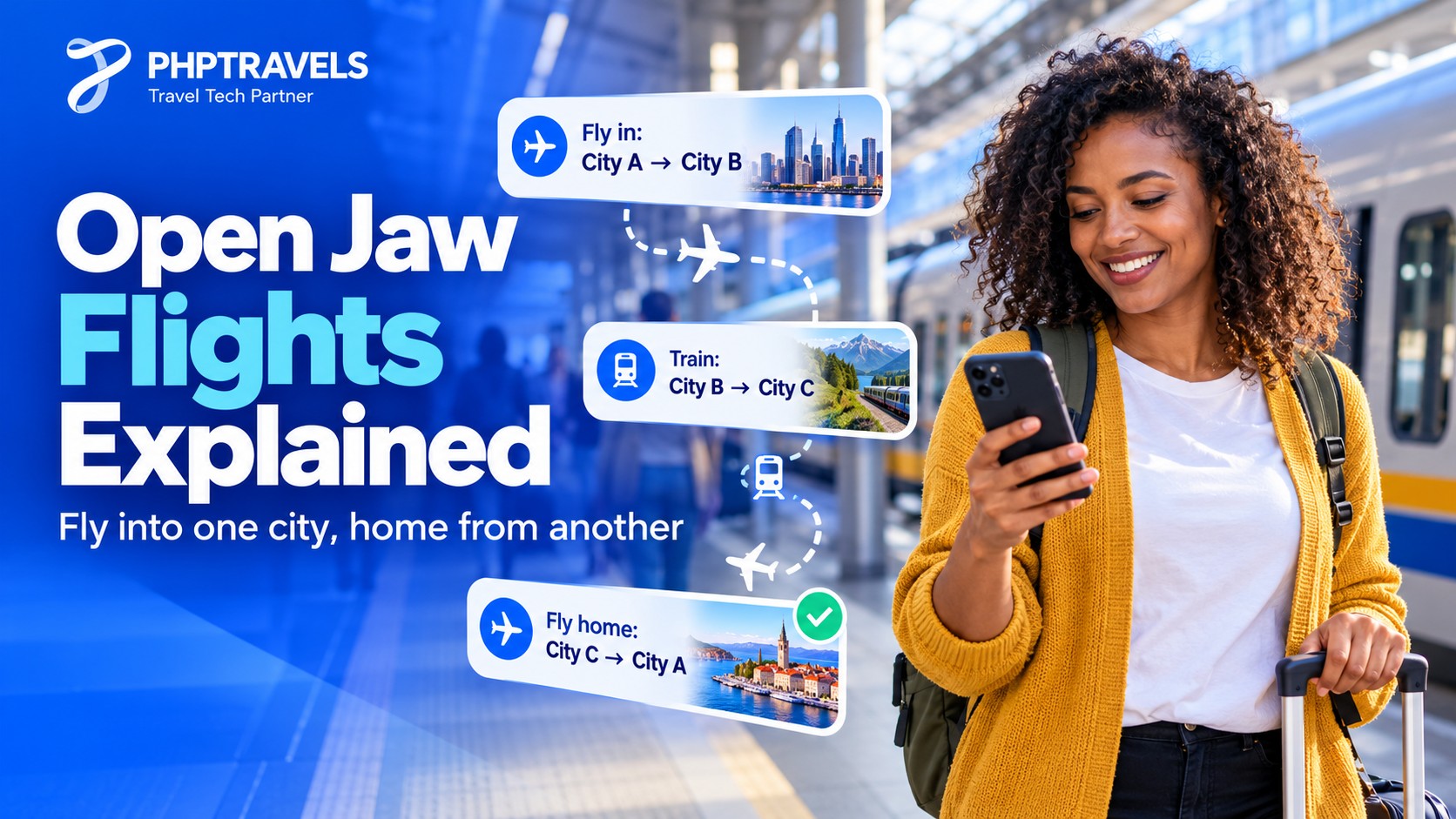
- Combine creatively. A fifth freedom sector can be one part of a multi-city trip, for example flying into one city and home from another; see open jaw flights for how those itineraries are priced.
For travel agents
In a GDS or an airline API, the sector appears like any other availability. The airline sells seats for the local market on its own flight number, so the agent books it as a normal segment. The traps are in how the flight looks:
- Same flight number, two different trips. A Dubai to Newark passenger on EK209 is on a one-stop flight; an Athens to Newark passenger on the same flight is non-stop. Your customer’s itinerary should say which one they bought.
- “Stops” vs connections. Some flight APIs describe a touchdown on the same flight number as a stop inside one segment, and a change of flight number as a separate segment. Duffel’s guide to displaying stops sets out that distinction and recommends designing results around slice, segment and stop. Our Duffel API integration guide covers the rest of that data model.
- Different sources, same seat. GDS, NDC and consolidator feeds can all return the same sector. Most agency flight engines, such as the flight booking software that aggregates GDS and API content into one list, have to decide which copy to show.
If the distribution side is new to you, airline distribution explained and our GDS guide explain where these segments come from.
How Booking Engines Should Display Fifth Freedom Flights

Most complaints about fifth freedom flights are display problems, not airline problems. A traveller sees “Emirates, non-stop, Athens to Newark” and expects to fly from Dubai, or sees “1 stop” on a through flight and assumes a plane change. A few rules prevent that.
Display rules that prevent surprises
- Show the operating carrier and the flight number on every result, not only the marketing airline’s logo.
- Label stops honestly. “Non-stop” for the sector on its own; “1 stop, same aircraft (Athens)” for a through passenger; “1 stop, change of flight” for a connection.
- De-duplicate on carrier, flight number and times, so the same sector from three feeds becomes one card, but never merge a codeshare number into the operating flight without showing both.
- Re-check price and availability before payment. The aircraft also carries through passengers, so seats for local passengers on the sector can be limited and sell out between search and payment.
- Keep the full segment detail on the booking. The PNR and e-ticket should show the boarding point and flight number, so the airport and the customer read the same thing.
Where PHPTRAVELS fits
PHPTRAVELS is self-hosted travel booking software, not an airline or a consolidator, so it does not create fifth freedom inventory. What it handles is the display problem above. The Flights module searches every connected GDS, NDC and low-cost source in parallel, merges the same flight sold by several sources into one card matched on carrier, flight number and times, and counts stops, airlines, price, departure times and baggage across the merged results for filtering. The chosen offer is revalidated with its supplier before the card is charged, seat maps are priced per segment, and markup rules can target an airline or a route. Flight suppliers include Amadeus, Sabre, Travelport, Duffel, Mystifly, TBO Holidays, PKFare and Kiwi; check the live integrations page before planning, because you connect them with your own contracts and credentials. For the difference between GDS and airline-direct content, see NDC vs GDS.
To see how a mixed results page handles stops and duplicate flights, try the live demo, or price your setup by supplier and business model.
Fifth freedom flights FAQ
Are fifth freedom flights cheaper?
Not automatically. They add competition on the route, which can help, but the fare is set by the airline for that market like any other flight. Compare the sector with the local airlines on the same dates and fare conditions.
Can I book only the fifth freedom leg?
Yes, where the airline holds the rights and sells the sector. Search the two foreign cities directly. If the sector is one-direction only, you will find it in that direction alone.
Is a fifth freedom flight a stopover?
No. A stopover is a break of 24 hours or more between flights on your own ticket. On a fifth freedom flight the aircraft stops; if you board at the intermediate city, your own trip is non-stop.
Do fifth freedom flights still exist?
Yes. Emirates, Singapore Airlines, Qantas, Ethiopian, Turkish, Cathay Pacific, United and many smaller carriers operate them, though individual sectors start and end each season.
Fifth freedom flights are a product of aviation law turned into an everyday booking choice: a foreign airline flying between two foreign cities on a service tied to home. For travellers they are worth searching for on busy routes. For agents and booking platforms, the job is to show them clearly, with the right carrier, flight number and stop label, so the customer knows exactly which aircraft they are boarding and why. If you are building or upgrading a flight booking site, book a PHPTRAVELS demo.