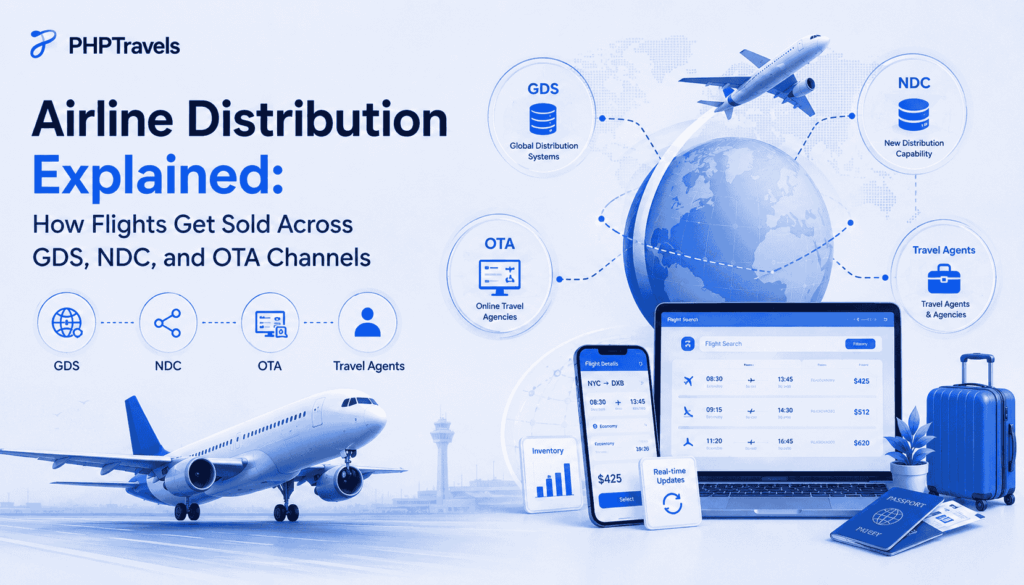
If you sell flights, you already know the pain. Fares look right in one channel and wrong in another. A booking confirms, then the PNR throws a schedule change nobody catches until the passenger calls. Ancillaries show on the airline website but not in your agency screen. None of this is bad luck it is how airline distribution actually behaves once you connect more than one source of flight content.
Airline distribution is the system that decides which fares, schedules, and offers reach which seller, and in what format. Get it right and bookings flow, margins hold, and agents stop firefighting. Get it wrong and you carry the operational cost on every transaction.
This guide breaks down how the airline distribution model works end to end, where it breaks, and what travel businesses do about it.
Quick Summary
- Airline distribution is how airlines push fares, schedules, and ancillaries to sellers through direct and indirect channels.
- The legacy stack runs on ATPco (fare filing), the GDS (aggregation and booking), and the airline’s PSS/reservation system.
- NDC moves control of the “offer” back to the airline, enabling dynamic pricing, bundles, and rich content the GDS could not carry.
- OTAs and travel agents depend on clean inventory synchronization, markup logic, and PNR handling these are where most operational cost hides.
- Reducing airline distribution costs is mostly about automation: fewer manual touches between search, booking, ticketing, and back office.
- A travel booking platform is what holds all of this together once you connect more than one supplier.
What Is Airline Distribution?
Airline distribution is the end-to-end process of getting an airline’s seats, fares, and ancillary products in front of buyers and turning a search into a confirmed, ticketed booking. The “buyer” might be a leisure traveler on an OTA, a corporate booker, or a downline travel agent purchasing through a B2B portal.
The core problem distribution solves is reach. An airline cannot sell every seat through its own website, so it relies on intermediaries global distribution systems, aggregators, consolidators, and online travel agencies to extend that reach into markets and channels it cannot serve directly. Each link in that chain adds capability, but also cost and complexity.
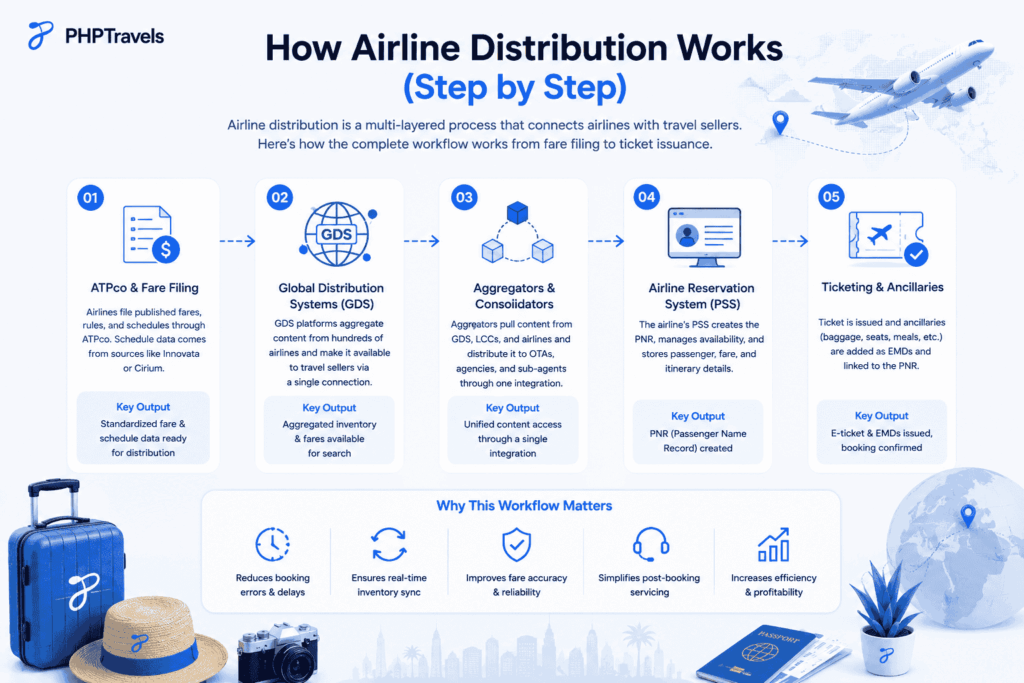
How Airline Distribution Works (Step by Step)
Most people picture distribution as “the airline lists a flight and agents sell it.” The real workflow has several distinct layers, and understanding them is the difference between debugging a booking issue in minutes versus hours.
ATPco and Fare Filing
Before a fare can be sold, it has to exist as data. Most airlines file published fares and fare rules through ATPco, which standardizes pricing data so any system can interpret it consistently. Schedule data flows from sources like Innovata/Cirium. This filed content is the raw material every downstream channel prices against which is also why a stale filing cycle can leave agents quoting fares the airline no longer honors.
Global Distribution Systems (GDS)
The GDS Amadeus, Sabre, and Travelport sits between airlines and sellers. It aggregates filed fares and schedules from hundreds of carriers and exposes them through a single connection. For decades this was the backbone of indirect distribution: an agent searched once and saw the whole market.
The trade-off is that the GDS historically controlled the offer. Airlines filed static fares and the GDS decided how they displayed. A full-service carrier and a low-cost carrier could look almost identical in a results screen because the system flattened branded products into bare fares.
Aggregators and Consolidators
Not every seller connects directly to a GDS or an airline. Aggregators and consolidators bundle access to multiple sources GDS content, low-cost carrier APIs, and direct airline feeds into one integration point. For a growing OTA, an aggregator can be the fastest way to reach broad content without managing dozens of individual supplier contracts and certifications.
The Airline Reservation System (PSS)
On the airline side, the passenger service system holds the reservation. When a booking is made, it creates a PNR (Passenger Name Record) the master record tying together the itinerary, passengers, fare, and ticket. Ticketing then issues the actual document, and ancillaries are recorded as EMDs (Electronic Miscellaneous Documents). Today these often live as separate records, which is exactly the fragmentation modern standards are trying to fix.
A Real-World PSS Example: British Airways and Amadeus
British Airways is a useful example of how the reservation layer and the distribution layer work together without being the same thing. The airline began moving core reservation capabilities to Amadeus in 2000, and its reservations system was transferred to Amadeus in 2002. British Airways has also used Amadeus for functions including inventory and departure control.
This distinction matters when people refer to the British Airways reservation system. The passenger service system manages core functions such as reservations, inventory, and passenger records, while distribution technologies determine how those offers reach travel agents, OTAs, and other sellers.
That distribution layer is continuing to evolve. In June 2026, British Airways announced plans to move its NDC platform to Amadeus Altéa NDC using IATA schema 21.3. The change is part of the airline’s broader move toward modern Offers and Orders rather than a replacement for the basic concept of a PSS.
For an OTA or travel agency, the practical point is that one airline can be available through GDS, NDC, and other distribution connections while the underlying reservation, inventory, and servicing processes remain tied to its passenger-service technology.
The Main Airline Distribution Channels
Airline distribution channels split broadly into two models, and most travel businesses operate across both.
- Direct distribution the airline sells through its own website, app, and call center. Lowest distribution cost for the airline, full control of the offer.
- Indirect distribution sales flow through GDS, OTAs, travel agents, and corporate booking tools. Wider reach, but more intermediaries and higher cost per booking.
Layered on top of that is your own commercial model:
- B2C selling directly to the end traveler through a public booking site.
- B2B selling to downline agents, sub-agents, and corporate accounts through a portal with credit limits, wallets, and negotiated markups.
The operational demands differ. B2C is volume- and conversion-driven. B2B adds agent management, credit control, commission structures, and per-agent pricing rules all of which your platform has to enforce automatically, or your team enforces manually on every transaction.
NDC and the Future of Airline Distribution
The biggest shift in airline distribution is the move to NDC (New Distribution Capability), the IATA-backed XML standard built around Offers and Orders. The legacy stack ran on EDIFACT messaging designed in the 1980s fine for transmitting schedules and fares, poor at carrying rich, dynamic, personalized content.
NDC changes who owns the offer. Airlines now create real-time dynamic offers using the IATA Offers and Orders framework, bundling price, product features, and conditions into a single offer, instead of filing static fares the GDS controls. That lets carriers surface branded attributes seat type, Wi-Fi, lounge access, baggage, meals directly to the agent screen rather than flattening everything into a bare fare.
A companion standard, ONE Order, aims to consolidate the PNR, e-ticket, and EMD into a single order record, ending the fragmentation that makes servicing and accounting painful.
Adoption is real but uneven. In a recent industry survey, 81% of airline respondents said they have live NDC channels, with some carriers exceeding 50% NDC penetration of indirect bookings. IATA’s Distribution Advisory Council has set an aspirational goal of “100% Offers and Orders by 2030,” meaning full capabilities will be available by then not that the whole industry will have switched. For sellers, the practical takeaway is that you will run hybrid distribution GDS, NDC, and direct APIs side by side for years, and your systems have to normalize all of it into one consistent booking flow.
How Online Airline Distribution Helps OTAs and Travel Agents
For an OTA or agency, distribution is not the goal a clean, profitable booking is. Several operational mechanics determine whether you get there.
Inventory and availability synchronization.
Fares and seats change constantly across sources. If your search results lag the supplier, you sell fares that fail at booking. Real-time or near-real-time sync, with sensible caching, is what keeps look-to-book healthy without hammering supplier rate limits.
Dynamic pricing, markups, and commissions.
Every channel needs its own pricing logic. A B2C customer sees one price; a Gold-tier agent sees a marked-up net fare; a corporate account sees a negotiated rate. This markup and commission engine has to apply automatically per channel, per agent, and per currency.
Multi-currency and payments.
Cross-border selling means converting fares, holding margin against FX movement, and reconciling against supplier billing. On the B2B side, agent wallets and credit limits replace card payments, which adds invoicing and statement workflows.
PNR, ticketing, and reservation handling.
A booking is not done at confirmation. Schedule changes, voids, reissues, refunds, and cancellations all have to be handled against the supplier’s PNR rules ideally surfaced to staff automatically rather than discovered by the passenger.
Mid-office and back-office automation.
Voucher and itinerary generation, queue management, supplier reconciliation, and reporting are where margins quietly leak. Automating voucher generation and reconciliation removes the manual touches that scale linearly with booking volume.
Reducing Airline Distribution Costs: Manual vs Automated Workflows
Most travel businesses solve distribution problems in the same predictable order and make the same predictable mistakes.
The usual path.
A new agency starts with one or two suppliers, manages bookings semi-manually, and patches edge cases by hand. It works at low volume. Then a third and fourth supplier arrive, each with its own data format, booking flow, and quirks, and the manual approach collapses under reconciliation errors and slow servicing.
Common mistakes to avoid:
- Treating every supplier as a one-off integration instead of normalizing them into a common booking model.
- Hard-coding markups and commissions instead of using a rules engine, so pricing changes require developer time.
- Ignoring servicing automation refunds and reissues eat staff hours that never show up in a demo.
- Underestimating reconciliation between what was sold, what was ticketed, and what the supplier billed.
Manual vs automated, in practice.
Manual workflows are cheap to start and expensive to scale; every new channel adds headcount. Automated workflows cost more upfront but flatten the cost curve search, booking, ticketing, voucher generation, and back-office reconciliation run without proportional staffing. The break-even comes faster than most operators expect.
Before choosing a solution, check that it can:
- Connect GDS, NDC, and direct LCC/airline APIs and normalize them into one flow.
- Enforce channel-, agent-, and currency-specific pricing automatically.
- Handle the full reservation lifecycle, not just the initial booking.
- Scale across markets without re-architecting for each new supplier.
Where PHPTRAVELS Fits in Airline Distribution
Once a travel business connects more than one source of flight content, the real work is no longer “getting fares” it is holding everything together: consistent search, reliable booking, correct pricing per channel, and clean servicing afterward.
PHPTRAVELS is a travel booking platform built around exactly that. It integrates GDS, NDC, and direct supplier APIs and normalizes their content into a single search and booking flow, so a fare behaves the same way regardless of where it came from. Its markup and commission engine applies per-channel and per-agent pricing automatically, with multi-currency support for cross-border selling.
On the B2B side, it provides agent management, wallet and credit-limit controls, and invoicing, so downline distribution scales without manual oversight. PNR handling, voucher generation, and back-office reconciliation are built into the workflow rather than bolted on which is what keeps servicing cost from rising with volume. For operators running hybrid GDS-plus-NDC distribution through the rest of this decade, that consolidation is the point: one platform managing the channels instead of separate tools fighting each other.