Self transfer flights are the cheap fares that look too good on a search results page: say, London to Bangkok for a third less than the next option, with a small note that says “self-transfer” or “separate tickets”. The saving is real. So is the catch. You are not buying one journey from an airline; you are buying two or more journeys and promising yourself that you will make the connection between them. If the first flight runs late, nobody is obliged to rebook you on the second.
This guide explains how self transfer flights work, why they are often cheaper, what happens to your rights when a connection fails, the baggage and visa rules that catch people out, a 7-point booking checklist, and how travel agencies and booking engines should sell them without inheriting the risk.
What Are Self Transfer Flights?
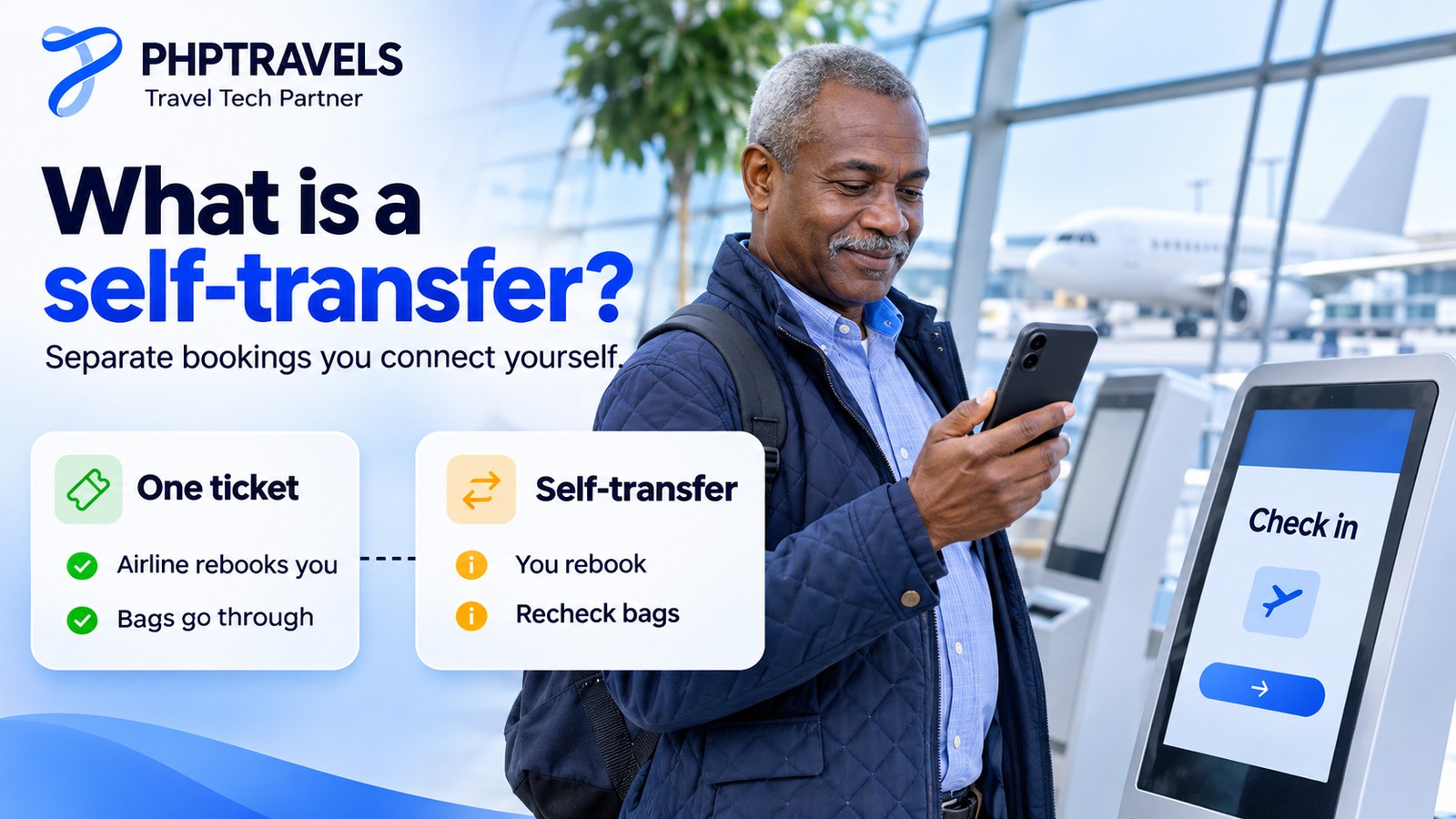
A self-transfer is a connection between two flights that were sold to you as separate reservations, usually on airlines that have no agreement with each other. Each airline sees only its own booking. To the first carrier, your trip ends when you land at the connecting airport; to the second, it starts when you check in there.
Kiwi.com, one of the best-known sellers of these itineraries, gives a simple example in its help page on self-transfer itineraries: a direct New York to Prague ticket can cost more than two separate tickets, New York to Amsterdam and Amsterdam to Prague. Kiwi also states the trade-off plainly: “This isn’t an official itinerary offered by the airlines and they won’t take responsibility for the unofficial connections with self-transfer.”
Google Flights shows the same kind of result. Its help page on finding plane tickets says you can buy “separate or self-transfer tickets” for one trip, and that these options “might appear when they could save you money or open more flight schedules.”
Self transfer vs a protected connection
The difference only shows when something goes wrong, which is why travellers underestimate it at the booking stage.
| Question | One ticket (protected connection) | Self transfer flights |
|---|---|---|
| Who rebooks you after a missed connection? | The airline that sold the ticket | No airline is obliged to; only the seller’s own guarantee, if you bought one |
| Checked bags | Usually tagged to the final destination | Collected and checked in again at the connecting airport |
| Check-in | Once, at the origin | Again for every separate ticket |
| Minimum connection time | Airline will not sell a connection shorter than the airport minimum | Nothing stops a seller offering a tight gap |
| Documents at the connecting airport | Airside transit rules usually apply | Often the same entry documents as a final destination |
| Price | Through fare | Sum of separate fares, often lower |
The same thing can happen inside one ticket number if an agent issues separate PNRs. Our PNR guide and e-ticket guide explain how to read the booking record and ticket to see which one you have.
Layover vs stopover vs self-transfer
A layover is simply the time you wait between two flights. A stopover is a deliberate break in the journey that the fare allows, such as a few nights in Dubai on the way to Sydney. A self-transfer describes who is responsible for the connection, not how long it lasts: you can have a two-hour self-transfer layover or a three-day self-transfer stopover. An open jaw is something else again, covered in our open jaw flights guide.
Why Self Transfer Flights Can Be Cheaper

Airlines price connections inside their own network and with partners they have agreements with. When two airlines have no relationship, there is no joint fare, so a through ticket is either unavailable or built from expensive components. A seller that combines two independent one-way fares, often including a low-cost carrier that only sells point-to-point, can undercut every through option. The industry calls this virtual interlining; the difference from a real interline agreement is explained in our codeshare flights guide.
Self transfer flights reach travellers in three ways: metasearch sites such as Google Flights that list separate tickets side by side, online agencies that build and sell the combination as one order, and travellers who stitch tickets together themselves.
Is the saving real? A worked example
The figures below are illustrative, not live fares, but the arithmetic is the one to run before every booking.
| Line | Through ticket | Self transfer |
|---|---|---|
| Long-haul leg | $780 (bags included) | $430 (1 bag included) |
| Short low-cost leg | $90 | |
| Checked bag on the low-cost leg | $0 | $45 |
| Price you pay | $780 | $565 |
| Worst case if leg 1 is late and you miss leg 2 (later short flight, bought on the day) | $0, airline rebooks | +$180 |
| Worst case if the missed leg is the long-haul one (one-way bought on the day plus a hotel night) | $0, airline rebooks | +$900 or more |
The saving here is $215. If the leg you could miss is a short route with several flights a day, the worst case is a cheap replacement and the self-transfer still makes sense. If the leg you could miss is a once-daily long-haul flight, one missed connection costs several times the saving. The practical rule: put the long, infrequent flight first and the short, frequent one second, and price the worst case before you book, not the average.
Our guide to finding the cheapest flights online covers the other levers, such as date flexibility and alternative airports, that often beat a risky connection.
What Happens If You Miss a Self Transfer Connection

Kiwi.com’s help page puts it bluntly: if a delay makes you miss your second flight, “the airline who caused the disruption will only help you with flights that are part of their reservation.” The second airline treats you as a no-show. Google Flights gives the same warning: if your outbound trip is delayed, “you might miss your second trip,” and you should contact the airline.
Passenger rights: why one booking matters in the EU
Under EU Regulation 261/2004, the Court of Justice has held that flights “booked as a single unit” form one connecting flight, and compensation is judged on the delay at the final destination (Wegener, C-537/17, building on Folkerts, C-11/11). Separate bookings do not form a whole, so a late first flight generally does not entitle you to anything for the second ticket you lost.
There is an important twist for agencies. In flightright v American Airlines, C-436/21 (6 October 2022), the court ruled that flights on two airlines with no legal relationship still counted as a connecting flight because a travel agency had combined them, charged one overall price and issued a single ticket. How a seller packages separate flights can change the passenger’s rights, and which airline can face a claim.
Protection products and the US 24-hour rule
Some sellers of self transfer flights offer their own cover. Kiwi.com’s Connection Protection pays Kiwi.com Credit if airlines change, cancel or significantly delay part of a self-transfer trip, calculated to cover the cheapest replacement arriving within 24 hours of the original schedule, up to the cost of the booking. Read the exclusions of any such product; disruptions outside a carrier’s control are commonly limited.
In the US, airlines covered by the Department of Transportation’s customer service rule must let you hold a reservation, or cancel it without penalty, for at least 24 hours when you book a week or more before departure (14 CFR 259.5(b)(4)). That is why Google suggests buying separate tickets one by one: if the second one disappears, you can usually cancel the first.
Baggage, Check-In and Terminals on a Self Transfer

On a protected connection the airlines move your bag. On a self-transfer you do. Kiwi.com’s instructions describe the sequence at the connecting airport:
- Collect your bag from the belt showing your previous flight number.
- Leave the secure area and take the bag to check-in or bag drop for the next airline.
- Go through security, and customs or passport control where they apply, as if you were starting a new trip.
Kiwi adds that if a self-transfer is too short, it will not offer checked baggage at all. Check in online for the second flight before you leave home where the airline allows it; without a boarding pass you will have to go landside to a counter anyway. At large airports, confirm the terminal for each airline, because terminals are not always connected airside.
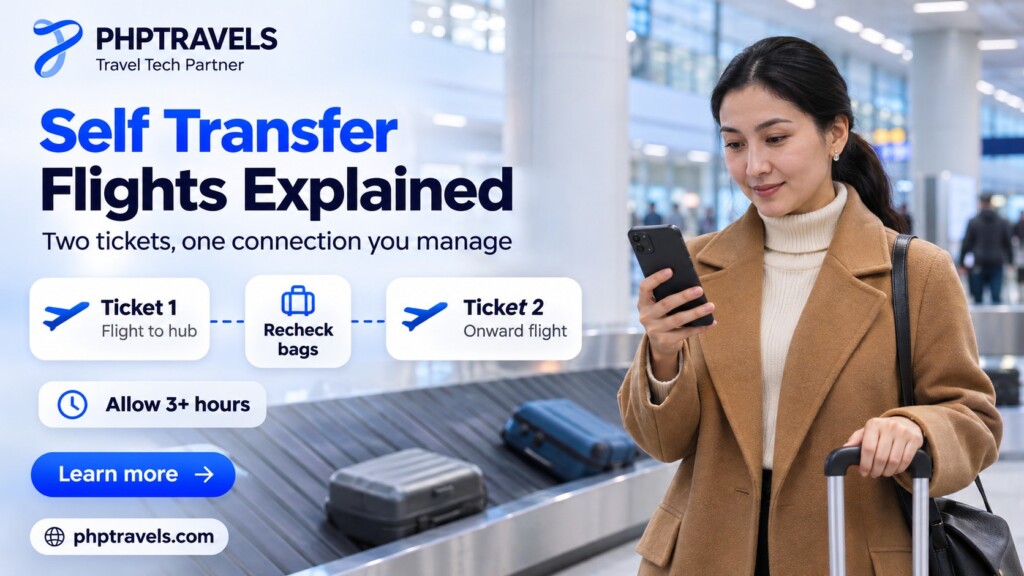
Can bags be checked through on separate tickets? Only if the two airlines have an interline baggage agreement and the agent at the first counter is willing to do it. Interline relationships run under the IATA Multilateral Interline Framework; if either airline only sells point-to-point tickets, there is nothing to check the bag through to. Plan as if the answer is no. Paid bags on each ticket are often recorded as EMDs, explained in our electronic miscellaneous document guide.
How much connection time to allow
For protected connections, airports agree a minimum connecting time. IATA describes the Station Standard MCT as “the official shortest time interval required to transfer a passenger and their luggage from one flight to a connecting flight” at an airport. Self-transfers are not checked against it, and you also need to beat the second airline’s check-in and bag-drop cut-off, not its departure time.
These are our working minimums for self transfer flights. They are planning guidance, not airline rules:
| Situation at the connecting airport | Allow at least |
|---|---|
| Same terminal, cabin bag only, already checked in, no passport control | 2 hours |
| Bag to recheck or a terminal change | 3 hours |
| International arrival: passport control, customs and bag recheck | 4 hours |
| Second flight is the last of the day on that route | Plan an overnight, or pick an earlier first flight |
| Arriving and departing from different airports in the same city | Avoid, or overnight |
The United States is a special case even for protected connections. US Customs and Border Protection states that processing “must be completed at the first port of entry” and that connecting passengers then re-check their luggage (CBP, Welcome to the United States). On a US self-transfer, add the second airline’s check-in cut-off on top of that.
Visas and Transit Rules for Self Transfer Flights
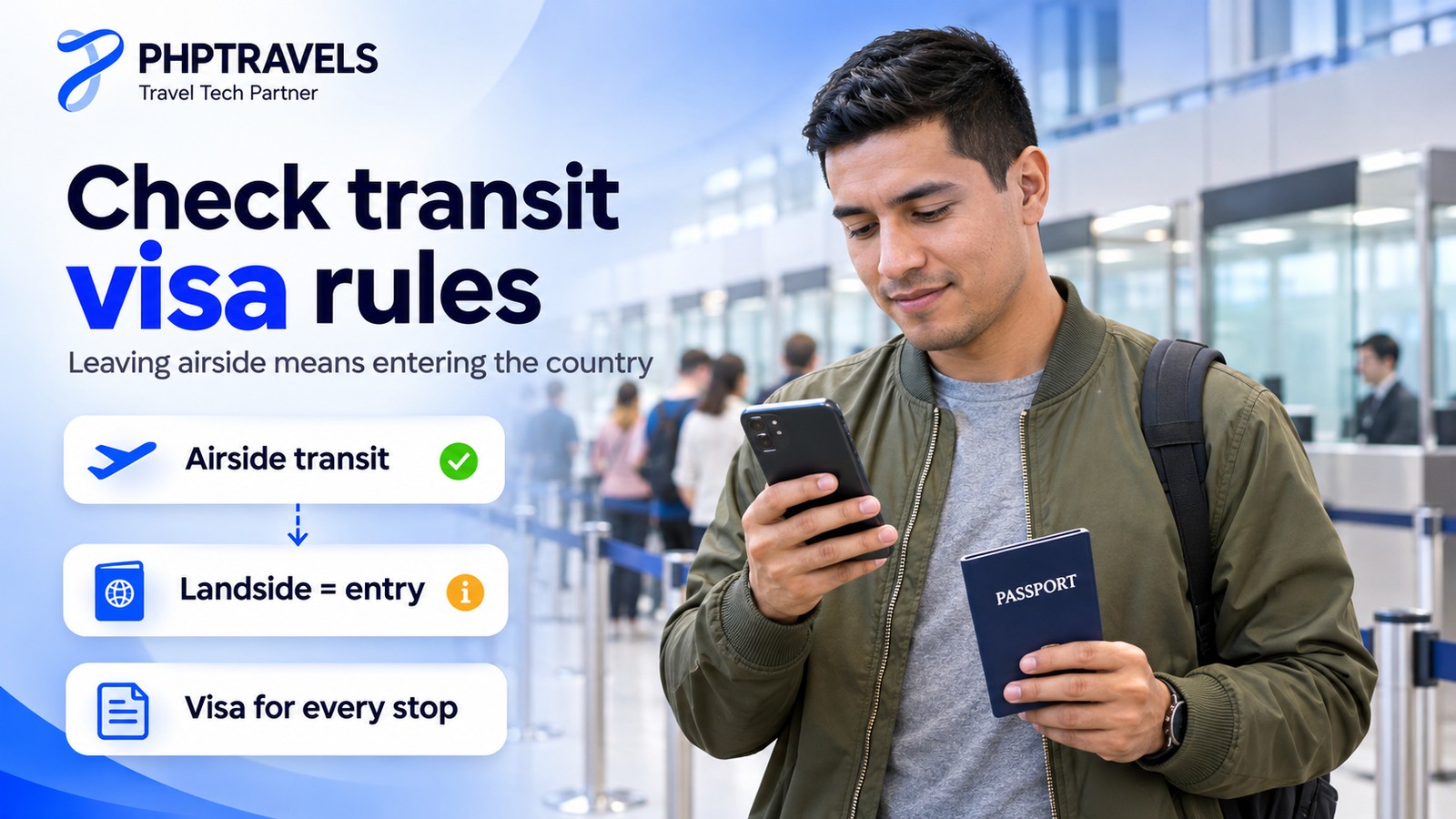
This is where self transfer flights fail most badly, because the problem appears before departure, at the check-in desk. If you have to leave the airside area to collect bags or check in, you are entering the country. Kiwi.com’s guidance is that you need “the same documents as if the transfer country were your final destination.”
United Kingdom
The UK separates the two cases in its transit visa guidance. A Direct Airside Transit visa is for travellers “changing flights in the UK” who “will not be going through UK border control.” If you are going through border control, which a self-transfer with checked bags at Heathrow or Gatwick usually means, the relevant route is a Visitor in Transit visa for stays up to 48 hours. GOV.UK also lists holders of an electronic travel authorisation (ETA) and Standard Visitor visas among those who do not need a transit visa.
Schengen area
The European Commission’s Schengen visa FAQ is explicit: an airport transit visa lets you wait in the international transit zone for a flight to a non-Schengen country, but “does not allow you to enter the Schengen territory.” Leave that zone to recheck a bag and, depending on nationality, you need a short-stay visa. Nationals of the countries on the common airport transit visa list, which includes Pakistan, Bangladesh, Sri Lanka, Nigeria and Ghana, need an airport transit visa even to stay airside.
United States, Gulf hubs and everyone else
Because CBP processing happens at the first US airport you land at, every self-transfer in the US is an entry. Even transit passengers need a visa or, for Visa Waiver nationals, an approved ESTA; CBP’s ESTA FAQ confirms that “In Transit” is a valid answer on the form, not an exemption.
The same logic applies at Gulf hubs. A Pakistani traveller who self-transfers in Dubai has to pass UAE immigration to collect and recheck bags, so they need a UAE visa just as if Dubai were the destination. Easy Visa’s Dubai visa guide sets out the normal visa route from Pakistan and typical processing times. Check every connecting country on the itinerary, not just the destination.
How to Book Self Transfer Flights Safely: 7 Checks
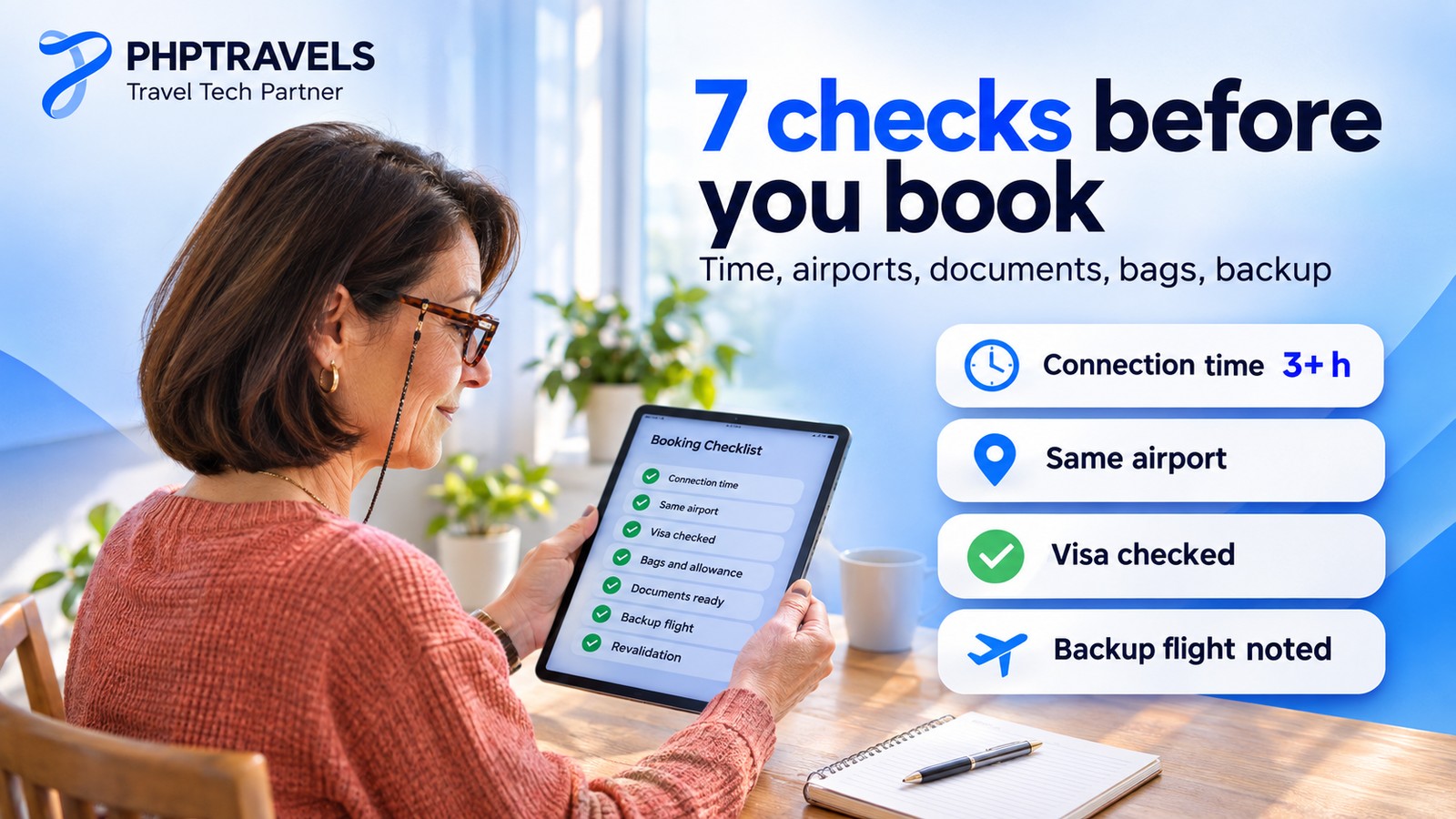
Run these seven checks before paying for any self transfer flights, whether you are booking for yourself or for a client.
- Connection time against the table above. Measure from scheduled arrival to the second airline’s check-in cut-off, not to departure.
- Same airport, and known terminals. London, New York, Paris, Istanbul and many other cities have more than one airport. A “connection” across town is a separate trip.
- Documents for landside entry. Apply the visa rules for every transfer country as if it were the destination. Passport validity rules apply there too.
- Bags priced on every ticket. Each airline has its own allowance and fees. Add them up before you compare prices.
- The worst case, not the average. Put the long, infrequent leg first. Check what a same-day replacement for the second leg would cost.
- A backup flight. Note the next departure on the second route. If there is none until tomorrow, budget for a hotel.
- Protection you understand. A seller guarantee, a flexible fare on the second leg, or travel insurance with missed-connection cover. Read what triggers it and what it excludes.
Buy the tickets in a sensible order too. Google’s advice is to confirm every ticket is available, then buy them one by one, using the US 24-hour rule where it applies if a later ticket cannot be bought. Make sure the passenger’s name is written exactly the same way, as in the passport, on every ticket.
Selling Self Transfer Flights as a Travel Agency

For an agency, self transfer flights are a pricing advantage and an after-sales liability at the same time. The customer will call you, not the airline, when the first flight lands late. Decide your policy before you sell the first one.
Display rules that prevent disputes
- Label it before price. “Self-transfer: separate tickets” next to the connection, not in the fare rules.
- Show what the traveller must do. Collect and recheck bags, check in again, change terminal, pass passport control.
- Show baggage per ticket. Not one allowance for the whole trip.
- Flag documents. A visa reminder for each connecting country.
- Revalidate every leg before payment. Prices on separate tickets move independently; the search, price, revalidate and book path is the same one Travels Tech walks through in its booking engine explainer, just repeated for each ticket.
- Write the misconnect policy down. Who pays for a replacement, who handles the call, and what the customer gets.
The C-436/21 ruling matters here. If you combine flights, charge one overall price and issue what amounts to a single ticket, EU law may treat the trip as a connecting flight. Get legal advice on how your invoices and tickets are presented in the markets you sell to.
Where PHPTRAVELS fits
PHPTRAVELS is booking software, not an airline or a seller of inventory. The itineraries, including how they connect, come from the flight suppliers you contract with. What the software controls is how you search, price and service them.
- Kiwi.com content. The Kiwi API integration is a module in the flights category: you enter the AffilID and API key from your Tequila account, apply your markup, and Kiwi.com itineraries come back with hold and cabin bag weights for each fare. Tequila access is granted by Kiwi.com, and Kiwi.com cancellations are raised with Kiwi.com support, not through the API. Our Kiwi Tequila API guide covers access.
- Multi-supplier search. The flights module searches connected GDS, NDC and low-cost sources together, with filters for stops and baggage on the merged results.
- Revalidation and fare rules. The chosen offer is revalidated with its supplier before the card is charged, and change and refund conditions from the supplier’s fare rules are shown before payment.
Other sources that show separate-ticket options, such as Google Flights, are covered in our Google Flights integration guide. The full supplier list is on the integrations page.
If you want to see how flight results, markups and bookings look from the agency side, open the live demo and compare the one-time licence plans on the pricing page.
Self transfer flights FAQ
Are self transfer flights safe?
Self transfer flights are as safe as any other flight; the risk is financial and logistical. If you allow enough time, travel light, hold the right documents and know your backup, a self-transfer is a reasonable way to save money.
Is a self-transfer the same as a layover?
No. A layover is the waiting time between flights. A self-transfer means the two flights are on separate bookings and you are responsible for the connection.
Do I need a visa for a self transfer?
Often, yes. On self transfer flights, if you must leave the airside area to collect bags or check in, you need the documents to enter that country. Check the rules for every connecting country.
What happens if my first flight is cancelled?
The first airline deals with its own booking only. Unless you bought a seller guarantee or suitable insurance, the second ticket is usually lost, and you pay for a new one. This is the single biggest difference between self transfer flights and a protected connection.
Self transfer flights reward travellers and agents who plan for the bad day: long enough connections, the expensive leg first, documents for every country you touch and a clear answer to “who rebooks me?” Get those right and the saving is worth having.