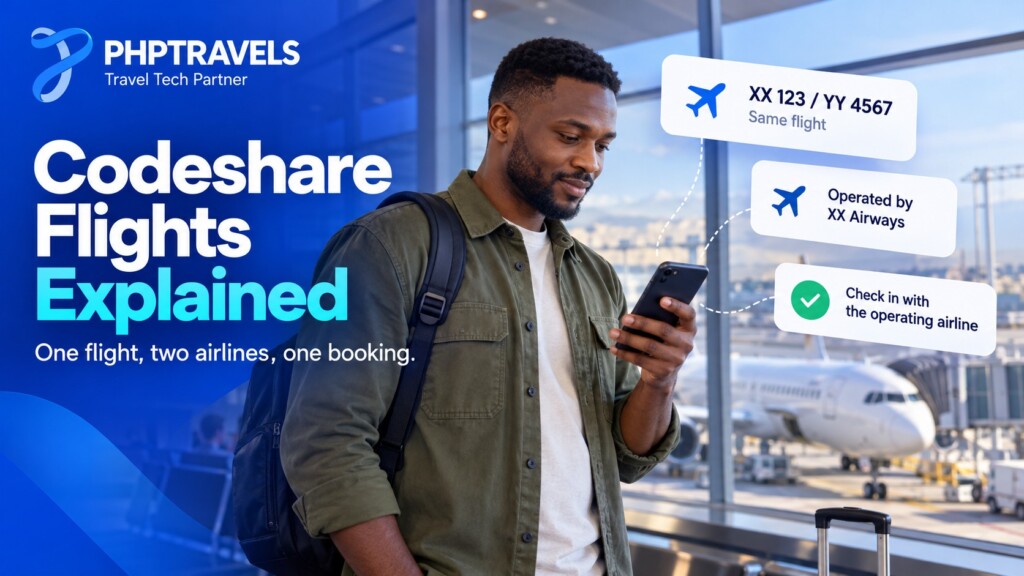
A codeshare flight is a single flight that is sold under two or more airline flight numbers. One airline flies the aircraft; one or more partner airlines put their own code and flight number on it and sell seats as if it were part of their network. Codeshare flights are why a ticket can say Finnair while you board a British Airways aircraft, and why the flight number on your booking may not appear on the departure board.
This guide explains how codeshares work for the passenger (check-in, baggage, seats, delays and refunds) and for the people who sell them: travel agents, OTAs and the booking engines behind them, who have legal disclosure duties and data to handle correctly.
- Two roles: the marketing carrier sells the seat under its code; the operating carrier flies the plane.
- Day of travel belongs to the operating carrier: check-in, terminal, seats, meals and boarding.
- The ticket belongs to the seller: fare rules, changes and, in the US, refunds follow whoever sold and charged for it.
- Disclosure is mandatory in many markets: US and EU rules require the operating airline to be named when the flight is offered and booked.
What is a codeshare flight?
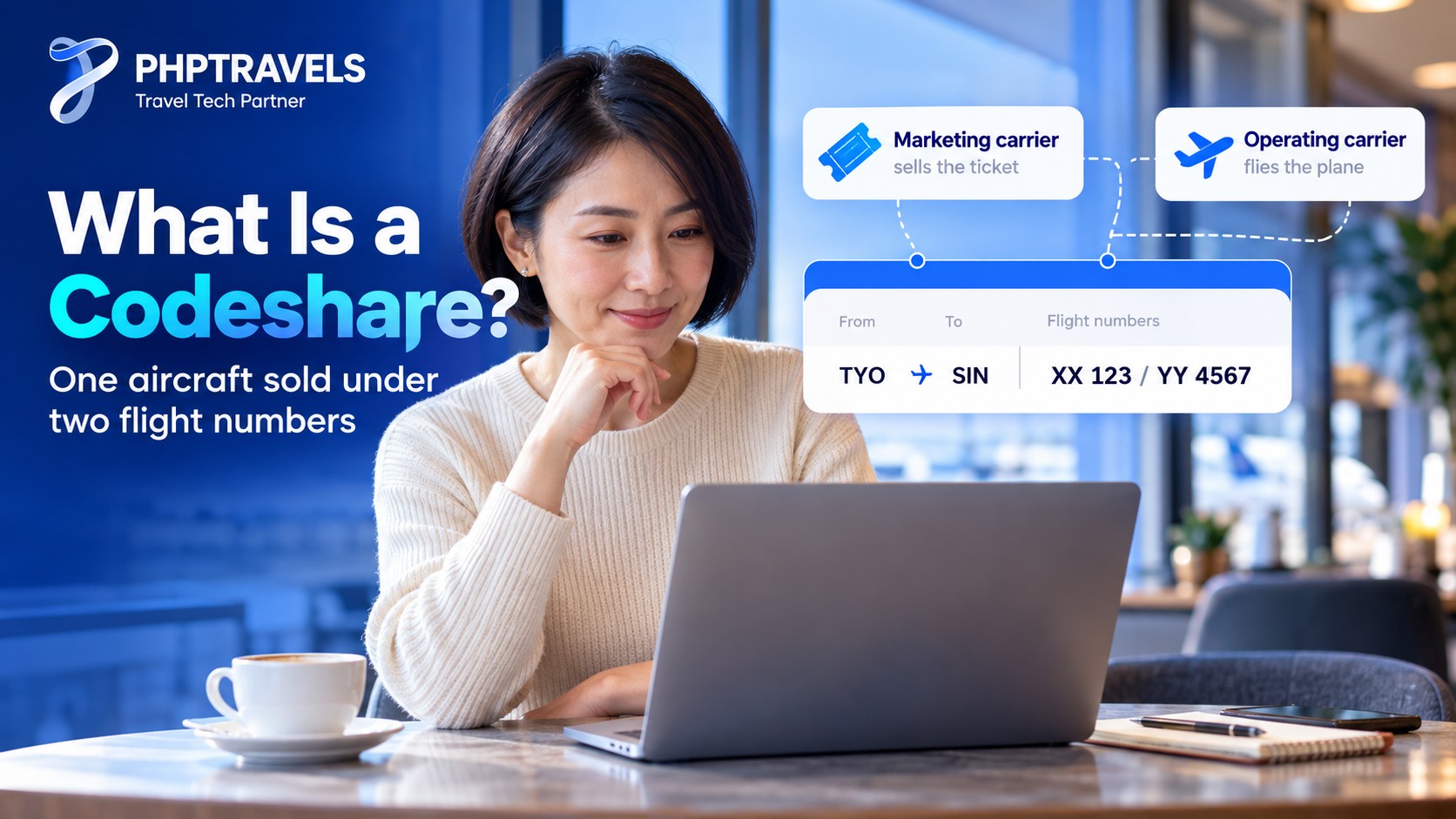
US federal rules give the cleanest definition. Under 14 CFR Part 257, a code-sharing arrangement is one “whereby a carrier’s designator code is used to identify a flight operated by another carrier”. The designator code is the two-character airline code (BA, AY, EK, QF) that appears in front of every flight number.
A real example from OAG, the airline schedules company: British Airways flight BA173 from London Heathrow to New York JFK is also sold by Finnair as AY5473, according to OAG’s insider’s guide to codeshares. Same aircraft, same crew, same departure time; two flight numbers, two airlines selling it. Emirates gives another: its codeshare FAQ says Emirates flights in the 5000 series are operated by Qantas, and Qantas 8000-series flights are operated by Emirates.
Marketing carrier vs operating carrier
Every codeshare has one operating carrier and at least one marketing carrier. Most confusion comes from not knowing which airline is responsible for what.
| Question | Marketing carrier | Operating carrier |
|---|---|---|
| Whose flight number is on the ticket? | Its own (e.g. AY5473) | Its own on its own sales (BA173) |
| Who flies the aircraft and provides the crew? | No | Yes |
| Who checks you in and boards you? | No | Yes |
| Whose fare rules apply to the ticket? | The fare you bought (usually its own) | Only if you bought its fare |
| Who controls seats, meals and onboard service? | No | Yes |
The flight that exists physically is the operating flight. The marketing flight numbers are sometimes called “commercial duplicates”, a term you will see in GDS displays.
Why airlines codeshare
An airline codeshare lets a carrier sell destinations it does not fly, without buying aircraft or traffic rights for every route. OAG shows Iberia’s US network as an example: Iberia appears to fly all over the United States, but every one of those domestic flights is operated by American Airlines with an Iberia flight number on it. A passenger can buy Madrid to Houston from Iberia on one ticket and connect in Miami onto an Iberia-coded American flight.
The operating airline gains passengers it would not otherwise reach, and both feed traffic through each other’s hubs. The passenger gets one ticket for a multi-airline trip, usually with bags checked through.
Are codeshare flights bad?
No. You get the same scheduled flight as the operating carrier’s own customers. The catches are practical: the cabin, meals and onboard benefits are the operator’s, not the brand you booked; seat selection and check-in may need the partner’s website; and when something goes wrong you need to know which airline to call.
How codeshare flights work behind the scenes

A codeshare is a commercial agreement backed by schedule data, inventory links and ticketing arrangements. Three parts matter to anyone selling or flying codeshare flights.
The agreement and the shared schedule
A codeshare agreement sets out which flights are shared, how seats are allocated and paid for, and who handles passengers when things go wrong. Under it, the operating carrier sends its schedule to the marketing carrier, which adds its own flight number and distributes the flight as part of its network. In industry schedule files these links are carried in data element identifiers: OAG explains that DEI 010 on the operating flight leg lists all the commercial duplicate codes and flight numbers, while DEI 050 on the marketing flight identifies the operating airline and its flight number. Marketing carriers can also rely on the operator’s minimum connecting times instead of filing their own.
Keeping schedules identical is a constant job: when the operator retimes or cancels a flight, every marketing carrier must pick up the change, or passengers get sold connections that no longer work.
Free-sale vs block-space codeshares
Airlines divide seats on a codeshare flight in one of two ways, per OAG:
- Free sale: both airlines keep selling until the flight is full, with no fixed limit on the marketing carrier. Sales draw on the operating carrier’s inventory.
- Block space: the operating carrier allocates a fixed number of seats to the marketing carrier, which sells them from its own allocation.
Either way, a codeshare booking ends up in two systems. The marketing carrier records the passenger under its flight number and booking class, and the operating carrier records the same passenger under its own flight and a mapped booking class. Qantas’s agent guidance on codeshare flight information shows this in a booking: QF8415 Sydney–Dubai sold in K class appears with “OPERATED BY EK415 M”, meaning Emirates holds the seat in its own M class. If you want the mechanics of booking classes and seat limits, see our guide to airline inventory management.
Why codeshare fares can differ
Each airline files fares for its own code. The same physical seat can therefore be sold at different prices, with different change rules and baggage allowances, depending on which flight number you buy. OAG notes that partners try to align pricing, but because demand changes by the minute, a codeshare partner’s fare occasionally lags the operator’s latest price, which is one reason codeshare flights are sometimes cheaper. Fares can also restrict codeshares: Qantas tells agents to check the Fare Application paragraph of a fare rule, because some fares do not allow codeshare flights at all.
Codeshare vs interline vs alliance vs joint venture

These four words get used interchangeably, but they describe different levels of cooperation, and they change what a passenger and a seller can expect.
- Interline: airlines agree to accept each other’s tickets and through-check bags. IATA’s Multilateral Interline Traffic Agreement (MITA) is the standard legal framework, and an interline relationship only exists once two parties concur with each other under it. Each flight keeps its own airline’s code.
- Codeshare: one airline also puts its code on the partner’s flight and sells it as its own. A codeshare normally sits on top of an interline relationship, because the partners still have to accept and settle each other’s tickets.
- Alliance: a multi-airline brand such as oneworld, SkyTeam or Star Alliance, built around loyalty, lounges and connections. Many codeshares run inside alliances, but not all.
- Joint venture: partners coordinate schedules and prices and share revenue on a set of routes. In the US, the Department of Transportation reviews such alliances and codeshares and can grant antitrust immunity for them.
| Interline | Codeshare | Alliance | Joint venture | |
|---|---|---|---|---|
| One ticket across airlines | Yes | Yes | Via interline/codeshare | Yes |
| Partner’s code on your flight | No | Yes | Often | Usually |
| Shared loyalty and lounges | No | Sometimes | Yes | Yes |
| Joint pricing and revenue sharing | No | No | No | Yes |
Codeshares regularly cross alliance lines. OAG points out that Virgin Australia codeshares with both Qatar Airways (oneworld) and Singapore Airlines (Star Alliance). Emirates is in no alliance at all, as its EK airline code and Dubai hub profile shows, yet it codeshares with Qantas and, since a 2017 partnership agreement, with its sister airline flydubai. There is also virtual interlining, where a seller combines separate tickets on airlines with no agreement; easyJet’s connection product is the example OAG cites. That is not a codeshare, and the passenger usually carries the misconnection risk.
What a codeshare changes for the passenger

On a codeshare, the day of travel runs on the operating airline’s rules while the ticket runs on the seller’s. Here is how that plays out.
Check-in, terminal and boarding
Check in with the operating carrier. Qantas states plainly that check-in for codeshare flights is always with the operating airline, and its counters, terminal and gates are the ones that count. In Dubai, for example, Emirates uses Terminal 3 and flydubai Terminal 2, and Emirates’ flydubai partnership page explains the transfer between them. On the departure board, look for the operating flight number; your marketing number may only show in rotation, or not at all.
Baggage rules on codeshare flights
Whose allowance applies is not simply “the airline you fly”:
- Journeys to or from the US: 14 CFR 399.87 says the baggage allowances and fees that apply at the start of the itinerary apply throughout it, and that on codeshare flights carriers must apply the marketing carrier’s allowances and fees wherever they differ from the operating carrier’s.
- Other international journeys: IATA Resolution 302 applies the rules of the “most significant carrier”. IATA’s interline baggage guidance says that on codeshare flights the marketing carrier’s policy generally prevails, unless that carrier publishes a rule that the operating carrier’s policy should apply.
Airlines confirm this in practice. Emirates says that on a flight with an EK number operated by Qantas, Emirates baggage allowances apply, and that Emirates allowances apply for the full journey on Emirates–flydubai codeshare itineraries even when the first sector is on flydubai. The bag tag itself carries the operating flight’s designator so the bag is loaded on the right aircraft. The safe rule for travellers: read the allowance printed on your booking or e-ticket, not the operating airline’s general website.
Seats, meals and special assistance
The operating airline’s rules apply to meals, seating and specific needs, according to Qantas’s agent guidance, which also tells agents to book unaccompanied minors and stretcher passengers under the operating airline’s flight number. Seat selection and meal requests often have to be made on the operating carrier’s website using its own booking reference.
Miles and status
Most codeshare partners let you earn miles in the marketing carrier’s programme, and frequent flyers often keep lounge and priority benefits on partner-operated flights. The amount you earn depends on the partnership and the booking class you bought, so check the programme’s partner earning chart before assuming full credit.
Delays, cancellations and refunds
Under the EU’s flight compensation rules, Regulation 261/2004 applies to the operating air carrier, which owes care and compensation on flights within its scope even when the passenger’s contract is with another airline, acting on that airline’s behalf. In the US, the Department of Transportation’s 2024 refund rule makes the merchant of record, the airline or ticket agent that charged the passenger, responsible for prompt ticket refunds, including on codeshare and interline itineraries. In practice: go to the operating airline at the airport for rebooking and care, and to whoever sold the ticket for changes and refunds.
How to tell if a flight is a codeshare, and how to book one

You should never have to guess. In the US, Part 257 requires sellers to show the operating carrier’s corporate name next to each codeshare flight on the first search results page, in a font no smaller than the itinerary, and rules out roll-over or pop-up disclosures. In the EU, Regulation 2111/2005 requires the contracting carrier to tell passengers the identity of the operating airline at the time of reservation, and of any later change.
To check a booking you already hold:
- Look for “Operated by” next to each flight on the itinerary or confirmation. If it names a different airline from the flight number, it is a codeshare.
- Read the flight number. Some airlines reserve number ranges for partner flights, such as Emirates’ 5000 series on Qantas-operated services, but this is a convention, not a rule, so treat it as a hint.
- Check the ticket number. The first three digits identify the airline that issued (validated) the ticket, which may differ from the operating carrier; our e-ticket guide explains the format.
- Find the operating airline’s booking reference. The marketing airline’s record and the operating airline’s record are separate passenger name records, each with its own locator. Use the operating carrier’s reference for online check-in and seat selection; good confirmations show both.
- Look up the operating flight on the operating airline’s flight-status page on the day, because that is the flight the airport tracks.
How to book a codeshare flight
You book a codeshare like any other flight: on the marketing airline’s website, through a travel agent or through an OTA. The useful habit is to compare the same flight under each code. The operating airline’s own number and each partner’s number may come with different fares, change rules, baggage allowances and mileage earning, even though you will sit on the same aircraft. Price the whole journey, not only the codeshare leg: on one through ticket the airlines usually rebook you if a delay breaks the connection, which a separately bought flight does not give you.
Selling codeshare flights: what agencies and booking engines must handle

For a traveller, a codeshare is a footnote. For an agency, an OTA or its booking-engine team, it brings obligations and data rules that touch disclosures, search results, sell requests and after-sales service.
Disclosure rules for sellers
Part 257 applies to ticket agents doing business in the US as well as airlines. It covers online search results (operating carrier named next to the flight, on the first display), oral sales (tell the customer the first time the flight is offered that another airline operates it), ticket confirmations (a written “Operated by” notice with the operating carrier’s corporate name) and advertising. Qantas reminds agents that the ticket and itinerary must always show which airline operates the flight, that this is required by many regulators including the US DOT and India’s civil aviation security bureau, and that fines may apply. It also warns that some airports, most Indian airports among them, ask to see a ticket or itinerary naming the operating airline before letting a passenger into the terminal.
Marketing and operating carrier in API responses
Flight APIs carry both roles per segment, and your booking engine has to read the right one. In the Duffel API, every segment of an offer has marketing_carrier with marketing_carrier_flight_number and operating_carrier with operating_carrier_flight_number. In Amadeus Self-Service Flight Offers Search, a segment’s carrierCode and number are the marketing flight and an operating object holds the operating carrier’s code, as defined in the published OpenAPI specification. When an engine merges several suppliers, it has to normalise these fields into one model; this walkthrough of how a flight booking engine turns supplier responses into bookings shows where that step sits between search and ticketing.
Three practical rules follow:
- Display the operating airline’s name, not only its two-letter code, wherever Part 257 or similar rules apply to you.
- Use the operating carrier for check-in links, terminal information and flight status; use the marketing carrier for fare rules, ticketing and changes.
- Store both records’ booking references on the booking. Our Duffel integration guide notes that orders can return several airline booking references on codeshare or interline itineraries, so the customer can find the operating airline’s reference.
One aircraft, several flight numbers in search results
A popular trunk route can return the same departure three or four times: once under the operating airline’s number and once under each partner’s code, often at different prices. Showing every version can make results look padded; hiding them can hide a cheaper fare. Decide deliberately: either list each code with a clear “Operated by” line, or group codes that share an operating carrier, flight number and departure time into one card with the alternative fares inside. Our guide to designing a flight search covers how much detail each result card should carry.
Traffic restrictions, fare rules and servicing
Some codeshare flights can only be sold in certain combinations. Qantas gives two examples: a QF-coded US domestic flight operated by American Airlines can only be booked together with a QF international flight, and QF-coded flights inside India operated by IndiGo cannot be booked on a purely domestic itinerary and are cancelled if they are. These restrictions appear in the GDS as “traffic restriction” text and in fare rules, and an engine that ignores them will create bookings the airline later cancels.
After the sale, schedule changes come from the operating carrier and reach you through the marketing carrier, so queue them and contact customers promptly. Refunds follow the merchant of record: if your agency charged the customer, US rules expect your agency to refund when one is due.
Where PHPTRAVELS fits
PHPTRAVELS is the booking software an agency runs, not an airline or a booking intermediary. Its flights module searches every connected GDS, NDC and low-cost source in parallel, merges the same flight returned by several sources (matched on carrier, flight number and times), revalidates the chosen offer with its supplier before payment, and takes the booking through to the PNR and e-ticket. The airline reservation system keeps each booking with its fare rules, payment and ticket status. Supported flight suppliers, such as Amadeus, Sabre, Travelport and Duffel, are listed on the integrations page.
Be clear about the limits. Because duplicates are matched on carrier and flight number, codeshare versions of one aircraft that carry different marketing numbers are separate results; check in the demo how your connected supplier’s codeshare segments and operating-carrier details display before you go live. The codeshare data, fares and traffic restrictions come from your suppliers, under your own contracts. PHPTRAVELS is not a merchant of record, so refund and disclosure duties stay with your agency. The source code is included under a commercial licence, so your developers can add your own display rules, such as a stricter “Operated by” format for US customers.
To see a flight search, fare rules and PNR flow end to end, open the PHPTRAVELS demo, then price the modules and suppliers you need on the pricing page.
Codeshare flights FAQ
Is a codeshare flight the same plane?
Yes. All the flight numbers on a codeshare refer to one physical flight, flown by the operating carrier’s aircraft and crew.
Who do I check in with on a codeshare flight?
The operating airline, at its counters or on its website, usually with its own booking reference.
Whose baggage allowance applies on a codeshare flight?
Usually the marketing carrier’s. US rules require it on codeshare flights in itineraries to or from the US, and IATA’s interline guidance makes it the general rule elsewhere unless the marketing carrier says otherwise. The allowance printed on your ticket is the one that counts.
Why are codeshare flights sometimes cheaper?
Each airline prices its own code. A partner’s fare can briefly lag the operator’s latest price, or come with different rules and baggage, so the same seat can cost less under another flight number.
Can I earn miles on codeshare flights?
Usually, in the marketing carrier’s programme and sometimes the operator’s, depending on the partnership and booking class. Check the earning chart first.
What is the difference between codeshare and interline?
Interline means airlines accept each other’s tickets and bags while each flight keeps its own code. A codeshare goes further: one airline sells the partner’s flight under its own flight number.
Key takeaways
Codeshare flights are one flight with several flight numbers: the operating carrier runs the day of travel, the seller owns the ticket, and the rules for baggage, compensation and refunds split along that line. Travellers should look for the “Operated by” line and the operating airline’s booking reference. Sellers should name the operating carrier on every search, quote and confirmation, read the marketing and operating fields correctly, respect traffic restrictions and keep both booking references. To try that flow in a working booking engine, book a PHPTRAVELS demo.