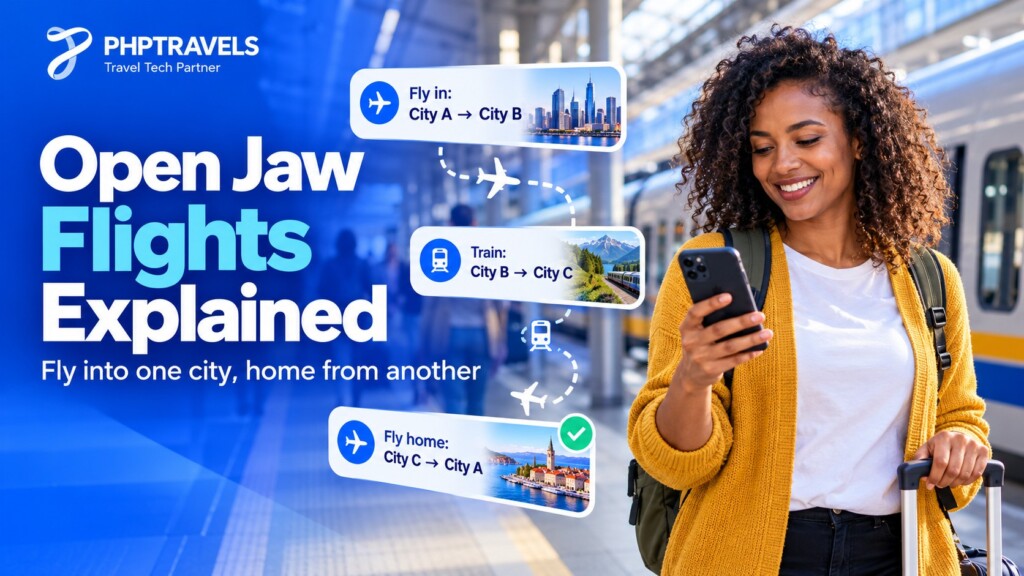
Open jaw flights are return trips where you fly into one city and fly home from another, or fly out from one city and return to a different one, all on a single ticket. The stretch you are not flying (Bangkok to Phuket, Rome to Venice, Los Angeles to San Francisco) is yours to cover by train, bus, car or a separate flight. Because the airline still treats the trip as a round trip, an open jaw is often the cheapest and simplest way to see more than one place without backtracking.
This guide covers what travellers search for (what an open jaw flight is, the three types, whether it is cheaper and how to book one) and what sits behind it: the IATA and ATPCO pricing rules, the ARNK segment in a GDS booking, and how flight APIs and booking engines describe these itineraries.
- One ticket, two directions, a gap: the gap is called the open segment or surface sector.
- Usually priced as two half round trips: not as two one-way fares, which is why it is often cheaper.
- Not every fare allows it: the airline’s combination rules decide, and some limit how long the gap may be.
- Booked as “multi-city”: search engines and airline sites rarely have an “open jaw” button.
What is an open jaw flight?

An open jaw flight is a return ticket where the destination, the origin, or both are not the same in each direction. Wikipedia’s open-jaw ticket entry gives the classic case: fly London to New York, then return to London from Philadelphia. Drawn on a map, the outbound and inbound lines form a shape like an open mouth, which is where the name comes from.
Airline tariffs use almost the same wording. United’s Contract of Carriage defines an open-jaw trip as “travel which is essentially of a round trip nature” where the outward point of departure and inward point of arrival, or the outward point of arrival and inward point of departure, are not the same.
The trip still has two directions, an outward journey and a return journey, and both sit on one ticket. What makes it “open” is the leg in between that the airline does not fly you on. In airline terms that leg is the open segment or surface sector.
Two practical details catch people out:
- Different airports in the same city do not count. Landing at New York JFK and leaving from Newark is still treated as a normal round trip, because both airports serve the same metropolitan area.
- An open jaw is not a stopover. A stopover breaks a journey at a point the airline flies you through. On an open jaw, you leave the airline’s network at one city and rejoin it at another.
Travellers use open jaw flights for touring trips (fly into Bangkok, travel south overland, fly home from Phuket), cruises that end in a different port, one-way road trips and multi-country rail holidays in Europe. Business travellers use them when meetings run from one city to the next.
The 3 types of open jaw tickets

IATA’s fare resolutions define three shapes. The definitions below are from IATA Resolution 012 as quoted in Travelport’s fares and pricing help on Category 10 combinations; the examples are from ANA’s open-jaw itinerary page.
| Type | What is different | Example | Typical use |
|---|---|---|---|
| Turnaround (destination) open jaw | You arrive in one city and start the return from another | Tokyo to Los Angeles; San Francisco to Tokyo (drive LA to SF) | Touring a region, road trips, cruises |
| Origin open jaw | You start from one city and return to a different one | Tokyo to Shanghai; Shanghai to Osaka | Living between two cities, returning to a different home airport |
| Double open jaw | Both ends differ | Tokyo to Guangzhou; Hong Kong to Nagoya (overland Guangzhou to Hong Kong) | Long trips with overland sections at both ends |
Consumer articles usually call the turnaround type a “destination open jaw”; fare manuals call it a turnaround open jaw. They mean the same thing. Single open jaws (one gap) are the everyday case. Whether a double open jaw is allowed depends on the fare’s combination rules, so check them before you promise one to a client.
Open jaw vs circle trip and multi-city
If you add a flown leg in the middle instead of a gap (London to Bangkok, Bangkok to Phuket, Phuket to London, all flown), the trip closes into a circle trip. If it has three or more flown legs going to different places, it is usually just called a multi-city trip. An open jaw is the special case with exactly two flown directions and a gap the airline does not cover.
How open jaw fares are priced

The reason open jaw flights are popular is the pricing. Under IATA Resolution 017b, as reproduced in the same Travelport Category 10 reference, the fare for an open jaw “shall be the sum of half the applicable round trip fares for both international legs of the open jaw”. In plain terms: the outbound is charged at half the round-trip fare to where you land, and the return at half the round-trip fare from where you leave.
A worked example
The numbers below are illustrative, not live fares, but the arithmetic is how a pricing engine builds the ticket.
| Itinerary option | How it is priced | Fare before taxes |
|---|---|---|
| Open jaw: London–Bangkok, Phuket–London | Half of a 900 London–Bangkok round trip (450) + half of a 980 London–Phuket round trip (490) | 940 |
| Same open jaw, fare rule says “charge the highest round-trip fare” | The higher of the two round-trip fares applies to the whole trip | 980 |
| Two one-way tickets on the same airline | Full one-way fare each way, e.g. 650 + 700 | 1,350 |
| Round trip to Bangkok + separate Phuket–Bangkok flight | 900 + a domestic one-way, plus a second ticket to manage | 900 + domestic fare |
The second row is real fare logic, not a hypothetical: ATPCO’s combination data includes a “Highest RT” setting, and fare rules carry text such as “CHARGE THE HIGHEST ROUND-TRIP FARE ON THE OPEN JAW”. On many full-service long-haul routes a one-way fare costs well over half the round trip, which is why two one-ways (row three) usually lose. The last row can win if the domestic leg is cheap, but you then hold two tickets, and if the domestic flight is late and you miss the long-haul departure, neither airline has to rebook you.
The rules that decide whether a fare can be combined
- Category 10 (Combinations): airlines file whether each fare may form an open jaw, round trip, circle trip or end-on-end combination. Travelport documents that when no Category 10 data applies, the system assumes open jaws are not permitted. That is why some cheap fares simply will not price as an open jaw.
- Surface sector length: for normal (fully flexible) fares, Resolution 017b says an international surface sector must not be longer than the flown distance of the shorter of the two fare components. Special (discounted) fares carry their own limits in Category 10, such as “mileage of the open segment must be equal/less than mileage of the shortest flown fare component”, or a rule that the open segment must be within one country.
- “One country” groupings: when applying its normal-fare open jaw conditions, Resolution 017b treats Canada and the USA as one country, Scandinavia as one country (except for trips wholly within Scandinavia) and Europe as one country (except for trips wholly within Europe).
- The strictest rule wins: the same United contract (Rule 7) states that when fares are combined to create round, circle or open-jaw trips, the most restrictive provisions apply to the entire transportation. In practice, a non-refundable fare on one direction usually makes the whole ticket non-refundable.
- Two fare components: Travelport notes that while ATPCO data does not cap the number of fare components, most systems will not price an open jaw with more than two.
One more nuance agents see in practice: for itineraries that include a special fare, Travelport’s pricing considers both an open jaw pricing unit and two one-way fares joined end-on-end, and returns whichever combinations validate. So the same search can come back priced two different ways depending on the fares the airline filed.
Open jaw vs multi-city vs two one-way tickets

Travellers often use “open jaw” and “multi-city” interchangeably, and on booking sites they are the same search form. The differences that matter are how the ticket is priced and what happens when something goes wrong.
| Open jaw (one ticket) | Multi-city (one ticket, 3+ legs) | Two one-way tickets | |
|---|---|---|---|
| Pricing basis | Usually half round trips | Combination of fares per leg | Two separate one-way fares |
| Typical cost on full-service airlines | Close to a normal round trip | Usually higher; each extra leg adds a fare component | Often the most expensive |
| Low-cost carriers | Rarely relevant; most price each direction separately | Same | Normal way to book |
| You miss the first flight | Return usually cancelled unless you tell the airline in advance | Later legs usually cancelled | The other ticket stays valid |
| Changes | One reissue under the fare rules | One reissue | Change fee per ticket |
| Best for | Touring between two cities | Three or more flown stops | Mixing airlines, very flexible plans |
Google’s own Google Flights help page spells out the separate-ticket risks: if you buy separate tickets you may be charged a change fee for each ticket, each airline has different baggage rules, and self-transfer tickets may require you to claim and recheck your bags.
How to book open jaw flights, step by step

There is rarely an “open jaw” option on a booking form. You build one with the multi-city search.
- Fix the two flown directions and the gap. Decide where you land, where you leave from and how you will cover the distance between them. Check the cost of that surface sector too: a one-way car rental with a drop-off fee or a long train journey can cancel out the saving.
- Search as multi-city. On Google Flights, choose multi-city as the ticket type (the help page lists one-way, round trip and multi-city), then enter two flights: home to city A, and city B to home. Most full-service airline websites have a multi-city or “different return city” option that works the same way.
- Compare three prices. Price the open jaw, a normal round trip to one of the two cities plus a separate connecting flight or train, and two one-way tickets. On long-haul full-service routes the open jaw usually wins; on short-haul low-cost routes, two one-ways often do.
- Confirm it is one ticket. One booking reference and one ticket number covering both directions means the airline treats it as a single contract. If the result says “separate tickets” or “self-transfer”, it is not an open jaw fare. Our e-ticket guide explains how to read the ticket number.
- Read the fare rules for both directions. Change and refund conditions apply to the whole ticket. If one direction is on a partner airline, check who operates it; our guide to codeshare flights explains why the operating carrier decides check-in and baggage.
- Fly every flight in order. Do not treat the ticket as two independent halves. United’s Contract of Carriage (Rule 6) says flight coupons are honoured only in the order in which they were intended to be used, and Cathay Pacific says coupons after an unused one are forfeited. Miss the outbound and the return is usually cancelled too.
If you book through an agency or OTA, the multi-city form on its site feeds the same search pipeline as any other trip. This walkthrough of how a travel booking engine works, step by step follows a multi-city flight from the search request to the confirmed booking.
Open jaw rules and mistakes to avoid
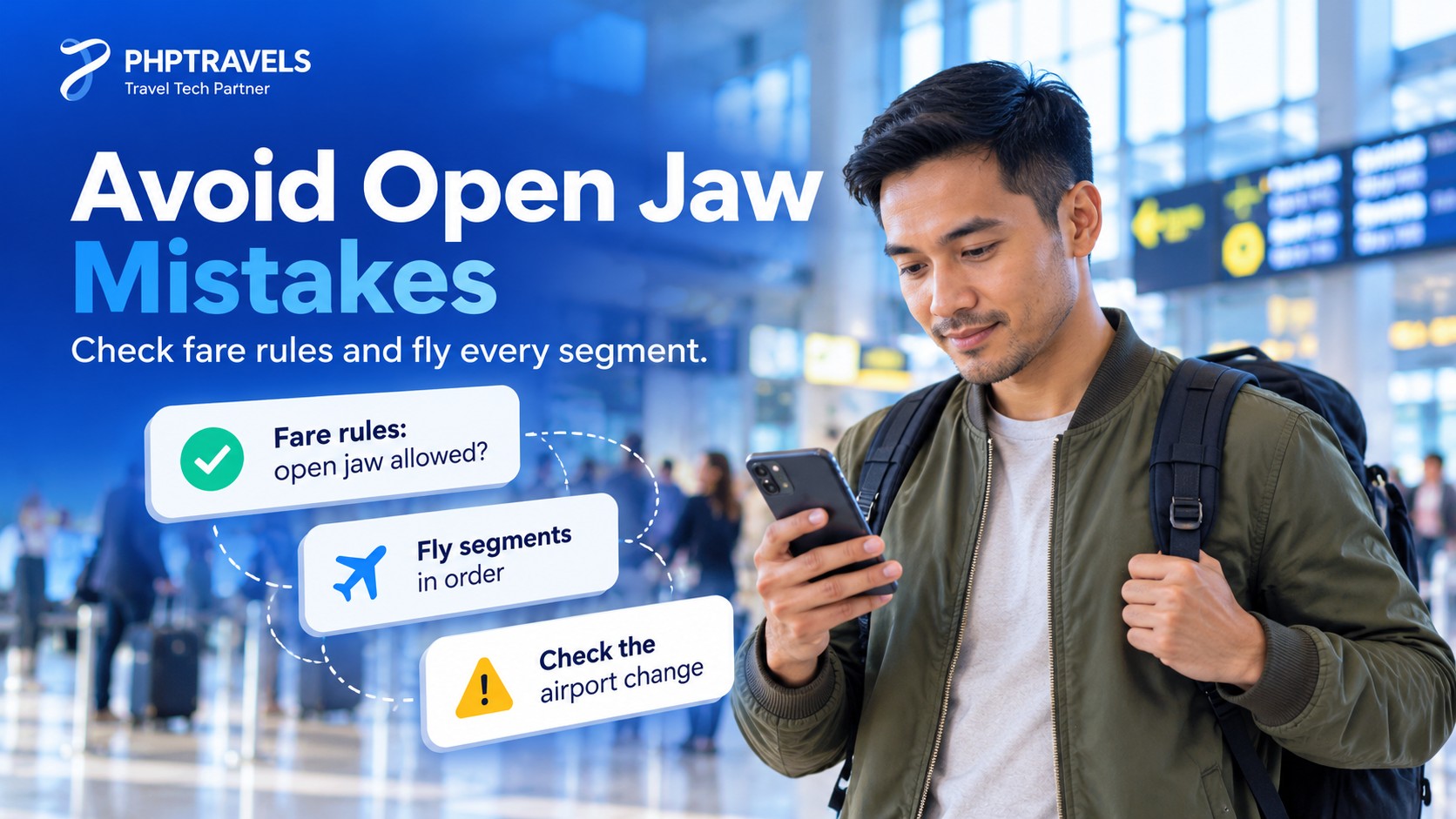
Most problems come from assuming the airline sees the trip the way the traveller does.
The gap is too long
A trip that flies into Paris and home from Istanbul may price as two one-ways if the fare limits the open segment to one country or to a distance shorter than the flown legs. If the price jumps when you widen the gap, that is usually the reason.
The fare does not allow open jaws at all
The cheapest fare in a search is often the most restricted. If its Category 10 rule does not permit the combination, the system moves to the next fare that does. Travellers see a higher price than the round trip they priced earlier and assume the site is wrong.
Assuming open jaw is always cheaper
It is usually close to a round trip on full-service airlines, not below it. Where low-cost carriers carry much of the traffic, as on many short-haul routes in Europe and Asia, one-way fares are normal and an open jaw brings little benefit.
Forgetting the airport change
The return starts from a different airport, sometimes in a different country. Entry rules, onward-ticket checks and transport to that airport need planning, especially when the gap crosses a border.
Skipping or swapping flights
Because coupons must be flown in sequence, a traveller who decides to fly the gap on the same airline instead, or to skip the outbound, needs the ticket changed first. Etihad’s conditions of carriage are typical: out-of-sequence use is only valid after the fare is recalculated and the ticket reissued.
How travel agents and booking engines handle open jaw itineraries

For an agency this is ordinary work, but it touches booking, pricing, display and servicing. Each has its own detail.
In a GDS booking: the ARNK segment
Airline and GDS booking systems expect each segment to start where the previous one ended. On an open jaw they do not, so the agent adds an arrival unknown segment, written ARNK, to show the break is intentional. Amadeus’s Service Hub article on ARNK gives the entry (SIARNK) and an example PNR:
  2  AF 002 R 09JAN 4 CDGJFK HK1  0730 2E 0830 1040
  3  ARNK
  4  AF 333 R 15JAN 3 BOSCDG HK1  1745 E  1845 0725+1
Paris to New York, an unknown arrival, then Boston back to Paris: a turnaround open jaw. Without the ARNK, Amadeus warns “CHECK SEGMENT CONTINUITY” when the agent ends the transaction.
In flight APIs: slices and origin-destinations
Modern flight APIs have no special open jaw flag. You describe each direction and the gap is implied:
- Duffel describes a search as a list of slices. Its flights key concepts page explains that a one-way trip is one slice, a return is two, and a multi-city trip has more than two. An open jaw is two slices whose points do not mirror each other, for example LON to BKK and HKT to LON.
- Amadeus Self-Service Flight Offers Search takes an
originDestinationsarray. The published OpenAPI specification allows 1 to 6 entries, which must be in chronological order.
Enterprise GDS connections work the same way at a higher level: TravelsOTA’s Amadeus flights API overview lists one-way, round-trip and multi-city itineraries among the search criteria a platform sends. If you are choosing between the two Amadeus routes, see our comparison of Amadeus Self-Service and Enterprise APIs.
Pricing and display
- Show the gap. A results card that says “Bangkok to Phuket: own arrangements” prevents the most common complaint, a traveller who thought the middle leg was included. Our guide to designing a flight search covers multi-city forms on mobile, where each leg needs to be separate and easy to edit.
- Show fare rules for the whole ticket before payment, not just for the first direction.
- Re-price before charging. These prices depend on which fares combine, so a cached price is more likely to be wrong than on a simple return. Booking revalidation catches the change before the card is charged.
- Name the operating carrier on every segment when either direction is a codeshare.
Servicing
Both directions usually form one pricing unit, so a change to either one is usually handled as a reissue of the whole ticket under its fare rules, not an edit to one half. Schedule changes deserve care too: if the airline moves the return flight from city B, the traveller’s surface plans (a train ticket, a car drop-off) may also need to move.
Where PHPTRAVELS fits
PHPTRAVELS is travel booking software that an agency installs or has hosted and sells through under its own brand. Its flights module covers several of the jobs above, according to the live feature page:
- parallel search across the GDS, NDC and low-cost sources you connect, merged into one results list;
- fare rules from the supplier shown before payment, and a price check with the supplier before the card is charged;
- PNRs, ticketing queues (including airline schedule changes), and void, refund and reissue from the booking;
- markups by route, airline, cabin or channel, and a B2B agent portal with wallets and credit limits.
Two honest limits. First, what an open jaw prices to comes from the fares your suppliers return under your own contracts; the software connects to Amadeus, Sabre, Travelport, Duffel and the other suppliers on the integrations page, but it does not grant inventory. Second, search options differ by supplier, so bring your own open jaw routes to the PHPTRAVELS demo and check how the search form, results and PNR handle them. You can build a quote for the suppliers and modules you need on the pricing page.
Open jaw flights FAQ
Are open jaw flights more expensive than a round trip?
Usually not by much. Because they are priced as two half round-trip fares, the total is typically close to a round trip to either city. Some fares charge the higher of the two round-trip fares, and a fare that does not allow open jaws will push the search to a more expensive one.
Is flying into one airport and out of another in the same city an open jaw?
No. Airports serving the same city, such as New York JFK and Newark, are treated as one point, so the trip is priced as a normal round trip.
What does ARNK mean on my itinerary?
ARNK means “arrival unknown”. It marks the gap between the city you flew into and the city you fly home from. It is not a flight and needs no action, other than getting yourself between the two cities.
Can I book an open jaw on a low-cost airline?
Most low-cost carriers sell each direction as a separate one-way fare, so booking “into one city, out of another” costs the same as two one-ways. The open jaw pricing advantage mainly applies to full-service airlines that publish round-trip fares.
What is a double open jaw?
A trip where both ends differ: you leave from one city, arrive in a second, depart from a third and return to a fourth, such as Tokyo to Guangzhou and Hong Kong to Nagoya. Many fares allow it; some restrict it.
Can I skip the outbound and only use the return?
Generally no. Airlines require coupons to be used in order, and unused earlier coupons usually cancel the rest. Change the ticket with the airline or your agent first.
Key takeaways
- Open jaw flights are return tickets with a gap you cover yourself, at the destination end, the origin end, or both.
- It is usually priced as two half round trips, so it often beats two one-way tickets on full-service airlines.
- Airline combination rules decide whether a fare allows it and how long the gap can be.
- Book it with a multi-city search, confirm it is one ticket, and fly every coupon in order.
- Agencies need ARNK handling, multi-slice API searches, clear display of the gap and re-pricing before payment. To see how PHPTRAVELS handles your routes, book a PHPTRAVELS demo.