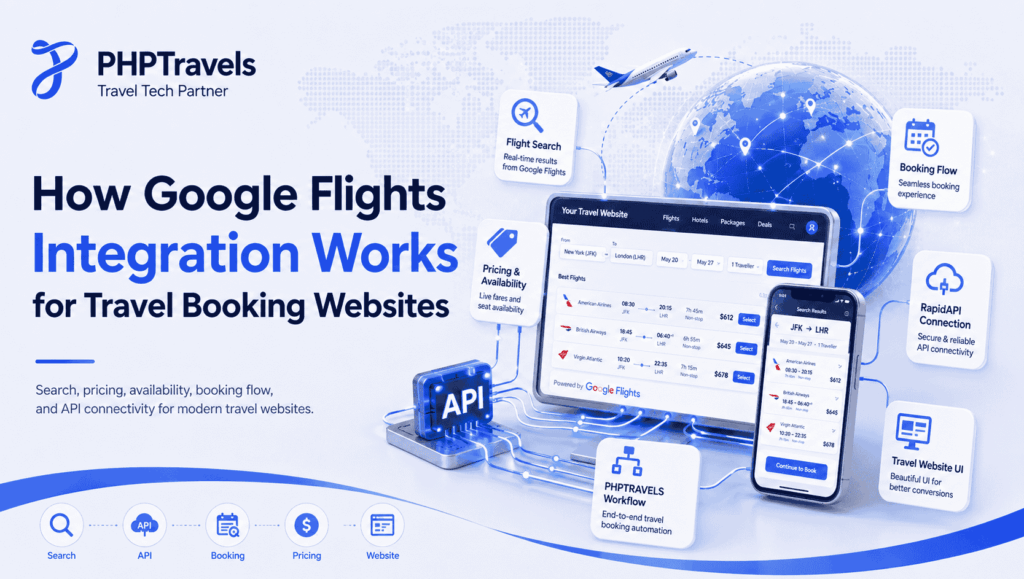
Travelers expect flight search to be fast, clear, and easy to compare. They want to enter a route, review suitable options, understand the price, and continue toward booking without confusing results.
For a travel agency, that experience requires a dependable data connection, consistent result mapping, price validation, a clear booking path, and operational controls.
Google Flights integration refers to two different models: an airline or OTA connecting its booking options with Google Flights, or a travel website using an independent third-party flight-search API that provides Google Flights-style results. These models are not the same. A third-party API does not automatically provide official Google inventory, booking authority, ticketing, or post-booking servicing.
This guide focuses on implementation: how travel websites use flight search data, how a RapidAPI-style connection may work, how search differs from booking, and where PHPTRAVELS fits.
Quick Summary
- The integration usually supports flight discovery, not the complete ticketing lifecycle.
- A third-party provider may deliver schedules, fares, and availability through RapidAPI.
- Results should be normalized before appearing on a branded website.
- A booking API may still be needed for PNR creation, ticketing, changes, and refunds.
What Does Google Flights Integration Mean?
In practical terms, Google Flights API integration means connecting a travel website to flight information that can be presented through its own interface. Depending on the provider, the data may include airports, dates, airlines, flight numbers, stops, cabin classes, journey duration, prices, and booking or referral links.
The phrase can be misleading because there is no generally available public-facing Google Flights API that gives every developer a complete search, booking, ticketing, and servicing workflow. PHPTRAVELS explains the background and enterprise alternatives in its Google Flights API guide, so this article does not repeat that history.
For implementation planning, the main question is not simply, “Can we show flight data?” It is, “What can the selected provider legally and reliably supply, and what happens after the traveler selects an offer?”
That distinction prevents a project from being built around a search feed that cannot support the intended commercial journey.
How Travel Websites Use Flight Search Data
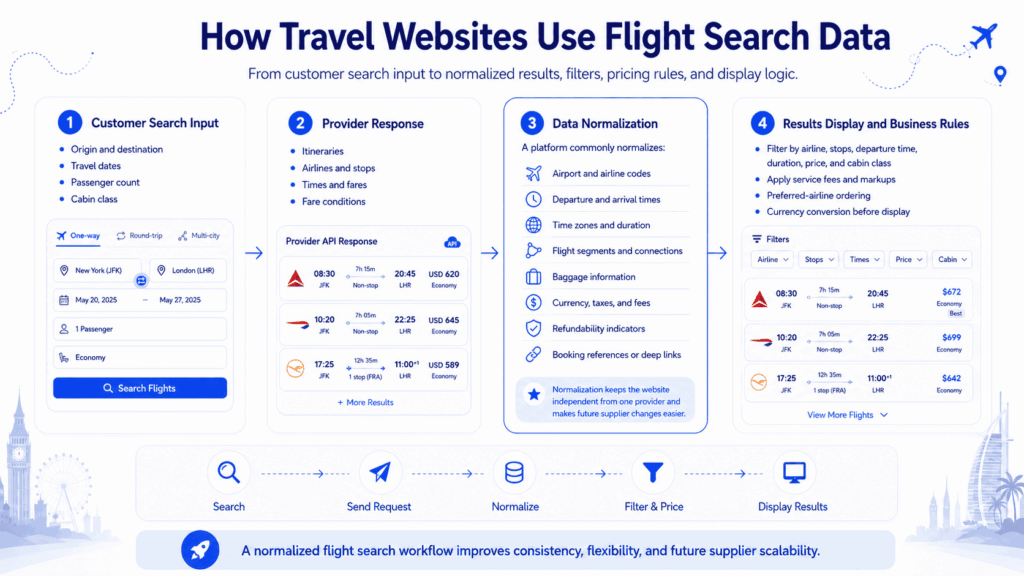
A customer enters an origin, destination, travel dates, passenger count, and cabin class. The website converts those fields into a structured request and sends it to the connected provider.
The response may contain many itineraries with different airlines, stops, times, fare conditions, and prices. Before displaying them, the website should convert the provider-specific response into a consistent internal format.
A platform commonly normalizes:
- Airport and airline codes
- Departure and arrival times
- Time zones and duration
- Flight segments and connections
- Baggage information
- Currency, taxes, and fees
- Refundability indicators
- Booking references or deep links
Normalization keeps the interface independent from one provider and makes future supplier changes easier.
The website can then apply filters for airline, stops, departure time, duration, price, and cabin class. Business rules such as service fees, markups, preferred-airline ordering, and currency conversion can also be applied before results are displayed.
Google Flights Integration vs a Flight Booking API
A flight search connection and a flight booking API solve related but different problems.
| Capability | Search Connection | Full Booking API |
|---|---|---|
| Route and schedule search | Usually supported | Supported |
| Fare comparison | Often supported | Supported |
| Filters and sorting | Website controlled | Website controlled |
| Price revalidation | May be limited | Normally required |
| Traveler details | Usually not handled | Supported |
| PNR creation | Usually not supported | Supported |
| Payment and ticketing | Usually not supported | Supported |
| Changes and refunds | Usually not supported | Supplier dependent |
| Completion | Referral or handoff | Can stay on the website |
Google Flights helps travelers compare options from airlines, online travel agencies, and aggregators. Google states that booking options come from its partners, while changes and cancellations are handled by the airline or travel agency responsible for the booking.
A Google Flights booking integration may therefore follow one of these models:
- Search and referral: The customer compares options and follows a link to an airline or OTA.
- Search plus booking supplier: One connection supports discovery, while a contracted API handles pricing, PNR, and ticketing.
- Metasearch: The website compares offers and earns through referrals or partner agreements.
- Agency-assisted flow: The customer submits a request and an agent completes the booking through another system.
The correct model depends on supplier permissions, market coverage, ticketing authority, support capacity, and the agency’s revenue strategy.
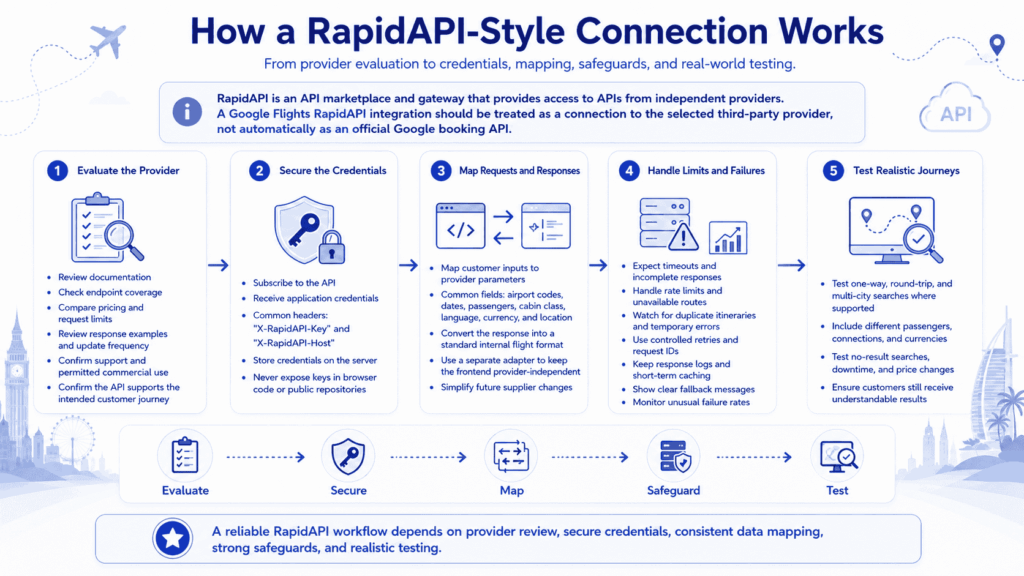
How a RapidAPI-Style Connection Works
RapidAPI is an API marketplace and gateway that provides access to APIs listed by independent providers. A Google Flights RapidAPI integration should be treated as a connection to the selected third-party provider, not automatically as an official Google booking API.
1. Evaluate the Provider
Review its documentation, endpoint coverage, pricing, request limits, response examples, update frequency, support, and permitted commercial use.
Confirm that the API allows production use and supports the intended customer journey.
2. Secure the Credentials
The development team subscribes to the API and receives application credentials. RapidAPI commonly requires X-RapidAPI-Key and X-RapidAPI-Host headers for requests routed through its runtime. Store them on the server, not in browser code or a public repository.
3. Map Requests and Responses
Customer inputs are mapped to the provider’s accepted parameters, which may include airport codes, dates, passengers, cabin class, language, currency, and location.
The response is then converted into the platform’s standard flight format. A separate adapter keeps the frontend independent from the provider and simplifies future supplier changes.
4. Handle Limits and Failures
Production code should expect timeouts, incomplete responses, rate limits, unavailable routes, duplicate itineraries, and temporary errors.
Useful safeguards include controlled retries, request IDs, response logs, short-term caching, clear fallback messages, and monitoring for unusual failure rates.
5. Test Realistic Journeys
Test one-way, round-trip, and multi-city searches where supported. Include different passengers, connections, currencies, no-result searches, downtime, and price changes. Customers should receive understandable results even when conditions are imperfect.
Search, Pricing, Availability, and Booking Flow
A dependable flight experience works as a sequence.
Step 1: Search
The traveler enters the route, dates, passengers, and cabin preference.
Step 2: Request Processing
The platform validates the search and sends a traceable request to the provider.
Step 3: Result Mapping
It normalizes returned itineraries and shows airline, schedule, stops, duration, baggage where available, and price.
Step 4: Comparison
The traveler filters by price, airline, time, stops, or duration. The interface should show important trade-offs instead of ranking everything by the lowest headline fare.
Step 5: Offer Selection
The platform identifies whether the next action is a referral, internal checkout, agent request, or separate supplier booking flow.
Step 6: Revalidation
Before payment, a booking-capable supplier should recheck the fare and seats. The website must clearly handle updated prices or unavailable offers.
Step 7: Booking or Handoff
The platform can collect traveler details and payment information. The booking-capable supplier then creates the PNR and, where supported, issues the ticket and returns the booking confirmation.
Step 8: Support
The agency needs access to the actual booking source for changes, cancellations, schedule updates, refunds, and customer service. Search data alone does not provide post-booking control.
Agencies that require a complete book-to-ticket workflow can review PHPTRAVELS flight API integration options for GDS, NDC, and contracted flight suppliers.
Where PHPTRAVELS Fits
PHPTRAVELS can act as the operational layer between the traveler, search provider, booking supplier, and agency team.
The platform can support branded search, filters, currencies, pricing rules, accounts, payments, booking records, and admin management. The flow depends on whether the source supports search, referral, or full booking.
A practical setup may combine:
- A third-party flight search connection
- A normalized response adapter
- A branded B2C website
- B2B agent access where needed
- Markups and service fees
- Multi-currency presentation
- Payment gateway connections
- Referral or booking tracking
- Admin logs and reports
- Additional suppliers for ticketing coverage
The PHPTRAVELS integrations lists Google Flights in its flight category alongside other travel connections.
Agencies planning direct flight sales can also review the flight booking software, which supports B2B and B2C portals, admin controls, payments, supplier connectivity, and reporting. More platform capabilities are described on the flights module features page.
PHPTRAVELS does not turn a search-only source into a ticketing provider. It connects the available data and supplier capabilities to a customer and operational workflow that matches the agency’s business model.
When Should an Agency Use This Integration?
This approach can be useful when an agency wants to:
- Add a familiar flight comparison experience
- Launch a metasearch or referral product
- Test customer demand before negotiating a larger GDS agreement
- Combine a search source with a separate booking supplier
- Offer more route and fare discovery choices
- Keep flight search within a branded travel portal
It may not be enough when the business requires guaranteed ticket issuance, negotiated fares, complex exchanges, airline settlement, or complete post-booking servicing from the same provider.
In those cases, the agency should evaluate a contracted flight booking supplier, GDS, NDC source, consolidator, or aggregator that supports the full lifecycle.
Connect Google Flights with PHPTRAVELS
A successful Google Flights integration project begins by separating flight discovery from booking operations. Search data can help customers compare routes and fares, but the business still needs a process for price validation, booking ownership, payment, ticketing, and support.
PHPTRAVELS helps agencies and OTAs bring these pieces into one branded platform. Whether your model uses third-party search data, referrals, a separate booking API, or several suppliers, the implementation should be based on reliable data, clear commercial rights, and a workflow your team can manage.
Explore PHPTRAVELS integrations or contact the team to plan a Google Flights integration for your travel website and booking model.