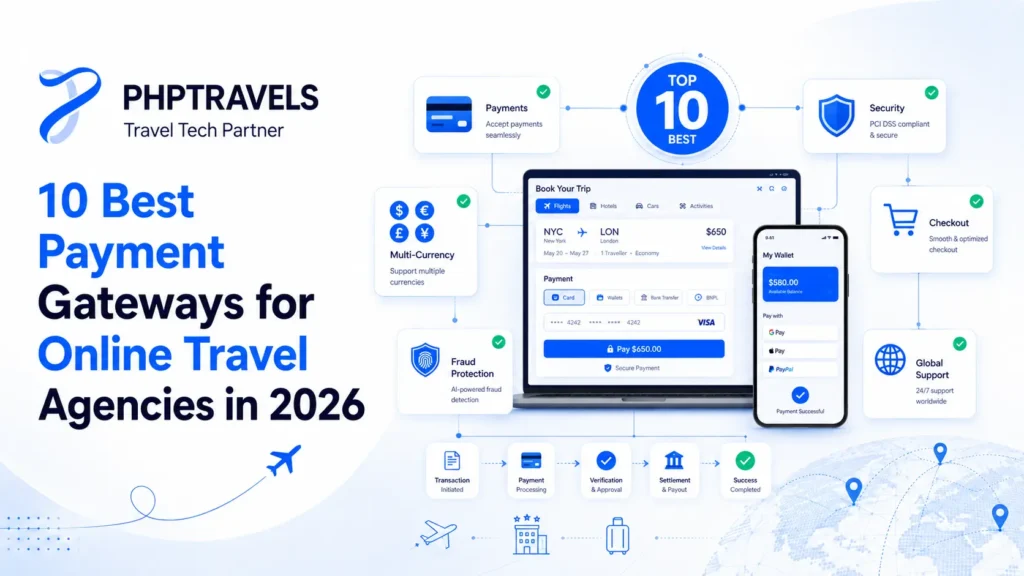
Online travel agencies process payments differently from ordinary ecommerce stores. A booking may involve international customers, multiple currencies, refunds, cancellations, supplier payments, chargebacks, and strict fraud controls. That makes the payment gateway a core part of an OTA’s booking infrastructure, not just a checkout add-on.
The best payment gateway for an online travel agency should support the markets you sell in, the payment methods travelers use, secure authentication such as 3D Secure, reliable refunds, fraud prevention, multi-currency processing, and API integration with your booking engine. Global reach matters, but so do settlement rules, dispute handling, approval rates, and reconciliation.
Quick Answer: What Are the Best Payment Gateways for Online Travel Agencies?
For global OTAs, Stripe, Adyen, Checkout.com, Worldpay, PayPal/Braintree, and Nuvei are strong options for international online payments. Razorpay and PayU can be especially relevant for agencies serving South Asia or other high-growth markets, while Mollie is a strong option for many European businesses. Authorize.net remains useful for businesses that want a long-established gateway with fraud controls and eCheck support.
There is no single “best” provider for every travel company. The right choice depends on where your company is registered, where customers are located, supported currencies, local payment methods, booking value, chargeback risk, settlement needs, and technical integration.
Why Payment Gateways Matter More in Travel
Travel has a more complicated payment lifecycle than many retail transactions. A traveler may pay today for a flight, hotel, tour, transfer, or package delivered weeks or months later. Plans change, suppliers modify bookings, and customers may request partial or full refunds.
For this reason, an OTA should evaluate more than transaction fees. Payment success rate, fraud screening, tokenization, 3D Secure support, refund APIs, webhooks, dispute workflows, settlement timing, local acquiring, and multi-currency capability can all affect customer experience and finance operations.
If you are still defining requirements, read this guide on how to choose a payment gateway for a travel agency.
Best Payment Gateways for OTAs
| Payment Gateway | Best Suited For | Main Strength |
|---|---|---|
| Stripe | Global digital-first OTAs | Developer tools and multi-currency payments |
| PayPal / Braintree | Agencies wanting wallet recognition | PayPal ecosystem plus cards and wallets |
| Adyen | Large travel brands | Global acquiring, local methods and risk tools |
| Checkout.com | Scaling international OTAs | Travel-focused acquiring and performance |
| Worldpay | Airlines and established travel companies | Travel expertise and large-scale processing |
| Razorpay | India-focused businesses | Local rails plus international payments |
| PayU | High-growth markets | Local payment-method coverage |
| Mollie | European travel businesses | European methods and simple integration |
| Authorize.net | US-focused SMBs | Mature gateway and fraud controls |
| Nuvei | Travel and mobility businesses | Travel-focused payment infrastructure |
1. Stripe
Stripe is a flexible choice for online travel agencies that want an API-first payment stack. It supports a broad range of payment methods and multi-currency use cases, making it suitable for OTAs selling across different markets. Stripe also provides tools for authentication, fraud management, saved payment methods, and programmable payment flows.
For travel businesses, the main advantage is developer control. Payments can connect with booking confirmations, cancellations, refund logic, and back-office systems. Stripe also supports industry metadata for travel-related merchant categories such as travel agencies, lodging, car rental, and flights.
Best for: digital-first OTAs, travel startups, and global booking platforms.
PHPTRAVELS provides a dedicated Stripe API integration path for travel booking workflows.
2. PayPal and Braintree
PayPal remains valuable because many travelers already recognize the wallet at checkout. Braintree, a PayPal service, extends the stack with card processing, PayPal, digital wallets such as Apple Pay and Google Pay, and supported local payment methods.
For an OTA, PayPal can work as an additional checkout option even when another provider handles most card payments. Braintree may fit agencies that want a broader embedded payment experience without losing access to the PayPal ecosystem.
Best for: agencies that want a familiar wallet plus cards and digital wallets.
Review the available PayPal API integration for PHPTRAVELS.
3. Adyen
Adyen is designed for large-scale international commerce and has dedicated solutions for travel and online travel agencies. It supports a wide mix of local and international payment methods and combines acquiring, risk management, payment optimization, and settlement capabilities.
This is useful for OTAs operating across countries where payment preferences vary. A global stack can reduce the need to manage many disconnected providers while allowing checkout experiences to offer methods relevant to each market.
Best for: enterprise OTAs, hotel groups, airlines, and travel marketplaces with complex international payment operations.
4. Checkout.com
Checkout.com has payment solutions specifically for travel and focuses on both receiving traveler payments and supporting supplier-payment workflows. This matters for OTAs because the payment journey often continues after the customer is charged; agencies may also need to pay hotels, airlines, or other suppliers.
Its travel focus, acquiring capabilities, issuing options, and payment-performance tools make it a strong candidate for international OTAs. Checkout.com has also publicly documented travel relationships involving businesses such as Agoda and GetYourGuide.
Best for: fast-growing OTAs and travel marketplaces needing customer-payment and supplier-payment capabilities.
5. Worldpay
Worldpay has a dedicated travel and airline offering and supports large payment operations across international markets. For established travel companies, its value goes beyond basic card acceptance and includes travel-specific processing, fraud controls, cross-border payments, and large-scale operational requirements.
Worldpay also documents airline-specific transaction data capabilities, which can be relevant to businesses processing flight-related payments.
Smaller OTAs should still compare onboarding, support, integration effort, and commercial terms before selecting an enterprise payment platform.
Best for: airlines, enterprise travel sellers, and high-volume travel businesses.
6. Razorpay
Razorpay is a strong option for travel businesses operating from India or targeting customers who use Indian payment methods. In addition to domestic payment rails, Razorpay supports international card payments and multi-currency acceptance for eligible businesses. Its documentation currently describes international payment support with 3D Secure 2.0.
For India-based OTAs, this can support domestic customers using familiar payment options while also accepting eligible international transactions. Availability and onboarding can depend on business type and regulatory requirements.
Best for: India-based travel agencies, OTAs, tour operators, and travel startups.
See the PHPTRAVELS Razorpay API integration.
7. PayU
PayU is relevant in high-growth markets where local payment preferences can differ from the standard card-and-wallet mix. Its global payment business emphasizes local and alternative payment methods across markets including Central and Eastern Europe, Latin America, and Africa.
For OTAs, local payment coverage can improve checkout relevance. A gateway supporting the methods customers already use may be more valuable than a provider with extensive global features but weak coverage in your primary sales market.
Best for: travel businesses expanding across emerging and high-growth markets.
8. Mollie
Mollie is a practical option for many European online businesses and supports cards, bank-based payments, wallets, and region-specific payment methods. Its documentation also covers multi-currency transactions and multi-currency balances.
An OTA serving markets such as the Netherlands, Belgium, Germany, France, or neighboring European countries may care as much about relevant local bank-payment options as international card acceptance.
Best for: European OTAs, tour operators, and regional travel companies.
9. Authorize.net
Authorize.net is a long-established payment gateway backed by Visa. It offers online payment capabilities, eCheck support, tokenization options, and an Advanced Fraud Detection Suite with configurable transaction filters.
Its current pricing is also very different from the information on the old PHPTRAVELS article—for example, Authorize.net currently advertises no signup fee on its gateway pricing page, demonstrating why hard-coded historical pricing should be removed from this article.
Compared with newer global payment platforms, Authorize.net is generally most relevant to merchants with a strong United States focus.
Best for: US-focused travel agencies and small to midsize travel businesses wanting a mature gateway with fraud screening.
10. Nuvei
Nuvei offers payment solutions specifically for travel and mobility businesses. Its travel positioning makes it relevant for companies dealing with international customers, multiple payment methods, fraud risk, and complex travel transactions.
Nuvei also documents travel-specific technical capabilities for airline transactions, including airline payment data fields.
For an OTA evaluating enterprise providers, compare Nuvei with Adyen, Checkout.com, and Worldpay based on onboarding countries, local acquiring, settlement, dispute tools, reporting, technical requirements, and commercial terms.
Best for: travel and mobility companies seeking a global, travel-focused payment partner.
Payment Gateway Integration With Travel Booking Software
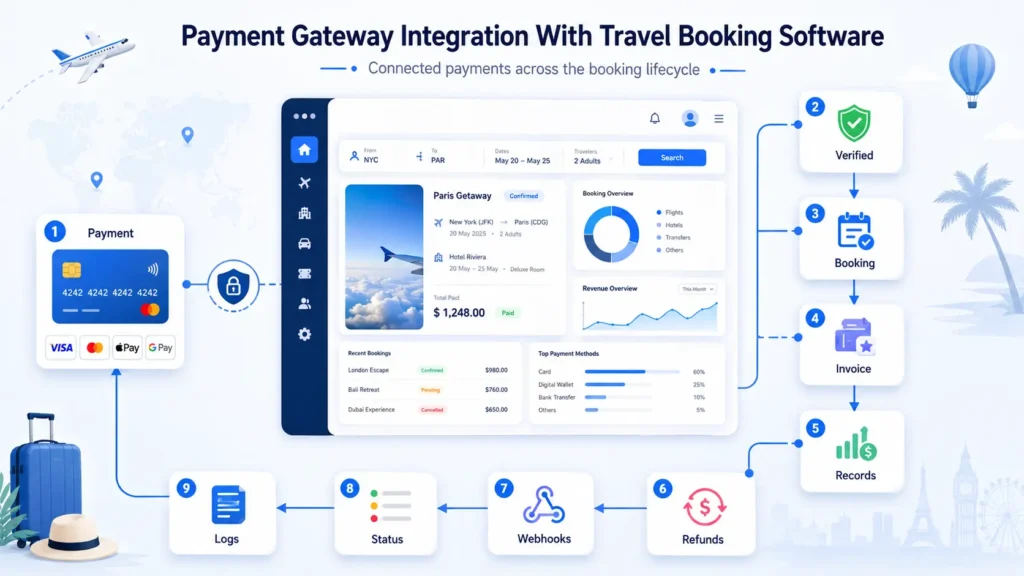
A payment gateway works best when connected directly to the booking lifecycle. After a traveler pays, the booking system should receive a verified payment status, confirm or hold the reservation according to business rules, generate the appropriate invoice or voucher, and keep financial records synchronized.
For cancellations, the system should help staff identify the original transaction, apply the correct refund rule, and record the payment event against the booking. Webhooks are particularly important because payment status can change after the customer leaves checkout.
PHPTRAVELS supports travel payment gateway integration that connects payments with travel booking workflows. Agencies building a broader technology stack can also review the travel booking software and available travel technology integrations. PHPTRAVELS describes payment status, refunds, and operational logs as parts of its connected booking workflows.
Security, PCI DSS and Fraud Prevention
Travel businesses should minimize direct handling of raw card data and use provider-supported tokenization or hosted payment components where appropriate. PCI DSS responsibilities depend on how the payment flow is implemented, so using a compliant payment provider does not automatically remove every security responsibility from the merchant.
3D Secure can also be important where regulations or issuing banks require additional customer authentication. Fraud rules should be tuned carefully: overly aggressive controls can reject legitimate travelers, while weak controls can increase disputes and chargeback exposure.
Because payment security extends beyond the gateway itself, travel companies should also review their practices for securely handling customer data.
Final Thoughts
The best payment gateway for an online travel agency is the one that matches the agency’s actual markets and booking workflow. Global reach, local payment methods, security, payment approval performance, refunds, disputes, settlement, and integration quality matter more than brand popularity alone.
Before going live, test successful and failed payments, 3D Secure challenges, cancellations, partial refunds, duplicate-payment protection, webhook handling, and reconciliation.