For a travel agent, hotel booking is no longer just about finding a room. Agents need competitive rates, reliable availability, clear cancellation policies, fast confirmations, and enough margin to make each booking commercially worthwhile.
That is where RateHawk fits into the B2B travel ecosystem.
RateHawk is a booking platform for travel professionals that gives agencies and tour operators access to accommodation and other travel services. Instead of negotiating separately with thousands of properties, a RateHawk travel agent can search aggregated inventory, compare available offers, book for clients, and manage reservations through a professional B2B workflow.
This guide explains how RateHawk B2B hotel booking works from a travel agent’s point of view, where margins and confirmations fit into the process, what happens after a booking, and when an agency may need a separate booking platform such as PHPTRAVELS.
What Is RateHawk for Travel Agents?
RateHawk is a B2B travel booking service designed for travel agencies, tour operators, and other travel professionals.
Its main value is aggregation. Rather than an agent checking many hotel supplier systems individually, RateHawk brings inventory from multiple sources into one environment.
According to RateHawk’s B2B platform for travel professionals, the service currently lists more than 2.9 million accommodation options from 330+ suppliers across 220 countries and territories.
For travel agents, this can make hotel sourcing faster because rates, property options, and booking details can be reviewed within the same workflow.
How Does RateHawk B2B Hotel Booking Work?
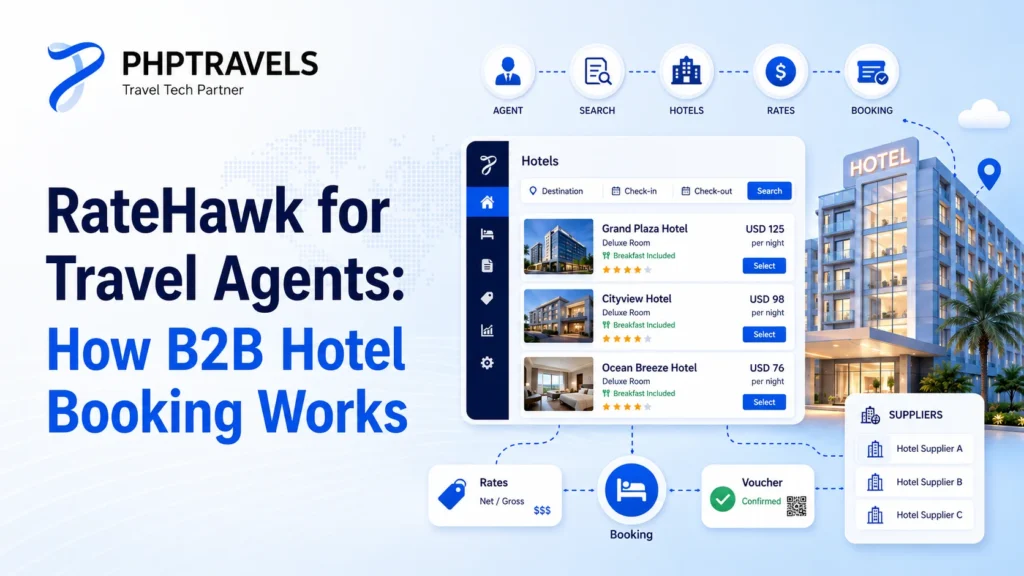
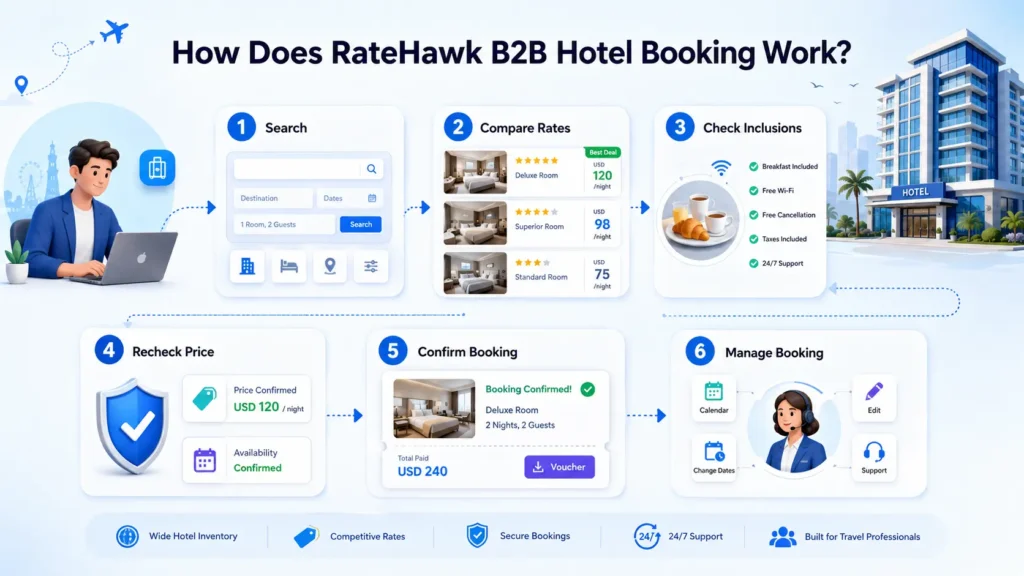
The basic RateHawk B2B workflow is straightforward: an agent searches for a stay, reviews available rates and conditions, selects an option for the client, confirms the reservation, and then manages the booking after sale.
1. The Travel Agent Searches for a Hotel
The agent starts with the client’s destination, check-in and check-out dates, number of guests, and room requirements.
A B2B hotel booking system then searches the available inventory and returns matching properties and rates.
Location, room type, meal plan, cancellation policy, and client preferences all affect which offer is actually best.
2. The Agent Compares B2B Rates
B2B hotel rates are commercial rates made available to travel businesses rather than normal retail shoppers.
Depending on the supplier and agreement, a rate may give the agency room to add its own markup or operate under another commercial model.
RateHawk advertises both net and gross working models. This matters because agencies need to understand the price they receive, the price they present to their client, and the margin they expect to keep.
3. The Agent Checks What the Rate Includes
Two rates for the same hotel and room can have different conditions.
One may include breakfast while another does not. Cancellation deadlines may be different. Some rates may be refundable, while others can carry stricter conditions.
Before confirming a booking, an agent should review the full offer rather than compare only the headline price.
This is important in B2B travel because the agent is responsible for communicating the booking conditions accurately to the customer.
4. Availability and Price Are Confirmed
Hotel inventory changes constantly. A room displayed during search may be sold or repriced before the booking is completed.
A modern booking flow therefore needs a final availability and price check before confirmation.
RateHawk promotes real-time availability and immediate booking confirmations for travel professionals. From the agency’s perspective, this reduces the amount of manual hotel confirmation work compared with traditional request-based booking processes.
5. The Booking Is Confirmed for the Client
After the selected rate has been accepted and the booking succeeds, the agent receives the reservation details needed to serve the traveler.
The workflow may include a booking reference, accommodation details, stay dates, room information, payment status, policies, and a voucher or confirmation document.
6. The Agency Manages the Booking After Sale
A hotel booking does not end when the confirmation is generated.
Clients may ask to change dates, cancel a stay, reconfirm a reservation, or clarify hotel details. Agencies therefore need a clear post-booking process.
Why Do Travel Agents Use B2B Hotel Platforms?
Travel agents use B2B hotel platforms to access broader inventory, compare professional rates, reduce manual supplier work, and manage bookings more efficiently.
The practical benefits include broader accommodation access, B2B pricing, faster search, clearer conditions, centralized reservation management, and less manual supplier work.
However, a supplier platform and an agency’s own booking website are not the same thing. That distinction becomes important when the agency wants to build its own brand.
How Do Travel Agents Make Money With RateHawk?
A travel agency makes money by applying its commercial model to the travel services it sells.
With hotel distribution, this often involves the difference between the agency’s underlying rate and its selling price, or another commission or pricing arrangement agreed with the supplier.
The important point is margin control.
Agents should understand the exact rate type and conditions before automating pricing, because margin also has to cover operating costs such as support and payment processing.
If an agency sells through sub-agents, the model becomes more layered. The main agency may need separate markups or commissions for each partner while still protecting its own margin.
PHPTRAVELS’ B2B hotel booking platform is designed for this type of multi-agent structure, including agent access, markups, commissions, credit controls, and supplier connectivity.
Is RateHawk the Same as a B2B Hotel Booking System?
Not exactly.
RateHawk can provide B2B inventory and a professional booking environment, but an agency may also need its own customer-facing or agent-facing booking system.
| Layer | Main Role |
|---|---|
| RateHawk or another hotel supplier | Supplies travel content, rates, availability, and booking access |
| Agency booking platform | Controls the agency’s brand, users, pricing, payments, customer journey, and reporting |
An agency booking manually may be comfortable with a supplier interface. An OTA or wholesaler that wants users to book under its own brand usually needs a separate platform around supplier connections.
That is why supplier choice and booking software choice should be treated as related but different decisions.
Can RateHawk Be Connected to a Travel Agency Website?
Yes. RateHawk provides API connectivity for eligible businesses, allowing its inventory to be used inside a separate travel website or booking application.
For the agency, the important decision is not only whether an API exists. It is how that supplier data will fit into the complete booking workflow.
If you want the technical side of that connection, read PHPTRAVELS’ existing RateHawk API integration guide. That article covers the integration workflow in detail, while this guide focuses on the travel-agent and commercial booking process.
Agencies evaluating several supplier connections can also review PHPTRAVELS’ travel API integration services to understand how hotel APIs can be normalized and connected to one booking platform.
When Does a Travel Agency Need Its Own Booking Platform?
An agency usually needs its own platform when it wants to control the customer experience instead of relying only on supplier portals.
This becomes important when the business wants branded hotel sales, sub-agent accounts, markups or commissions, credit controls, online payments, multiple suppliers, vouchers, and centralized booking management.
A supplier gives the agency access to inventory. A booking platform turns that inventory into the agency’s own sales operation.
For hotel-focused businesses, PHPTRAVELS hotel booking software brings search, supplier connectivity, pricing, payments, confirmations, and back-office reservation management into one environment.
Can an Agency Use RateHawk With Other Hotel Suppliers?
Yes, and for some businesses that can be a sensible strategy.
No hotel source should automatically be assumed to provide the best rate or availability for every property, destination, and travel date.
An agency may combine RateHawk with another bedbank, direct hotel contracts, or additional hotel APIs. The booking engine can then search more than one source and present suitable offers.
Hotel names and room types may be formatted differently. Duplicate properties need to be mapped. Cancellation policies must be presented consistently. Search performance has to remain fast, and the platform needs rules for selecting or displaying competing rates.
For a small agency, one strong supplier may be simpler. Higher-volume businesses may benefit from a multi-supplier strategy.
What Should Travel Agents Check Before Using RateHawk?
Before choosing any B2B hotel supplier, an agency should evaluate how well the service fits its actual customer base.
Start with destination coverage. A large global inventory number is useful, but the properties and rates available in the destinations your clients book most often matter more.
Then review the commercial model. Understand net or gross pricing, payment terms, currencies, cancellation policies, and how your agency will earn its margin.
Agents should also examine confirmation, cancellation, support, accounting, and back-office requirements.
If an API connection is planned, technical access and approval should be evaluated separately from the standard agent workflow.
The best supplier is not simply the one with the largest number of hotels. It is the one whose inventory, rates, reliability, terms, and operating process fit the agency’s business.
How Does PHPTRAVELS Work With RateHawk for Travel Agencies?
PHPTRAVELS can provide the booking-platform layer around a hotel supplier such as RateHawk.
Instead of giving customers or sub-agents direct access to a supplier account, the agency can run its own branded booking experience.
Supplier inventory can feed the search process while PHPTRAVELS manages the agency-facing parts of the workflow, such as presentation, markup rules, users, payments, booking records, vouchers, and reporting.
This gives agencies more control over their brand and makes it easier to add suppliers later while keeping the customer or agent experience consistent.
RateHawk for Travel Agents: Is It a Good Fit?
RateHawk can be a useful fit for agencies that want access to broad accommodation inventory through a B2B travel platform.
It may be particularly relevant when the agency values instant confirmation, professional pricing models, global destination coverage, and the option to move from manual agent booking toward API-based distribution.
It is not automatically the right solution for every agency. A local specialist, global OTA, and hotel wholesaler can have very different requirements.
The decision should therefore be based on actual destinations, customer types, margin requirements, support expectations, and technology plans.
Final Takeaway
for travel agents is best understood as a B2B sourcing and booking option, not simply as another public hotel website.
It can help agencies search professional hotel inventory, review rate conditions, confirm bookings, and manage reservations for clients. Its role becomes even more valuable when an agency wants wider international coverage without negotiating individually with every hotel.
For an OTA, wholesaler, or growing travel agency, the next step is usually greater control: your own brand, customer or agent accounts, pricing rules, payments, multiple suppliers, vouchers, and centralized reporting.
That is where a platform such as PHPTRAVELS fits around the supplier connection.
The best setup is not about choosing the most technology. It is about choosing the right combination of hotel inventory, commercial terms, and booking tools for the way your agency actually sells travel.