Flight and hotel APIs for Saudi travel agencies determine which airfares and hotel rooms an agency can sell, how accurately prices are revalidated, and how reliably bookings, cancellations, exchanges, and refunds are handled. For a Saudi agency, the right integration should also support Arabic and right-to-left pages, Saudi Riyal pricing, local invoicing, secure customer-data handling, and Umrah-related operations.
Start with your agency’s real booking demand rather than the supplier with the largest advertised inventory. Review your most requested routes, key hotel destinations, booking volume, refund workload, staff experience, settlement model, and technical capacity before comparing GDS, NDC, airline-direct, aggregator, bedbank, and direct-contract options.
Quick Answer
- Most Saudi travel agencies should begin with one dependable flight source and one hotel source.
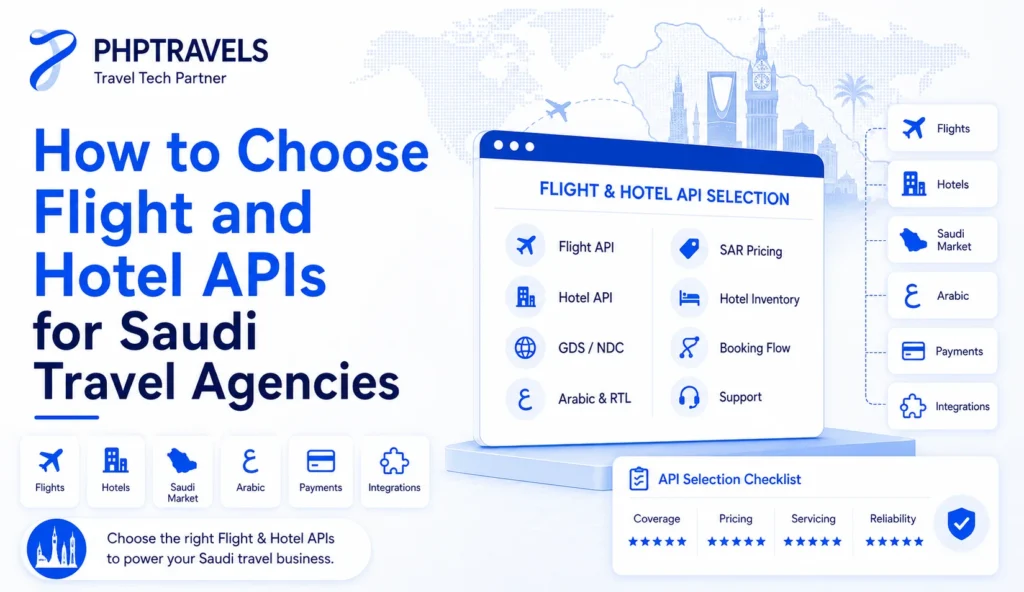
- Prioritize bookable inventory, price revalidation, ticketing or confirmation, cancellations, refunds, Arabic and RTL support, SAR pricing, settlement terms, technical support, security, and total integration cost.
- Add another supplier only when search and booking data reveals a measurable gap in routes, hotel coverage, pricing, or capacity.
How to Compare Flight and Hotel APIs for Saudi Travel Agencies
| Selection Area | What the Agency Should Verify |
|---|---|
| Inventory | Frequently requested Saudi and international routes, hotels and room types |
| Price accuracy | Revalidation before payment and clear tax, baggage and cancellation details |
| Booking workflow | Confirmation, ticketing, timeout recovery and duplicate-booking prevention |
| Post-booking | Voids, cancellations, refunds, exchanges and schedule changes |
| Saudi localization | Arabic, RTL, SAR, invoices, vouchers and local payment workflows |
| Commercial model | Deposits, prepaid wallets, commissions, settlement and support ownership |
| Reliability | Uptime, rate limits, error clarity, logs and production support |
| Security | Permissions, encryption, audit logs, retention and data-processing responsibilities |
Why Does the Saudi Market Require a Specific API Strategy?
Saudi agencies may sell domestic business travel, international leisure trips, inbound tourism, B2B inventory, corporate travel, and Umrah packages.
One supplier may perform well for international flights but offer weak domestic content. Another may have broad hotel coverage but limited inventory near Makkah and Madinah during high-demand periods.
Start with real booking demand, not a provider’s sales presentation. Review your last six to twelve months of inquiries and identify:
- Your most frequently searched routes
- Your highest-value hotel destinations
- Your main customer groups
- Common cancellation and refund requests
- The languages and currencies customers use
- The suppliers your team already understands
What Type of Flight API Should a Saudi Travel Agency Choose?
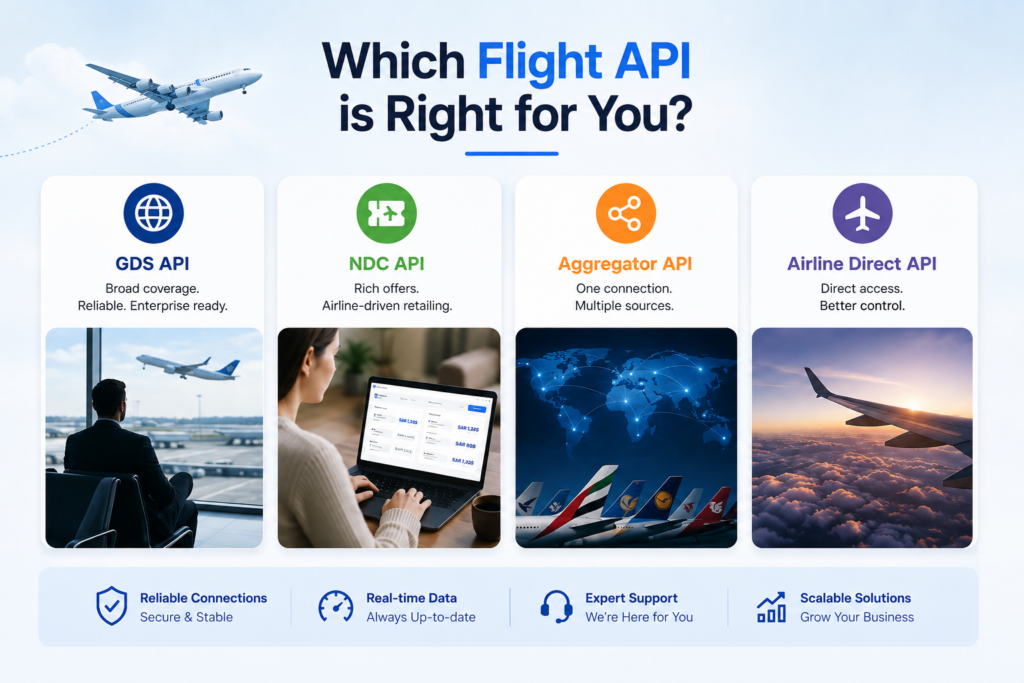
Most agencies choose between a GDS connection, an NDC connection, an airline-direct API, or a flight aggregator.
Each option has advantages and limitations.
When Is a GDS Flight API Suitable?
A GDS is usually suitable for an established travel agency that needs broad airline coverage and mature reservation, ticketing, queue, PNR, exchange, and refund workflows. It is particularly relevant for corporate travel businesses or agencies with trained ticketing staff.
GDS connections can fit established agencies and corporate travel companies with trained ticketing staff.
Access may involve supplier contracts, credentials, technical certification, deposits, productivity requirements, or accreditation. The exact requirements depend on the provider, agency, and market.
When Is an NDC Flight API Suitable?
An NDC connection is suitable when an agency wants richer airline offers, branded fares, baggage, seats, meals, and other airline services. However, the connection should only be selected after verifying its post-booking capabilities, because servicing support varies between airlines and implementations.
Depending on the airline and connection, NDC may provide branded fares, baggage, seats, meals, and other airline services.
NDC should not be treated as a complete replacement for every GDS workflow. Its content and servicing capabilities vary by airline, aggregator, and implementation.
Ask whether the connection supports exchanges, cancellations, refunds, schedule changes, and disrupted bookings—not only flight shopping and initial booking.
When Is a Flight Aggregator Suitable?
A flight aggregator is often the fastest starting option for a new agency because one integration can provide access to several airline, GDS, or NDC sources. It reduces initial development work, but the agency must clearly understand who owns, tickets, services, and refunds each booking.
Before selecting an aggregator, confirm:
- Who owns the booking
- Who issues the ticket
- Who manages schedule changes
- Who processes refunds
- Who supports the customer when a booking fails
These responsibilities should be clear before the API goes live.
What Should You Check in a Flight API?
A useful flight API must support more than a search box.
Check whether it can:
- Search one-way, round-trip, and multi-city flights.
- Display baggage, fare rules, fare families, and optional services.
- Revalidate the fare before payment.
- Create a booking without duplicate transactions.
- Issue tickets and retrieve their status after a timeout.
- Process voids, cancellations, refunds, and exchanges.
- Handle airline schedule changes and notifications.
- Log supplier requests and responses for technical support.
A low fare is not valuable if it disappears at checkout or cannot be serviced after booking.
Agencies that need a complete technical overview can also review the PHPTRAVELS flight module features and travel API integration.
What Type of Hotel API Should a Saudi Travel Agency Choose?
Hotel inventory may come from bedbanks, wholesalers, GDS hotel content, online travel partners, channel managers, or direct hotel contracts.
The right source depends on where customers stay, what properties they request, and how the agency earns its margin.
When Is a Hotel Bedbank API Suitable?
A bedbank or wholesale hotel API can provide broad hotel inventory, net rates, cancellation policies, and instant confirmation.
It often suits agencies that sell international hotels or provide hotel inventory to B2B sub-agents.
However, coverage alone is not enough.
Different suppliers may list the same property with different room names, meal plans, cancellation terms, taxes, and occupancy rules. Your booking platform needs room mapping and duplicate handling so customers do not see several confusing versions of the same hotel.
When Are Direct Hotel Contracts Suitable?
Direct contracts can be valuable when your agency has strong booking volume in a destination or close relationships with selected hotels.
They may offer better control over:
- Contracted rates
- Room allotments
- Payment terms
- Group inventory
- Package pricing
- Seasonal promotions
The disadvantage is additional operational work. Your team may need to maintain rates, stop-sales, minimum stays, blackout dates, and special offers.
Many agencies use APIs for global inventory and direct contracts for strategic local properties.
What Matters for Makkah and Madinah Hotel Inventory?
For pilgrimage-focused agencies, general hotel coverage is not enough.
Check property depth near important areas, room occupancy rules, group allocations, meal plans, transfer coordination, cancellation windows, and inventory behavior during peak travel periods.
The hotel API should connect with the agency’s Umrah workflow instead of forcing staff to manage pilgrims, rooms, transfers, payments, and documents in separate systems.
The PHPTRAVELS Umrah booking software connects package creation, pilgrim information, visa-related workflows, hotel allocation, transfers, and group management.
Which API Features Matter Most in Saudi Arabia?
Does the API Support Arabic and Right-to-Left Layouts?
A supplier may return most of its content in English. Your booking platform should still support Arabic labels, right-to-left pages, customer communication, and clear presentation of supplier policies.
Check how hotel names, room descriptions, fare rules, invoices, vouchers, and cancellation conditions appear in Arabic and English.
Unreviewed machine translation can create misunderstandings about fares, rooms, refunds, and customer responsibilities.
Can the System Price and Report in Saudi Riyal?
Customers should see clear pricing in Saudi Riyal.
The platform should also manage:
- Supplier currencies
- Exchange rates
- Agency markups
- Agent commissions
- Service fees
- Currency rounding rules
The system should recalculate or revalidate the final amount before payment. Currency movements or supplier price changes can otherwise create a gap between the displayed selling price and the agency’s actual cost.
Does It Support Saudi Tax and Invoicing Workflows?
An API supplies inventory, but the booking platform must turn that information into accurate customer documents and accounting records.
Saudi tax guidance states that simplified tax invoices must contain required information, be issued in Arabic, and show the total price including VAT.
Ask whether the platform can separately record:
- Supplier cost
- Agency markup
- Service fees
- Taxes
- Customer payments
- Supplier payments
- Cancellations
- Refunds
Confirm the exact tax treatment with a qualified Saudi tax adviser because it can vary according to the transaction, supplier relationship, and business structure.
How Should Customer Data Be Protected?
Travel bookings may contain names, contact details, identification information, passport data, and payment-related records.
Saudi Arabia’s Personal Data Protection Law protects personal data and defines obligations for organizations that control and process it.
Evaluate the provider’s:
- Data encryption
- Role-based permissions
- Audit logs
- Data-retention controls
- Backup procedures
- Security incident process
- Cross-border data handling
- Subprocessor arrangements
Confirm which customer information the supplier stores, where it is stored, and whether other companies receive it.
This is a technology checklist and should not replace professional legal advice.
How Should Agencies Compare API Pricing?
Do not compare providers using setup cost alone.
Calculate the total cost of ownership, including:
- Integration and platform fees
- Monthly or annual charges
- Per-search, per-booking, or per-ticket costs
- Deposits, guarantees, or prepaid wallets
- Minimum sales or productivity commitments
- Currency conversion expenses
- Payment processing charges
- Certification and testing costs
- Technical support fees
- Custom change fees
- Staff time for reconciliation and servicing
A cheaper API can become expensive if it creates failed bookings, manual support work, poor conversion rates, or weak margins.
How Should You Test an API Before Launch?
Build a test plan from real customer behavior. Include both successful bookings and failed or changed bookings.
For flights, test popular Saudi routes, baggage options, child and infant passengers, duplicate requests, failed payments, ticketing delays, cancellations, and schedule changes.
For hotels, test different occupancies, child ages, meal plans, taxes, nonrefundable rates, sold-out rooms, price changes, cancellation deadlines, duplicate properties, and failed confirmations.
Track:
- Search response time
- Price accuracy
- Booking success rate
- Confirmation time
- Error clarity
- Post-booking reliability
- Manual work required
A fast search response means little if the final booking confirmation regularly fails.
Should a Startup Use One API or Multiple APIs?
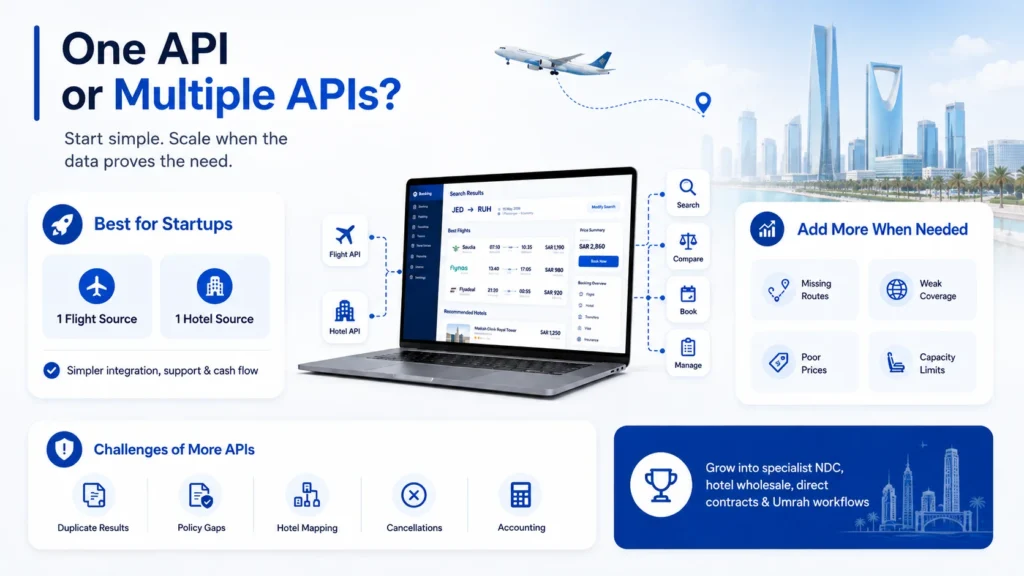
A startup should normally begin with one reliable flight API and one reliable hotel API. This keeps development, supplier support, reconciliation, staff training, wallet management, and post-booking operations manageable.
Add a second supplier only when real search and booking reports show a specific problem, such as missing routes, weak Makkah or Madinah hotel inventory, poor price competitiveness, frequent sold-out results, or supplier capacity limits.
Multiple APIs can expand inventory, but they also introduce duplicate results, inconsistent policies, hotel-mapping conflicts, different cancellation processes, more complicated accounting, and additional support relationships.
A growing agency may eventually combine a primary flight source, a specialist NDC connection, a global hotel wholesaler, direct hotel contracts for high-volume destinations, and a dedicated Umrah workflow. Each additional source should solve a measured business problem rather than simply increase the number of integrations.
More APIs can improve inventory coverage, but they also create:
- Duplicate search results
- Inconsistent policies
- Hotel mapping problems
- Different cancellation processes
- More complex accounting
- Additional supplier support relationships
A growing agency may combine one main flight source, a specialist NDC source, a global hotel wholesaler, direct contracts for high-volume Saudi destinations, and a dedicated Umrah package workflow.
How Can PHPTRAVELS Support Flight and Hotel API Integration?
PHPTRAVELS provides flight and hotel modules, B2C and B2B workflows, supplier connectivity, markups, multi-currency pricing, booking records, invoices, vouchers, and post-booking controls.
Its integrations directory lists flight and hotel connections such as Amadeus, Travelport, Duffel, TBO, PKfare, Hotelbeds, Stuba, and Agoda. Supplier access still depends on each provider’s contract, credentials, approval, and commercial terms.
Saudi agencies can review the travel agency software for Saudi Arabia page for Arabic, right-to-left, SAR, B2B, B2C, supplier, and pilgrimage-related workflows.
The goal is not to connect the highest number of APIs. It is to create a stable booking operation that customers and staff can trust.
What Is the Final API Selection Checklist?
Before selecting an API, confirm that it:
- Covers the routes, airlines, hotels, and destinations customers request
- Returns bookable prices and supports price revalidation
- Handles booking, cancellation, refund, and change workflows
- Fits your accreditation, settlement, deposit, and booking volume
- Works with Arabic, RTL, SAR, and your pricing rules
- Supports secure data handling and clear access controls
- Produces useful logs, reports, invoices, and reconciliation records
- Provides realistic testing and responsive production support
- Fits the total budget, not only the initial integration fee
The best API is the one that produces reliable bookings, manageable operations, and sustainable margins for your agency.