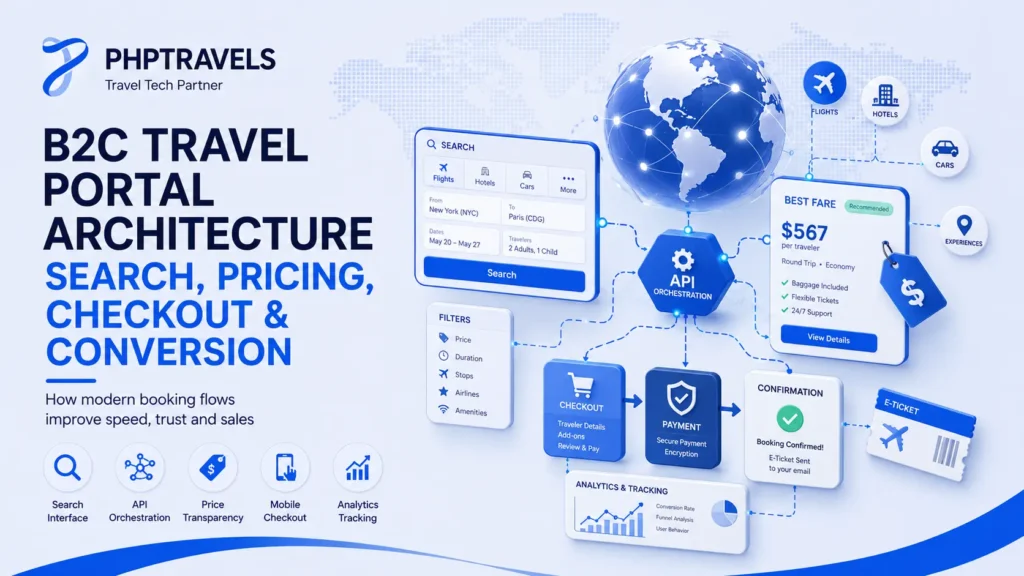
A B2C travel portal is more than a website displaying flights and hotels. It is a connected system that searches inventory, calculates prices, confirms availability, collects payment, issues documents, and records the booking journey.
Each technical layer affects conversion. Slow search, unclear fees, or weak payment recovery can lose an otherwise qualified customer. This guide explains the complete flow from search to voucher.
What Is B2C Travel Portal Architecture?
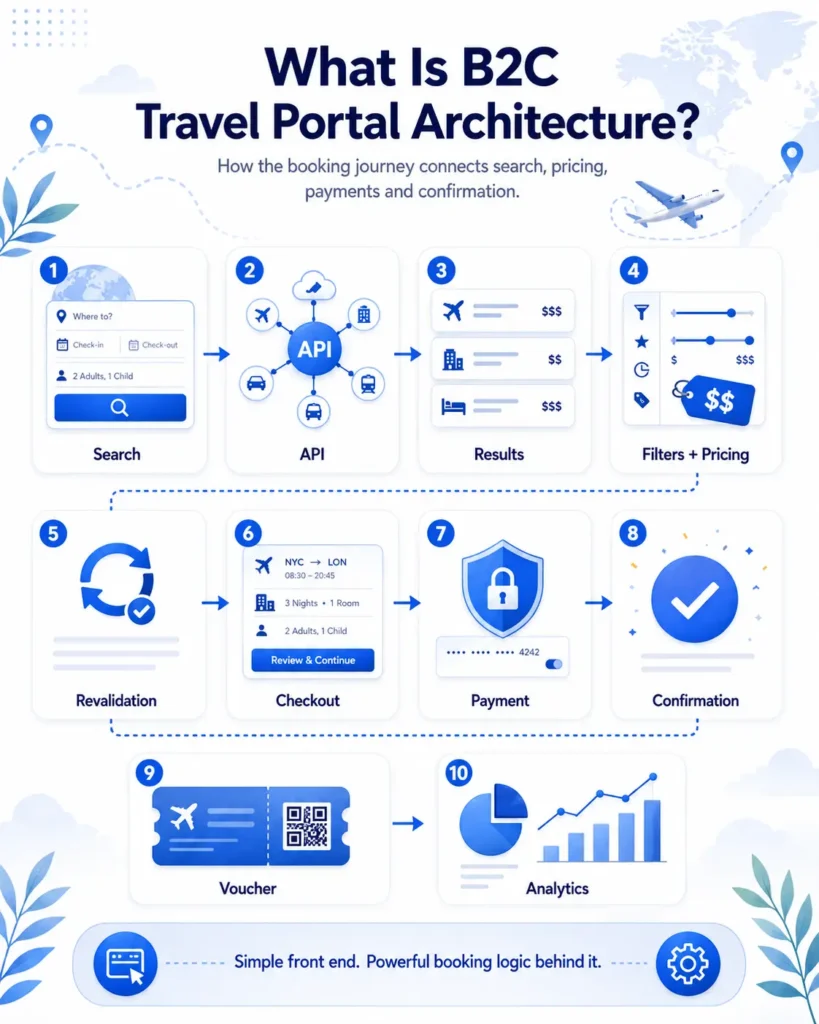
B2C travel portal architecture is the structure that connects the customer-facing booking experience with supplier APIs, pricing rules, payments, confirmations, back-office tools, and analytics.
A practical flow looks like this:
Search interface → API orchestration → normalized results → filters and pricing → rate revalidation → checkout → payment → supplier confirmation → voucher → analytics and follow-up
Each layer has a clear job. The front end should remain simple for the traveler, while the system handles supplier differences, pricing rules, errors, and booking states in the background.
PHPTRAVELS brings search, availability, pricing, checkout, vouchers, and admin booking records into one operational workflow through its B2C booking software.
How Should the Search Interface Be Designed?
The search interface should ask only for information required to return useful results.
For flights, this usually includes origin, destination, travel dates, trip type, passenger count, and cabin class. For hotels, it includes destination, check-in and check-out dates, rooms, and guests.
Keep the form easy to scan. Use clear labels, sensible default values, date validation, airport or destination suggestions, and helpful error messages. On mobile, use large fields and controls that can be completed with one hand.
When appropriate, remember recent searches so returning users do not repeat the same route, destination, or guest details. The goal is to move the traveler to relevant results quickly and confidently.
What Happens After a Traveler Clicks Search?
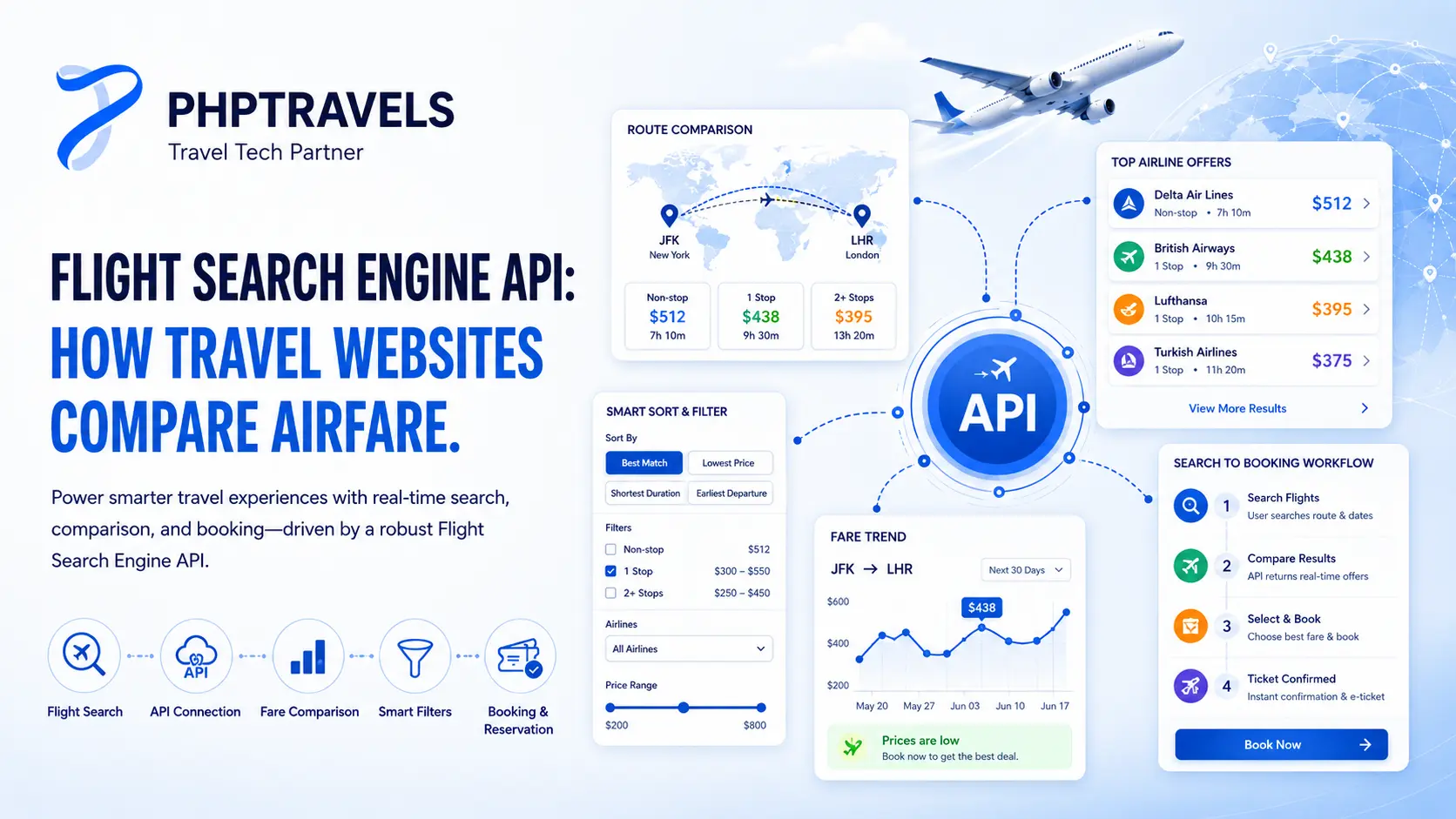
The portal sends a structured request to one or more inventory sources. These may include GDS connections, NDC providers, hotel suppliers, bed banks, direct contracts, or other travel APIs.
The API orchestration layer decides which suppliers to call, applies timeouts, handles authentication, retries temporary failures, and prevents one slow source from blocking all results.
Supplier responses rarely use the same format. One source may return taxes separately, another may include them in the total, and another may use different codes for the same cabin, room, or cancellation rule. The portal must normalize this data before showing it to the customer.
A well-built travel API integration separates supplier connectivity from booking rules. PHPTRAVELS describes a flow that includes real-time pricing, revalidation, retries, monitoring, and revalidate-before-book logic.
How Do Filters and Sorting Improve Conversion?
Filters help travelers reduce a large result set to a manageable shortlist. Sorting helps them decide which option to review first.
Useful flight filters include price, stops, airline, departure time, arrival time, airport, baggage, and refundable fare options. Hotel filters may include price range, star rating, location, guest rating, meal plan, property type, amenities, and cancellation policy.
The default sort should match the likely intent. “Recommended” can combine price, duration, quality, and popularity, but the logic should be understandable. Travelers should also be able to sort by lowest price, shortest duration, highest rating, or closest location.
Show active filters, make them easy to remove, and update the result count. On mobile, use a fast panel that preserves the traveler’s position.
Why Is Price Transparency Part of the Architecture?
Price transparency means the customer can understand what the displayed amount includes before reaching the final payment step.
The pricing layer may combine the supplier rate, markup, taxes, service fees, discounts, currency conversion, and optional extras. These calculations should follow one consistent order so the same booking does not show conflicting totals on different screens.
Show mandatory charges early. Clearly label optional items such as baggage, meals, transfers, insurance, or room upgrades. When a fee depends on the payment method or market, explain it before the customer enters card details.
A price breakdown should answer three questions:
- What is the base amount?
- What additional charges apply?
- What is the final amount payable now?
Transparent pricing builds trust and reduces support requests, disputes, and checkout exits.
Why Must the Portal Revalidate the Rate?
Travel prices and availability can change between search and payment. Rate revalidation checks the selected option again before the system takes the customer’s money or submits the booking.
For flights, the portal may recheck fare availability, booking class, taxes, baggage conditions, and ticketing limits. The PHPTRAVELS flight booking software specifically describes rechecking fares before payment as part of the booking flow.
For hotels, the system should confirm the room, board basis, occupancy, cancellation terms, taxes, and final rate.
When nothing has changed, checkout continues. When the price changes, the portal should show the old and new totals, explain the update briefly, and ask the traveler to accept it. When the option is unavailable, return suitable alternatives without forcing a completely new search.
This layer protects the customer from paying for an expired offer and protects the business from confirming a booking at the wrong margin.
What Makes Mobile Checkout Convert Better?
Mobile checkout should be short, stable, and easy to resume.
Use a single-column layout, large touch targets, appropriate keyboard types, automatic formatting, and as few fields as possible. Keep the booking summary visible without overwhelming the screen. Show progress with simple steps such as Travelers, Payment, and Confirmation.
After a validation error, preserve the form, highlight the exact field, and explain the correction plainly.
The checkout should load quickly on mobile networks and avoid unnecessary scripts. Payment authentication, including redirects or verification screens, should return the traveler to the correct booking state rather than starting the process again.
For additional implementation guidance, Google’s guide to payment and address form best practices explains how autofill, mobile-friendly input fields, clear validation, and reliable page performance can reduce checkout friction. These practices are especially useful for travel portals, where customers may need to enter details for several passengers before completing payment.
Travel businesses that need a dedicated customer experience across devices can also explore PHPTRAVELS’ mobile travel applications.
Should the Portal Allow Guest Booking or Require Registration?
For most B2C portals, guest checkout should be available because forced registration adds friction at the highest-intent stage.
A guest should be able to complete the booking with an email address, phone number, traveler details, and payment information. After confirmation, the portal can offer account creation using the data already provided.
Registered booking still has value. An account can store traveler profiles, invoices, loyalty points, preferences, saved searches, and upcoming trips. It also makes changes and repeat bookings easier.
The architecture should support both paths within the same booking and service process, with equal pricing accuracy, security, vouchers, and support.
How Should Payment Failures Be Handled?
A payment failure should not automatically become a lost booking.
The system should identify whether the failure came from invalid details, authentication, insufficient funds, gateway downtime, a network interruption, or a technical error. The customer message should be useful but should not expose sensitive gateway or security data.
When supplier rules allow, hold the selection briefly. Let the traveler retry, choose another method, or return from authentication. Idempotent requests should prevent duplicate charges or reservations.
Payment status and booking status must remain separate. A payment may succeed while the supplier confirmation is still pending, or the supplier request may fail after authorization. These cases need controlled reversal, refund, or manual review workflows.
A dedicated travel payment gateway integration should connect payment responses with booking, refund, and reconciliation states.
How Can Abandoned Bookings Be Recovered?
Abandoned booking recovery starts by saving progress at the right points.
With permission, the portal can save the selected itinerary, contact information, booking value, and checkout stage. It can then send a reminder by email or another approved channel with a secure link back to the saved booking.
The recovery message should reflect the real booking state. Do not promise that a fare or room is still available. Revalidate the rate when the traveler returns and explain any change before payment.
Segment recovery by cause. A results-page exit needs a different message from a failed payment. High-value bookings may justify personal follow-up; other journeys can use automated reminders.
Track recovered revenue, not only reminder clicks, to judge whether the workflow is useful.
What Should Happen After Payment?
After payment, the portal should show a clear booking status and reference number immediately.
The confirmation layer must distinguish between confirmed, pending, ticketing in progress, failed, and cancelled states. It should not display a final confirmation when the supplier has not confirmed the service.
Once confirmed, generate the correct document: an e-ticket, hotel voucher, tour voucher, transfer confirmation, invoice, or complete itinerary. Send it by email and keep it available in the customer account or secure booking lookup page.
The core PHPTRAVELS workflow connects payment details with voucher issuance and keeps booking status, confirmation, and admin records together.
Customer communications should include support details, cancellation terms, payment summary, supplier instructions, and the traveler’s next action.
Where Should Cross-Selling Appear?
Cross-selling should help complete the trip, not interrupt the main booking.
Relevant offers can appear on the results page, product page, checkout, confirmation page, or post-booking messages. Examples include adding a hotel to a flight, an airport transfer to a hotel, baggage to a fare, an activity to a destination, or a room upgrade to an accommodation booking.
Use context to choose the offer. A traveler booking a short business trip may value an airport transfer, while a family booking a resort may prefer meals, activities, or a larger room.
Do not preselect paid extras. Show the full additional price and explain whether the item is refundable. The architecture should record each add-on separately while keeping it connected to one itinerary, payment view, and support history.
A portal combining flights and accommodation can connect the flight booking engine with the hotel booking engine to create relevant cross-selling opportunities.
Which Analytics Should a B2C Travel Portal Track?
Analytics should show where customers progress, hesitate, fail, and return.
Track search volume, search-to-results rate, zero-result searches, filter usage, product views, checkout starts, completed bookings, conversion rate, average booking value, payment failures, cancellations, refunds, and repeat bookings.
Also measure search response time, supplier error rate, revalidation failure rate, price-change rate, confirmation time, and booking recovery. These technical metrics often explain changes in commercial performance.
Where consent and privacy rules allow, connect bookings to channel, campaign, landing page, device, and market. Use consistent funnel-event names across the website, app, gateway, and back office.
PHPTRAVELS’ guide to travel analytics highlights search-to-booking conversion, average booking value, marketing-source performance, pending payments, and failed transactions as useful measures.
How Do the Main B2C Travel Portal Architecture Layers Compare?
Each architecture layer solves a different problem in the booking journey. The table below shows its role, the conversion risk it controls, and the recommended implementation.
| Architecture layer | Main purpose | Common conversion risk | Recommended approach |
|---|---|---|---|
| Search interface | Collects trip details and starts the booking journey | Complicated forms, unclear fields, and slow responses | Use simple fields, destination suggestions, date validation, recent searches, and a mobile-friendly layout |
| API orchestration | Connects the portal with multiple travel inventory suppliers | Slow APIs, supplier errors, duplicate results, and inconsistent responses | Apply supplier routing, timeouts, retries, response normalization, caching, and fallback rules through a reliable travel API integration |
| Filters and sorting | Helps customers reduce and organize search results | Too many irrelevant options or confusing default sorting | Offer useful filters and transparent sorting by price, duration, rating, stops, location, or recommended value |
| Price transparency | Explains the amount the customer will pay | Unexpected taxes, service fees, or add-on costs | Show mandatory charges early and provide a clear breakdown of the base rate, taxes, fees, discounts, and final total |
| Rate revalidation | Confirms the latest price and availability | Stale fares, unavailable rooms, and incorrect totals | Recheck the selected rate before payment and explain any price or availability change clearly |
| Mobile checkout | Collects traveler and payment details on smaller screens | Long forms, poor validation, slow pages, and interrupted payment flows | Use a single-column checkout, large controls, autofill, short forms, saved progress, and clear validation |
| Guest and registered booking | Determines whether customers must create an account | Forced registration can cause checkout abandonment | Allow guest checkout and offer optional account creation after confirmation |
| Payment processing | Authorizes and records the customer’s payment | Gateway errors, failed authentication, duplicate charges, and uncertain booking status | Use secure travel payment gateway integration, safe retries, multiple payment methods, and separate payment and booking statuses |
| Abandoned booking recovery | Brings qualified customers back to an unfinished booking | Lost revenue after checkout or payment-stage exits | Save the booking state, send consent-based reminders, revalidate the rate, and measure recovered revenue |
| Vouchers and confirmation | Gives the customer proof and instructions after booking | False confirmations, missing documents, or unclear booking status | Show a booking reference immediately and issue the correct ticket, voucher, invoice, or itinerary only after supplier confirmation |
| Cross-selling | Adds relevant services to the customer’s trip | Irrelevant offers can distract customers from completing the booking | Connect the flight booking engine and hotel booking engine to offer useful hotels, transfers, baggage, activities, or upgrades |
| Analytics and tracking | Measures technical and commercial performance | Businesses cannot identify where customers abandon or systems fail | Track search speed, filter usage, checkout starts, payment failures, confirmations, average booking value, abandonment, and recovered bookings |
How Do All Architecture Layers Work Together?
A high-converting B2C portal does not optimize search, pricing, checkout, and confirmation as separate projects. It treats them as one booking journey.
The search layer finds relevant inventory. API orchestration keeps supplier responses reliable. Normalization creates comparable results. Pricing makes the total understandable. Revalidation prevents stale bookings. Checkout collects accurate traveler and payment data. Confirmation creates trust. Recovery brings qualified customers back. Analytics shows where the next improvement is needed.
The goal is to make a complex supplier and operational system feel simple to the traveler.
Final Takeaway
The best B2C travel portal architecture is not the one with the longest feature list. It is the one that consistently moves a traveler from search to confirmed booking with clear prices, reliable availability, a mobile-friendly checkout, useful failure handling, and measurable conversion data.
Travel businesses planning this workflow can start with PHPTRAVELS’ B2C booking platform, then connect the required flight booking engine, hotel booking engine, supplier APIs, and payment gateways around one controlled booking lifecycle.