
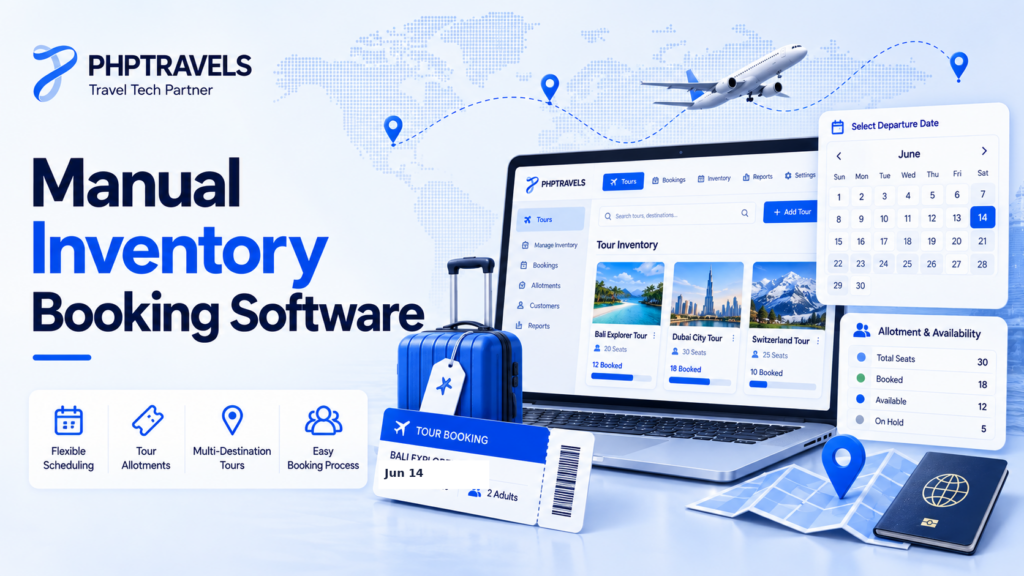
Most tour operators do not start with Amadeus credentials and a bedbank contract. Manual inventory booking software makes that starting point explicit.
They start with what they already sell: a desert safari with fixed departures, a city walking tour with a daily cap, a
week-long cultural package with hotel allotments they negotiated themselves, or a private transfer product priced in their own spreadsheet. Manual inventory booking software can replace that spreadsheet with one clear workflow.
Manual inventory booking software is the layer that turns those own products into searchable, bookable, payable items—with vouchers and reporting—without waiting months for supplier API onboarding.
This guide explains what manual inventory actually means, where WhatsApp-and-Excel ops fail, how it differs from live API inventory, what a serious stack must include, a practical rollout p
ath, and where PHPTRAVELS fits honestly as a modular booking platform (you load your products; APIs are optional later).
What Is Manual Inventory Booking Software?
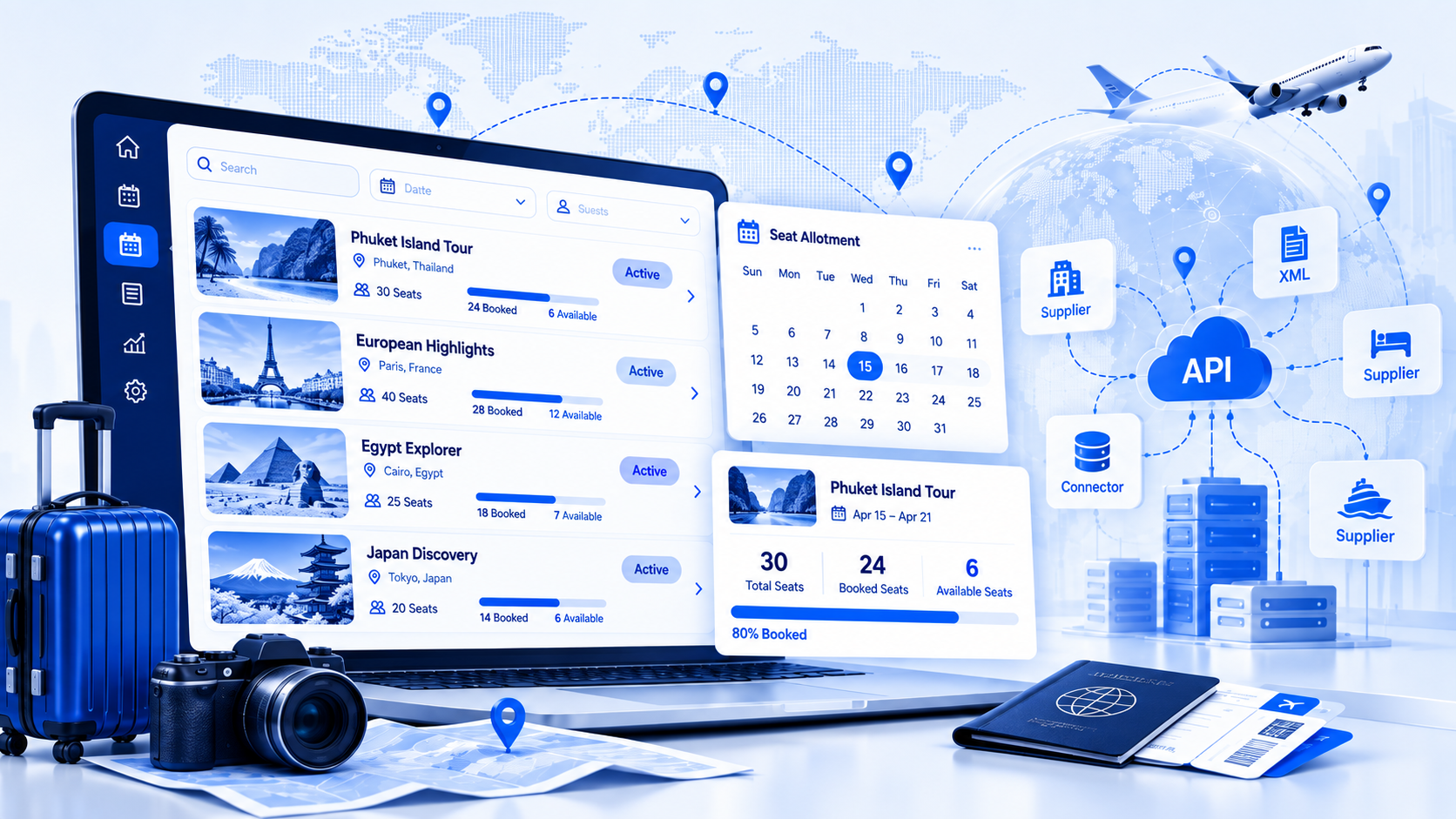
Manual inventory is not “old-fashioned software.” It is a deliberate inventory mode:
- You create the product (tour, activity, package day, transfer, stay allotment, etc.)
- You set rates, seasons, blackouts, and capacity
- You control availability calendars or allotments
- The booking engine sells against your data, not a third-party API response
That is different from API inventory, where a GDS, bedbank, or activity aggregator returns live offers from suppliers you a
re contracted to use. Both modes are valid. Many healthy operators run hybrid: own tours as manual inventory, plus hotels or flights via APIs when contracts are ready. Manual inventory booking software is the practical starting layer.
Manual inventory booking software matters when:
- Your margin and differentiation sit in your experiences, guides, and contracted allotments
- Supplier APIs are delayed, expensive, or irrelevant to what you sell today
- You need online (or B2B agent) bookings this month, not after a six-month integration project
- You must stop double-selling the Friday 07:00 desert departure that only holds 12 seats
Industry digitalization pressure on tourism SMEs is real—operators are expected to take digital bookings and issue clear documentation—but digital does not have to mean “connect every global API first.”
Starting with own-product inventory is often the fas Manual inventory booking software keeps that path measurable.. This is the fastest honest path.
Why Spreadsheets and WhatsApp Break Tour Operator Ops
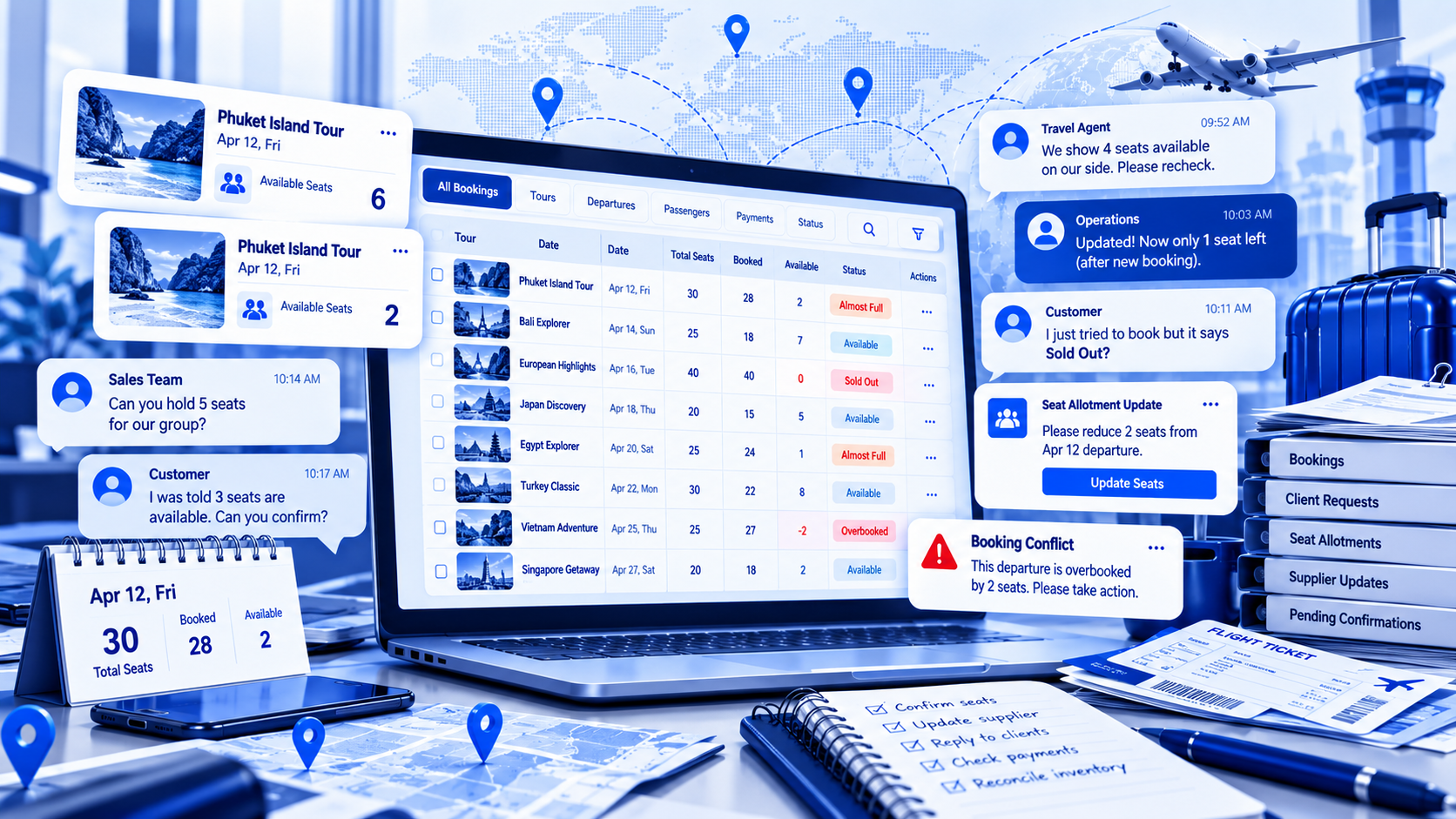
A familiar day in a mid-size DMC without booking software:
- A guest (or retail agent) asks for “Saturday desert safari, shared, two adults, hotel pickup.”
- An ops person checks a Google Sheet named
Safari_Seats_FINAL_v7. - Another sale lands on WhatsApp for the same departure while the sheet is still open.
- Pickup time is typed differently in two chats; the voucher is a blurry PDF from last season.
- Finance reconciles deposits from bank transfer screenshots at month-end.
The failure modes are predictable:
- Double-sells / overselles when capacity is not atomically reserved at booking time
- Rate drift when seasonal prices live in someone’s head or an outdated sheet
- Document chaos (no standardized voucher, weak guest details, missing pickup notes)
- No agent channel (sub-agents cannot see net rates or remaining allotment without calling you)
- No clean handoff to guides, drivers, and hotels because bookings are not structured records
Manual inventory booking software does not magically create demand. It creates a single system of record for products, allotments, bookings, and documents so ops stops being a group chat.
If you later add multi-currency storefronts for overseas agents, pair this with how multi-currency booking software should behave (PHPTRAVELS multi-currency article). Markup and commercial rules belong in software too (travel markup management).
Manual Inventory vs Supplier APIs vs Hybrid
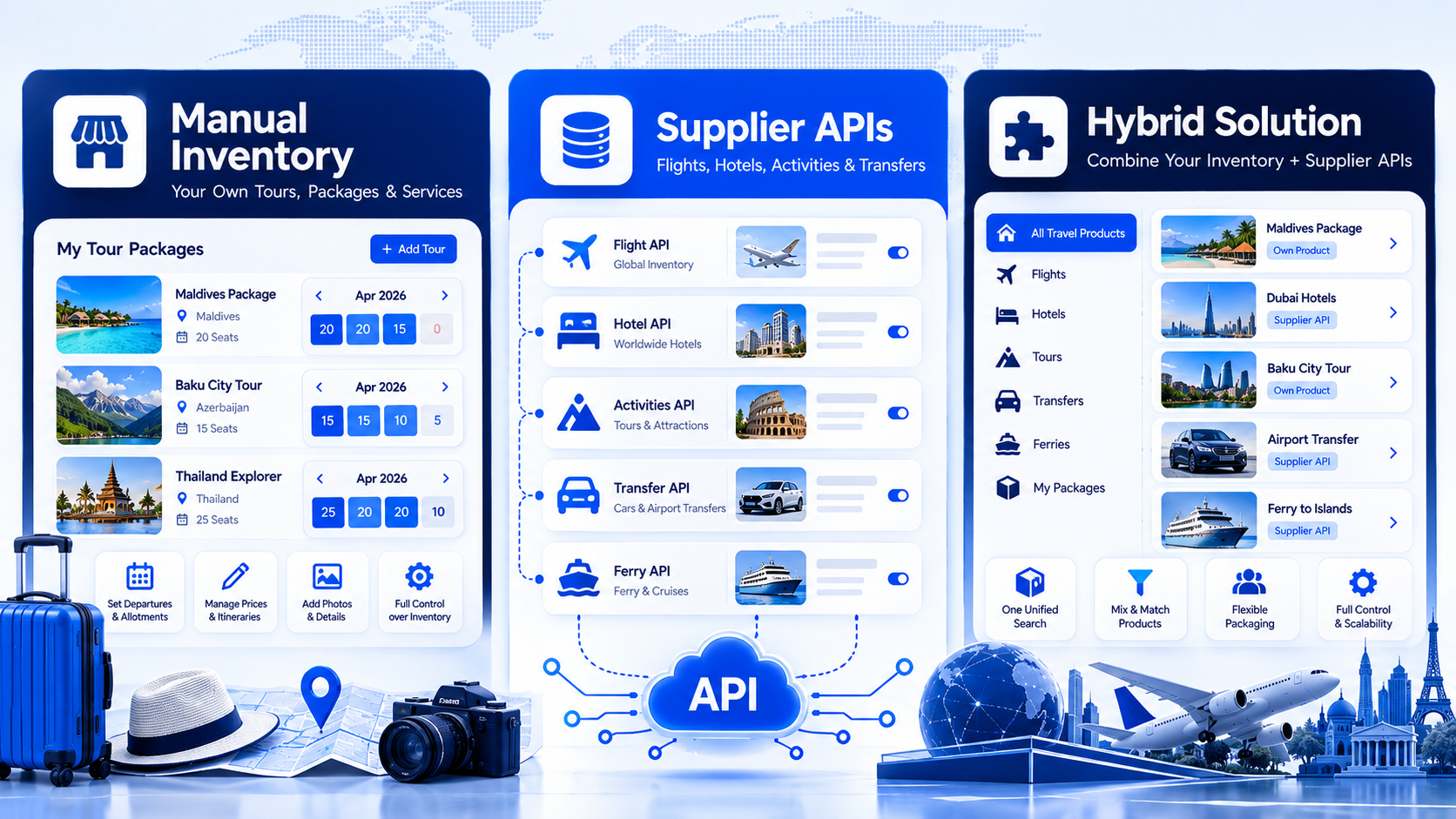
| Mode | Inventory source | Strengths | Weaknesses | Best fit |
|---|---|---|---|---|
| Manual inventory | Operator-loaded products, rates, allotments | Fast go-live; full control; fits unique tours | You own content ops and capacity discipline | Tour ops, DMCs, experience sellers, contracted allotments |
| Supplier APIs | Live offers from GDS/bedbanks/aggregators | Scale, breadth, fresher third-party stock | Needs contracts + credentials; integration time; less unique | OTAs, agencies selling global flights/hotels |
| Hybrid | Own products + selected APIs | Differentiate with own tours; fill gaps with APIs | Needs clear ops rules for which mode wins | Growing operators expanding beyond own catalogue |
A common mistake is delaying the website until “all APIs are connected.” Another mistake is promising global hotel inventory in marketing while the stack only has demo data—software connects; it does not grant inventory
. For licensed booking platforms, the buyer brings supplier contracts and API credentials when they enable API mode.
Dynamic packaging (assembling flight+hotel+tour at sell-time) is a related but different problem—see dynamic packaging software. Manual inventory is often the right first chapter for tour-led businesses; packaging and APIs come when the commercial model needs them.
What a Real Manual Inventory Stack Must Include
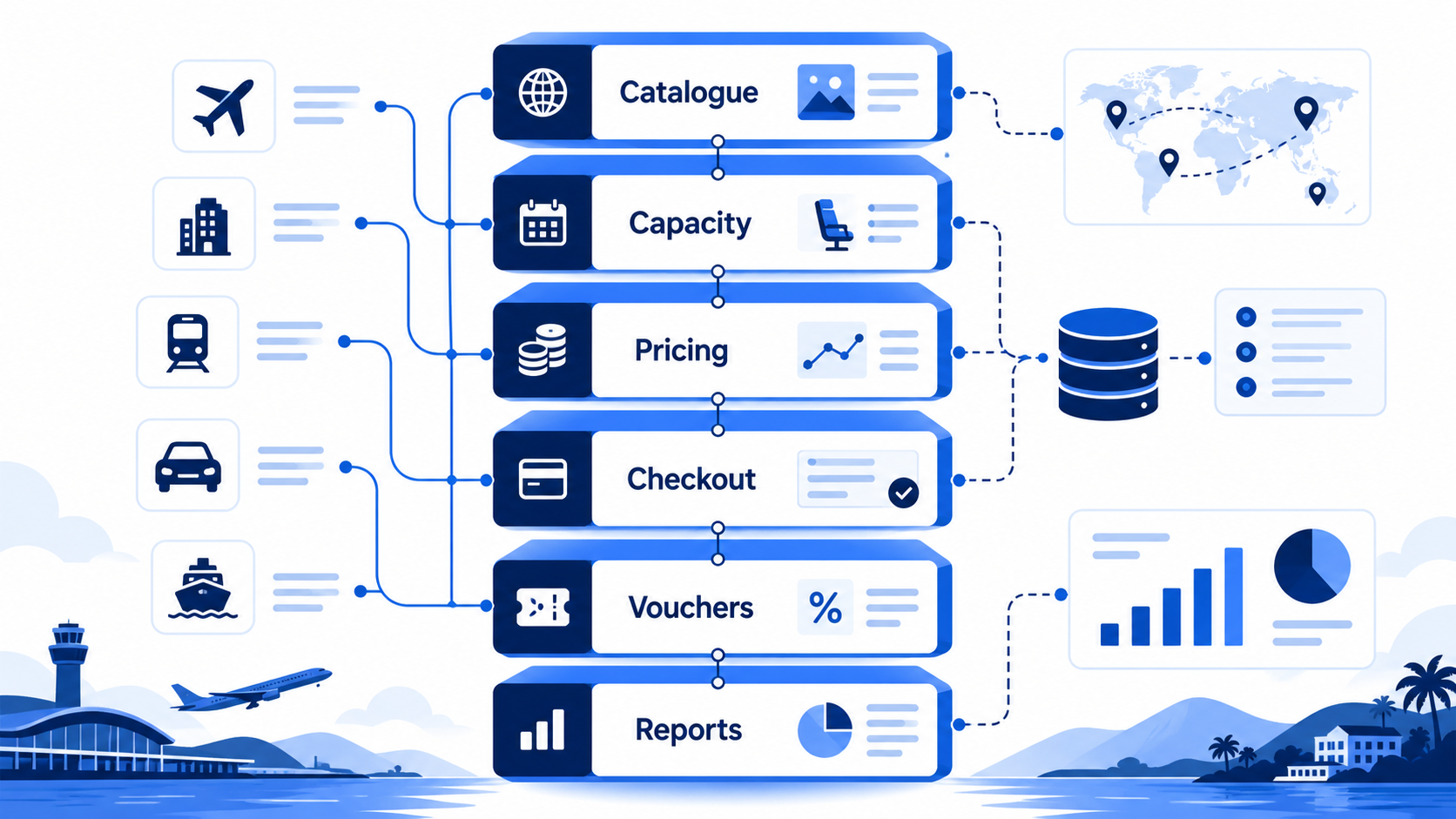
Ignore buzzwords. A usable manual inventory booking stack usually needs these layers:
1. Product catalogue you control
Tours, activities, packages, transfers, or allotment stays—with clear titles, descriptions, inclusions/exclusions, duration, meeting points, and media. If the shopper cannot understand the product, no checkout will save conversion.
2. Availability and capacity rules
Calendar departures, seat/pax caps, cut-off times, blackout dates, and per-date allotments. Soft “we’ll confirm later” inventory creates oversell risk; decide what is instant-book vs on-request.
3. Pricing that matches how you sell
Adult/child, private vs shared, seasonal rates, weekend premiums, optional add-ons (quad bike upgrade, dinner, photographer). Commercial controls should sit in the system, not in a side calculator.
4. Booking flow + payment into your accounts
Guest details, pickup info, special requests, deposit vs full payment. Money should settle to your gateway or bank pro
cess—not a platform taking a cut as merchant of record unless you explicitly chose that model. PHPTRAVELS is licensed software; the buyer uses their own payment accounts.
5. Vouchers and ops documents
Standardized vouchers for guests; pickup lists / manifests for guides and drivers; cancellation policy text that matches what you actually allow.
6. Back office and reporting
Bookings by departure, product, channel, and payment status. Without this, “software” is just a prettier WhatsApp.
7. Optional B2B agent layer
If retail agencies sell your tours, you need agent logins, net/commissioned rates or credit rules, and a portal that shows what they can sell. White-label or branded agent portals are a separate decision (white-label travel booking software).
A Practical 30-Day Rollout for Tour Operators
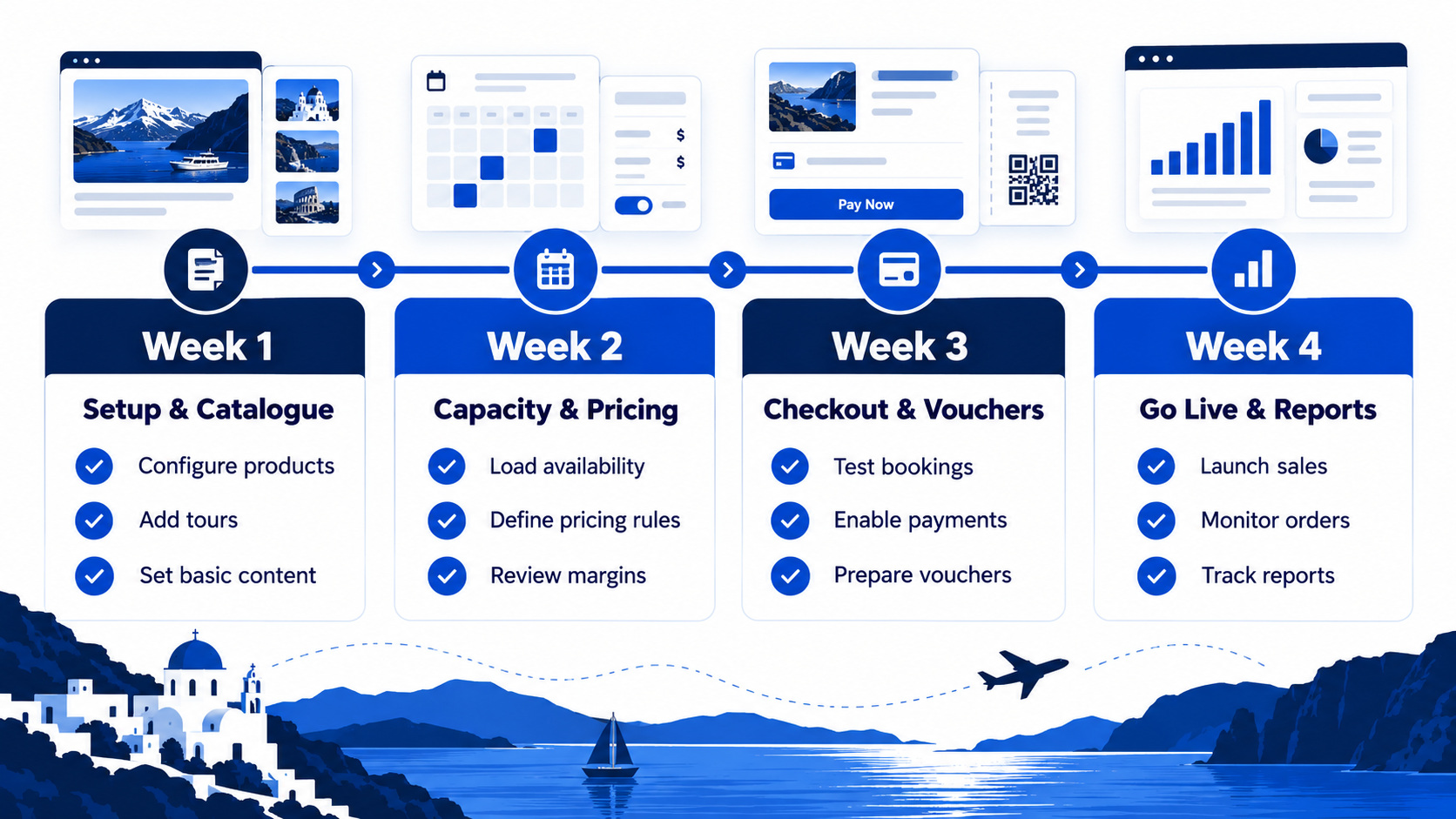
You do not need a six-month transformation program to stop the spreadsheet bleeding.
Week 1 — Product truth
– Pick 5–15 SKUs that actually sell (not the entire brochure)
– Write inclusions/exclusions once; kill contradictory PDFs
– Define capacity and cut-offs per departure
Week 2 — Load and price
– Enter products into the booking software’s manual inventory
– Set seasons and child policies
– Configure payment methods you already have (cards, bank transfer, pay-later rules if you use them)
Week 3 — Test like a hostile customer
– Book, amend, cancel (where allowed)
– Generate vouchers; check pickup fields
– If you use agents: create one test agency login and verify net rates / visibility
Week 4 — Go live thin, then expand
– Put the best sellers online first
– Train ops on the back office as the only seat map
– Add the next product batch only after week-1 SKUs run clean for 7 days
Go-live checklist (print this):
– [ ] Capacity cannot be oversold for capped departures
– [ ] Voucher template matches brand and policy
– [ ] Finance can reconcile payments to bookings
– [ ] Someone owns content updates (rates/blackouts)
– [ ] API integrations are a phase 2 backlog, not a go-live blocker
Where PHPTRAVELS Fits (Honest Product Fit)
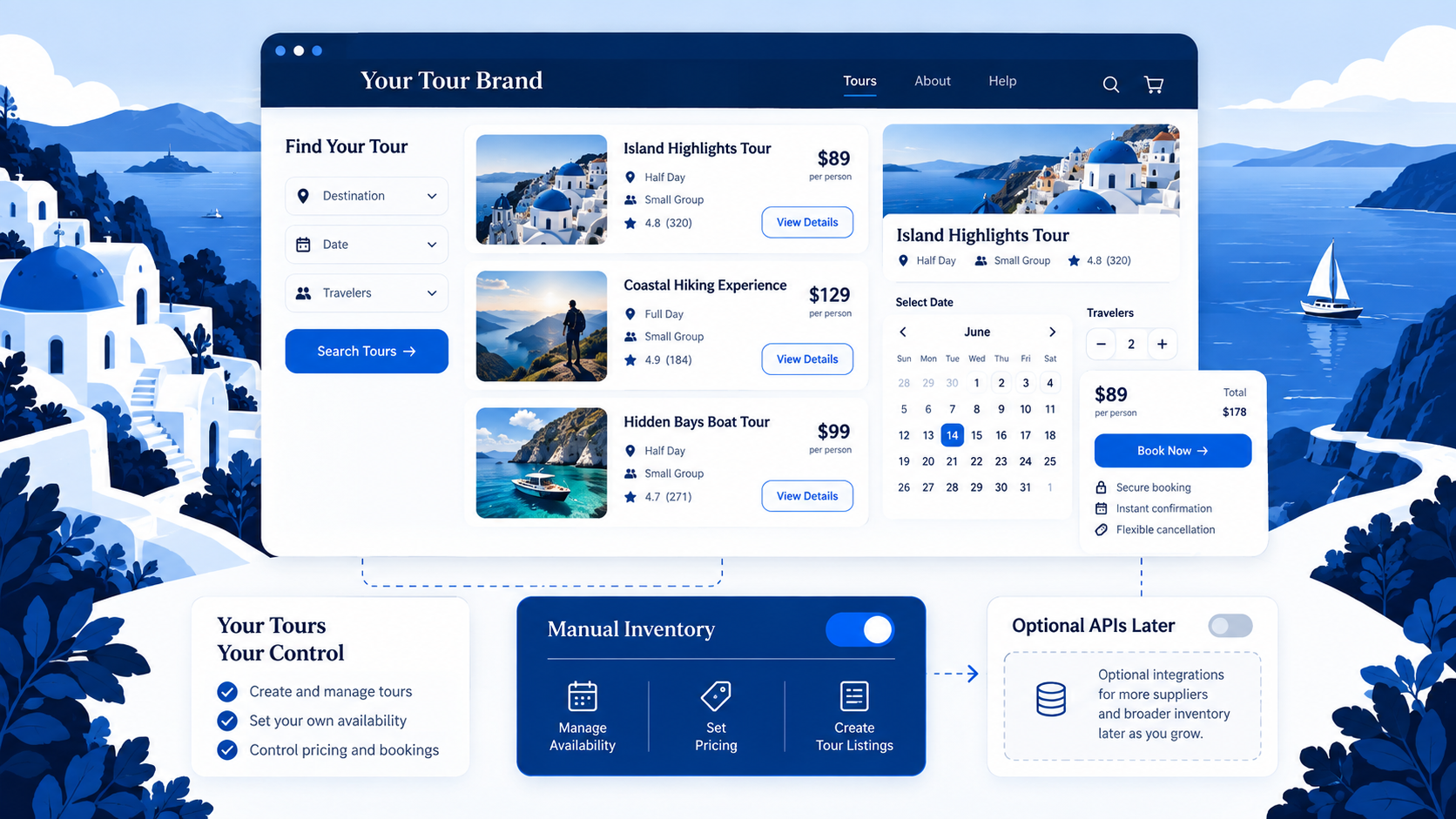
PHPTRAVELS is travel booking software for agencies, tour operators, OTAs, and DMCs. Relevant truths for this topic:
- Booking modules (including Tours and others) can run on manual inventory—the operator loads their own products, rates, and availability instead of connecting a supplier API first. That is how many tour operators start.
- You can enable modules independently and later connect supplier APIs when you have contracts and credentials. The software connects; it does not ship free global inventory.
- Business models include B2C, B2B, or both—useful if retail agents sell your tours through an agent portal.
- Payments go through your gateway accounts (for example Stripe, PayPal, and others listed on the live integrations/pricing pages—verify current options before buying).
- It is a licensed product (self-hosted / managed options), not a sign-up SaaS that takes a cut of bookings.
What we will not claim: that PHPTRAVELS is only for manual inventory, that it replaces your need for ops discipline, or that any named supplier is “included” without your own contract.
Next steps if this matches your problem:
– See a working demo: phptravels.com/demo
– Configure modules and estimate building blocks: phptravels.com/pricing
– Browse live supplier/payment options: phptravels.com/integrations
If your roadmap includes assembling flight+hotel+tour offers later, read the dynamic packaging software guide next. If overseas agents need priced storefronts in their currency, keep the multi-currency article handy.
FAQ: Manual Inventory Booking Software

Is manual inventory only for small operators?
No. Large DMCs still run own-product inventory for signature tours and contracted allotments. Size does not force API-first.
Can I add hotels and flights later?
Yes—when you have supplier contracts and API credentials, many platforms let you enable API-connected modules alongside manual products. Do not market inventory you cannot legally sell.
Do I need a B2B portal on day one?
Only if agencies already sell for you (or will immediately). Many operators launch B2C first, then open agent logins.
Will software stop no-shows and WhatsApp bargains?
It reduces accidental oversells and document chaos. Commercial policy (deposits, cut-offs, agent discipline) is still your job.
Is PHPTRAVELS open-source / MIT with free inventory?
No. Treat it as commercial licensed booking software with source access depending on plan. Inventory and payment accounts remain yours. Confirm current licensing language on the live site before purchase.
Manual inventory booking software is the practical on-ramp for tour operators who already know what they sell. Load the products that make your margin, sell them with real capacity controls
, issue clean vouchers—then add APIs when the business case is ready. If you want to see that workflow on a modular platform, start at the demo or pricing configurator.
Related reading: dynamic packaging software for agencies building flight+hotel offers.
For industry distribution context, see IATA resources alongside how manual inventory booking software fits a hybrid stack.
. This manual inventory booking software workflow keeps ownership clear while you validate demand. Manual inventory booking software can then scale with your confirmed demand.
Operators can audit manual inventory booking software before adding suppliers.
Manual inventory booking software gives teams a controlled launch path. Manual inventory booking software also keeps ownership with the operator. Choose manual inventory booking software when speed and control matter. Manual inventory booking software is the controlled starting point.