Agencies that grow past a handful of bookings a day eventually hit the same wall: the booking tool that felt easy at launch starts shaping the business. Per-booking fees stack up. Custom workflows stay on a roadmap forever. Exporting customer and order history for a migration feels like negotiating with a landlord.
Self-hosted travel booking software is the alternative model: you run a licensed booking platform on infrastructure you control (or that is managed for you under your licence), keep branding and merchant accounts in your name, and connect the supplier APIs you are contracted to use. This guide clarifies what “self-hosted” actually means in travel tech, when SaaS is still the right call, what a serious stack must include, and where PHPTRAVELS fits as a licensed product—without pretending inventory ships in the box.
What Self-Hosted Travel Booking Software Really Means

Self-hosted travel booking software is not a vague slogan for “we have an API.” It is a deployment and ownership model.
In a multi-tenant SaaS booking product, many agencies share one vendor-operated environment. You log into their URL (or a lightly branded subdomain), accept their release cadence, and usually pay a subscription, a booking fee, or both. Your data lives in their tenancy. Leaving means an export project.
In a self-hosted / licensed model, you receive software you install on a VPS or cloud account you control—or you pay for managed hosting while still holding a licence tied to your domain. Typical ownership boundaries when the model is honest:
- Brand and domain are yours
- Customer and booking records sit in your database
- Payment money settles to your gateway merchant accounts
- Supplier contracts and API credentials are yours; the software connects, it does not grant inventory
- Customization rights depend on the licence and plan—not on a public MIT dump unless the vendor explicitly says so
Self-hosted does not mean zero ops. Someone must patch the OS, renew certificates, monitor uptime, and schedule upgrades. Managed hosting shifts that labour; it does not change the commercial idea that you own the stack rather than rent a seat forever.
Why Agencies Push Back on Pure SaaS Booking Stacks

Picture a mid-size agency that sold successfully on a popular SaaS OTA builder for three years. Volume climbed. So did the blended cost per ticket. The team wanted a B2B agent portal with credit terms that matched how their sub-agents actually pay. The SaaS offered “coming soon,” then a paid add-on with rigid rules. Finance asked for a clean data warehouse feed; the export was rate-limited and incomplete. Marketing wanted a white-label sub-portal for a corporate client; the vendor’s branding rules blocked it.
None of that proves SaaS is “bad.” It proves product-market fit changes with scale. Common friction points agencies report when they outgrow rented booking UIs:
- Unit economics: flat SaaS fees look cheap early; per-booking or GMV cuts hurt when you are the one closing the sale
- Workflow lock-in: cancel/amend, group allotments, or hybrid manual+API inventory do not match how you operate
- Data gravity: CRM, accounting, and BI need reliable access to your orders—not a PDF dump
- Negotiation leverage: when renewals arrive, switching cost becomes the vendor’s pricing power For exit planning, treat customer and booking exports as a first-class requirement—aligned with accountability expectations in the UK ICO’s data protection principles.
Self-hosted travel booking software addresses those pains only if you (or a partner) can run infrastructure and supplier onboarding. Otherwise you trade one dependency for another.
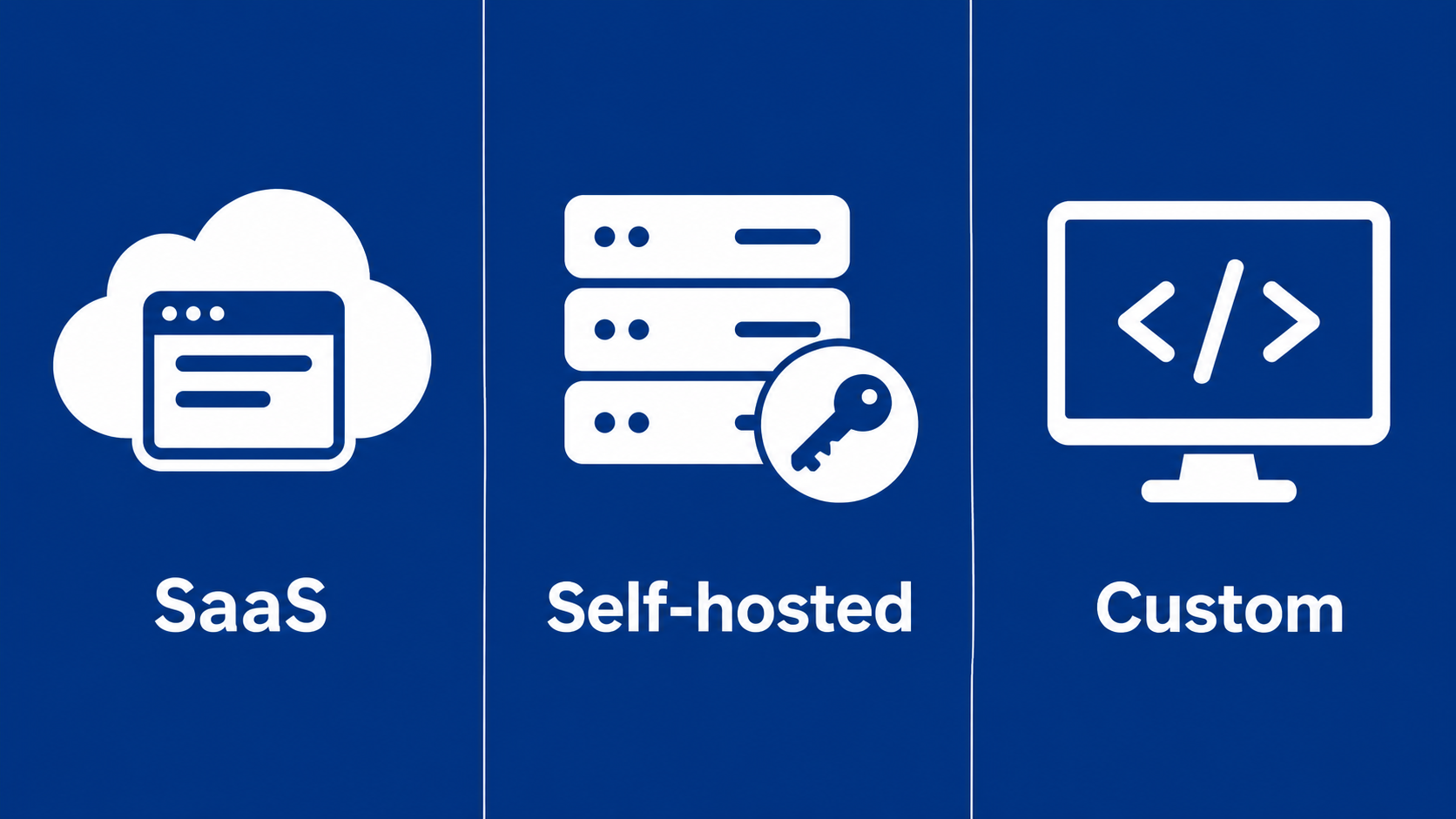
Self-Hosted vs SaaS vs Custom Build
| Model | How it works | Strengths | Weaknesses | Best fit |
|---|---|---|---|---|
| Multi-tenant SaaS | Vendor hosts shared app | Fast start, less DevOps | Lock-in, fee shape, limited customize | Validation, tiny teams, narrow use cases |
| Self-hosted / licensed | You install (or managed under your licence) | Ownership, brand control, cost shape at volume | Needs ops + supplier work | Agencies/OTAs/tour ops with contracts |
| Custom build | Hire a team to write from scratch | Exact workflows | 12–36 months, high burn, ongoing ownership | Rare; usually overkill vs licensed platform |
A useful rule: if you do not yet have supplier contracts or a payment merchant account, software ownership will not create a travel business. Fix commercial foundations first. If you already sell and feel taxied by platform fees or blocked customizations, self-hosted travel booking software (or a licensed managed deploy) belongs on the shortlist—before a greenfield engineering rewrite.
Related reading on branding layers: white-label travel booking software. On commercial rules inside the stack: travel markup management software and multi-currency travel booking software.
What a Credible Self-Hosted Stack Must Include
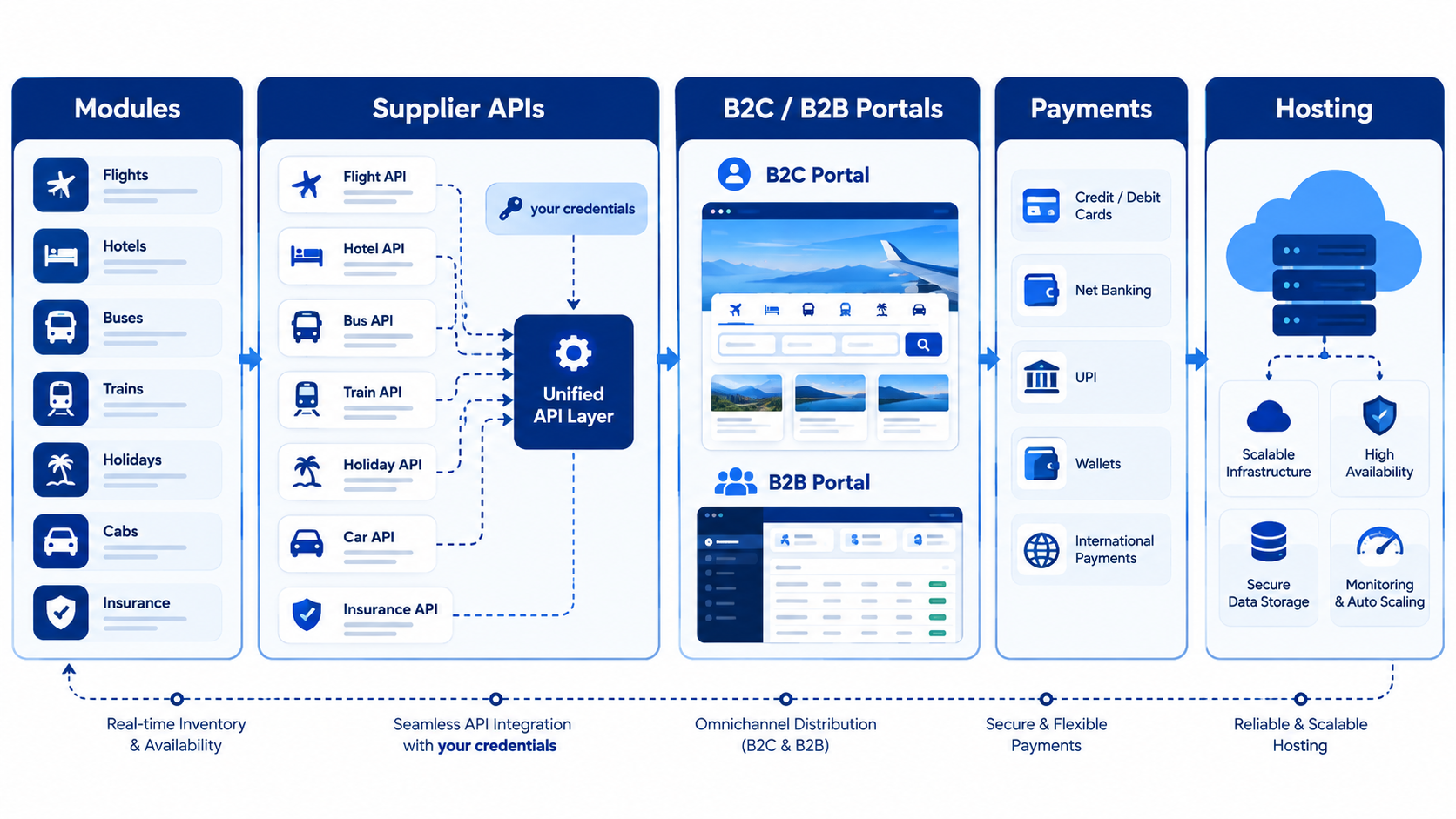
Ignore splash pages that only say “unlimited bookings.” Evaluate layers:
1. Modular inventory surfaces
Flights, stays, tours, cars, and ancillaries (where relevant) should enable independently. Tour operators often start with manual inventory for own products, then add bedbanks/GDS later (manual inventory for tour operators). Agencies assembling multi-component trips need order logic that can grow into packaging-style flows (dynamic packaging software).
2. Supplier connectivity you control
Connectors matter only if you can attach credentials you are entitled to use. Metasearch brands are not bookable GDS replacements unless a real booking API exists. Always verify the live integrations list.
3. B2C and B2B channels
Storefront for consumers; agent portal for sub-agents/wholesalers when that is your model—including markup and (where your process needs it) credit/wallet behaviour.
4. Payments on your merchant accounts
Stripe, PayPal, regional gateways, bank transfer, pay-later patterns—as your compliance and risk allow. Money should not be forced through a vendor wallet you do not control.
5. Commercial and localization controls
Markup rules, multi-currency display, multi-language content where you sell, and white-label sub-portals when partners need branded access.
6. Real hosting requirements
Self-hosted PHP/MySQL travel platforms typically need a proper VPS or cloud instance—not cheap shared hosting. Budget for backups, monitoring, and staging. Payment card scope usually shrinks when card data stays with a gateway—confirm boundaries with guidance from the PCI Security Standards Council and your provider.
7. After-sales and documents
Vouchers, booking admin, amend/cancel paths, and reporting. Ownership of the database is useless if ops still lives in WhatsApp.
A Practical Decision Checklist Before You Self-Host
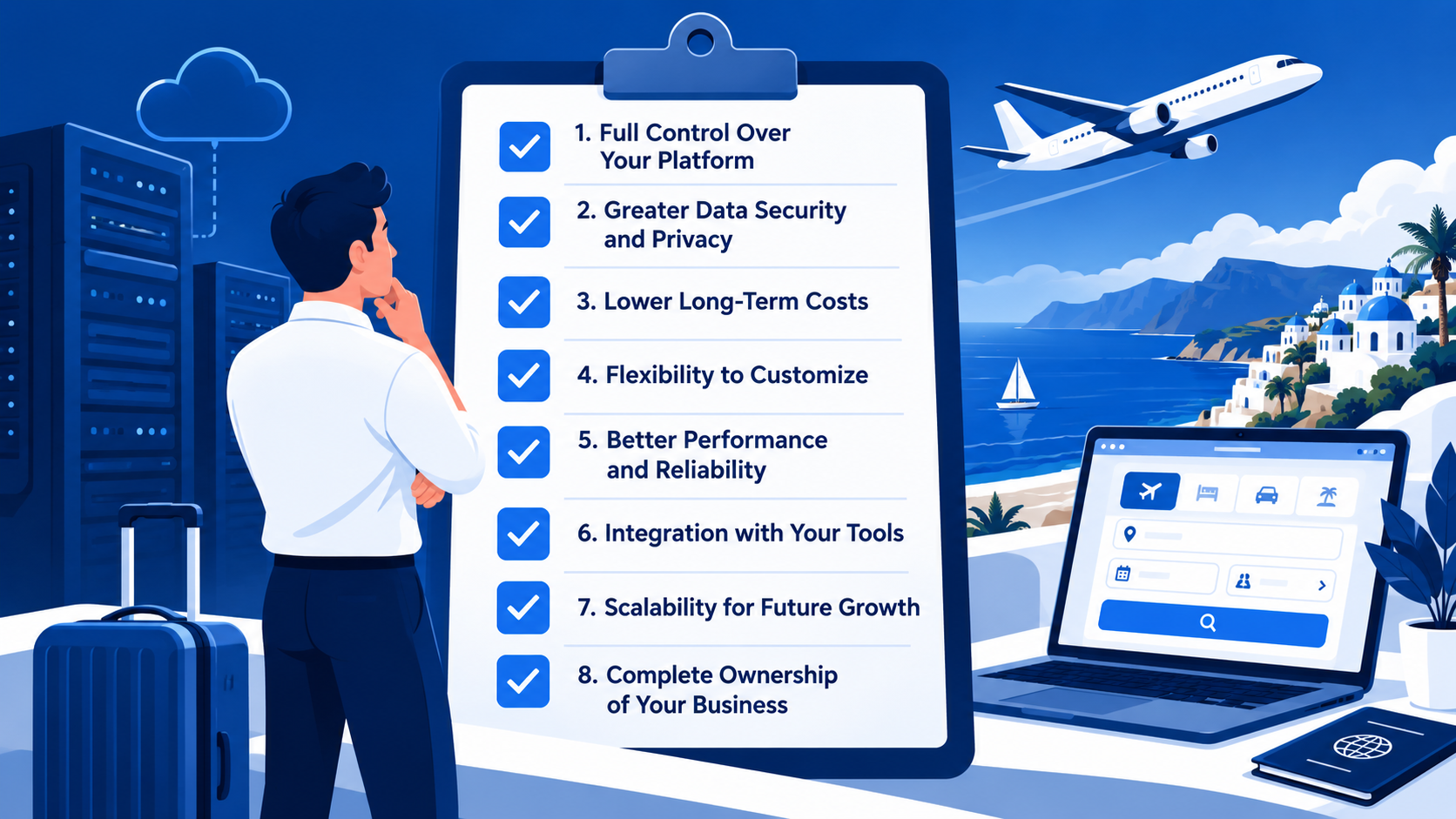
Use this before you buy any licence:
- Supplier reality: Which APIs can you credential in the next 30–60 days?
- Payment reality: Do you have (or can you get) merchant accounts for your markets?
- Ops owner: Who patches servers, handles SSL, and runs upgrades—internal or managed?
- Channel model: B2C only, B2B only, or both on day one?
- Must-have workflows: Manual tours? Flight+hotel packaging? Agent credit? List them; demo them.
- Exit test: Ask how you export bookings, customers, and content. If the answer is fuzzy, treat that as risk—even for SaaS.
- Total cost shape: Licence + hosting + supplier fees + gateway fees + people. Compare against SaaS at your projected volume—not a brochure scenario.
- Compliance boundary: PCI scope usually shrinks when card data stays with the gateway; still confirm your QSA/provider guidance.
If steps 1–3 are blank, stay on a lighter tool or a tightly scoped pilot. If steps 1–3 are solid and SaaS economics hurt, shortlist self-hosted travel booking software and pressure-test on a demo.
Where PHPTRAVELS Fits (Honest Product Fit)
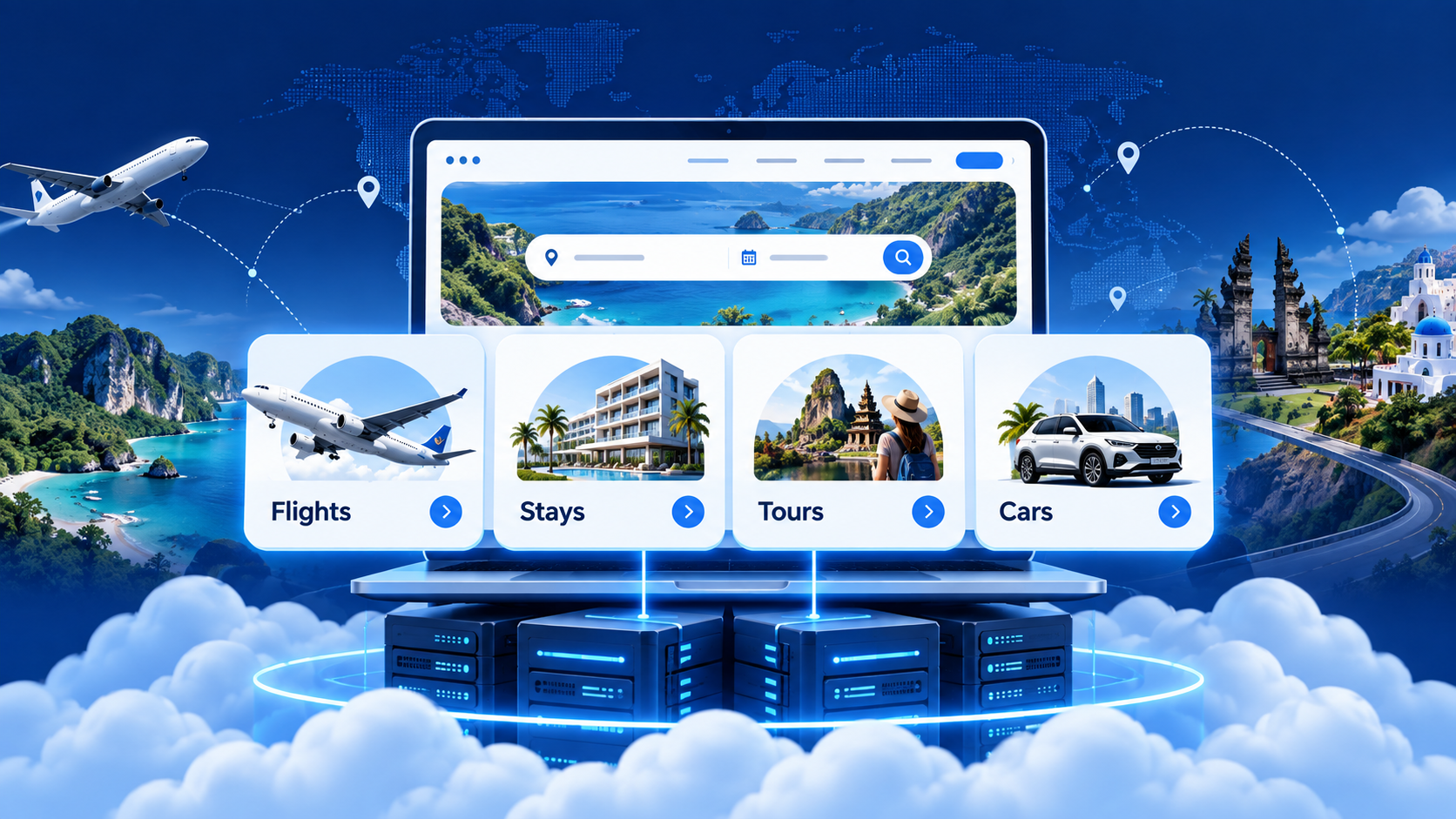
PHPTRAVELS is travel booking software sold as a licensed product for agencies, tour operators, OTAs, DMCs, and travel startups. It provides a B2C storefront, B2B agent portal, back office, supplier API connections, and payment handling under your brand. It is not a booking intermediary that takes a cut of your tickets, and it does not include free global inventory—you bring contracts and credentials.
For teams comparing self-hosted travel booking software options, the relevant product truths are:
- Self-hosted with source / commercial licence, with managed hosting and enterprise scopes available—confirm current packaging on site
- Modular modules (flights, stays, tours, cars, and others such as ferries, rail, eSIM, visa, insurance, bus, cruises—verify live)
- B2C, B2B, or both, with markup, multi-currency, multi-language, and white-label sub-portal capabilities described in the product
- Buyer-owned payment gateway accounts and customer relationship
- Installer / onboarding against a licensed domain
What this article does not claim: unrestricted public open-source / MIT licensing for every plan, a fixed public sticker price (use the live pricing configurator), or that self-hosting removes the need for supplier and ops work. Poor fit remains zero-effort SaaS seekers and single-widget use cases.
Even-handed comparison context: phptravels.com/compare.
FAQ: Self-Hosted Travel Booking Software

Is self-hosted travel booking software the same as “on-premise in our office”? Not necessarily. Most agencies self-host on a cloud VPS. The point is your tenancy and licence, not a literal rack in the back room.
Will self-hosting automatically be cheaper than SaaS? At low volume, often no. At higher volume with heavy per-booking SaaS fees, the licensed model can win—if you count hosting and people honestly.
Do I need developers on payroll? For a packaged licensed platform, many agencies run with a sysadmin/partner plus configuration—not a full product engineering team. Custom UI or exotic suppliers change that.
Does PHPTRAVELS include flights and hotels out of the box? The software can connect; inventory requires your supplier agreements and API credentials. Check integrations.
Can I start SaaS-like and move later? Possible in theory; expensive in practice if data and SEO live on a vendor domain. Prefer a path that keeps your domain and customer records from day one.
Next step
If SaaS lock-in, fee shape, or customization limits are the real pain—and you already (or will soon) hold supplier and payment credentials—book a PHPTRAVELS demo and size modules on pricing. Ask specifically about self-hosted vs managed deployment for your domain, then pilot one real O&D and one unhappy-path cancel before you commit.