A traveler hits Book. Your payment gateway shows paid. The voucher email goes out. From the customer’s point of view, the job is finished.
From your ops team’s point of view, the job just started.
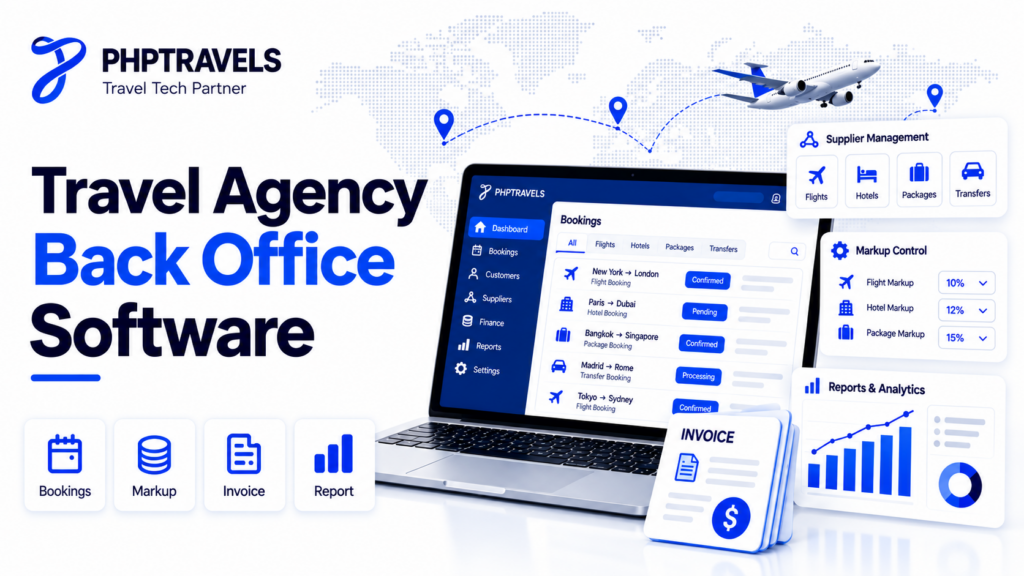
Someone still has to confirm supplier status, apply the right markup for that channel, answer an amendment request, issue a corrected invoice to a sub-agent, and explain why last month’s hotel ledger does not match the bank feed. If that work lives in WhatsApp threads and five spreadsheets, you do not have a back office — you have a backlog with formatting.
This guide explains what travel agency back office software actually covers, how it differs from mid-office tools, CRM, billing apps, and an agent portal, and how to evaluate platforms without buying enterprise TMC machinery you will never use.
Front office, mid-office, and back office — plain definitions for agencies
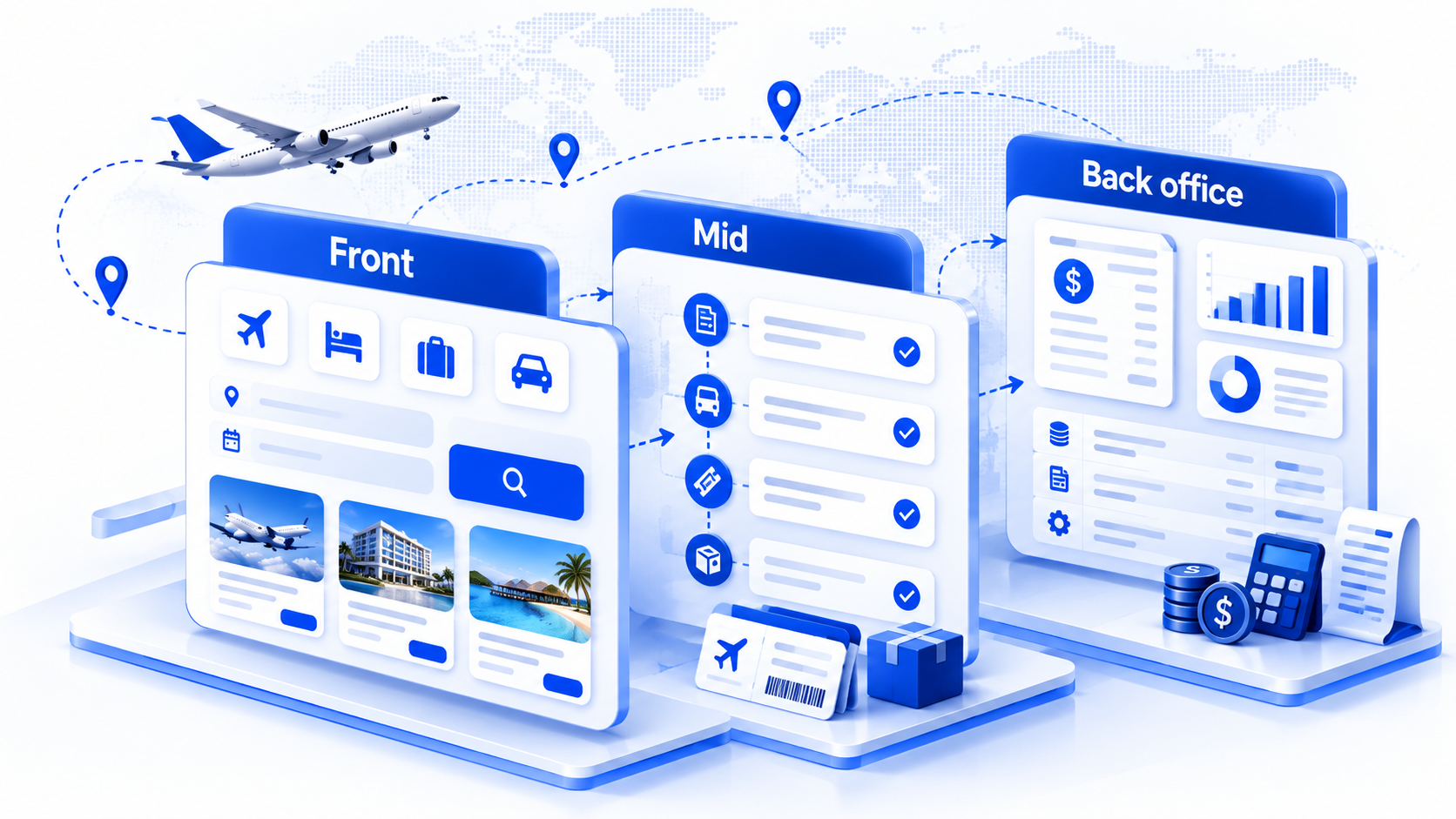
Travel teams reuse bank vocabulary, and the labels are not always consistent. A practical three-layer map still helps when you are buying software:
| Layer | What it does | Typical tools |
|---|---|---|
| Front office | Search, price display, book, pay — the customer or agent experience | OTA website, B2B agent portal, mobile apps |
| Mid-office | Post-booking fulfillment quality: ticketing, document packs, policy checks, itinerary changes | Agent desktop add-ons, GDS workflows, specialized fulfillment tools |
| Back office | The admin and finance backbone: booking records, customers/agents, suppliers, markup/commission, invoices, payments status, reporting | Booking-platform admin, accounting exports, specialized reconciliation suites |
Industry explainers (for example AltexSoft’s mid- and back-office overview) use the same split: front books, mid finishes and controls, back settles and reports. Leisure agencies and OTAs often collapse “mid” and back” into one admin console. Corporate TMCs usually keep them separate because of policy, ticketing, and IATA settlement complexity.
If a vendor’s homepage only talks about beautiful search UI, ask where the booking system of record lives after checkout. That answer is your back office.
What breaks when your “back office” is email and Excel
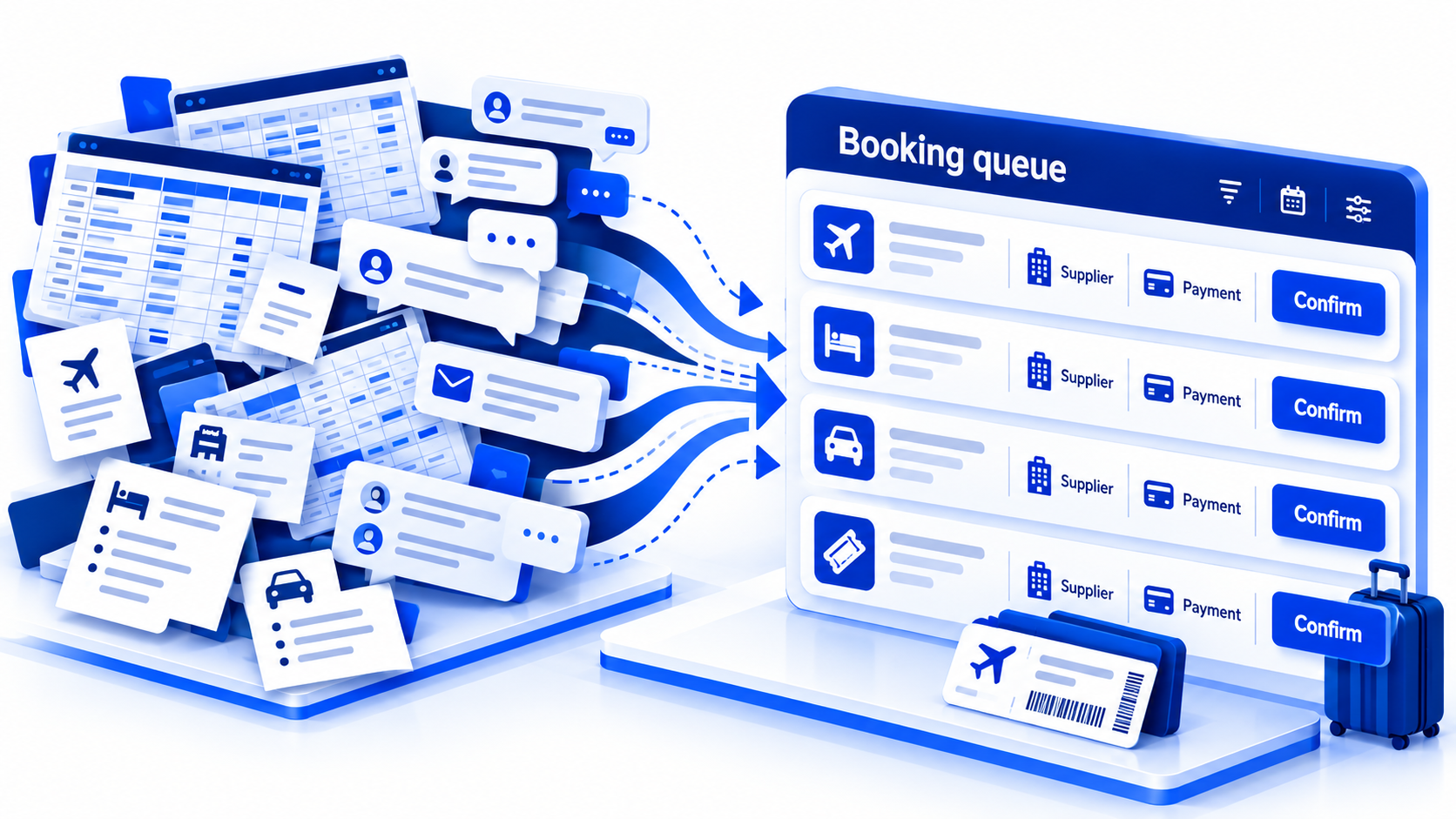
Manual ops can work at five bookings a day. It fails quietly, then suddenly, when volume or channels multiply.
Common failure modes:
- Duplicate truth — Website booking ID, supplier confirmation, and the accountant’s spreadsheet disagree on status.
- Channel pricing drift — B2C retail, B2B net, and “special favor” WhatsApp rates are applied inconsistently because rules are not attached to the booking.
- Amendment amnesia — Date changes and partial refunds exist in inboxes, not in an auditable booking history.
- Supplier fog — Nobody can say which API credential set created a reservation when a hotel no-show dispute arrives.
- Month-end archaeology — Finance reconstructs the month instead of reviewing exceptions that were flagged daily.
Back office software does not remove judgment. It gives judgment a single queue and a durable record.
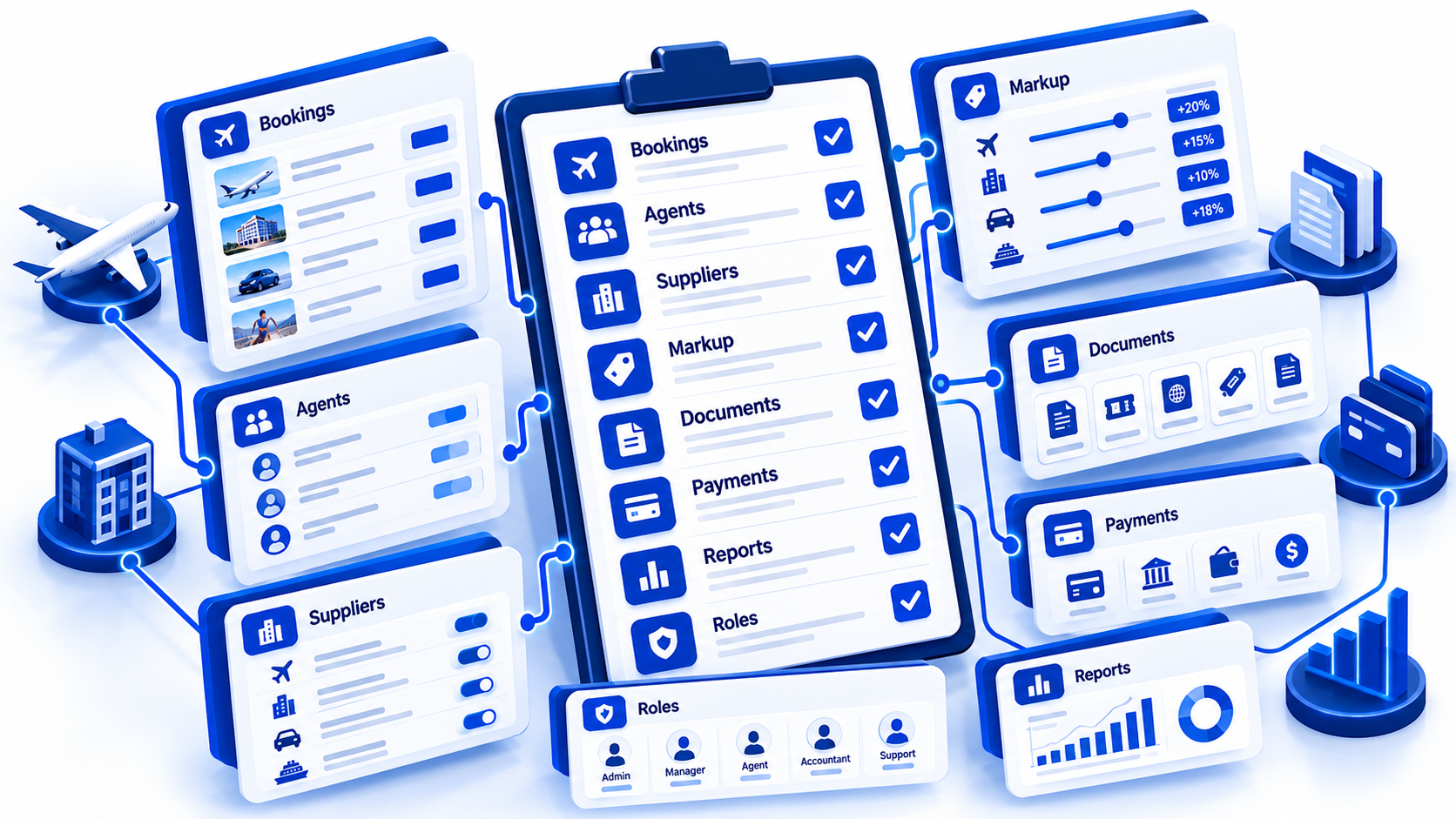
Core capabilities checklist for travel agency back office software
Use this as a buyer checklist. Score each item 0–2 in demos (missing / partial / solid).
1) Unified booking administration
Online API bookings and manual inventory (own tours, allotments, offline confirmations) should land in one admin list with filters by module, status, date, agent, and payment state. If offline bookings stay in a parallel notebook, your reports will lie. See also manual inventory for tour operators.
2) Customer and agent accounts
For B2C: traveler profiles, booking history, and support notes. For B2B: sub-agent logins, negotiated rate visibility, credit limits, and invoice cycles. A portal without credit control is a storefront with unpaid risk.
3) Supplier connections with honest ownership
The back office should show which suppliers/modules are enabled and which bookings came from which connection. Critically: you normally hold the supplier contract and API credentials. Software that implies inventory ships with the licence is selling a different product (or overselling).
4) Markup and commission rules that stick
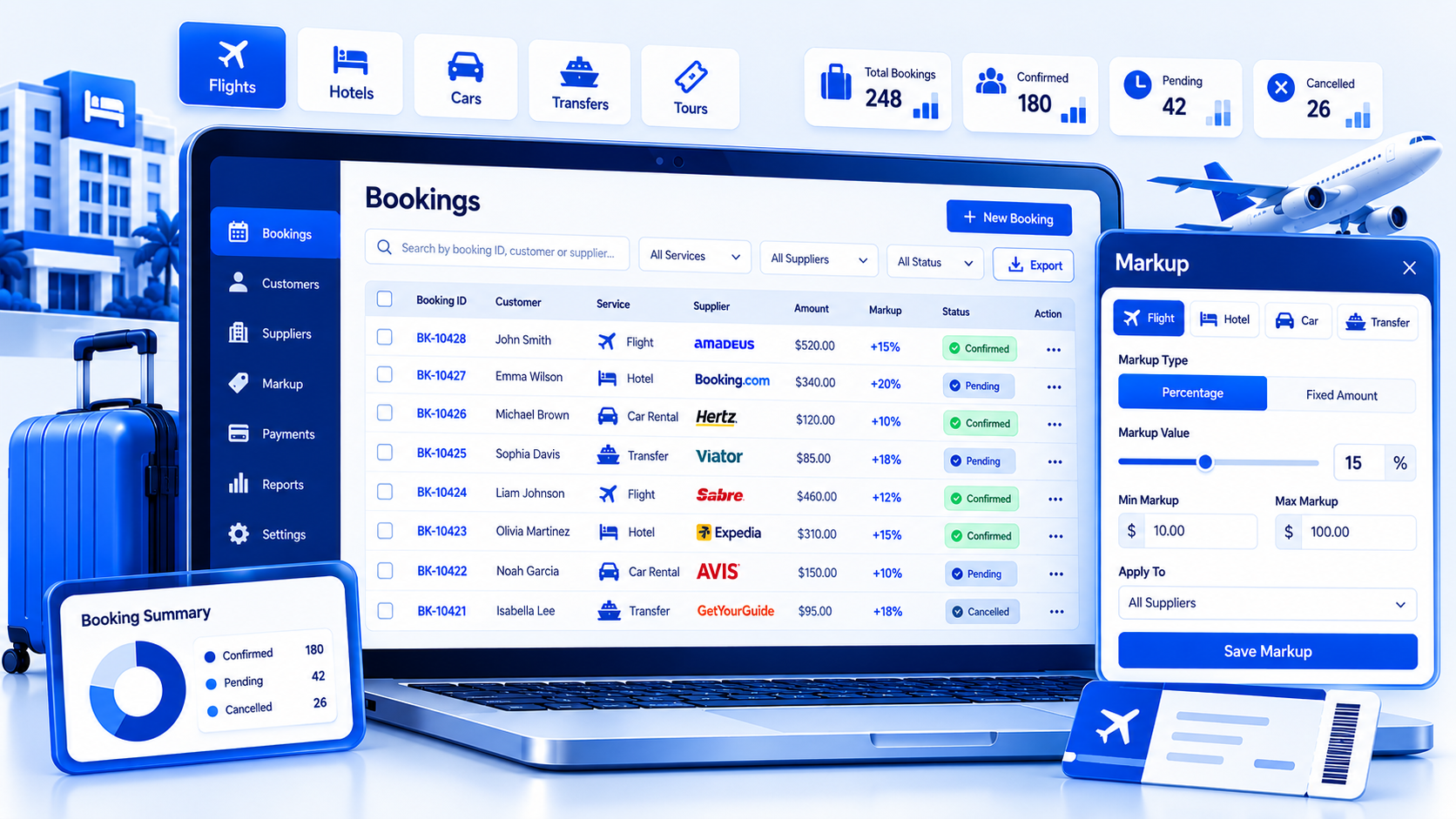
Rules should apply at booking time and remain visible afterward. Related reading on PHPTRAVELS’ blog covers commission management and markup management in more depth — those are back-office pricing controls, not the whole back office.
5) Documents people can trust
Vouchers, invoices, and receipts must match what was actually booked and paid. Mixed-language or wrong-currency documents create support load faster than a slow search UI.
6) Payment status, not just “paid”
Gateways (card/wallet), bank transfer, pay-later, and agent wallet balances create different ops paths. Staff need to see method, status, and what still needs collection — without opening the gateway dashboard for every ticket.
7) Reports ops actually open
Daily: bookings, cancellations, unpaid. Weekly: supplier mix, agent production, refund volume. Monthly: margin by module/channel. Fancy BI is optional; reliable CSV/export to accounting is not.
8) Role-based access
Front-desk staff should not edit supplier credentials. Finance should not need root admin. Branch managers need scoped views (multi-branch controls are a related, but separate, problem).
What this checklist deliberately does not require on day one
Full IATA BSP/ARC auto-reconciliation, corporate duty-of-care, or T&E platforms like Concur. Those matter for IATA-accredited, flight-heavy TMCs. Many leisure OTAs and tour operators need a solid booking back office first, then an accounting export, then specialized settlement tools only if ticket volumes justify them.
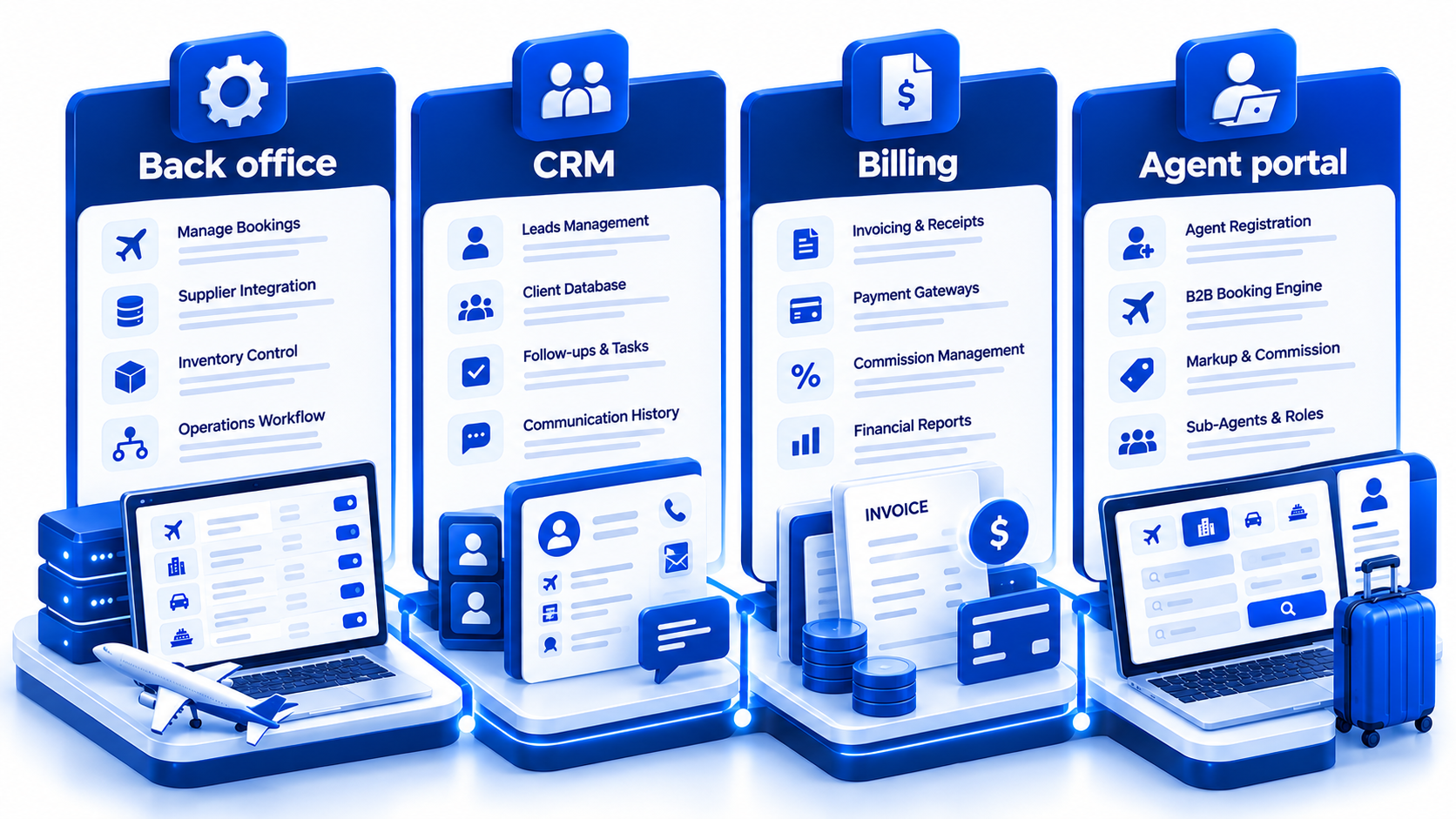
Back office vs CRM, billing, and agent portal
Buyers often shop four labels that sound interchangeable. They are not.
| Need | Job-to-be-done | Wrong buy if… |
|---|---|---|
| Back office | System of record for bookings, suppliers, markup, documents, payment status, ops reports | You only buy a CRM and hope bookings “appear” |
| CRM | Pipeline, contacts, follow-ups, retention campaigns | You expect it to reconcile supplier ledgers |
| Billing software | Invoices, collections, AR aging | You still have no booking admin queue |
| Agent portal | How sub-agents search, book, and see their rates (guide) | You ignore credit limits, invoices, and shared admin behind the portal |
Mature agencies eventually use more than one. The expensive mistake is buying a portal or a CRM when the real fire is that confirmed bookings never enter a clean admin system of record.
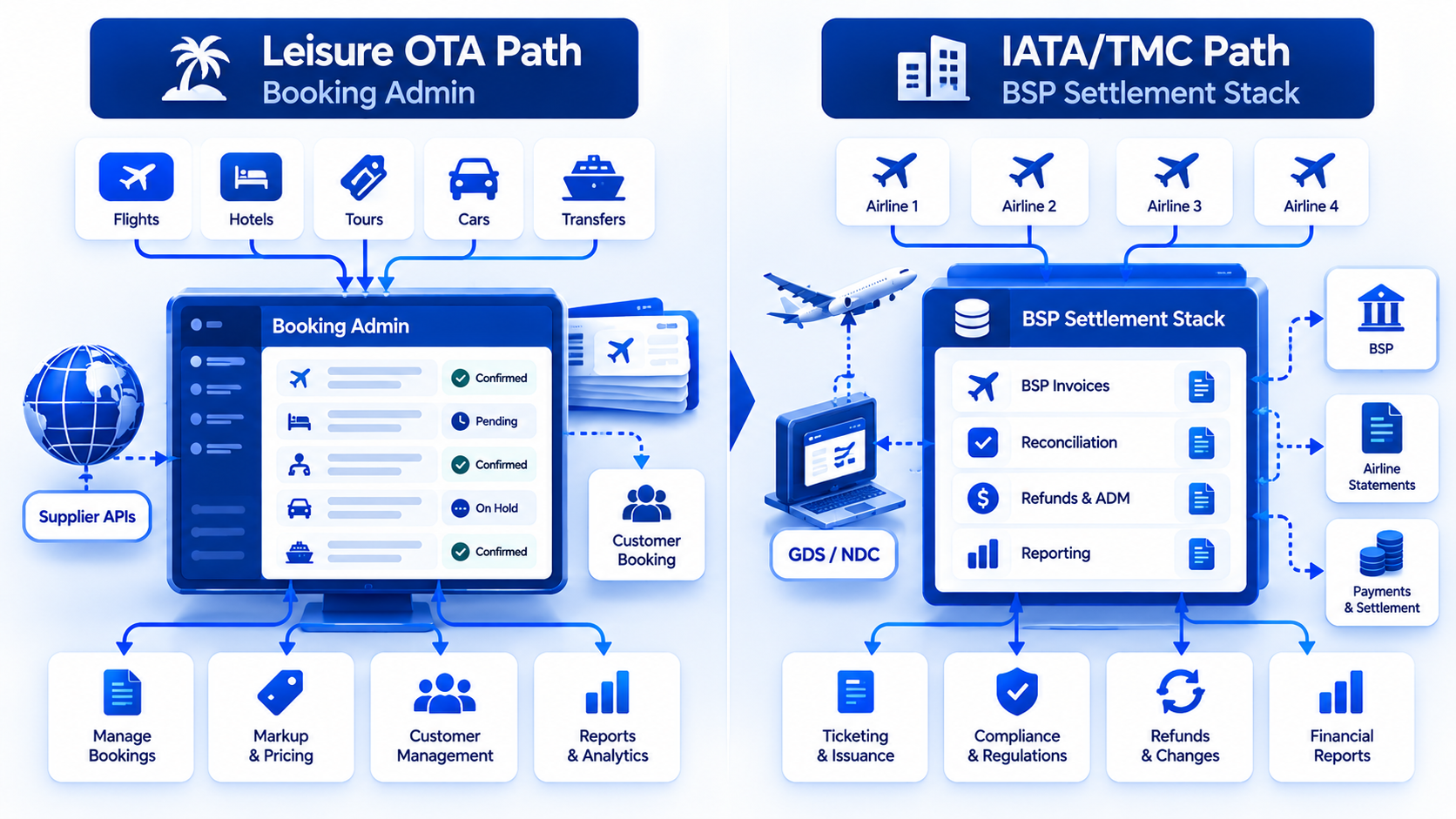
Mid-office vs back office when you need both
Buy the pain you have.
| Your situation | Likely need |
|---|---|
| Launching an OTA / agency site with hotels, tours, maybe flights via aggregators | Booking platform with strong back office admin |
| Multi-agent B2B distribution | Same + credit, net rates, agent invoices |
| High-volume IATA ticketing with BSP settlement risk | Booking stack plus specialized mid/back reconciliation tooling |
| Corporate TMC with policy & approvals | Mid-office / OBT ecosystem; booking engine alone is not enough |
IATA’s Billing and Settlement Plan (BSP) is the standardized framework that simplifies sales reporting, remittance, and settlement between airlines and IATA-accredited agents. It is a real financial backbone for accredited flight distribution — and it is not the same product as a leisure booking-platform admin. Do not assume every “back office” vendor includes BSP reconciliation; most booking platforms do not, and should say so.
A common expensive mistake is purchasing a full TMC mid-office ERP because a blog post said “back office, while the real fire is that your online bookings never enter a clean admin queue.
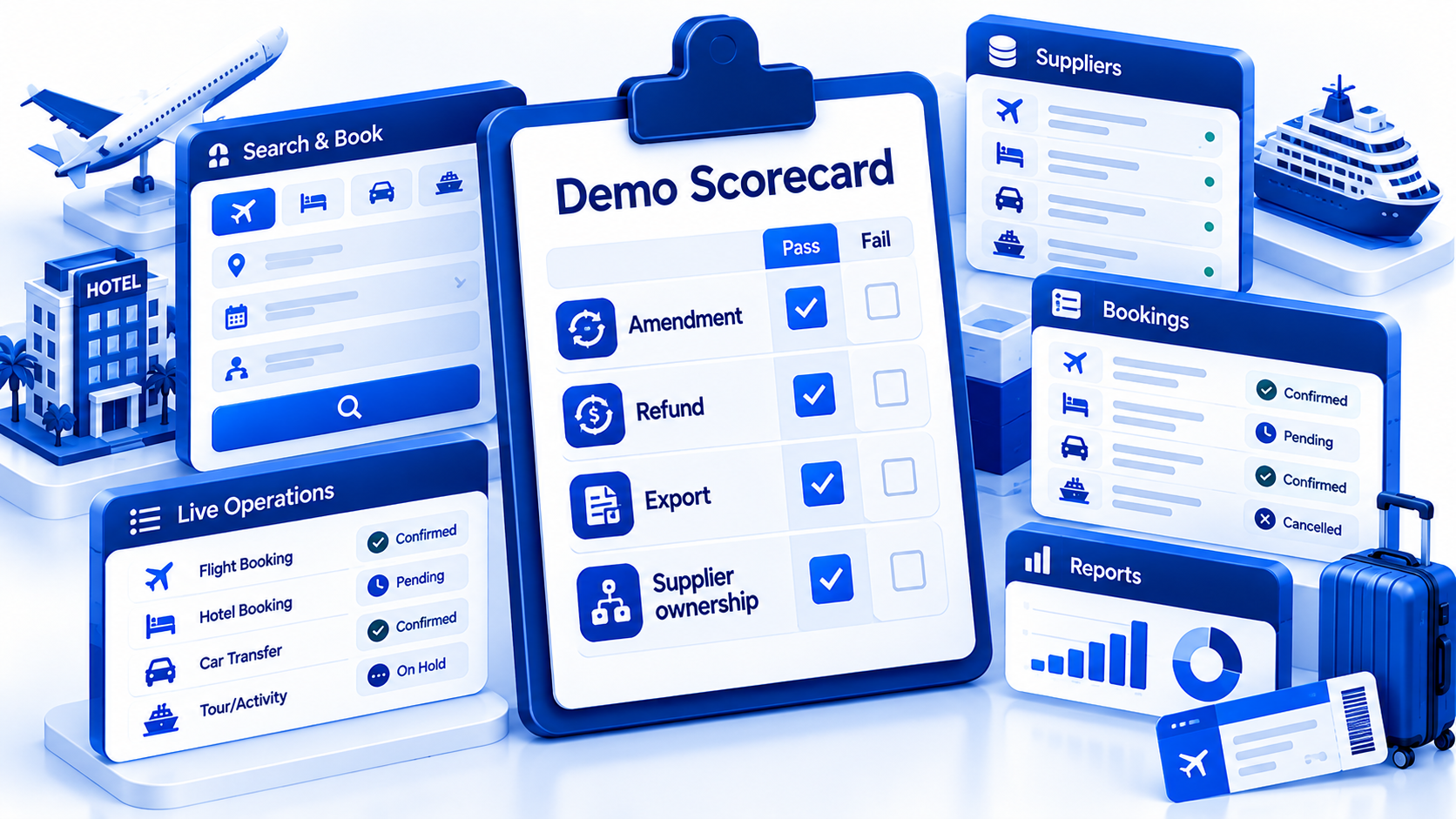
Evaluation scorecard before you buy
Ask vendors (and yourself) these questions in the demo — with a real test booking, not slides.
- What is the system of record after booking? Show the admin record, not only the confirmation email.
- Who owns supplier contracts and credentials? If the answer is vague, stop.
- Can we run B2C, B2B, or both on one deployment? Shared inventory and one ops queue matter once sub-agents appear.
- Walk an amendment and a partial refund from request to updated voucher/invoice.
- How do markups and agent commissions appear on the booking?
- What exports to accounting (and how often do they break)?
- Self-hosted vs managed — who patches, who holds the data, what is licensed vs rented? Related: self-hosted travel booking software.
- Mobile apps — same inventory and back office, or a separate toy app?
Red flags: “we include inventory,” unexplained per-booking platform cuts presented as optional, or no path for manual/offline products if you sell your own tours.
Where PHPTRAVELS fits (honestly)
PHPTRAVELS is travel booking software for agencies, tour operators, OTAs, and DMCs. A deployment typically includes:
- A B2C storefront and/or B2B agent portal
- Booking engines/modules you enable (flights, stays, tours, cars, and others as configured)
- Supplier API connections — the platform connects; you bring contracts and credentials (integrations)
- Payment handling through your gateway accounts
- A back office for bookings, customers, suppliers, markup rules, and reports
It is sold as a licensed product (self-hosted or managed options), not a zero-config marketplace SaaS. PHPTRAVELS is not the merchant of record and does not take a cut of your bookings. Reported scale on the product site includes 40+ integrations and thousands of agency deployments — verify current figures on phptravels.com.
Fit: teams that want their own branded booking stack with a real admin layer for day-to-day ops — including B2C and B2B sharing one inventory and back office.
Not a fit (say so early): buyers who need a dedicated IATA BSP reconciliation ERP, pure corporate mid-office/OBT suites, or “sign up and sell with included inventory.” Those are different jobs.
See a working stack on the demo, then price modules and suppliers on the configurator — published building blocks change, so treat the configurator as authoritative.
30 / 60 / 90 ops rollout
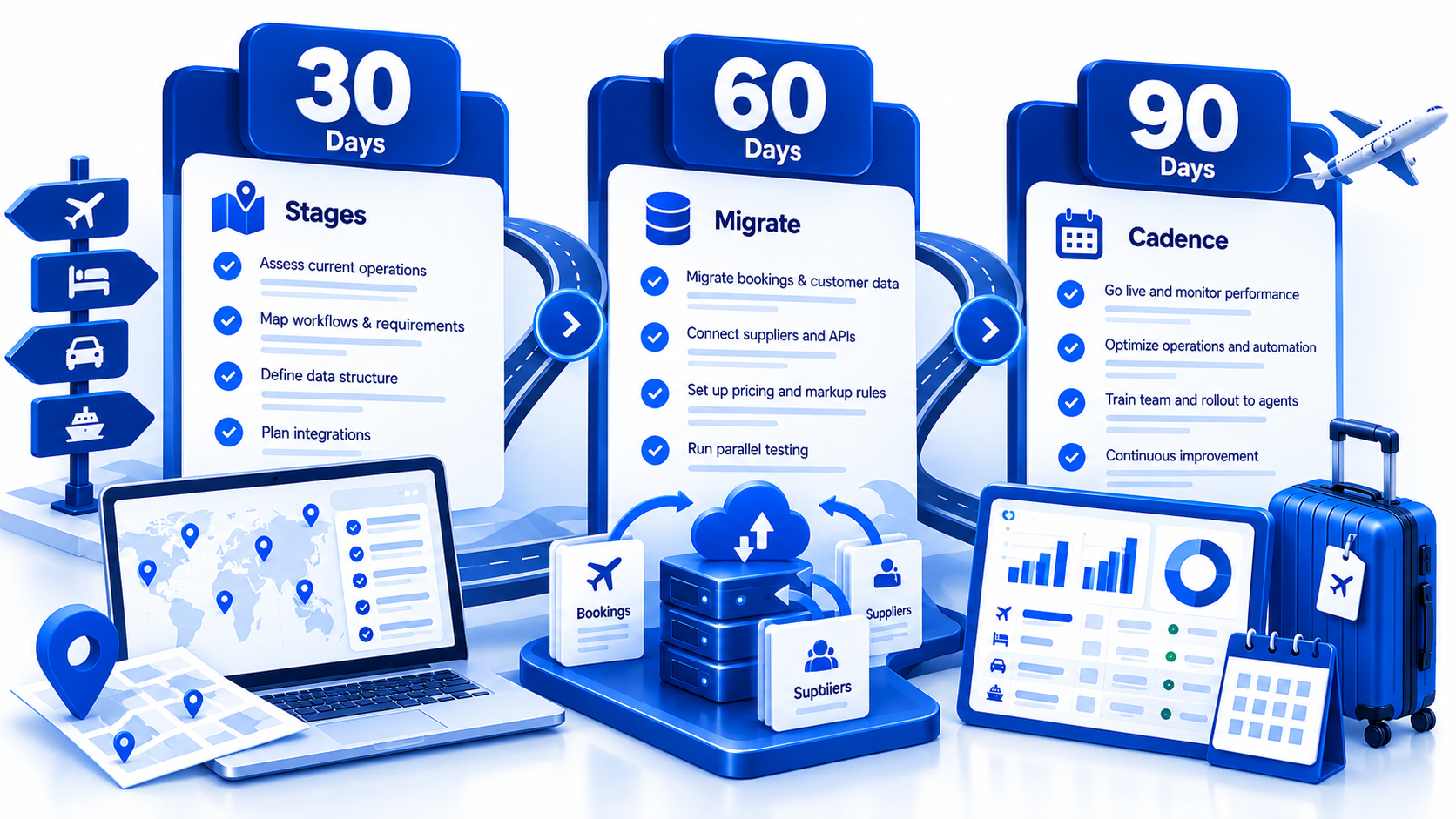
Days 1–30 — Map and pick a source of truth
List every place a booking can be created today (website, GDS desktop, email, Excel). Choose one admin system that must win. Freeze new shadow spreadsheets.
Days 31–60 — Migrate the critical path
Enable only the modules you sell. Connect suppliers you already contracted. Configure markup/credit rules. Train staff on amendment and refund paths with role permissions. Template vouchers/invoices.
Days 61–90 — Cadence
Daily unpaid/cancellation review. Weekly supplier and agent production. Month-end export rehearsal with finance. Write a one-page exception playbook (no-show, supplier cancel, payment mismatch).
Software without cadence becomes another login. Cadence without software becomes heroics. You need both.
FAQ
Is back office software the same as a CRM?
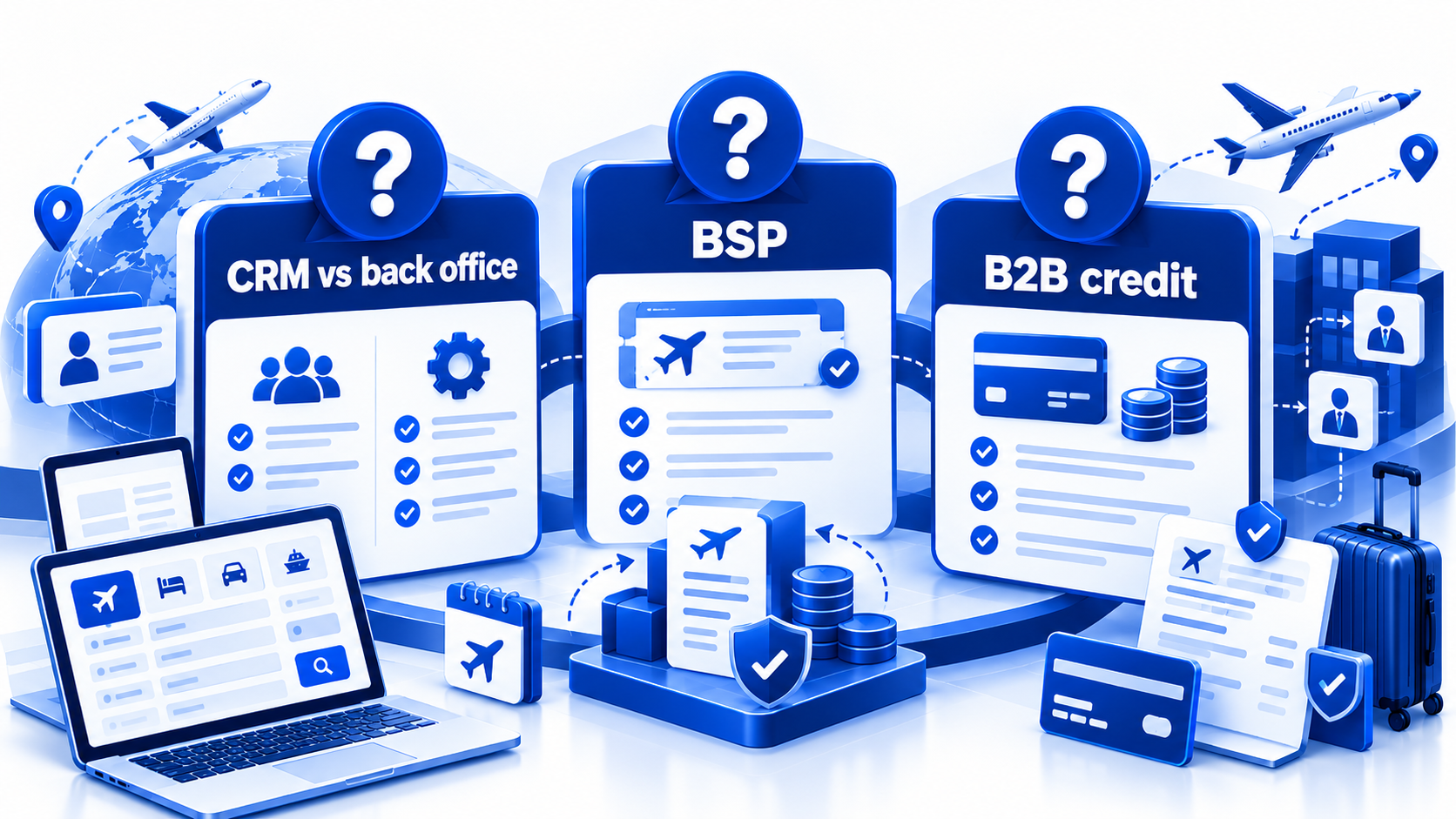
No. CRM tracks relationships and pipeline. Back office tracks bookings, money, suppliers, and documents. Mature teams use both; do not expect one tool to fake the other forever.
Do I need BSP reconciliation software?
Only if you are in the IATA ticketing/settlement world at meaningful volume. Many hotel/tour-led agencies never need it. Flight-heavy accredited agencies often do as a specialist layer beside the booking platform. Start from IATA’s BSP overview before you buy a second suite.
Can we start B2B-only?
Yes, if sub-agent distribution is the business. Just ensure credit limits, net rates, and invoicing are in the back office from day one — B2B without credit control is how agencies fund their agents’ cash flow by accident. The agent portal is the front door; the back office is what keeps that door solvent.
Will multilingual or multi-currency break the back office?
They add document and reporting complexity. Localize the full journey (UI → voucher), and keep currency rules explicit. See also multilingual travel booking software.
Bottom line: Travel agency back office software is the system that keeps bookings, people, suppliers, and money aligned after the celebration email. Choose a booking platform whose admin layer is strong enough for your real ops — and add specialized mid-office/settlement tools only when your accreditation and ticket volume demand them.
Ready to inspect a booking-stack back office hands-on? Start with the PHPTRAVELS demo and build a realistic configuration on pricing.