The problem is not your travelers. It is not that they are deliberately ignoring rules. The problem is that most travel systems only tell you what went wrong after the money is gone. You get the report on the 15th of the following month, long after that expensive flexible fare was booked, long after that hotel night exceeded the per-diem by forty percent, long after the leakage became permanent.
Corporate travel spend is the second-largest controllable expense for most companies. And right now, a significant portion of that spend is bleeding out through policy gaps that your current tools simply cannot catch in real time.
The question is not whether your organization has travel policy violations. The question is how much you’re losing before anyone notices.
Quick Summary
- Traditional expense tools are reactive. They analyze past spend. By then, the money is already gone.
- Policy leakage happens at booking, not during expense submission. Stop it before the transaction completes.
- AI enforcement replaces manual oversight. Rules apply instantly based on traveler seniority, trip purpose, region, and budget.
- The next three years will bring unprecedented travel pricing volatility. Companies without proactive controls will lose margin.
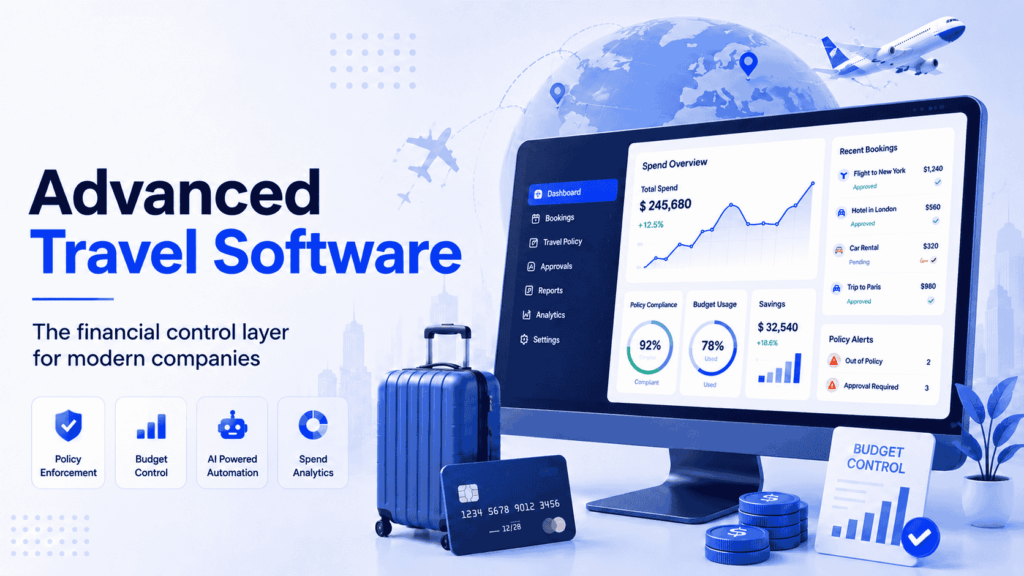
- Advanced travel software acts as a financial guardrail blocking non-compliant spend, enforcing budgets, and automating approvals without slowing down your team.
What Is Travel Policy Leakage and Why Does It Increase Travel Spend?
Let’s talk about what leakage actually looks like on the ground.
A senior sales manager books a flight from London to New York. The company policy allows economy class for flights under six hours and business class above that threshold. This flight is seven hours. The manager books business class completely within policy. But the fare they select is refundable, fully flexible, and costs twice as much as the non-refundable business class fare on the exact same flight. The policy didn’t specify fare class flexibility. The system didn’t flag it. The company just overpaid by eight hundred dollars.
That is policy leakage.
It happens thousands of times every day across travel programs worldwide. Not through malice, but through absence of real-time enforcement.
Now multiply that by every flight, every hotel night, every train ticket, every car rental across your organization. The number becomes substantial very quickly.
Traditional travel and expense systems were built for a different era. They assumed you could collect receipts, run reports, and correct behavior next quarter. That model is no longer viable. Travel pricing volatility is increasing. Supplier contract terms are becoming more complex. And the gap between booking and audit is simply too large to manage manually.
- Global Business Travel Association estimates corporate travel spending exceeds trillions annually.
- Travel managers often report 20-30% reduction in out-of-policy bookings after automation.
- Manual approval workflows can delay bookings by several hours or days.
Why Traditional Spend Controls Fail at the Booking Stage
Most companies approach travel spend control through a combination of three mechanisms: policy documents, manager approvals, and post-trip audits.
Each of these has the same fundamental flaw they operate after the financial commitment is made.
Policy documents are reference material. No matter how clearly written, they don’t sit between your traveler and the checkout button.
Manager approvals introduce delay and bias. A busy manager approving ten trips per week cannot consistently verify fare comparisons, route optimization, or policy exceptions. And when the manager is traveling themselves, approvals stall.
Post-trip audits catch violations that already happened. At best, you recover a small percentage through manual reconciliation. At worst, you write it off as the cost of doing business.
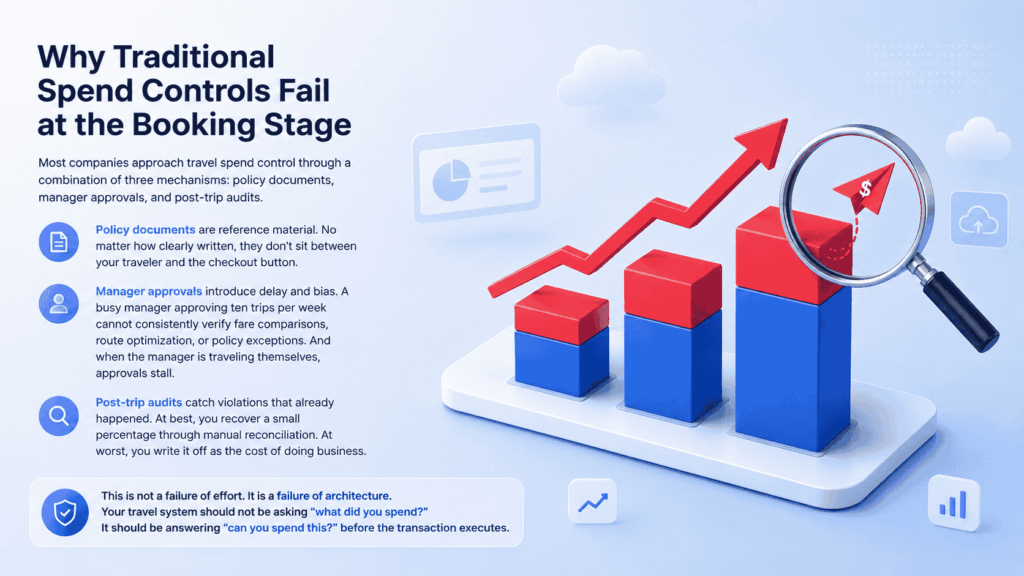
This is not a failure of effort. It is a failure of architecture. Your travel system should not be asking “what did you spend?” It should be answering “can you spend this?” before the transaction executes.
How AI Travel Management Software Enforces Travel Policy
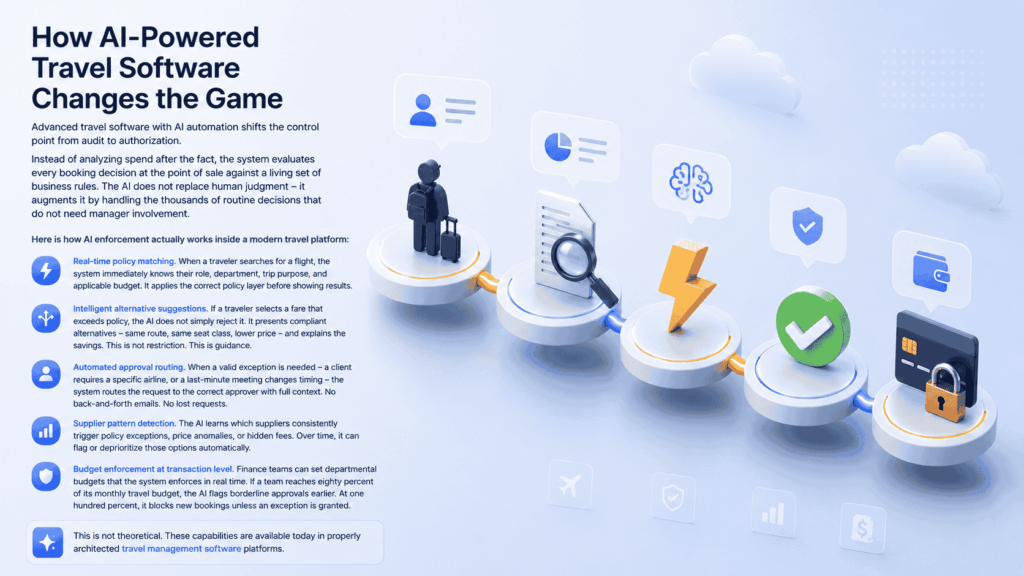
Advanced travel software with AI automation shifts the control point from audit to authorization.
Instead of analyzing spend after the fact, the system evaluates every booking decision at the point of sale against a living set of business rules. The AI does not replace human judgment it augments it by handling the thousands of routine decisions that do not need manager involvement.
Here is how AI enforcement actually works inside a modern travel platform:
Real-time policy matching. When a traveler searches for a flight, the system immediately knows their role, department, trip purpose, and applicable budget. It applies the correct policy layer before showing results.
Intelligent alternative suggestions. If a traveler selects a fare that exceeds policy, the AI does not simply reject it. It presents compliant alternatives same route, same seat class, lower price and explains the savings. This is not restriction. This is guidance.
Automated approval routing. When a valid exception is needed a client requires a specific airline, or a last-minute meeting changes timing the system routes the request to the correct approver with full context. No back-and-forth emails. No lost requests.
Supplier pattern detection. The AI learns which suppliers consistently trigger policy exceptions, price anomalies, or hidden fees. Over time, it can flag or deprioritize those options automatically.
Budget enforcement at transaction level. Finance teams can set departmental budgets that the system enforces in real time. If a team reaches eighty percent of its monthly travel budget, the AI flags borderline approvals earlier. At one hundred percent, it blocks new bookings unless an exception is granted.
This is not theoretical. These capabilities are available today in properly architected travel management software platforms.
AI Features That Reduce Travel Spend
Include:
- Predictive budget monitoring
- Automated policy enforcement
- Dynamic approval routing
- Fare anomaly detection
- Hotel price assurance
- Supplier performance analysis
AI Travel Spend Management Software Comparison
| Feature | Traditional Expense Tool | Modern AI Travel Software |
|---|---|---|
| Real-time enforcement | No | Yes |
| Policy blocking | No | Yes |
| Automated approvals | Limited | Yes |
| Budget tracking | Partial | Real-time |
| Leakage prevention | No | Yes |
The Shift from Reactive Reporting to Proactive Enforcement
The companies that will win over the next three years are not the ones with the most sophisticated dashboards. They are the ones that prevent bad spend before it happens.
Think about the difference between a fraud detection system that alerts you after a transaction clears versus one that blocks the transaction in real time. The first tells you what you lost. The second prevents the loss entirely.
Travel spend enforcement is no different.
Finance teams are increasingly demanding that travel systems provide not just visibility, but control. The question “how much did we spend on flights last month?” is being replaced by “how can we ensure we never overpay for a flight again?”
This requires a fundamentally different approach to corporate travel management software. One where policy rules are not suggestions in a PDF but enforceable logic in the booking flow.
Real-World Scenarios Where Advanced Software Wins Immediately
Let me give you specific examples of where this plays out in daily operations.
Scenario one: The hidden city fare problem.
A traveler books a flight from Chicago to Dallas. The system finds a fare five hundred dollars cheaper if they book Chicago to Houston with a connection in Dallas and simply skip the second leg. This is technically allowed by most airlines but violates corporate policy and creates risk of fare audits. Traditional systems don’t catch this. AI-powered software flags the booking as non-compliant and explains exactly why.
Scenario two: The hotel tax trap.
A hotel in Paris shows a nightly rate of two hundred euros. At checkout, the total is two hundred sixty euros due to city taxes, service fees, and a resort fee that was buried in fine print. Most expense systems never see this discrepancy. Advanced travel software calculates the fully burdened cost before the booking is confirmed and compares it against policy thresholds.
Scenario three: The out-of-policy workaround.
A traveler cannot book their preferred airline because it exceeds the policy cap. Instead, they book a cheaper airline and then upgrade at the gate using a personal credit card, expensing only the base fare. This hides the true cost of travel and bypasses policy entirely. AI systems that integrate with travel and expense report management software can flag this pattern because the final itinerary does not match the original booking class.
Scenario four: The approval bottleneck.
A regional sales team needs approval for a client dinner during a conference. The booking request sits in a manager’s inbox for three days while the traveler goes ahead anyway. By the time the approval is granted, the spending has already occurred. Automated approval rules can handle standard exceptions instantly, routing only truly unusual requests to human review.
How to Choose AI Travel Spend Management Software
If you are evaluating platforms that claim to offer AI-driven spend control, ask these specific questions.
Does enforcement happen at booking or after?
Many systems say they offer policy compliance but only flag violations in a weekly report. You need real-time blocking and guidance at the point of transaction.
Can the system handle complex rules?
Your policy is not simple. Different rules for different roles, regions, trip purposes, and budget periods. The software must support layered, conditional logic.
Does it integrate with your existing stack?
You already use an ERP, an expense system, and possibly a corporate card program. Your travel agency management software needs to talk to all of them.
How does the AI handle exceptions?
No policy covers every scenario. The software should make exceptions easy to request and approve, not force travelers to find workarounds.
Can finance teams see real-time data?
Waiting until month-end to understand spend is no longer acceptable. Your travel expense management software should provide live dashboards that update with every booking.
Common Mistakes Companies Make When Implementing Spend Controls
Even with the right technology, implementation matters. Here are the pitfalls I see most often.
Over-restricting without flexibility. If your system blocks every fare that deviates from the absolute cheapest option, travelers will find ways around it. Build in reasonable flexibility and focus enforcement on significant violations.
Ignoring the traveler experience. Policy enforcement that feels punitive creates shadow booking travelers using personal cards, consumer OTAs, or direct supplier sites. Your best online booking software must be easy enough that compliance is the path of least resistance.
Setting and forgetting policy rules. Your travel policy should evolve with your business. Review rules quarterly based on actual spend data and traveler feedback.
Failing to communicate the why. When travelers understand that policy compliance keeps travel budgets healthy and prevents cuts elsewhere, they are far more likely to cooperate. Use your platform to show the savings from compliant choices.
Introducing PHPTRAVELS Advanced Travel Software
This is where PHPTRAVELS fits into the picture.
We build advanced travel software that combines the booking experience travelers actually want with the financial controls finance teams demand. Our platform enforces policy in real time, automates approvals, and provides live spend visibility without slowing down your team.
The system integrates with major GDS providers, direct supplier APIs, and your existing expense infrastructure. Whether you are a corporate travel department, a travel management company, or an OTA looking to offer spend control features to business clients, the architecture is flexible enough to match your needs.
Key capabilities include:
- Real-time policy enforcement at booking
- Automated approval workflows with conditional routing
- Budget tracking and enforcement at department and project level
- Supplier pattern detection and preference learning
- Live spend dashboards for finance teams
- B2B travel booking software for agencies serving corporate clients
- Flight booking software with integrated policy controls
- Travel CRM software that tracks traveler preferences and policy history
The platform is used by travel agencies, tour operators, and corporate travel desks across more than fifty countries. It supports multi-currency travel software operations and scales from small teams to enterprise deployments.
The Future of Travel Spend Management
Over the next thirty-six months, travel pricing will become more volatile than anything we have seen in the past decade. Fuel surcharges, demand fluctuations, supplier consolidation, and regional instability will create constant price movement.
Companies that rely on manual audits and monthly reports will not be able to keep up. The gap between market price and what you actually pay will widen.
The organizations that protect their margins will be those that have already shifted to real-time, AI-driven enforcement. They will not analyze past leakage. They will prevent future leakage.
This is not speculative. Look at how financial services evolved fraud detection. Twenty years ago, banks reviewed transactions after the fact. Today, your card is declined instantly if the pattern looks wrong. Travel spend management is following the exact same trajectory.
Conclusion
Travel spend is too large, too volatile, and too important to manage through monthly reports and manual audits. The companies that thrive in the coming years will be those that build financial guardrails directly into their booking systems.
Advanced travel software with AI enforcement is not a luxury. It is becoming a mandatory component of responsible financial governance for any organization with meaningful travel volume.