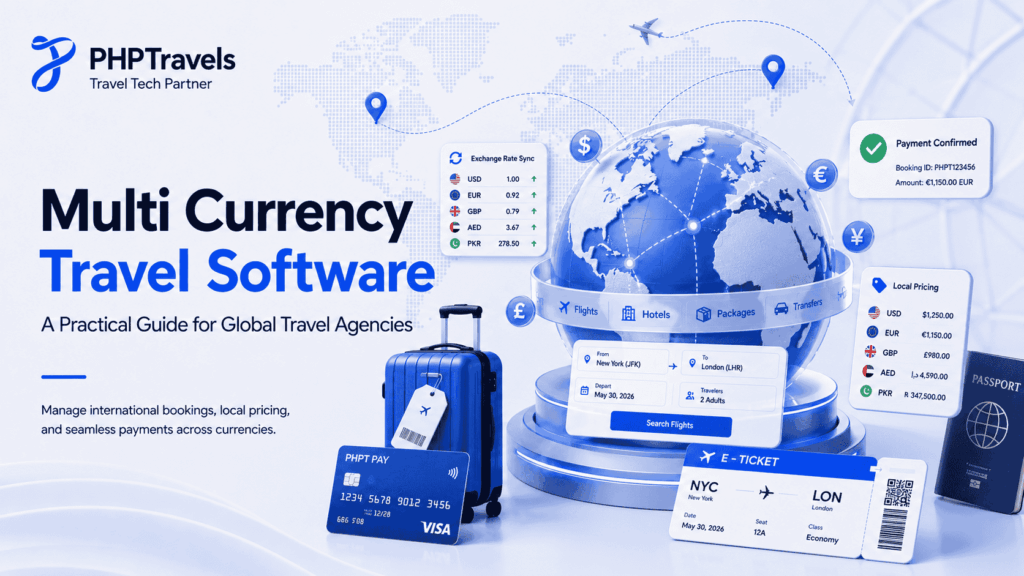
Selling travel across borders is not simply a matter of adding a currency switcher to a booking website. A global travel business may receive hotel rates in USD, flight fares in EUR, transfer prices in AED, and customer payments in GBP or SAR. At the same time, travelers may expect search results, policies, checkout instructions, vouchers, and emails in their preferred language.
That is why multi currency travel software must connect localization, pricing, foreign exchange, payments, booking operations, and reporting inside one workflow.
For OTAs, DMCs, tour operators, wholesalers, and B2B travel businesses, the objective is not to show more currency symbols. It is to keep customer pricing clear while protecting margins and keeping payments, refunds, invoices, and reports consistent.
What Is Multi Currency Travel Software?
Multi currency travel software is a travel booking and operations platform that can manage pricing, bookings, payments, markups, refunds, and reporting across more than one currency.
In a basic setup, a travel business may store prices in one base currency and convert them for display to customers. More advanced setups can manage supplier currencies, customer-facing currencies, payment currencies, and settlement currencies separately.
For example, a DMC may contract hotel inventory in EUR, add a markup, quote a B2B agent in GBP, accept payment in GBP, and report company performance in its accounting currency. A suitable system should keep those stages connected without staff recalculating every booking manually.
A complete platform may combine currency management with multilingual content, RTL interfaces, regional payment methods, and localized booking communications. PHPTRAVELS’ travel booking software connects booking modules with broader travel operations.
Why Multi-Currency and Multilingual Support Should Work Together
Language and currency solve different parts of the same booking experience.
A traveler can understand a Spanish website but still hesitate when the final price appears only in an unfamiliar currency. Likewise, a customer may see the correct local currency while cancellation rules or payment instructions remain unclear because they are available in only one language.
Localization should cover the full journey, including search, fare rules, quotations, checkout, confirmation emails, vouchers, cancellations, refunds, and support. CSA Research reported that 76% of surveyed online shoppers preferred products with information in their own language, showing why language should be treated as part of the buying experience.
For businesses entering Arabic-speaking markets, localization also includes interface direction and regional operational needs. PHPTRAVELS provides an Arabic travel system with RTL support, regional payment options, VAT-related features, Arabic mobile app support, and multi-currency capabilities.
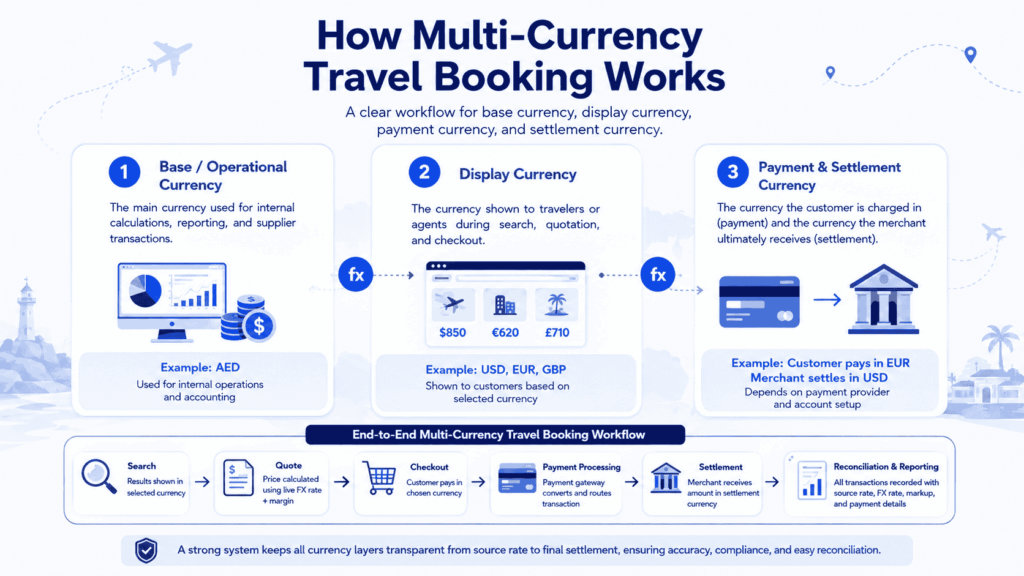
How Multi-Currency Travel Booking Works
A reliable workflow separates several currency concepts.
Base or Operational Currency
This is the main currency used for internal calculations or reporting. A company may operate in AED while buying inventory from suppliers in USD and EUR.
Display Currency
This is the currency shown to the traveler or agent during search, quotation, and checkout. The business must decide how frequently exchange rates update and whether an FX margin or buffer applies.
Payment and Settlement Currency
The payment currency is what the customer is charged in. Settlement currency is what the merchant ultimately receives through the payment provider, depending on processor and account configuration.
Payment systems distinguish customer-facing presentment currency from settlement currency. This distinction matters when designing a global checkout and reconciliation workflow.
A strong system keeps these layers visible so staff can trace the source rate, FX rate, markup, customer payment, and recorded transaction.
Essential Features of Multi Currency Travel Software
Not every system that displays several currencies provides complete multi-currency operations. Travel companies should evaluate the following capabilities.
Automated Exchange Rate Updates
Exchange rates change, so a system should support scheduled or automated updates. Some businesses may prefer frequent updates, while others use controlled rates for quotations, packages, or contract periods.
A travel company should also decide whether the same FX rate applies everywhere or whether particular sales channels, products, or quotations require separate rate rules.
Manual FX Control and Margin Protection
Automation should not remove commercial control. Agencies may need to set manual rates, define validity periods, add FX buffers, or create different pricing rules by market.
A practical system should help commercial teams protect margins when supplier and selling currencies differ.
For example, inventory may arrive from a supplier in USD while the customer sees and pays in EUR. The system must apply currency conversion and markup rules in the correct order so the agency understands the real margin on the booking.
Multi-Currency Booking and Checkout
Customers should be able to search, compare, book, and pay with a consistent currency experience. Taxes, service charges, booking fees, and other additions should also be clear before payment.
The selected currency should remain consistent throughout the booking journey. A traveler should not search in one currency, reach checkout in another, and then discover a different payment currency without a clear explanation.
Currency-Aware Markups and Commissions
Travel businesses need commercial rules such as percentage or fixed markups, agent-specific pricing, supplier-level rules, destination-based margins, service-specific commissions, and market-specific pricing.
For agent distribution, a B2B booking engine can connect inventory access with agent pricing and workflows.
Direct-selling businesses may prioritize a localized B2C booking system focused on the end-customer journey.
The important point is that currency conversion should work with the business model rather than operate as an isolated front-end feature.
Local and International Payment Gateways
Currency support and payment support must be planned together. A platform may display a currency that a particular gateway, merchant account, or payment method cannot process as intended.
Before launch, confirm which currencies each gateway accepts, how settlement works, and whether local payment methods are available.
PHPTRAVELS also supports travel payment gateway integration for connected payment workflows.
A payment strategy should consider not only credit cards but also the payment behavior of the markets being targeted. The preferred payment workflow can vary by region, merchant account, business entity, and gateway availability.
Refunds, Cancellations, and FX Differences
Refunds are often overlooked in multi-currency operations.
Suppose a customer pays in EUR, the supplier charge is in USD, and the exchange rate changes before cancellation. The business needs clear rules for:
- refundable amounts;
- cancellation penalties;
- exchange-rate differences;
- gateway fees;
- supplier refund timing;
- customer communication.
A good operational process must preserve the original booking and payment data so staff can understand what happened at every stage.
The refund workflow should also define which rate is used when the booking currency, supplier currency, and payment currency are different.
Multi-Currency Reporting and Reconciliation
Reporting should answer practical questions:
- Which markets generate the most revenue?
- Which currencies create the highest FX exposure?
- What margin remains after supplier cost and conversion?
- Which gateway processed each transaction?
- Are refunds and cancellations fully reconciled?
- How much is payable to suppliers in each currency?
The platform should preserve original transaction data while supporting meaningful reporting in the company’s operational currency.
This is particularly important for travel businesses using multiple suppliers because a single booking operation may involve several currencies, payment dates, and settlement schedules.
Multilingual Features That Matter Beyond Translation
A multi-language travel website needs more than translated menu labels.
Full Booking Journey Translation
Translation should cover product descriptions, buttons, filters, validation messages, fare rules, policies, emails, invoices, and vouchers.
A partially translated experience creates confusion when customers most need clarity.
For example, translating the homepage while leaving cancellation rules and confirmation emails in another language does not provide a complete localized journey. The travel platform should consider language at every customer touchpoint.
RTL Interface Support
Languages such as Arabic, Urdu, and Hebrew require right-to-left presentation.
Proper RTL support involves page structure, navigation order, form alignment, icons, menus, and responsive behavior, not only translated text.
The PHPTRAVELS Arabic travel platform, for example, combines RTL presentation with local payment and multi-currency capabilities for MENA-focused travel businesses.
Translation Workflow and Governance
Travel businesses should decide who owns translations and how updates are approved.
Automatic translation can accelerate drafts, but high-value booking content, policies, payment instructions, and legal terms need controlled review.
When the platform adds a new feature, travel product, payment instruction, or cancellation state, the translation workflow should ensure that every supported language remains consistent.
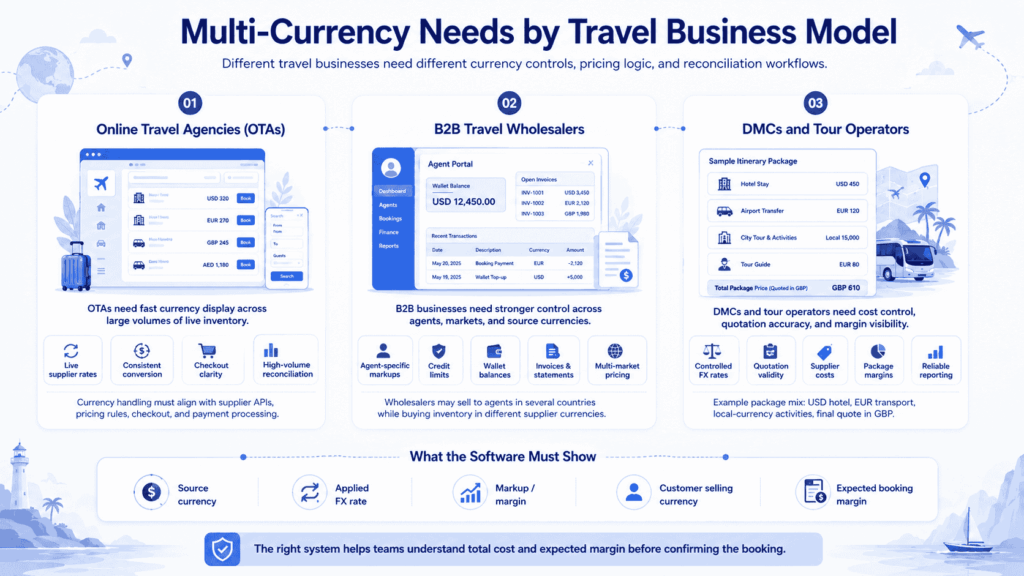
Multi-Currency Needs by Travel Business Model
Different travel businesses need different controls.
Online Travel Agencies
OTAs need fast currency display across large volumes of live inventory.
Key challenges include consistent conversion, checkout clarity, payment compatibility, and high-volume reconciliation.
An OTA may connect several suppliers, each returning rates differently. Currency handling must therefore work closely with supplier APIs, pricing rules, checkout, and payment processing.
B2B Travel Wholesalers
B2B businesses need agent-specific markups, credit limits, wallet balances, statements, invoices, and potentially different currencies for different source markets.
A wholesaler may have agents in several countries while buying hotel or flight inventory from suppliers using separate currencies. This requires greater control than simply converting prices on the public website.
DMCs and Tour Operators
DMCs and tour operators may buy hotels, transfers, activities, guides, and transport in several currencies while selling packages in another.
They need controlled exchange rates, quotation validity, supplier costs, package margins, and reliable reporting.
For example, a package could include a USD hotel contract, EUR transport service, and local-currency activities while the final quotation is issued to an overseas agent in GBP.
The software should help the operator understand total cost and expected margin before confirming the booking.
How to Choose the Right Multi Currency Travel Software
Before selecting a platform, test real workflows rather than asking only whether “multi-currency” is included.
Ask the vendor to demonstrate:
- How supplier rates in different currencies enter the system.
- How the base currency is configured.
- How exchange rates update and whether manual overrides are possible.
- How FX margins or buffers are applied.
- How B2B and B2C pricing rules differ.
- Whether selected gateways support target currencies.
- How refunds and cancellations are calculated.
- How invoices and vouchers display currency.
- How profit and revenue reports handle multiple currencies.
- How languages, RTL layouts, and regional SEO are managed.
Also verify API and payment compatibility early. The PHPTRAVELS integrations directory shows examples of supplier and payment connections used in broader travel technology stacks.
The best evaluation process uses realistic scenarios from your own business.
Instead of asking a vendor to show a currency dropdown, ask them to demonstrate a full workflow such as:
Supplier rate in USD → customer display in EUR → markup applied → payment accepted → booking cancelled → refund processed → transaction reconciled.
This makes it easier to determine whether the software supports actual multi-currency operations or only front-end currency display.
Common Multi-Currency Implementation Mistakes
The biggest mistake is treating multi-currency as a front-end feature.
Other problems include using one exchange rate rule for every workflow, failing to define quotation validity, ignoring refund FX differences, adding languages without translating booking communications, and enabling currencies before checking gateway support.
Another mistake is launching too many markets at once.
Start with source markets supported by real traffic, booking demand, supplier coverage, payment capability, and customer service capacity. Expand based on operational readiness and performance data.
Travel companies should also avoid choosing currencies only because they are technically available in the software. Currency selection should support a genuine market, customer segment, B2B partner network, or regional growth strategy.
How PHPTRAVELS Supports Global Travel Operations
PHPTRAVELS is built for travel businesses that need to connect booking modules, supplier integrations, payment options, localization, and business operations.
For MENA-focused deployments, the Arabic platform includes RTL presentation, Arabic content support, regional payments, VAT-related capabilities, and automated multi-currency updates.
A multi-currency platform should ultimately support the commercial strategy of the agency, OTA, DMC, or tour operator rather than forcing the business into a fixed and disconnected currency process.
Final Takeaway
Multi currency travel software is not just a currency converter.
For a global travel business, it is part of the operational architecture connecting supplier rates, FX rules, markups, customer pricing, payment processing, refunds, invoices, and reporting.
The strongest setup is one where language, currency, inventory, payments, and reporting work together.
Travel agencies that design these workflows before expanding into new markets are better positioned to give customers a clear booking experience while maintaining control over pricing and operations.