The travel industry is no longer divided neatly between traditional agencies and online booking websites. Local travel agencies, tour operators, destination businesses, hotels, transport providers, and activity suppliers are combining digital technology with local knowledge to serve travelers more effectively.
Understanding how the travel industry is evolving is important because customer expectations have changed. Travelers now want to research destinations, compare options, receive support, make payments, and manage bookings through connected digital channels. At the same time, many still value the reassurance and destination expertise provided by a knowledgeable local travel professional.
This means local travel businesses are not simply being replaced by technology. The strongest businesses are using technology to expand their reach, automate repetitive work, improve customer service, and package local expertise in a form that can be purchased globally.
Quick Summary
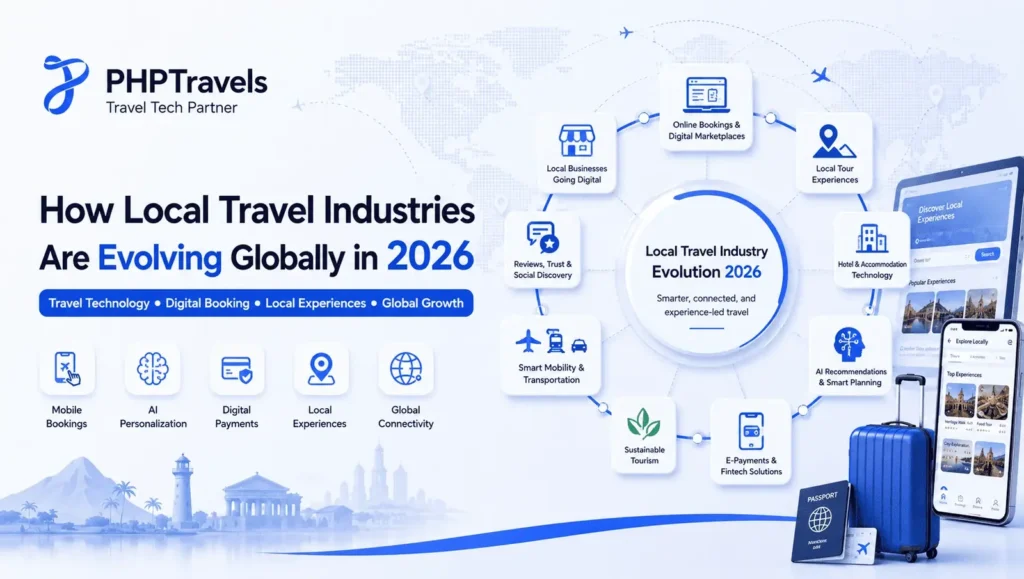
Local travel industries are evolving through:
- Online and hybrid booking models
- Connected travel inventory and APIs
- Mobile-first customer service
- Artificial intelligence and automation
- CRM systems and customer data
- Social media and experience-led marketing
- Greater demand for authentic local experiences
- Digital payments and multi-currency selling
- Sustainable and resilient tourism practices
What Does Travel Industry Evolution Mean?
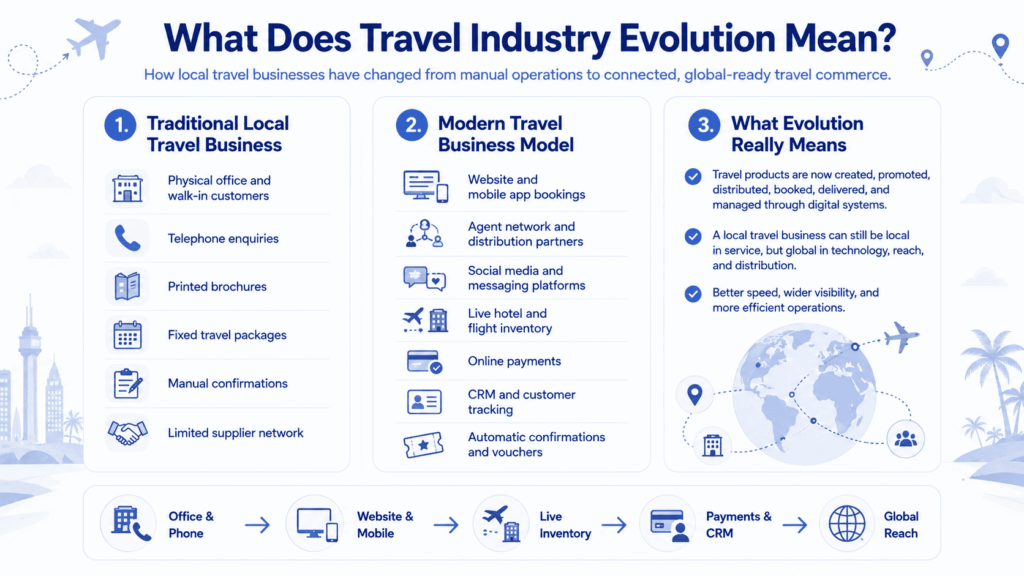
Travel industry evolution refers to changes in how travel products are created, promoted, distributed, booked, delivered, and managed.
In the past, a local travel business may have depended heavily on a physical office, telephone enquiries, printed brochures, fixed packages, manual confirmations, and direct relationships with a small number of suppliers.
Today, that same business may sell through a website, mobile application, agent network, social media account, messaging platform, or international distribution partner. It may connect to live hotel and flight inventory, collect online payments, track customers in a CRM, and automatically issue booking confirmations and vouchers.
The business remains local, but its technology, distribution, and customer reach can be global.
1. Local Agencies Are Moving Toward Hybrid Travel Models
One of the most important local travel industry trends is the growth of the hybrid agency.
A hybrid travel business combines digital convenience with human support. Customers may search or submit an enquiry online but speak to an agent before confirming a complex itinerary. They may complete a booking digitally but use WhatsApp, live chat, email, or telephone support when plans change.
This model is especially useful for:
- Multi-destination itineraries
- Group and family travel
- Business trips
- Religious travel
- Visa-sensitive journeys
- Customized tours
- High-value or complicated bookings
The advantage of the hybrid model is that it does not force customers to choose between technology and personal service. It uses technology for speed while preserving human guidance where it adds value.
Businesses planning this transition can review the PHPTRAVELS guide to starting an online travel agency and evaluate which parts of their existing operation should be digitized first.
2. Booking Inventory Is Becoming More Connected
Local travel companies previously relied on telephone calls, emails, spreadsheets, or manually updated rate sheets to check availability.
Modern travel businesses increasingly use supplier connections, XML feeds, JSON APIs, global distribution systems, extranets, and direct contracts to access inventory. This allows agencies to search and sell flights, hotels, tours, cars, transfers, and other products through one booking environment.
In airline retailing, for example, IATA’s New Distribution Capability supports the exchange of richer airline offers between airlines and travel sellers. Its purpose includes improving access to airline content and creating a more transparent shopping experience.
Connected inventory can help a local agency:
- Display broader travel options
- Check availability more quickly
- Reduce manual rate requests
- Apply markups consistently
- Generate confirmations automatically
- Sell outside normal office hours
- Reach customers in additional markets
However, an API connection alone is not enough. Agencies must also consider booking rules, cancellations, refunds, payment handling, supplier support, currency conversion, and post-booking servicing.
Businesses comparing supplier connectivity can review available travel API integrations and understand how different inventory sources fit their business model.
3. Mobile Service Is Becoming the Default Expectation
Travel is naturally mobile. Customers search while commuting, compare hotels during conversations, save itineraries on their phones, and require assistance while away from home.
As a result, local travel businesses are moving beyond desktop-only websites. They are adopting responsive booking experiences, mobile applications, digital vouchers, push notifications, messaging support, and mobile-friendly payment pages.
A mobile-first experience should allow travelers to:
- Search and filter travel products easily
- Read important fare and cancellation conditions
- complete forms without excessive typing
- Make secure payments
- Access vouchers and booking references
- Contact support
- Receive schedule or booking updates
Mobile service does not always require a large native application from the beginning. A well-designed responsive website and structured messaging workflow can be a practical first step. Businesses with stronger repeat usage may later explore travel mobile app development.
4. Artificial Intelligence Is Supporting Travel Operations
Artificial intelligence is changing how travel companies manage information, customer service, marketing, and internal work.
Travel businesses can use AI-supported tools to summarize enquiries, organize customer requests, suggest itinerary ideas, classify support tickets, translate content, identify patterns in booking data, and help agents prepare faster responses.
Industry research is increasingly focused on AI, digital assistants, super apps, financial technologies, and connected mobility as important parts of future travel experiences.
Practical AI use cases for a local agency may include:
- Drafting itinerary descriptions
- Answering basic pre-booking questions
- Suggesting relevant destinations
- Translating customer communications
- Categorizing incoming enquiries
- Identifying frequently requested products
- Supporting marketing content creation
- Summarizing booking or customer histories
AI should not be treated as a replacement for accurate supplier information or experienced human judgment. Prices, availability, entry conditions, booking rules, and cancellation policies should still be verified through reliable sources.
The best approach is to use AI to assist staff while keeping clear human review for decisions that affect the traveler.
5. Customer Data Is Becoming an Operational Asset
Traditional travel businesses often keep customer information across notebooks, spreadsheets, inboxes, messaging applications, and individual staff devices.
This makes it difficult to understand the full customer relationship. An agent may know that someone previously booked a family holiday but may not see their preferred destinations, earlier enquiries, payment history, special requests, or previous support issues.
A structured travel agency CRM can bring this information into one controlled workflow.
CRM and customer data can help agencies:
- Follow up on open enquiries
- Segment customers by interest
- Record communication history
- Identify repeat customers
- Send more relevant offers
- Assign enquiries to team members
- Track conversion performance
- Improve post-booking support
Personalization should remain useful rather than intrusive. Customers should understand what information is collected, why it is needed, how it is protected, and how they can manage their communication preferences.
6. Travel Marketing Is Becoming Experience-Led
Travel marketing has moved far beyond printed brochures and general advertisements.
Social platforms, video content, search engines, customer reviews, destination guides, creators, and user-generated content now influence travel decisions at different stages of the customer journey.
Local businesses have an important advantage here. They can create content based on first-hand knowledge instead of repeating general destination information.
A local operator can publish detailed neighborhood guides, seasonal advice, transport explanations, cultural guidance, sample itineraries, packing recommendations, and honest descriptions of who should or should not book a particular experience.
This type of useful content can attract search traffic while building authority before the customer is ready to make a booking.
7. Travelers Are Looking for More Authentic Local Experiences
Many travelers are becoming interested in experiences that feel connected to the destination rather than standardized for every market.
This can create opportunities for local guides, community businesses, independent hotels, transport providers, restaurants, activity operators, and specialist tour companies.
Examples include:
- Local food and market tours
- Cultural workshops
- Regional rail journeys
- Community-led experiences
- Nature and wildlife activities
- Heritage and ancestry travel
- Small-group neighborhood tours
- Rural and secondary-destination trips
- Locally operated wellness experiences
For local travel businesses, the opportunity is not only to sell a room or transport ticket. It is to connect individual services into a complete, understandable experience.
A city transfer, independent hotel, local guide, museum ticket, restaurant reservation, and day tour can become a valuable itinerary when they are packaged clearly and supported properly.
This shift can also distribute visitor spending across more local businesses instead of concentrating it only in major international chains.
8. Digital Payments Are Expanding Cross-Border Selling
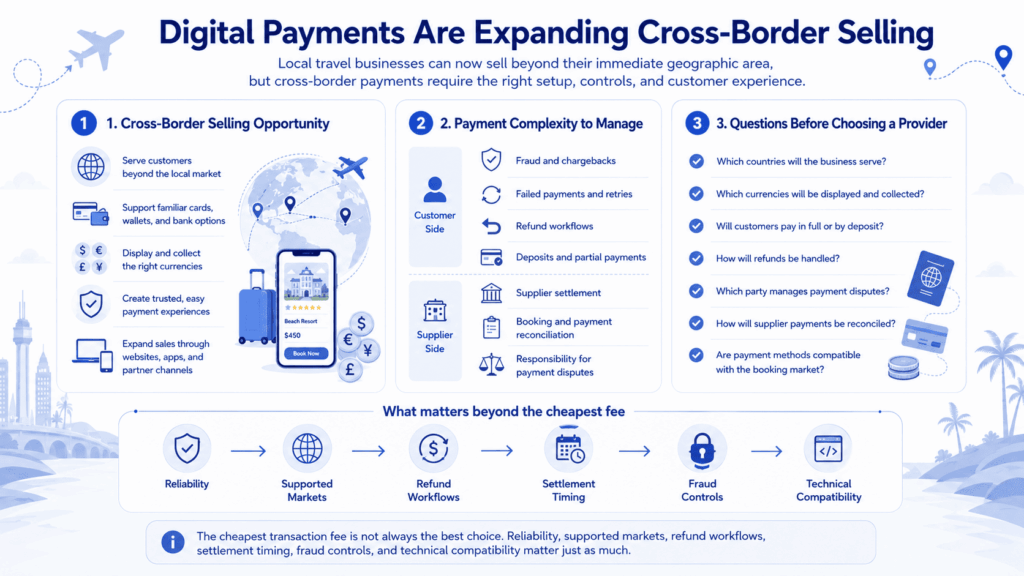
Local travel businesses can now serve customers beyond their immediate geographic area, but cross-border selling introduces payment complexity.
Travelers may expect familiar cards, wallets, bank options, currencies, and payment interfaces. The agency must also consider fraud, chargebacks, failed payments, refunds, deposits, partial payments, and supplier settlement.
A suitable payment setup should answer several questions:
- Which countries will the business serve?
- Which currencies will be displayed and collected?
- Will customers pay in full or by deposit?
- How will refunds be handled?
- Which party is responsible for payment disputes?
- How will supplier payments be reconciled?
- Are payment methods compatible with the booking market?
Agencies can review available travel payment gateway integrations before choosing a provider.
The cheapest transaction fee is not always the best choice. Reliability, supported markets, refund workflows, settlement timing, fraud controls, and technical compatibility are equally important.
9. Sustainability and Destination Resilience Are Becoming Business Issues
Sustainability is no longer limited to environmental messaging. It is increasingly connected to destination management, local economic impact, community participation, transport, visitor concentration, climate conditions, and long-term business resilience.
The OECD’s 2026 tourism research highlights greater use of tourism data, digital tools, local coordination, sustainability measurement, diversification, resilience, and management of tourism’s effects on communities and the environment.
Local travel businesses can respond by:
- Working with locally owned suppliers
- Avoiding misleading environmental claims
- Promoting suitable off-peak travel
- Providing realistic weather and safety guidance
- Offering alternatives to overcrowded locations
- Explaining local rules and cultural expectations
- Reducing unnecessary paper-based processes
- Improving cancellation and disruption procedures
- Building relationships with more than one supplier
Sustainability should be connected to actual operations. A business builds greater trust by explaining specific practices instead of using broad terms such as “eco-friendly” without evidence.
What These Changes Mean for Local Travel Agencies
The evolution of the travel industry does not mean every agency needs every new technology.
A small specialist tour operator may not need the same system as a multinational OTA. A business focused on customized luxury travel will have different requirements from an agency selling high-volume flight tickets.
The important question is not:
“What technology is popular?”
It is:
“Which part of our customer or operational journey is currently creating unnecessary delay, cost, confusion, or risk?”
For one agency, the priority may be online enquiry management. For another, it may be supplier connectivity, agent commissions, mobile booking, payment collection, or customer follow-up.
A connected travel booking software environment becomes valuable when the business is managing multiple products, users, suppliers, bookings, payments, and customer records that can no longer be controlled reliably through separate manual tools.
How Can a Local Travel Business Adapt?
Local travel businesses can approach digital transformation in manageable stages.
1. Map the complete customer journey
Record every step from first discovery to post-trip support. Identify where customers wait, repeat information, become confused, or leave the process.
2. Choose a clear business model
Decide whether the business will focus on direct customers, B2B agents, corporate travel, packaged tours, specialist destinations, supplier distribution, or a combination of channels.
3. Digitize the highest-friction process first
Do not automate everything at once. Start with the process creating the greatest operational problem, such as enquiry tracking, booking confirmations, supplier searches, payments, or commission calculations.
4. Connect systems carefully
Booking engines, APIs, CRM tools, payment gateways, accounting workflows, messaging channels, and reports should exchange information reliably. Disconnected tools can create more work rather than less.
5. Keep human support visible
Customers should know when automation is being used and how to reach a person when they need help. Human support remains especially important during disruptions, refunds, complex bookings, and urgent travel situations.
6. Measure business outcomes
Track useful results such as enquiry response time, conversion rate, booking value, repeat bookings, cancellation rate, support volume, payment failures, and agent performance.
The Future of Local Travel Industries
Local travel industries will continue to evolve as global distribution, artificial intelligence, digital payments, mobile technology, sustainability requirements, and traveler expectations develop.
However, technology alone will not determine which businesses succeed.
Local operators still provide something that global platforms often struggle to reproduce: first-hand knowledge, cultural understanding, specialist relationships, and human reassurance.
The strongest travel businesses will combine those local advantages with digital systems that make them easier to discover, trust, book, pay, and contact.
For a broader view of what may influence the sector over the coming years, read these travel industry trends shaping the future through 2030.