If you’ve recently visited Booking.com, you may have noticed a significant change.
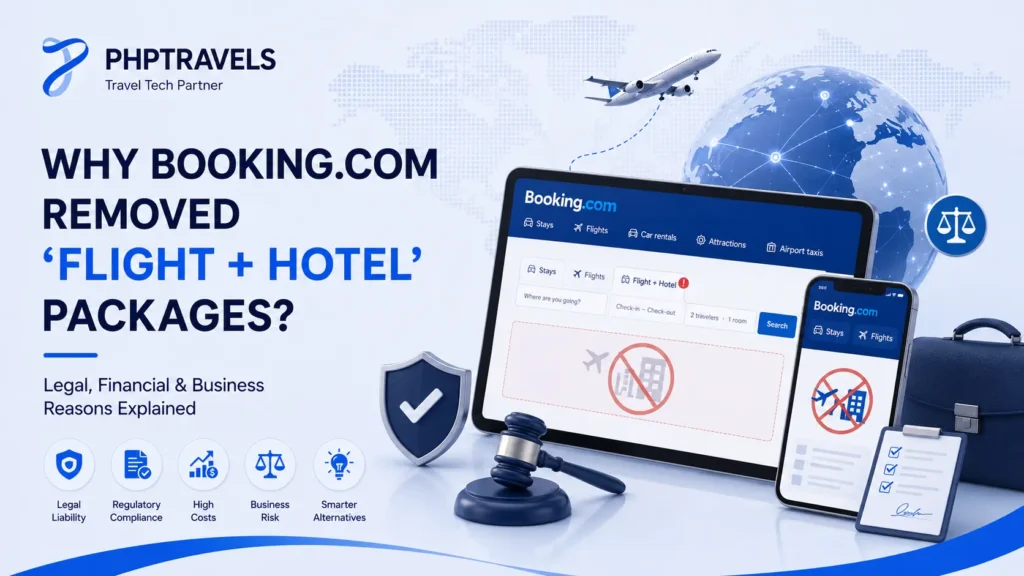
Why Booking.com Removed Flight + Hotel Packages the “Flight + Hotel” option, once featured alongside Hotels, Flights, Car Rentals, Attractions, and Airport Taxis, has quietly disappeared from many markets.
Naturally, this has led to questions across the travel industry.
Why would one of the world’s largest online travel companies remove a feature that seems designed to increase bookings and revenue?
The answer is more complex than most people think.
This wasn’t simply a design refresh or a product update. It reflects the growing legal, financial, and operational challenges of selling dynamic travel packages in today’s highly regulated travel industry.
In this article, we’ll explore the likely reasons behind Booking.com’s decision, explain the business implications for travel agencies, and discuss how companies can continue offering travel packages while managing risk effectively.
What Changed?
And Why Booking.com Removed Flight + Hotel Packages
Previously, Booking.com’s main navigation included:
- Stays
- Flights
- Flight + Hotel
- Car Rentals
- Attractions
- Airport Taxi
Today, many users only see:
- Stays
- Flights
- Car Rentals
- Attractions
- Airport Taxi
The dedicated Flight + Hotel option has disappeared in many regions.
Although Booking.com has not publicly released a detailed explanation for every market, the change aligns with broader trends in the online travel industry, where companies continuously evaluate legal exposure, compliance costs, and business efficiency.
What Is a Dynamic Package?
A dynamic package allows customers to build a holiday in real time by combining multiple travel products into one booking.
For example:
| Travel Service | Included |
|---|---|
| Flight | ✅ |
| Hotel | ✅ |
| Airport Transfer | Optional |
| Car Rental | Optional |
| Activities | Optional |
| Insurance | Optional |
Unlike traditional tour operators that sell pre-designed vacations, dynamic packages use APIs to combine travel services instantly based on customer preferences.
For travelers, this offers flexibility.
For travel businesses, however, it introduces additional responsibilities.
The Biggest Difference: Liability
Selling a hotel room by itself is relatively simple.
Selling an airline ticket is also straightforward.
But once both services are sold together as a package, the legal relationship can change dramatically depending on the country.
Instead of acting only as a booking platform, the seller may legally become the package organizer, making them responsible for the customer’s entire holiday experience.
This distinction is one of the biggest reasons package travel requires careful planning.
Why Package Holidays Carry More Risk
Consider this example.
A customer books:
- A flight
- A hotel
- Airport transfers
Everything seems fine.
Then the airline cancels the flight.
The hotel refuses late check-in.
The transfer company never arrives.
If each service was purchased separately, the customer generally deals with each supplier individually.
If everything was sold as one package, the customer is more likely to expect the travel company to resolve every issue—even if the problem originated with another supplier.
This creates significantly greater operational responsibility.
Understanding Legal Responsibilities
Package travel laws vary across different countries, but many jurisdictions have consumer protection rules specifically designed for package holidays.
For example:
| Region | Common Regulations |
|---|---|
| United Kingdom | ATOL & Package Travel Regulations |
| European Union | Package Travel Directive |
| Canada | Provincial Travel Regulations |
| Australia | Consumer Protection Laws |
These regulations exist to protect travelers when multiple travel services are sold together.
Depending on the jurisdiction, businesses may need to meet additional licensing, financial protection, or consumer protection requirements before offering package holidays.
Financial Costs Increase Quickly
Managing travel packages requires far more than simply connecting APIs.
Businesses may need to handle:
- Customer support
- Flight disruptions
- Hotel issues
- Supplier disputes
- Refund requests
- Alternative arrangements
- Chargebacks
- Legal claims
Each of these scenarios increases operating expenses.
For companies processing millions of bookings annually, even small increases in support costs can have a significant financial impact.
Why Large OTAs May Prefer Separate Bookings
Selling flights and hotels separately offers several operational advantages.
| Selling Services Separately | Selling Dynamic Packages |
|---|---|
| Lower legal exposure | Higher legal responsibility |
| Simpler refunds | More complex refunds |
| Fewer compliance obligations | Greater regulatory oversight |
| Lower support costs | Higher customer service costs |
| Easier supplier management | More coordination required |
For a global platform operating in hundreds of countries, simplifying operations can be a strategic business decision.
It’s Not About Technology
Many people assume the challenge is technical.
In reality, modern APIs make it relatively easy to combine flights, hotels, transfers, tours, and other travel services.
The real challenge begins after the booking is confirmed.
Technology can build the package.
Managing the legal, financial, and customer support responsibilities is where the complexity lies.
The Impact of Recent Travel Disruptions
The travel industry has experienced unprecedented disruptions over the past several years.
Airline strikes.
Weather-related cancellations.
Airport congestion.
Supplier insolvencies.
Changing government regulations.
All of these events increase the workload associated with managing package holidays.
When customers purchase a complete package, they often expect one company to coordinate solutions regardless of which supplier caused the disruption.
Dynamic Packages vs. Pre-Built Packages
Not all travel packages are created the same way.
| Feature | Dynamic Packages | Pre-Built Packages |
|---|---|---|
| Real-time pricing | ✅ | Limited |
| API driven | ✅ | Sometimes |
| Flexible combinations | ✅ | Limited |
| Operational complexity | High | Lower |
| Legal considerations | Higher | Moderate |
Many travel businesses continue offering packages by partnering with trusted suppliers or Destination Management Companies (DMCs), allowing them to simplify fulfillment while still providing attractive travel products.
Why More Agencies Are Working with DMCs
Destination Management Companies (DMCs) specialize in delivering travel experiences within specific destinations.
Instead of building every package from multiple independent suppliers, agencies can often source curated packages from experienced DMCs.
Benefits include:
- Local destination expertise
- Established supplier relationships
- Better operational coordination
- Simplified package management
- Faster customer support
Many agencies then add their own markup while leveraging the DMC’s local experience.
However, businesses should always review supplier agreements carefully to understand where responsibilities begin and end.
Does This Mean Dynamic Packages Are Disappearing?
Absolutely not.
Dynamic packaging continues to play an important role across the travel industry.
Many airlines, tour operators, OTAs, and travel agencies still successfully offer package holidays.
The difference is that companies are becoming more selective about:
- Which markets they operate in
- Which suppliers they work with
- How they structure package sales
- How they manage compliance
- How they protect both customers and their business
Rather than abandoning packages altogether, many businesses are refining their strategy.
What Travel Agencies Can Learn
Booking.com’s apparent shift offers an important lesson.
Technology alone isn’t enough.
Successful travel businesses also need:
- Clear supplier agreements
- Strong customer support processes
- Risk management policies
- Regulatory compliance
- Flexible booking technology
Agencies that balance technology with responsible business practices are better positioned for long-term growth.
How PHPTRAVELS Supports Modern Travel Businesses
Every travel agency operates differently.
Some prefer selling standalone services.
Others focus on B2B travel.
Many combine multiple suppliers.
Some integrate DMCs.
Others build fully customized booking workflows.
PHPTRAVELS provides an open-source platform that supports all of these approaches through flexible API integrations, multi-supplier connectivity, customizable booking flows, B2B and B2C functionality, and support for hotels, flights, tours, transfers, car rentals, and more.
This flexibility allows agencies to build solutions that match their business model while adapting to the regulatory requirements of the markets they serve.
Frequently Asked Questions
Did Booking.com officially announce why Flight + Hotel was removed?
Booking.com has not publicly stated a single global reason for removing the feature across all markets. The explanations discussed in this article are based on industry regulations, travel business practices, and common operational considerations rather than an official statement from Booking.com.
Are Flight + Hotel packages illegal?
No.
Package holidays are perfectly legal in many countries.
However, businesses must comply with the laws and regulations that apply in the markets where they operate.
Can travel agencies still sell travel packages?
Yes.
Thousands of travel agencies continue selling package holidays successfully.
The key is understanding applicable regulations, selecting reliable suppliers, and implementing effective operational processes.
Should every agency avoid dynamic packages?
Not necessarily.
Dynamic packaging can be an excellent business opportunity when supported by proper compliance, supplier management, and customer service.
Each agency should evaluate its own market, resources, and business strategy before deciding which approach best fits its goals.
Final Thoughts
The disappearance of the Flight + Hotel option from Booking.com highlights an important reality of today’s travel industry.
Selling travel isn’t only about connecting APIs or displaying inventory.
It also involves legal responsibilities, financial exposure, customer expectations, supplier management, and regulatory compliance.
Whether Booking.com’s decision was driven primarily by liability, operational efficiency, regional regulations, or broader business strategy, it reflects a wider trend across the industry: technology must be balanced with sustainable risk management.
For travel agencies, the takeaway isn’t to avoid packages—it is to build them thoughtfully.
With the right technology, trusted suppliers, clear operational processes, and an understanding of local regulations, agencies can continue delivering outstanding travel experiences while protecting both their customers and their business.