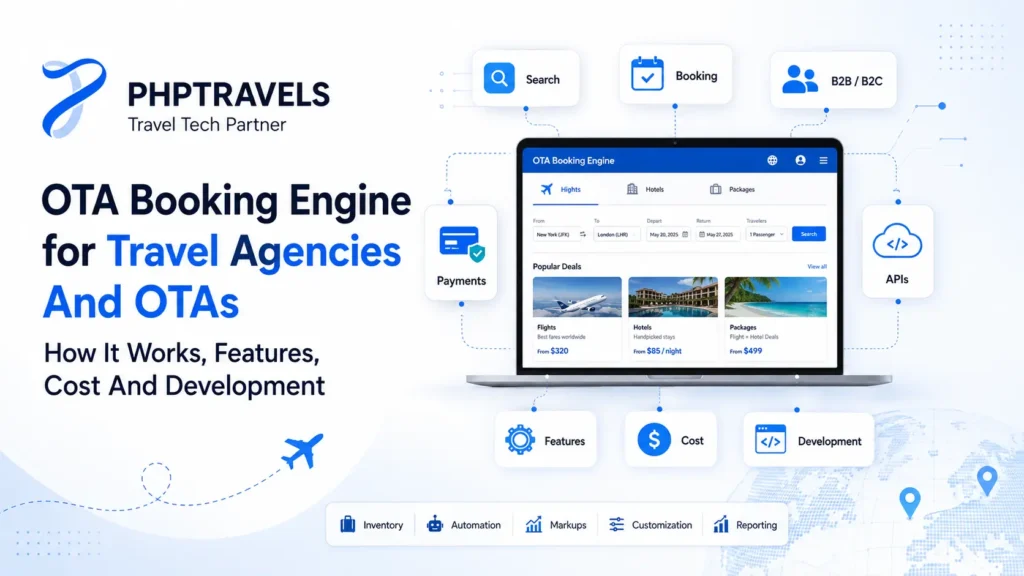
An OTA booking engine is software that allows travel agencies and online travel agencies to search live travel inventory, apply pricing and business rules, accept payments, and confirm bookings online.
A modern OTA booking engine can connect flights, hotels, tours, cars, transfers, and other travel products through supplier APIs and GDS connections while managing B2B agents, B2C customers, markups, commissions, currencies, vouchers, payments, and reporting from one platform.
For agencies that want to sell travel online without maintaining separate systems for every supplier or service, the booking engine becomes the central layer between travel inventory, the customer-facing website, payments, and back-office operations.
What Is an OTA Booking Engine?
An OTA booking engine, sometimes called an online travel booking engine or Internet Booking Engine (IBE), is the technology used by an online travel agency or travel company to turn live supplier inventory into bookable travel products.
When a traveler searches for a flight, hotel, tour or car, the engine sends the search request to connected inventory sources. It receives availability and pricing, applies the agency’s commercial rules, displays the results and manages the booking process through confirmation.
For a travel agency, this means customers can book online instead of waiting for an agent to manually check several supplier systems.
For an OTA, it provides the infrastructure required to operate a scalable online booking business.
OTA Booking Engine vs Travel Booking Engine
The terms OTA booking engine and travel booking engine are closely related, but they can describe slightly different scopes.
| Technology | Main Purpose |
|---|---|
| OTA Booking Engine | Powers an online travel agency that sells multiple travel products online |
| Travel Booking Engine | Broader term for software that searches and books travel inventory |
| Travel Booking System | May include booking, customer, payment and operational management |
| GDS / API | Provides inventory or booking connectivity; it is not the complete customer booking platform |
| Reservation System | Records and manages reservations, often as part of a larger booking platform |
A complete OTA platform normally combines several of these layers.
The booking engine controls the customer journey, while supplier APIs or GDS connections provide inventory and the back office manages reservations, agents, accounting rules and reporting.
How Does an OTA Booking Engine Work?
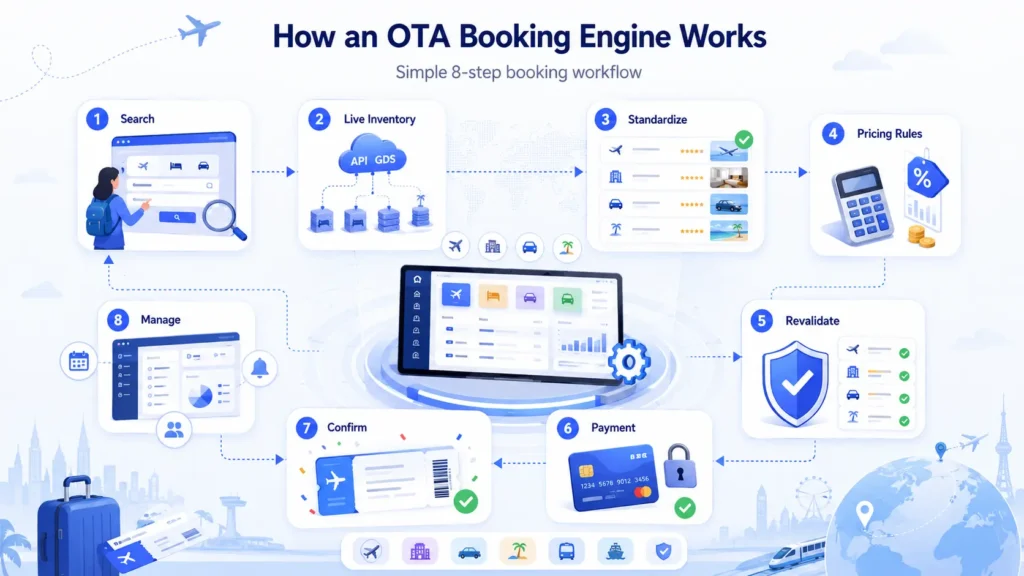
A typical OTA booking workflow contains eight stages.
1. Customer Searches for Travel
The traveler enters a destination, dates, number of passengers, rooms, or other travel preferences.
2. Booking Engine Requests Live Inventory
The platform sends search requests to connected GDS systems, travel APIs, direct suppliers, or contracted inventory.
3. Results Are Collected and Standardized
Different suppliers can return data in different formats. The OTA booking software organizes those results into a consistent format for the customer.
4. Markups and Pricing Rules Are Applied
The agency can automatically apply:
- Markups
- Commissions
- Service fees
- Discounts
- B2B pricing
- Agent-specific rates
5. Price and Availability Are Revalidated
Before confirmation, the booking engine can verify that the selected travel product is still available at the expected rate.
6. Customer Completes Payment
The traveler proceeds through checkout using the payment gateways enabled by the agency.
7. Booking Is Confirmed
The reservation is created through the connected supplier or GDS and confirmation details are returned to the platform.
8. Post-Booking Management Begins
The system can generate invoices, vouchers, confirmation emails, booking records, and reports for customers, agents, and administrators.
Core Features of an OTA Booking Engine
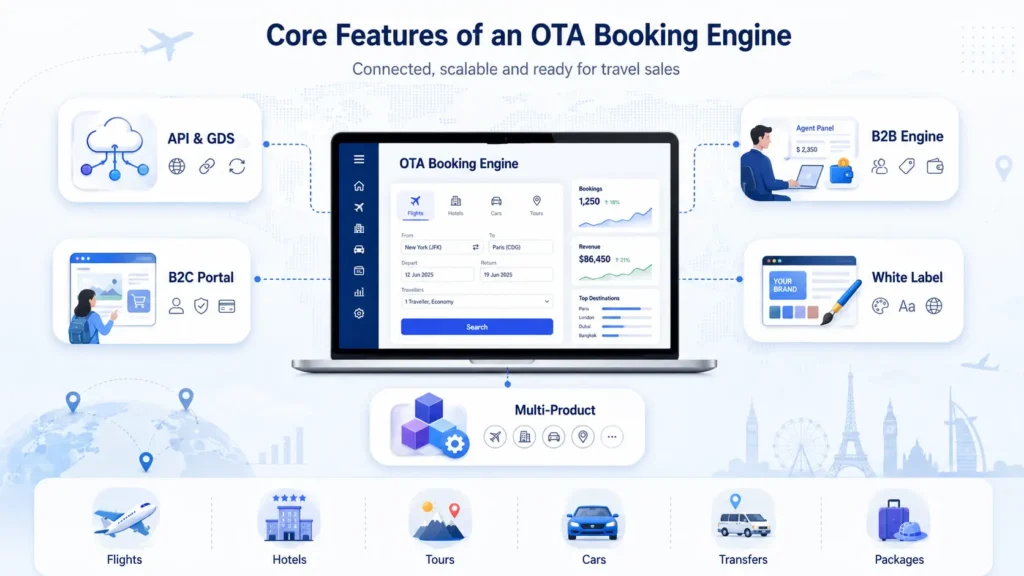
1. Real-Time Travel API and GDS Integration
A professional OTA booking engine connects with travel APIs, GDS platforms, and suppliers to retrieve real-time rates and availability.
This allows travelers to search available flights, hotels, tours, transfers, and rental cars without the agency manually updating inventory.
Travel businesses can integrate suppliers such as Amadeus, Sabre, Travelport, Hotelbeds, TBO, Viator, and other supported inventory providers depending on their business requirements.
Custom travel API integrations can also connect niche suppliers, local inventory, or proprietary travel systems.
2. White-Label and Private-Label Booking Engine
A white-label OTA booking engine allows travel agencies to operate the booking experience under their own branding.
Depending on the platform, agencies can customize:
- Domain name
- Logo
- Brand identity
- Booking interface
- Currency
- Languages
- Email templates
- Payment gateways
A private-label booking engine can be especially useful for agencies that want to launch a branded online travel business without developing the entire reservation infrastructure from scratch.
3. B2C Travel Booking Portal
An OTA can sell directly to travelers using a customer-facing B2C booking engine.
Customers can search travel products, compare available options, enter traveler details, complete payment, and receive confirmation through the agency’s website.
Typical B2C functionality can include:
- Guest checkout
- Customer accounts
- Promotional codes
- Multiple payment gateways
- Multiple currencies
- Booking history
- Mobile-responsive booking
- Automated invoices and vouchers
4. B2B Travel Booking Engine
A B2B travel booking engine enables agencies, sub-agents, corporate customers, and distribution partners to make reservations through controlled accounts.
B2B capabilities can include:
- Agent logins
- Agent-specific markups
- Commissions
- Wallet balances
- Credit limits
- Corporate accounts
- Booking management
- Separate pricing rules
This allows travel companies to grow their distribution network without manually handling every agent reservation.
5. Multi-Module OTA Booking Platform
A modern OTA booking platform can support multiple travel products within the same system.
These can include:
- Hotels
- Flights
- Tours
- Activities
- Cars
- Transfers
- Packages
Using one platform for multiple products makes it easier to manage reservations, customers, agents, pricing rules, and reports centrally.
6. Mobile-Responsive Booking Experience
A travel booking website should work smoothly across desktop, tablet, and mobile devices.
A responsive OTA booking engine allows travelers to search, compare, book, and pay without unnecessary friction regardless of the device being used.
7. Payment Gateway and Multi-Currency Support
An OTA booking system should support payment methods appropriate for the markets in which the business operates.
Depending on the selected platform and integrations, agencies may support multiple payment gateways, currencies, and payment workflows.
Payment security should be evaluated together with the requirements of the selected gateway and payment provide
8. Markups, Commissions and Revenue Controls
Travel businesses need control over how supplier rates become customer-facing prices.
An OTA booking platform can help agencies manage:
- Fixed markups
- Percentage markups
- Agent commissions
- Service charges
- Discounts
- B2B rates
- B2C rates
These controls allow agencies to manage different commercial models from a central platform.
Hotel Booking Engine for Travel Agents
A hotel booking engine for travel agents connects accommodation inventory with the agency’s customer or agent portal.
Inventory may come from hotel suppliers, bedbanks, direct contracts or other integrations.
The platform can then display room options, rates, policies and availability while applying the agency’s markup or commission rules.
For B2B agencies, hotel booking functionality can also be combined with agent-specific prices, credit limits and reservation management.
This is different from a hotel website’s direct booking widget because a travel-agency hotel engine may aggregate accommodation from many suppliers instead of representing only one property.
Flight, Tour and Car Rental Booking Engines
The same booking architecture can support additional travel products.
A flight booking module can connect airfare inventory and booking operations. A tour booking engine can manage activities or tour inventory, while a car rental booking engine can provide vehicle search and reservation workflows.
For an OTA, keeping these modules within one platform can provide a more consistent checkout and back-office experience.
It also gives the business opportunities to cross-sell additional services instead of relying on a single source of booking revenue.
OTA Booking Software for Travel Agencies vs Consumer OTAs
A common question is whether travel-agent booking tools are the same as consumer OTAs.
They are not.
A consumer OTA focuses primarily on the traveler’s shopping and booking experience.
Travel agency booking software must also consider the operational side of the business, including supplier management, agent access, commissions, markups, credit limits, reporting, vouchers and booking administration.
A modern agency may therefore operate both:
B2C: customers book directly.
B2B: agents and partners book using negotiated commercial rules.
The same underlying inventory can support both channels while pricing and account permissions remain separate.
OTA Booking Engine Development vs Ready-Made Software
One of the most important decisions is whether to develop an OTA booking engine from scratch or configure an existing platform.
| Approach | Best For | Main Consideration |
|---|---|---|
| Custom Booking Engine Development | Businesses with unique workflows or technical requirements | Maximum flexibility but greater development and maintenance responsibility |
| Ready-Made Travel Booking Software | Agencies that want an established booking foundation | Faster implementation with predefined architecture |
| White-Label Booking Engine | Businesses focused on launching under their own brand | Branding and configuration without rebuilding the entire platform |
| API-Based Implementation | Technical teams building their own frontend | More control over user experience while relying on external inventory services |
What Is Included in Travel Booking Engine Development?
Travel booking engine development normally involves more than designing search results pages.
The complete platform may require:
Frontend booking experience: Search, filtering, product details, traveler information and checkout.
Supplier connectivity: Travel APIs, GDS connections and contracted inventory.
Booking logic: Availability checks, pricing rules, revalidation, confirmation and cancellation workflows.
Payments: Payment gateway integration, currency handling and transaction records.
Back office: Reservations, agents, customers, reports and operational controls.
Commercial rules: Markups, commissions, fees, discounts and B2B pricing.
Notifications and documents: Confirmation emails, invoices and vouchers.
Security and access control: Customer, agent and administrator permissions.
Development therefore involves both customer-facing functionality and the operational systems required to keep bookings manageable after checkout.
How Much Does a Travel Booking Engine Cost?
There is no useful single price for every OTA booking engine because the cost depends on what the business needs to launch.
The main pricing factors include the number of booking modules, supplier integrations, GDS connectivity, B2B requirements, customization, white-label requirements, payment gateways, currencies, mobile applications and custom development.
An agency launching a standard branded booking portal will have very different requirements from an OTA connecting several proprietary suppliers and creating custom booking workflows.
When comparing travel booking engine pricing, request a breakdown of what is included rather than comparing only the headline price.
Check whether the quotation includes integrations, setup, branding, support, updates, hosting requirements and custom work.
How to Choose the Best OTA Booking Software
Before selecting a booking engine, evaluate how well the platform matches your real operation.
Check whether it supports the travel products you sell, your required suppliers, B2B and B2C distribution, multiple currencies, your preferred payment methods and the level of branding you need.
You should also evaluate how pricing rules work, how reservations are managed, what happens when a supplier changes a rate, how cancellations are handled and whether your team can access useful reports.
A long list of features is not enough if the platform cannot support the workflows your business uses every day.
OTA Booking Engine for Tour Operators
Tour operators may require a different combination of capabilities from flight- or hotel-focused OTAs.
Along with online sales, a tour operator booking engine may need tour inventory, departure dates, availability, supplier records, agent distribution, booking documents and operational management.
For operators selling through external agents, B2B functionality can provide controlled access to products and commercial terms while keeping bookings in a centralized system.
This helps reduce the need to manage reservations independently across disconnected tools.
What Does a Modern OTA Technology Stack Look Like?
A modern automated travel stack usually contains several connected layers rather than one standalone application.
At the inventory layer are supplier APIs, GDS connections and direct inventory.
The booking engine handles search, product selection, pricing and checkout.
Payment services process transactions.
The back office manages bookings, agents and operational activity.
Reporting gives the business visibility into sales and performance.
B2B and B2C interfaces then provide different ways for customers and partners to interact with the same travel infrastructure.
The strongest architecture is not necessarily the one with the largest number of tools. It is the one where inventory, booking, payment and post-booking information can move reliably through the complete workflow.
Why Agencies Use PHPTRAVELS as a Travel Booking Platform
PHPTRAVELS provides travel booking software for agencies, OTAs and other travel businesses that need multiple booking modules within one platform.
The system can support hotel, flight, tour and car booking workflows alongside travel API and GDS connectivity, B2B and B2C distribution, white-label branding, multi-currency checkout, agent management and reporting.
Businesses that want to evaluate the platform before deciding can test the booking experience through the live demo and review the available pricing options based on their implementation requirements.
Rather than choosing software based only on a feature checklist, test the full journey that matters to your operation:
Search → availability → pricing → checkout → confirmation → back-office management.
That will tell you much more about whether a platform fits your agency than a marketing comparison alone.
Final Thoughts
An OTA booking engine is the operational bridge between travel inventory and an online booking customer.
For travel agencies and OTAs, the right system should do more than display flights or hotels. It should connect inventory, apply commercial rules, support B2B and B2C sales, process bookings and payments, and give the business control over what happens after a reservation is created.
When comparing OTA booking software, focus on the complete booking workflow, supplier connectivity, business model, scalability and level of customization you actually need.
PHPTRAVELS provides a travel booking platform for agencies and OTAs that want to combine multiple booking modules, supplier connectivity, B2B/B2C distribution and back-office management within one system.
Next step: test the live booking workflow, review the available platform options, and compare them against the specific suppliers, travel products and sales channels your business needs.