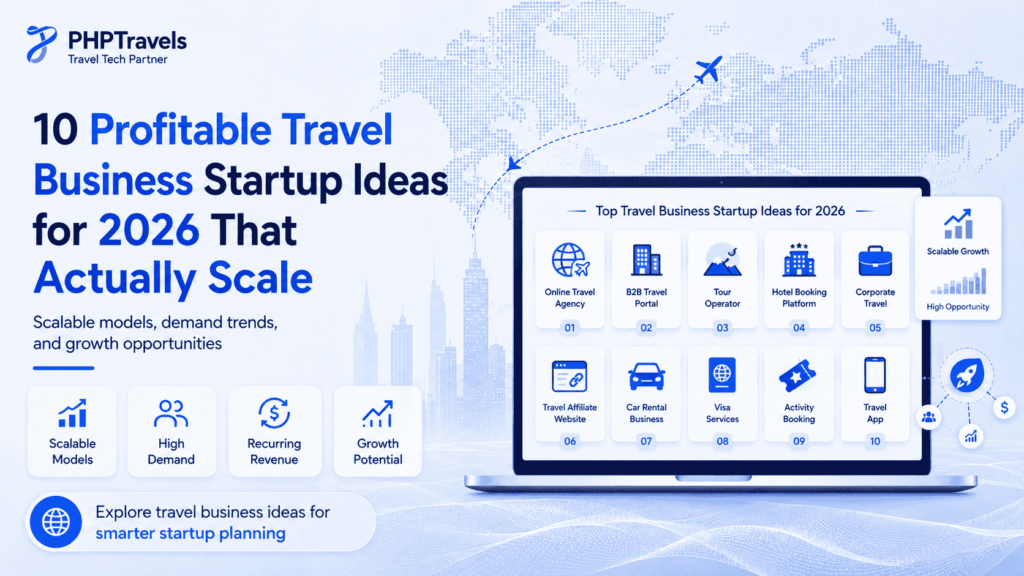
Travel business ideas range from low-cost service models, such as itinerary planning, affiliate content and local tours, to more complex businesses such as online travel agencies and corporate travel management.
The right option depends on your budget, experience, target market, local regulations and whether you want to earn through service fees, booking commissions, package markups, subscriptions or advertising.
This guide compares 10 travel and tourism business ideas by setup difficulty, revenue model, technology requirements and growth potential. Startup costs and earnings vary by country and business model, so use the estimates as planning guidance rather than guaranteed results.
Top 3 Ideas to Start Fast:
- Online travel agency
- Tour guide business
- Travel photography
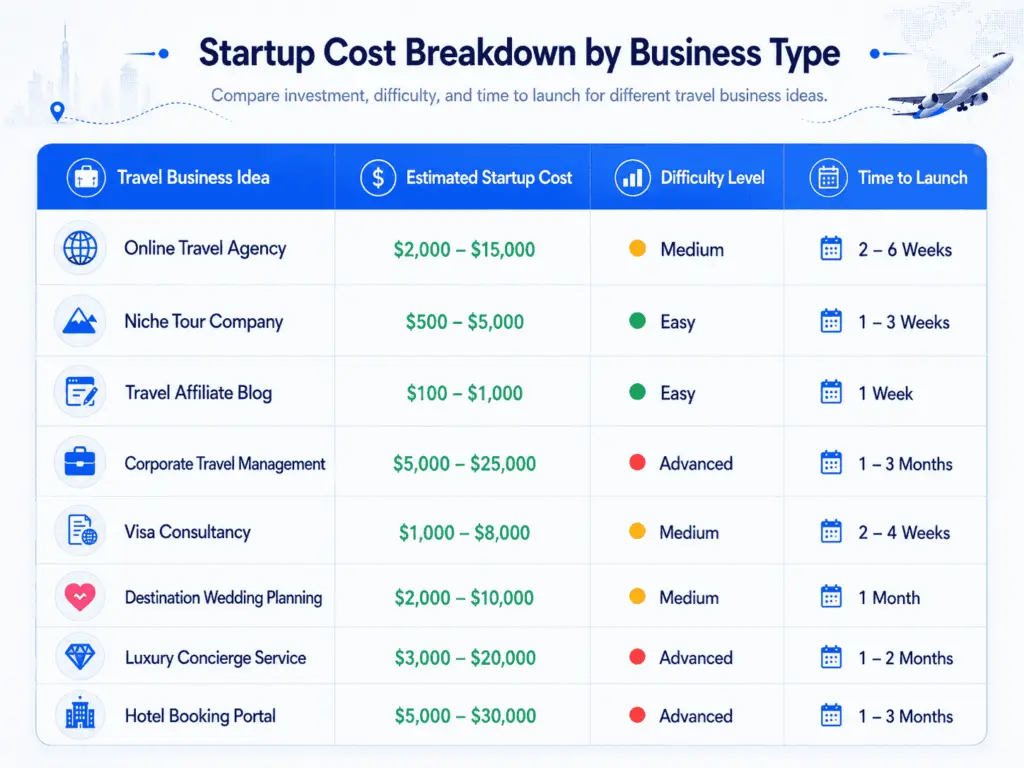
Startup Cost Breakdown Table by Business Type
1. Full-Service Travel Agency
Despite the rise of online travel agencies (OTAs), full-service travel agencies continue to thrive by offering what digital platforms can’t personalized expertise and tailored experiences. Travelers still value the reassurance of a knowledgeable advisor who can manage complex itineraries, exclusive deals, and last-minute changes. A modern full-service agency leverages both human expertise and advanced booking technology, combining the convenience of digital tools with the trust of one-on-one service. Specializing in niches such as luxury vacations, adventure tours, or corporate travel can set your agency apart. By providing curated packages, 24/7 customer support, and insider connections, you can attract loyal clients who seek stress-free planning. For entrepreneurs exploring travel business startup ideas, launching a full-service travel agency offers a profitable opportunity to meet the growing demand for customized travel solutions.
Need a custom travel solution? Talk to our sales team today. ✉ Talk to Sales- Offer curated packages for luxury, adventure, or corporate clients.
- Provide 24/7 customer support, something online portals rarely do.
- Integrate technology like CRM and API connections for flights, hotels, and tours
The value lies in trust and personalization. Clients often prefer dealing with a knowledgeable agent rather than navigating endless online options.
2. Business Travel Planning Company
Corporate travel is a multi-billion-dollar global industry that continues to grow rapidly as businesses expand their reach across borders. Managing corporate travel efficiently is not just about booking flights and hotels it involves complex planning, cost control, compliance management, and seamless coordination.
Startups and tech-driven companies specializing in business travel planning are transforming the way organizations handle corporate trips. These innovative solutions help companies solve critical pain points such as:
- Cost optimization through AI-powered fare comparison and negotiated rates
- Real-time expense tracking and automated reporting for better transparency
- Ensuring travel policy compliance across departments and employees
- Streamlining bookings and approvals to save time and reduce human error
- Enhancing employee safety, productivity, and travel experience
By partnering with a dedicated business travel planning company, organizations can not only save money but also gain valuable insights into travel trends, spending behavior, and compliance gaps. Whether you’re a growing startup or a large enterprise, effective corporate travel management is essential to keep your business agile, efficient, and competitive in today’s global landscape.
Do You Need a License to Start a Travel Business?
Starting a travel business is easier, but understanding the legal requirements is essential before launching your services. Depending on your country, niche, and business model, you may need registrations, licenses, or certifications to operate professionally and build customer trust.
For example, an online travel agency using booking APIs may require different approvals than a local tour guide business or corporate travel management company. The good news is that many travel startups can begin with basic registration and scale their licensing as the business grows.
Business Registration Requirements
Every travel business should begin with proper business registration. This helps you operate legally, open business bank accounts, accept online payments, and build credibility with suppliers and customers.
Depending on your country, you can register as:
- Sole proprietorship
- LLC or limited company
- Partnership
- Corporation
For small startups such as home-based travel agencies or itinerary planning services, registering a simple legal entity is often enough to get started.
Seller of Travel Licenses (US States)
Some US states require travel businesses to obtain Seller of Travel licenses before offering travel services to customers. States such as California, Florida, and Washington have specific compliance requirements designed to protect travelers from fraud and financial risk.
If your startup plans to target US travelers or sell vacation packages internationally, understanding these regulations is important for long-term growth and compliance.
IATA Accreditation
IATA accreditation can improve an agency’s recognition with airline partners and provide access to ticketing and payment workflows through the Billing and Settlement Plan where applicable. The exact accreditation model, financial requirements and ticketing authority depend on the agency’s country and airline relationships.
Although many startups begin by partnering with consolidators or APIs, obtaining IATA accreditation later can improve industry credibility and unlock additional revenue opportunities.
Tourism Board Approvals
Many countries require travel agencies, tour operators, and destination management companies to register with local tourism authorities. These approvals help businesses operate legally while increasing customer confidence.
For example, businesses offering guided tours, adventure travel, or cultural experiences may need tourism department permissions, especially when working with international tourists.
This is particularly important for:
- Tour guide businesses
- Adventure travel companies
- Cultural exchange programs
- Family travel services
Local Tax Registration
Travel businesses may also require VAT, GST, or local tax registration depending on their country and annual revenue.
Proper tax registration helps:
- accept digital payments
- issue invoices
- work with suppliers
- avoid legal complications
As your travel startup grows, proper accounting and tax compliance become essential for scaling operations professionally.
Liability Insurance Recommendations
Travel involves risks such as cancellations, delays, accidents, or unexpected disruptions. Liability insurance helps protect your business and customers against financial losses.
Professional travel businesses often use insurance coverage for:
- guided tours
- adventure activities
- international travel packages
- group travel management
Insurance also improves customer trust, especially for premium or corporate travel services where reliability and safety are major decision factors.
Ready to launch your travel startup? Get expert advice & custom pricing ✉ Contact SalesTechnology Stack Required for Modern Travel Businesses
Modern travel businesses depend heavily on technology to automate bookings, manage customers, process payments, and deliver a smooth travel experience. Whether you are launching a small travel startup or building a scalable online travel agency, choosing the right technology stack can help reduce manual work, improve customer satisfaction, and grow your business faster.
Different travel business models require different tools and systems. For example, an online travel agency needs booking APIs and payment gateways, while a travel blog focuses more on SEO and affiliate tracking tools. Understanding the right technology for your niche is essential for long-term success in the travel industry.
Online Travel Agency (OTA)
An Online Travel Agency (OTA) requires a strong booking infrastructure to manage hotel reservations, flight searches, and customer payments in real time. The core technology stack usually includes a booking engine, hotel APIs, flight APIs, and secure payment gateways.
Booking engines allow customers to search and reserve travel services instantly, while APIs connect the platform with global travel suppliers and inventory providers. Payment gateways help process transactions securely and support multiple currencies for international customers.
See how PHPTRAVELS powers OTAs & booking engines Live Demo →Modern OTAs also use:
- B2B travel portals
- customer dashboards
- automated invoicing
- booking management systems
- travel CRM software
These technologies help travel startups scale operations efficiently without relying heavily on manual staff.
Tour Agency
Tour agencies need tools that simplify itinerary management, customer communication, and booking coordination. A Customer Relationship Management (CRM) system helps manage inquiries, leads, repeat travelers, and follow-ups.
An itinerary builder allows agencies to create customized travel plans quickly, while WhatsApp integration improves customer communication through instant updates and support.
Additional useful tools include:
- booking management software
- scheduling systems
- tour inventory management
- email automation tools
These technologies help tour operators improve organization and deliver a better customer experience.
Travel Blog
Travel blogs rely more on content publishing, SEO optimization, and affiliate marketing tools than booking systems. Most travel bloggers use WordPress because it is flexible, easy to manage, and optimized for search engines.
SEO tools help bloggers rank for travel-related keywords and attract organic traffic from Google. Affiliate tracking software allows bloggers to earn commissions from hotel bookings, tours, flights, or travel products.
Common travel blogging tools include:
- keyword research tools
- email marketing platforms
- analytics dashboards
- social media scheduling tools
- affiliate management software
Successful travel blogs combine strong content strategies with SEO and monetization systems to generate passive income over time.
Corporate Travel Management
Corporate travel businesses require more advanced systems because they manage employee travel, reporting, invoices, and business expenses at scale.
Most corporate travel companies use:
- GDS/API integrations
- invoicing software
- reporting dashboards
- expense management systems
- CRM platforms
Global Distribution Systems (GDS) connect agencies with airline, hotel, and transportation inventory worldwide. Reporting and invoicing tools help businesses manage corporate accounts efficiently while maintaining transparency and compliance.
Automation is especially important in corporate travel because companies expect fast bookings, detailed reports, and 24/7 support.
Visa Consultancy
Visa agencies focus heavily on document handling, appointment management, and customer tracking. A document management system helps organize passports, application forms, supporting files, and visa records securely.
Appointment scheduling software improves workflow efficiency by allowing clients to book consultations online. CRM systems help agencies track applications, customer communication, and visa processing stages.
Additional useful technologies include:
- cloud storage systems
- automated reminders
- workflow automation tools
- client verification systems
These tools reduce paperwork and improve operational accuracy.
Luxury Travel Services
Luxury travel businesses prioritize customer personalization, premium support, and concierge-style experiences. CRM systems help agencies understand customer preferences, travel history, and special requests.
Concierge automation tools assist with:
- VIP itinerary planning
- reservation coordination
- personalized recommendations
- premium customer communication
Luxury travel brands often combine automation with human support to deliver highly customized travel experiences for high-value clients.
Advanced technologies used in luxury travel include:
- AI-powered personalization
- customer preference tracking
- premium booking systems
- real-time communication tools
These systems help luxury agencies provide seamless high-end travel experiences while maintaining strong customer relationships.
Why Technology Matters in Modern Travel Businesses
The travel industry is becoming increasingly digital and automation-driven. Businesses that invest in scalable booking systems, APIs, CRM software, and automation tools can reduce operational costs, improve booking accuracy, and serve customers more efficiently.
For startups, modern travel technology also creates opportunities to compete with larger agencies by offering:
- faster booking experiences
- real-time inventory
- automated customer support
- global payment processing
- mobile-friendly booking systems
Technology is no longer optional in the travel industry it is one of the most important factors for building a profitable and scalable travel business in 2026.
Top Travel Business Opportunities in 2026
The travel industry in 2026 is full of opportunities, especially for entrepreneurs looking to start with low investment or operate online. As technology and traveler behavior evolve, new business models are emerging that require less capital but offer strong growth potential.
Online Travel Business Opportunities
Starting an online travel business is one of the easiest ways to enter the industry with minimal setup. You can launch from anywhere and scale globally.
- Online travel agency using booking APIs
- Travel blog with affiliate marketing
- Niche travel platforms (luxury, adventure, budget)
- AI-powered trip planning services
These models allow you to automate bookings, earn commissions, and reach international customers without physical offices.
Home-Based Travel Business Ideas
Many travel businesses can now be run from home, making them ideal for beginners and freelancers.
- Home-based travel agent services
- Custom itinerary planning for clients
- Virtual travel consulting
- Managing group tours remotely
With the right tools and marketing strategy, you can build a profitable business without high overhead costs.
Low-Investment Travel Startup Opportunities
If you’re starting with a small budget, there are still plenty of profitable options.
- Tour guide services in your local area
- Travel photography or content creation
- Affiliate travel websites
- Social media-based travel services
These ideas focus more on skills and creativity rather than large financial investment, making them perfect for new entrepreneurs.
3. Travel Photography Business
In today’s digital era, travel and photography go hand in hand especially with the rise of platforms like Instagram, Pinterest, and YouTube. Social media has made photography a vital part of the travel experience, turning it into a profitable business opportunity for creative entrepreneurs.
A Travel Photography Business offers multiple income streams and can be built around a combination of the following models:
- Providing professional travel photo shoots at popular tourist destinations for solo travelers, couples, influencers, and content creators.
- Selling high-quality travel stock photos to brands, advertising agencies, digital publishers, travel blogs, and lifestyle magazines.
- Organizing guided travel photography tours or workshops, where aspiring photographers and tourists can learn and shoot alongside professionals in exotic or iconic locations.
4. Tour Guides Business
Travelers today look for authentic local expertise rather than generic itineraries. Starting a tour guide business is a great way to turn your knowledge of your city into a profitable venture. By offering themed tours such as history walks, food tastings, adventure trails, or nightlife experiences you can create unique value that attracts curious explorers.
To grow your tour guide business, use booking apps and travel platforms for instant visibility. Partnering with hotels, hostels, and travel agencies also boosts referrals and trust. Personalized tours not only help you stand out but also allow you to charge premium prices, especially if your experiences are immersive and tailored to travelers’ interests. With the right marketing and authentic storytelling, your tour guide business can quickly become a top choice for visitors.
- Offer themed tours (history, food, adventure, nightlife).
- Use apps or booking platforms for instant visibility.
- Collaborate with hotels, hostels, and agencies for referrals.
With personalized tours, you can charge premium prices especially if your experiences are unique and authentic.
5. Language Learning Travel Program
Travel is one of the most effective ways to learn a new language. A well-designed language learning travel program combines classroom instruction with real-life cultural immersion, helping learners gain confidence and fluency faster. Instead of just memorizing vocabulary, you practice daily with locals, explore traditions, and understand cultural context.
These programs often include structured lessons, guided tours, and interactive activities such as cooking classes or community events, making learning both educational and enjoyable. Whether you want to improve for career growth, study abroad, or personal enrichment, a travel program offers an immersive experience that traditional classrooms cannot match.
For example:
- Spanish + Salsa classes in Colombia.
- French language plus culinary tours in Paris.
- Mandarin courses paired with cultural exchanges in China.
This model works especially well for young professionals and students who want meaningful travel beyond leisure.
6. Cultural Exchange Programs
In today’s globalized world, more people are eager to explore and understand different cultures. Cultural exchange programs provide a unique opportunity to connect travelers with host families, local communities, or volunteer projects. These programs go beyond traditional travel by offering authentic cultural immersion, language practice, and meaningful relationships.
Through cultural exchange, participants experience daily life in another country, share traditions, and build global friendships. Whether it’s living with a host family, teaching English abroad, or joining volunteer initiatives, cultural exchange programs create lasting memories and valuable skills. They also foster cross-cultural understanding and personal growth, making them ideal for students, professionals, and travelers seeking deeper experiences.
You could design programs for:
- Students seeking international exposure.
- Professionals looking to broaden cross-cultural skills.
- NGOs or institutions supporting social impact projects.
By combining travel, learning, and volunteering, cultural exchanges create experiences people remember for life.
7. Family Adventure Travel
More families today are searching for vacations that balance safety with excitement. A family adventure travel business can meet this demand by creating trips that blend fun activities with peace of mind. From guided nature hikes and camping to water sports, cultural tours, and wildlife encounters, these experiences are designed to engage both children and adults.
Parents want trips that are stress-free yet memorable, while kids look for excitement and discovery. By offering customized itineraries, family-friendly accommodations, and trained guides, a family adventure travel business can provide unique value. Highlighting safety, bonding, and educational elements ensures the journey appeals to all.
With growing interest in meaningful travel, family adventure travel is a thriving niche with lasting potential.
- Kid-friendly itineraries (safari parks, amusement adventures, hiking trails).
- Multi-generation trips that balance fun and comfort.
- Packages with built-in safety and insurance.
Parents value curated family experiences that save them planning stress while ensuring safety
8. Budget-Friendly Travel Services
Not every traveler seeks luxury; many people want to explore the world without draining their savings. This is where budget-friendly travel services play an important role. These services help travelers plan affordable trips by offering cost-effective accommodations, discounted flights, and smart itineraries that maximize experiences without overspending.
Budget travel startups thrive by focusing on value, guiding people toward hidden gems, local dining, and low-cost activities that still deliver memorable experiences. By using travel apps, group packages, and flexible booking options, travelers can enjoy exciting adventures at a fraction of the usual cost.
For students, families, or solo explorers, budget-friendly travel services make global travel accessible, enjoyable, and stress-free proving that unforgettable journeys don’t require luxury prices.
Ideas include:
- Backpacking trip planners.
- Discount group travel packages.
- Subscription services offering deals on last-minute tickets.
With the right marketing, you can build a strong community of budget travelers who share tips and itineraries.
9. Adventure Travel Guide Service
Adventure tourism from hiking and diving to extreme sports is one of the fastest-growing travel segments. An adventure travel guide service can be highly profitable if you specialize in niche experiences.
Examples:
- Guided mountain climbing expeditions.
- Diving tours with licensed instructors.
- Remote camping and eco-travel experiences.
Safety, certifications, and unique routes are your selling points. As travelers chase thrill and authenticity, demand for professional guides keeps growing.
10. Social Network for Travelers
In today’s digital age, one of the most exciting startup opportunities is creating a social network for travelers. Unlike traditional travel agencies or tour guides, such platforms allow people to connect directly with fellow explorers worldwide. Travelers can share tips, post itineraries, review destinations, and even find travel companions for upcoming trips.
- Help travelers connect before or during trips.
- Share itineraries, reviews, and group bookings.
- Offer premium features like verified hosts, safety tools, or AI trip planners.
A dedicated social network for travelers also fosters authentic connections, helping users discover local experiences, budget-friendly options, and hidden gems not found in mainstream guides. By combining community-driven content with features like trip planning, booking recommendations, and safety tips, these networks empower people to travel smarter and more confidently.
Think of it as LinkedIn for travelers a platform where people network based on destinations, trips, or shared experiences. With the right execution, this can scale globally.
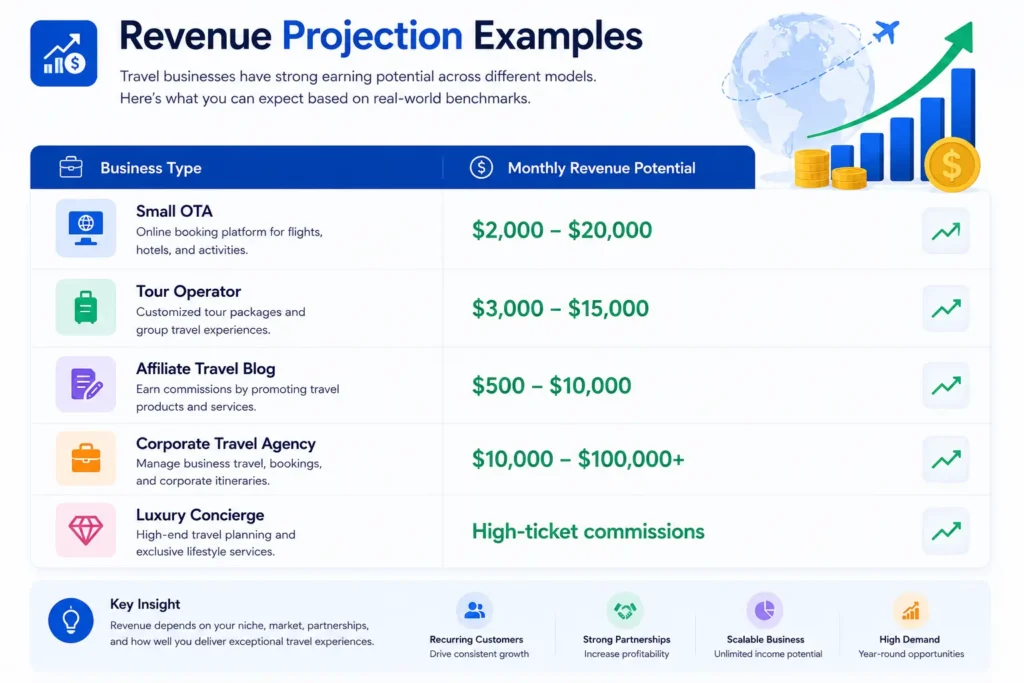
How Much Can a Travel Business Earn?
Final Thoughts
The travel industry is evolving rapidly, and startups that focus on personalization, technology, and experiences will thrive. Whether you start small with a photography or tour guide business, or aim big with a crypto-enabled travel platform, the opportunities are endless.
If you’re serious about launching in 2026, pick one idea, validate demand, and build a minimum viable product (MVP). The sooner you start, the faster you can test, refine, and grow.