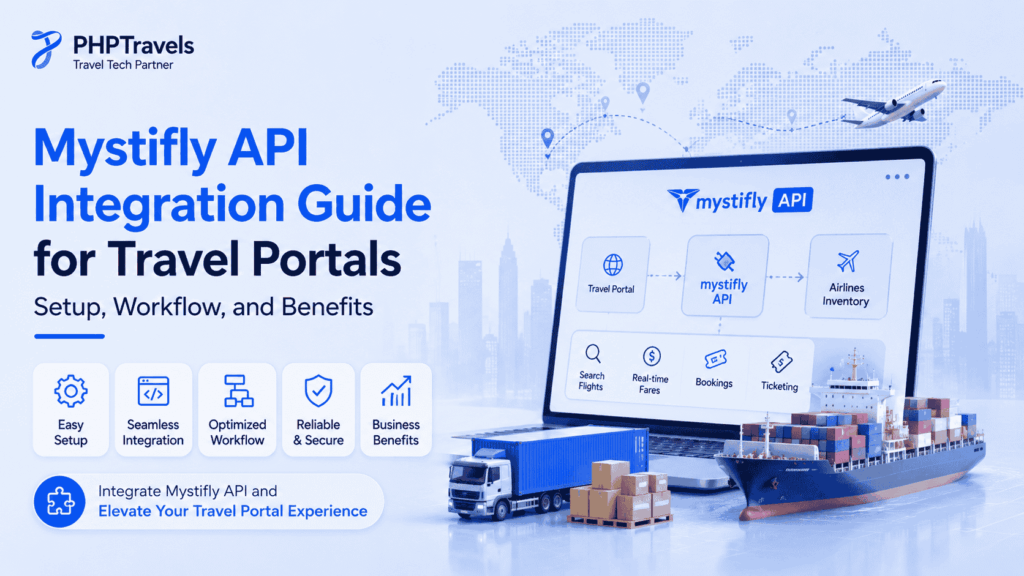
Mystifly API integration is an important step for travel portals that want to sell flights online with real time fares, booking automation, ticketing control, and post-booking servicing. For OTAs, travel agencies, DMCs, wholesalers, and B2B travel companies, the challenge is not only connecting to a flight supplier API. The real challenge is building a reliable flight booking workflow around search, pricing, passenger data, PNR creation, payments, markups, invoices, vouchers, cancellations, and reporting.
A travel portal needs more than airline content. It needs a structured operating system that connects supplier inventory with customer experience, agent management, and back office control.
Quick Summary
Mystifly API integration helps travel portals connect with multi source airfare content and automate flight booking operations.
Key takeaways:
- Mystifly travel API can support flight search, pricing, booking, ticketing, ancillaries, and post-booking workflows.
- A travel portal needs a booking engine layer around the API for payments, markups, agents, vouchers, invoices, and reports.
- Mystifly API setup should be planned around real business workflows, not only technical endpoints.
- B2B travel portals need agent wallets, credit limits, commission rules, and sub-agent controls.
- B2C OTAs need fast search, fare revalidation, secure checkout, instant confirmation, and customer self-service.
- PHPTRAVELS can help connect Mystifly API workflows with a complete travel portal structure for agencies and online travel businesses.
What Is Mystifly API Integration?
Mystifly API integration connects a travel portal, OTA website, B2B booking engine, or travel agency software with Mystifly’s flight distribution platform. Through the API, a travel business can request flight availability, compare fares, validate prices, create reservations, issue tickets, and manage post-booking actions.
In practical travel operations, the Mystifly flight API works as the content and transaction layer. Your travel portal sends requests to Mystifly, receives flight options, displays them to users, and processes the selected itinerary through the booking flow.
A complete Mystifly flight API integration may include:
- Flight search
- Fare quote and revalidation
- Fare rules
- Passenger information submission
- Booking creation
- PNR storage
- Ticketing workflow
- Ancillary services
- Void, refund, and reissue requests
- Booking status updates
- Supplier response handling
For travel portals, this is useful because it reduces dependency on manual fare checking and gives customers or agents a more automated flight booking experience.
Why Travel Portals Need a Flight API Integration
Flight booking is one of the most operationally sensitive parts of travel technology. Airfares change quickly, seats can disappear during checkout, fare rules vary by supplier, and ticketing deadlines are strict.
Without proper air ticketing API integration, travel businesses often face these problems:
- Agents manually check fares across supplier portals.
- Customers wait for offline quotes.
- Fare changes create payment disputes.
- Ticketing teams handle too many repetitive tasks.
- PNR and ticket data is stored in spreadsheets.
- Markups are applied inconsistently.
- Refunds and cancellations are difficult to track.
- Finance teams struggle with supplier reconciliation.
A well planned travel portal flight API solves many of these bottlenecks by connecting inventory, booking logic, payments, documents, and reporting inside one system.
Mystifly API Setup: What You Need Before Integration
Mystifly API setup should start with business planning before developers begin coding. Many travel companies make the mistake of requesting API credentials without defining how bookings, payments, ticketing, and servicing will work.
Commercial Access and API Credentials
The travel business usually needs to complete supplier onboarding before getting production API access. This may include commercial approval, account setup, test credentials, documentation access, and production credentials.
Your team should confirm:
- Which markets and point of sale countries are supported
- Which fare types are available
- Whether content includes GDS, NDC, LCC, or consolidator fares
- Which currencies are enabled
- What ticketing rules apply
- Which post-booking services are supported
- Whether sandbox testing is available
Booking Engine Readiness
The API alone is not the full travel portal. Your booking engine must be ready to receive, process, and display supplier data correctly.
Your system should support:
- One way, round trip, and multi city search
- Adult, child, and infant passenger logic
- Fare family and cabin display
- Baggage details
- Fare rules and penalties
- Repricing before checkout
- Passenger data validation
- PNR and ticket number storage
- Booking status tracking
Payment and Financial Workflow
Before going live, decide how the travel portal will handle payment. This depends on whether your model is B2C, B2B, or hybrid.
A B2C portal usually needs card payments, payment gateway status checks, booking confirmation emails, and customer invoices.
A B2B travel portal usually needs agent wallets, credit limits, agency statements, commissions, and ledger reports.
Mystifly API Workflow for Travel Portals
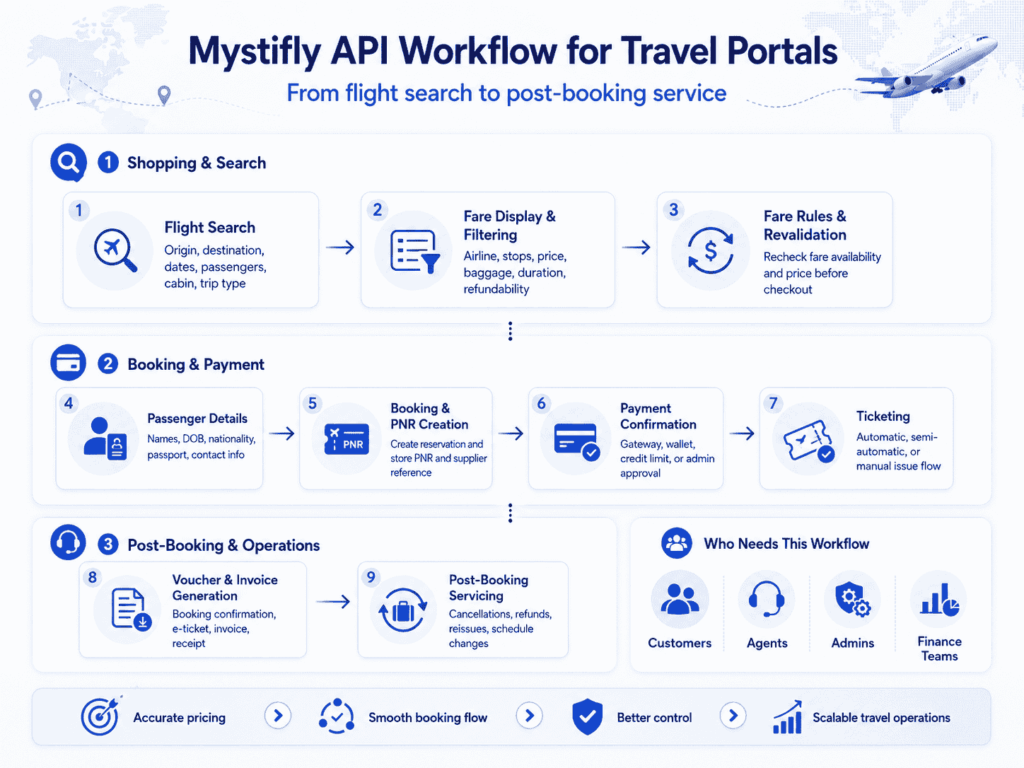
The Mystifly API workflow should follow the real journey from flight search to post-booking service. This workflow must be clear for customers, agents, admins, and finance teams.
1. Flight Search
The user enters origin, destination, dates, passenger count, cabin class, and trip type. The travel portal sends this request through the Mystifly flight booking API.
The response may include airline options, departure and arrival times, routes, stopovers, fares, taxes, baggage, cabin details, and fare source.
For B2C portals, this information must be displayed clearly to help customers compare options. For B2B portals, agents may need additional details such as net fare, markup, commission, and supplier source.
2. Fare Display and Filtering
A good travel portal should not simply show raw API results. It should organize the results for usability and conversion.
Useful filters include:
- Airline
- Departure time
- Arrival time
- Stops
- Price
- Cabin
- Refundability
- Baggage
- Journey duration
This is where user experience directly affects booking conversion. Poor filtering can make even strong airfare inventory difficult to sell.
3. Fare Rules and Revalidation
Before payment or booking confirmation, the system should revalidate the fare. This step checks whether the fare is still available and whether the price has changed.
Fare revalidation is critical because flight prices can change between search and checkout. If this step is skipped, the business may face failed bookings, margin loss, or customer complaints.
4. Passenger Details
The travel portal collects passenger information and validates it before sending the booking request.
Passenger fields may include:
- Full name
- Gender
- Date of birth
- Nationality
- Passport number
- Passport expiry
- Contact details
- Frequent flyer number where applicable
Incorrect passenger data can create ticketing issues, name correction costs, or airline servicing problems.
5. Booking and PNR Creation
After fare validation and passenger submission, the API creates the reservation. The travel portal should store the supplier booking reference, PNR, fare details, passenger details, and booking status.
For B2B portals, the system should also record which agent or sub-agent created the booking, what markup was applied, and whether the booking used wallet balance or credit.
6. Payment Confirmation
Payment workflow depends on the business model.
For B2C, the payment gateway should confirm successful payment before ticketing. For B2B, the system may deduct wallet balance, check credit limits, or allow admin approval.
The booking engine should avoid issuing tickets unless payment or credit rules are satisfied.
7. Ticketing
Ticketing can be automatic, semi-automatic, or manual approval based.
Automatic ticketing works when the business trusts the fare source, payment status, and risk controls. Semi-automatic ticketing is often better for agencies that want admin review before issuing high value or complex itineraries.
The portal should store e-ticket numbers and send confirmation to the customer or agent.
8. Voucher and Invoice Generation
Once the booking is confirmed, the system should generate documents automatically.
These may include:
- Booking confirmation
- E-ticket details
- Customer invoice
- Agent invoice
- Voucher
- Supplier reference
- Payment receipt
For professional travel operations, document automation saves time and reduces errors.
9. Post-Booking Servicing
Real flight operations continue after ticket issuance. Customers may request cancellations, refunds, date changes, or reissues. Airlines may also make schedule changes.
A strong Mystifly API workflow should support post-booking queues where admins can review requests, communicate with suppliers, update statuses, and keep an audit trail.
B2B Mystifly API Integration for Travel Agencies
A B2B flight booking API needs more operational control than a basic customer website. Travel wholesalers and consolidators often serve multiple agents, branches, and corporate accounts.
Important B2B features include:
- Agent login
- Sub-agent hierarchy
- Agent specific markup
- Commission rules
- Credit limits
- Wallet balance
- Deposit management
- Booking approval
- Agent invoices
- Sales reports
- Booking cancellation requests
- Admin control panel
In B2B operations, the same Mystifly airfare may be sold at different prices to different agents based on commercial agreements. The travel portal must calculate this correctly and keep financial records clean.
B2C Mystifly API Integration for OTAs
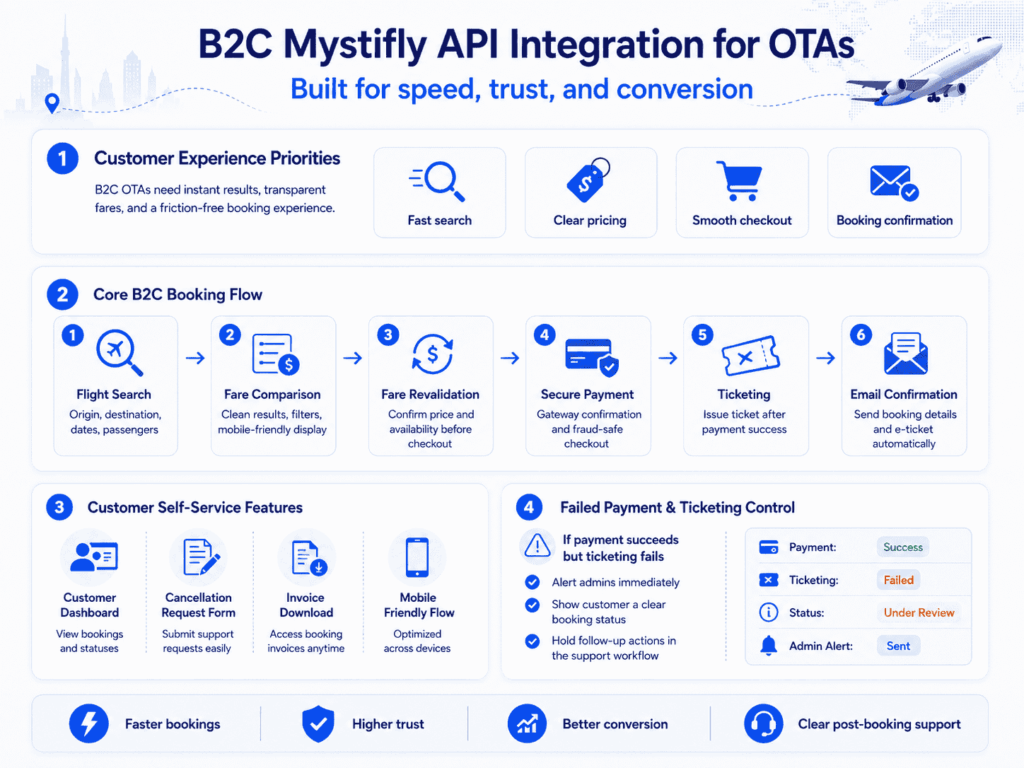
For B2C OTAs, the priority is speed, clarity, trust, and conversion. Customers expect instant results, transparent pricing, smooth checkout, and booking confirmation.
A B2C online travel agency flight API workflow should include:
- Fast flight search
- Clean fare comparison
- Mobile friendly booking flow
- Fare revalidation
- Secure payment
- Automated email confirmation
- Customer dashboard
- Cancellation request form
- Invoice download
B2C portals should also manage failed payment cases carefully. If a payment succeeds but ticketing fails, the system must alert admins immediately and show the customer a clear booking status.
Dynamic Pricing, Markups, and Commission Control
Flight API integration becomes commercially useful only when the travel portal can apply business rules on top of supplier fares.
A travel portal may need:
- Fixed markup per passenger
- Percentage markup
- Route based markup
- Airline based markup
- Cabin based markup
- Agent level markup
- Customer group pricing
- Service fees
- Currency conversion
- Commission deductions
For B2B travel businesses, markup layers can become complex. A wholesaler may add a margin, then agents may add their own service fee before selling to the traveler. The system must show the right price to each user while keeping admin level reporting accurate.
Manual vs Automated Mystifly API Workflows
Travel businesses usually move through three operational stages when adopting Mystifly API integration.
| Workflow Type | How It Works | Best For | Main Benefits | Common Limitations |
|---|---|---|---|---|
| Manual Flight Booking | Agents search fares manually, send quotes through email or chat, collect payment, and issue tickets through supplier portals. | Small agencies with low booking volume or highly customized service. | Flexible for complex requests and does not require advanced system setup. | Slow response time, higher human error risk, limited reporting, inconsistent pricing, and dependency on experienced ticketing staff. |
| Semi-Automated Booking | The travel portal handles flight search, fare display, passenger data, and payment, but ticketing requires admin approval. | Agencies that want online booking capability while keeping control over supplier risk and payment verification. | Balances automation with operational control, reduces manual search work, and allows admin review before ticketing. | Ticketing can still be delayed if admin approval is slow, and internal teams must monitor booking queues carefully. |
| Fully Automated Booking | The system handles search, fare revalidation, payment, ticketing, invoice, voucher, and confirmation with minimal staff involvement. | OTAs, high volume agencies, and scalable B2C or B2B travel portals. | Faster booking confirmation, reduced manual work, consistent pricing rules, better scalability, and improved customer experience. | Requires strong error handling, reliable payment checks, well tested supplier workflows, and clear fallback processes for failed bookings. |
Common Mistakes in Mystifly API Integration
Many travel portal projects fail because the integration is planned only from a developer’s perspective.
Common mistakes include:
- Starting development before defining the booking workflow
- Not testing fare revalidation properly
- Ignoring ticketing failure scenarios
- Not storing PNR and ticket data correctly
- Weak handling of supplier timeout errors
- No admin queue for refunds and reissues
- Poor markup and commission logic
- Missing wallet and credit control in B2B portals
- No invoice reconciliation with supplier bookings
- Testing only simple one way flights and ignoring edge cases
A proper Mystifly API integration guide should include both technical testing and operational testing.
Benefits of Mystifly API Integration for Travel Portals
Mystifly API integration can provide strong benefits when it is implemented with the right booking platform and business workflow.
Faster Flight Selling
Agents and customers can search live airfare options without waiting for manual quotes. This improves response time and supports online booking.
Better Inventory Access
A multi source flight API can help travel businesses access broader flight content from different distribution sources through one integration layer.
Improved Booking Automation
Search, fare validation, booking, ticketing, invoices, and vouchers can be connected into one workflow, reducing repetitive admin tasks.
Stronger B2B Control
Travel agencies and wholesalers can manage agent pricing, wallet balances, credit limits, commissions, and reports through the travel portal.
Cleaner Financial Operations
Automated invoices, booking records, payment logs, and supplier references make reconciliation easier for finance and back office teams.
Better Customer Experience
Customers receive faster search results, clearer pricing, booking confirmation, e-ticket details, and post-booking support options.
How PHPTRAVELS Fits Into Mystifly API Integration
After the Mystifly API setup is planned, the next step is building the travel portal layer around it. This is where PHPTRAVELS fits naturally.
PHPTRAVELS can help travel businesses create a B2B or B2C travel portal that connects flight API workflows with real operational features. Instead of treating Mystifly API as a standalone connection, PHPTRAVELS helps structure the full booking journey from search to confirmation and back office management.
PHPTRAVELS can support travel portal requirements such as:
- Flight booking engine
- B2B and B2C portal workflows
- Agent management
- Markup and commission rules
- Payment gateway integration
- Booking management
- Invoice and voucher generation
- Admin dashboard
- Supplier API connectivity
- Custom workflow support
For agencies, OTAs, DMCs, and tour operators, this platform layer is important because the API provides flight content, while the portal manages how that content is sold, controlled, paid for, and serviced.
Practical Checklist Before Going Live
Before launching Mystifly API integration, review the full workflow.
Your travel portal should be ready for:
- API authentication
- Sandbox testing
- Search response handling
- Fare revalidation
- Passenger validation
- Booking creation
- PNR storage
- Ticket number storage
- Payment success and failure cases
- Markup calculation
- Agent wallet deduction
- Invoice generation
- Cancellation and refund requests
- Admin alerts
- Supplier timeout handling
- Reporting and reconciliation
A launch should not be based only on successful test bookings. It should include failed bookings, fare changes, payment errors, duplicate requests, refund cases, and post-ticketing scenarios.
Conclusion
Mystifly API integration can help travel portals build a more automated and scalable flight booking operation. It gives travel businesses access to flight content and booking capabilities, but the real success depends on how well the API is connected with the booking engine, payment workflow, pricing logic, agent management, ticketing process, and back office operations.
For B2C OTAs, the goal is fast search, smooth checkout, and reliable confirmation. For B2B travel agencies, the goal is agent control, markup flexibility, credit management, and clean reporting. For tour operators and DMCs, the goal is to add flights into broader travel packages and manage the complete itinerary.
With PHPTRAVELS, travel businesses can build the operational layer required to use Mystifly API effectively inside a modern travel portal.