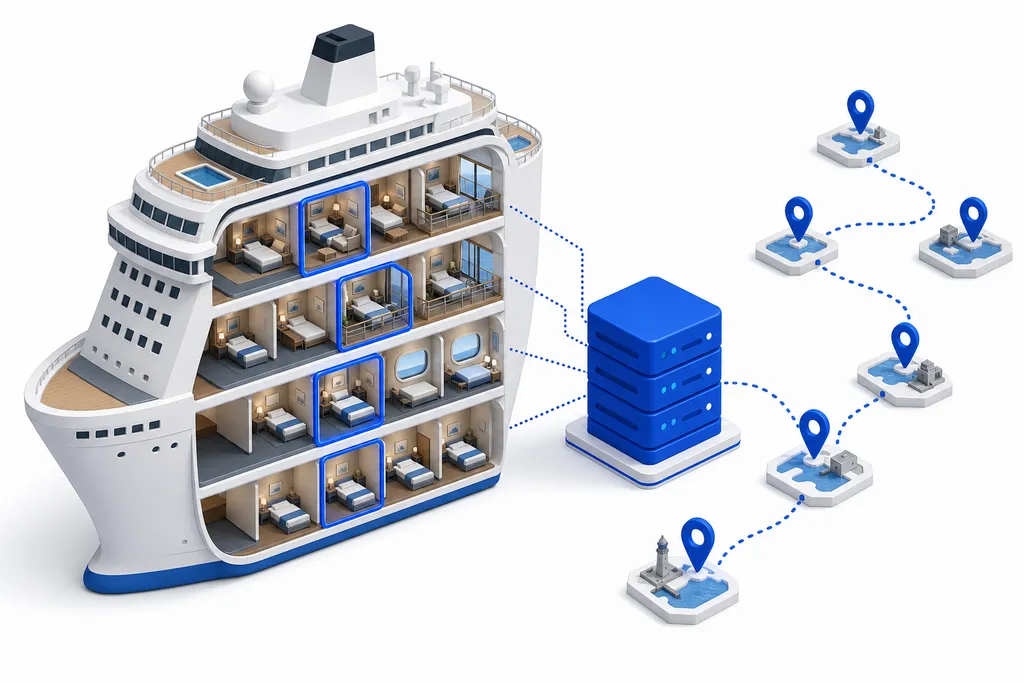
Cruises API for agencies: sailings, cabins and payment schedules
A cruise API lets your website show live sailings, price cabin categories and create cruise bookings with the cruise line. This page explains what the data looks like, how cabins and payments work, and the two ways to put cruise inventory on your own PHPTRAVELS site.
Sailings and itineraries
Cabin categories and deck plans
Deposits and final payment
Custom cruise integrations
What a cruise API returns
One sailing, described in data
A cruise is sold as a sailing: one ship, one itinerary, one departure date. Every cruise API, whatever its format, is built around that unit.
A search sends a region, a month or date range, a duration and the number of guests. The response is a list of sailings, each with the ship, the cruise line, the embarkation and return dates, the ports of call with their times, the days at sea and a lead price per person for each cabin category still open.
From there, further calls price a chosen category for the real guests, list the cabins you can pick, place a booking and take payments against it. Line names and formats differ, so a platform maps every source to the same sailing, cabin and booking model before a guest sees it.
Cruise line
Your partner line
Partner ship · 7 nights
Open
Embarks
2027-05-15
Returns
2027-05-22
Itinerary
D1Southampton--:-- · 17:00
D2At sea
D3Bruges (Zeebrugge)08:00 · 18:00
D4Amsterdam09:00 · 19:00
D5At sea
D6Copenhagen07:00 · 17:00
D7Oslo09:00 · 16:00
D8Southampton07:00 · --:--
Illustrative record, not any one cruise line's format.
Cabin categories
Four steps up the ship: inside, ocean view, balcony, suite
Under each sailing, a cruise API lists cabin categories. They are the main price driver, and each one moves several things at once.
01InsideNo window
The entry price of the sailing. Lines often split it into several categories by deck and position, each with its own code.
Price level
02Ocean viewWindow or porthole
A step up for natural light. Some categories have an obstructed view, which the API marks in the category description.
Price level
03BalconyPrivate veranda
A private outdoor space, with categories that change by deck height and midship or aft position.
Price level
04SuiteBalcony and living area
The top of the price list, often with extras attached to the fare, and the categories most likely to be sold as a specific cabin.
Price level
Category codes and fare codes
Each category has a code, and each sailing can be sold under several fare codes: standard fares, promotional fares and group or agency rates. The same cabin can carry different prices and conditions depending on the fare code.
Guarantee or specific cabin
With a guarantee booking, the guest buys a category and the line assigns the cabin later, at that category or better. A specific cabin booking fixes the cabin number at the time of booking. Many lines price the two differently.
Cabin selection
Pick the cabin on the deck plan
When a line allows specific cabin booking, the API returns the cabins still available in the chosen category, with deck, position and how many guests each one sleeps.
Deck 9
Select a cabin
ForwardAft
0814
242636
Corridor
29
011119
Inside
Ocean view
Balcony
Suite
Not available
Cabin 9110
Inside
Interior cabin, the lowest price on this deck. Sold as a specific cabin or as a guarantee.
Ocean view
Window cabin at the bow, where the hull curves. The API returns its view note with the category.
Balcony
Midship balcony cabin. Position on the deck is often a separate category with its own price.
Suite
Aft-facing suite with a larger balcony. Usually booked as a specific cabin, not a guarantee.
1.List the cabinsAfter the guest picks a category, the platform asks the line for the open cabins in it and draws them on the deck.
2.Hold the cabinMany cruise APIs let you hold the chosen cabin for a short time while the guest enters names and pays.
3.Book itThe booking confirms the cabin number, the guests and the fare code, and the line returns its booking reference.
In the PHPTRAVELS Cruises, ships carry their decks and cabin categories and guests choose with the facts in front of them, whether the cabins are yours or come from a connected line.
Payment schedule
Deposit now, the rest before sailing
Cruises are booked months ahead and paid in stages. The cruise line sets the dates and amounts for each sailing and fare, and the API returns them with the booking.
01
Booking and deposit
The guest pays a deposit set by the line, per person or per booking, to confirm the cabin.
02
Final payment due
The balance is due by a date the line sets before departure. Unpaid bookings can be cancelled by the line after it.
03
Documents
Once paid in full, the line releases the cruise documents and the guest completes check-in details.
04
Sailing day
The guest embarks. Changes after this point are handled on board or under the line's rules.
Cancellation penalties by window
Deposit windowPenalty growsHighest penalty
The closer to sailing, the more of the fare is kept on cancellation. The windows and percentages belong to each line and fare, so a cruise API sends them with the booking and your platform shows them to the guest before payment.
When you sell your own contracted sailings, the Cruises works the same way: you set the deposit and the balance due date per sailing, and outstanding balances are tracked in the admin until they are paid.
Pricing in cruise
How a cruise price is built
Cruise prices read differently from hotel or flight prices. A cruise API returns the parts separately, and your booking engine has to put them together the same way the line does.
On top of the line's price, PHPTRAVELS applies your markups and commissions by ship, sailing or channel, and agents in the B2B travel portal see their own net fares.
A
Per person, not per cabin
Cruise fares are quoted per guest. A cabin for two costs twice the per-person fare, and the API prices each guest by age and position in the cabin.
B
Based on double occupancy
Lead prices assume two guests sharing. Third and fourth guests usually pay a lower fare, and a guest sailing alone pays a single supplement.
C
Taxes, fees and port charges
Government taxes, fees and port charges are added per person on top of the cruise fare. Show them as their own lines so the total holds no surprises.
D
Onboard credit and extras
Some fares include onboard credit, a drinks package or gratuities. The API returns these as fare inclusions, and they are a reason two fares for one cabin differ.
How to get cruise inventory
Your own contracts or a cruise line API
There are two routes to cruises on your site. Many agencies start with the first and add the second when volume justifies it.
Ready in the Cruises module
Load your own cruise contracts
Enter the sailings you contract in the admin: ships, decks, cabin categories, port-by-port itineraries, departure dates, per-person fares, seasons, deposits and balance dates. Cruise partners can be given a supplier login to keep their own sailings up to date.
Group space and allocations you hold
Commission per cruise line
Net fares for B2B agents
Live from the day you install
Custom integration
Connect a cruise line or consolidator API
There is no ready cruise connector in the PHPTRAVELS integration list. Because every plan includes the full source code, a cruise line or cruise consolidator API is connected as a Custom API integration, mapped to the same sailings, cabins and bookings the module already shows.
You sign with the cruise line or consolidator
You receive and keep the API credentials
The connector maps sailings, categories and cabins
Bookings, payments and cancellations follow the line's rules
A cruise API is a set of web services a cruise line or cruise consolidator opens to travel sellers. Your system uses it to search sailings, read itineraries, price cabin categories, list available cabins, place bookings and take deposit and final payments.
No. The Cruises module is built around inventory you manage yourself: ships, cabin categories and sailings you contract. A connection to a specific cruise line or consolidator is developed as a custom integration on the included source code.
You apply to the cruise line or a cruise consolidator as a travel seller. Access terms differ by line and market. You sign the agreement and receive the credentials yourself; PHPTRAVELS never provides supplier credentials.
A guarantee booking secures a cabin category at a set price, and the cruise line assigns the actual cabin later, at that category or higher. A specific cabin booking fixes the cabin number at the time of booking.
The cruise line sets them per sailing and fare, and its API returns them with the booking. For sailings you load yourself, you set the deposit and the balance due date per sailing in the admin.
Cruise fares are quoted per guest, usually based on two guests sharing a cabin. Third and fourth guests pay their own fares, a solo guest pays a single supplement, and taxes, fees and port charges are added per person.
Yes. Agents book in the B2B portal with their own net fares and commissions and pay from their agent wallet, from the same installation as your public site.
The Enterprise plan includes the PHPTRAVELS REST API and webhooks with documentation, and every plan includes the full source code, so your developers can extend the cruise booking engine or connect it to other systems.
Start with the sailings you already contract, loaded into the Cruises module, and see how they sell. When a cruise line partnership or volume makes it worth it, add that line's API through a custom integration.
We use Google cookies to measure which ads bring visitors and enquiries, and to show you relevant ads. Accept to allow them, or reject to keep only the cookies the site needs to work. Privacy statement