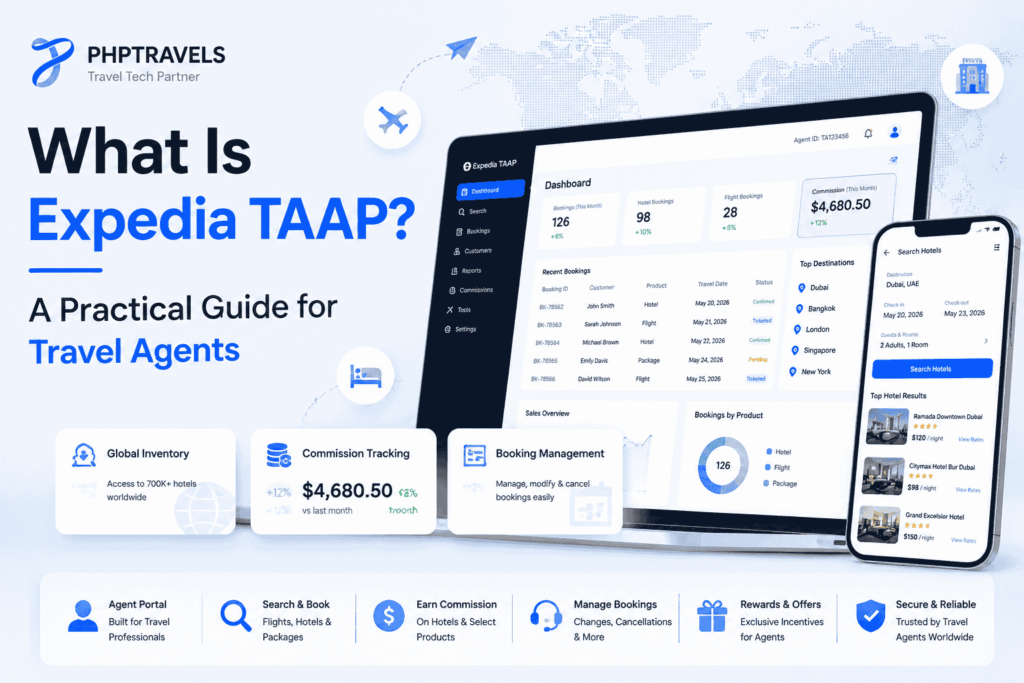
Independent travel agents and small agencies often hear about Expedia TAAP but rarely get a clear explanation of what is Expedia TAAP, how it works in daily operations, and where its strengths and limits sit. This guide explains the platform from a practical industry perspective, focusing on how agents actually use it rather than how it is marketed.
What Is Expedia TAAP and How It Works for Travel Agents
Expedia TAAP is part of the broader Expedia Group ecosystem, which operates multiple global travel brands serving both consumers and travel professionals.
Rather than sending customers to public booking websites, agents use a dedicated agent portal to control the booking process themselves. This allows agents to quote prices, confirm reservations, handle changes, and earn commission while keeping ownership of the client relationship.
For many agencies, Expedia TAAP acts as a transition tool between traditional offline selling and more structured digital operations.
Who Expedia TAAP Is Designed For
Expedia TAAP for travel agents is built for agencies that sell directly to customers but do not operate their own large scale booking infrastructure.
It is commonly used by independent agents, small to mid size agencies, and offline agencies moving online. These businesses typically want access to global inventory and commission earning opportunities without negotiating individual supplier contracts.
It is not designed to function as a full agency management system. It supports selling, not complete business automation.
How Travel Agents Use Expedia TAAP in Daily Operations
Searching and Quoting Travel Products
Agents use the Expedia TAAP agent portal to search hotels, flights, and packages while communicating with clients. Quotes are usually shared by email or messaging, based on live availability and pricing at the time of search.
Because prices are dynamic, agents often confirm availability again before finalizing a booking.
Booking on Behalf of Clients
Bookings are made under the agent account, but traveler details belong to the customer. The agent controls the booking, payment method, and confirmation process.
This structure allows agents to remain the primary point of contact instead of pushing clients toward self service consumer platforms.
Managing Changes and Cancellations
Expedia TAAP allows agents to manage post booking changes directly through the portal. Amendments and cancellations are subject to hotel or airline policies, but the agent remains in control of the request.
This is particularly important for service oriented agencies that handle changes frequently.
Expedia TAAP Flights and Hotel Inventory
Hotel Inventory
Expedia TAAP provides access to a broad range of hotel inventory worldwide. Hotel booking engine this includes international chains, regional brands, and independent properties.
Agents can see refundable and non refundable rates, room only or meal inclusive options, and promotional pricing when available. Inventory and pricing depend entirely on supplier conditions.
Flights
Expedia TAAP flights allow agents to book air tickets across multiple airlines. Fare rules are set by airlines, not by Expedia TAAP.
Agents should clearly explain change and cancellation conditions to clients, as airline penalties can apply even when bookings are made through the agent portal.
Understanding Expedia TAAP Commission Structure
How Expedia TAAP Commission Works
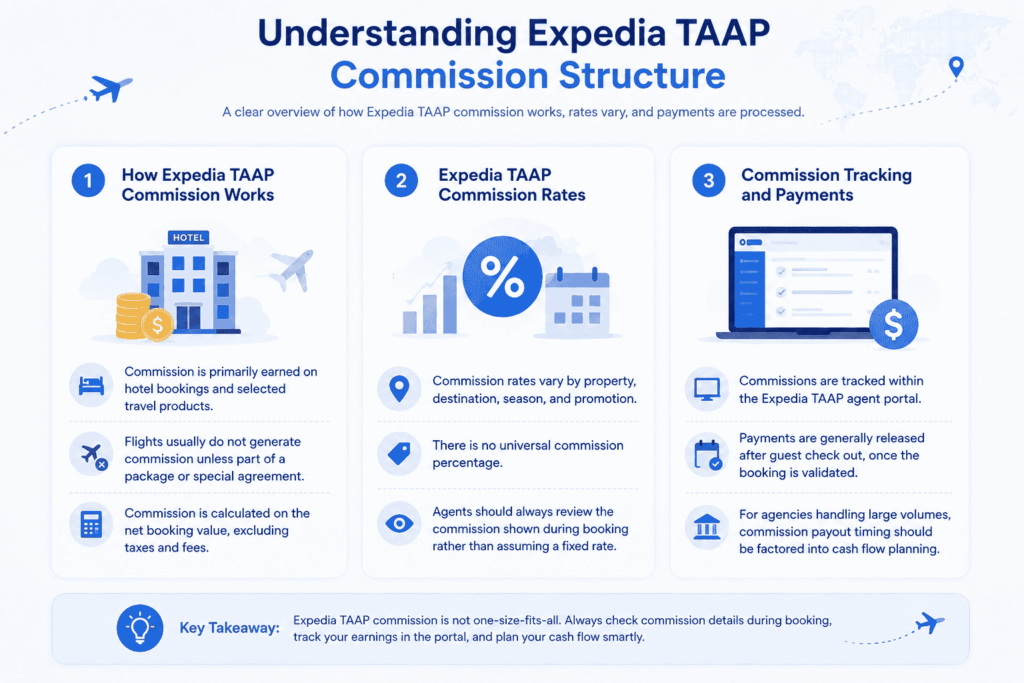
Expedia TAAP commission is primarily earned on hotel bookings and selected travel products. Flights usually do not generate commission unless part of a package or special agreement.
Commission is calculated on the net booking value, excluding taxes and fees.
Expedia TAAP Commission Rates
Expedia TAAP commission rates vary by property, destination, season, and promotion. There is no universal commission percentage.
Agents should always review the commission shown during booking rather than assuming a fixed rate.
Commission Tracking and Payments
Commissions are tracked within the Expedia TAAP agent portal. Payments are generally released after guest check out, once the booking is validated.
For agencies handling large volumes, commission payout timing should be factored into cash flow planning.
Expedia TAAP Rewards and Incentive Programs
Expedia TAAP rewards are offered periodically through incentive campaigns. These may include bonus commissions or points based programs tied to specific booking conditions.
While useful, rewards should be treated as supplementary benefits rather than predictable revenue. They change frequently and are not guaranteed.
Expedia TAAP Login and Agent Portal Access
Getting Access
To use Expedia TAAP, agents must apply and receive approval. Requirements vary by region and business type.
Once approved, agents receive Expedia TAAP login credentials to access the agent portal.
What the Agent Portal Includes
The Expedia TAAP agent portal allows agents to search inventory, create bookings, manage changes, and review commission data. It is designed for agent controlled workflows rather than consumer self booking.
Practical Limitations Agents Should Understand
Despite its strengths, Expedia TAAP has clear limitations.
It does not provide built in CRM or accounting tools
It does not automate internal agency workflows
It offers limited customization
It depends fully on supplier policies
Agents focused on manual selling often find it sufficient. Travel agency management software aiming to scale operations usually encounter these limits sooner.
When Expedia TAAP Makes Sense for an Agency
Expedia TAAP is most effective when agents sell directly to clients, want quick access to global inventory, and prefer commission based selling without managing supplier contracts.
It is less suitable as a standalone solution for agencies seeking high volume automation or centralized multi agent operations.
Connecting Expedia TAAP to a Booking Platform
As agencies grow, many look for ways to reduce manual quoting and reporting. In these cases, Expedia TAAP API integration for B2B and B2C booking engines is often used to connect TAAP inventory with automation, reporting, and multi agent workflows.