
In an industry defined by real-time pricing, global supplier connectivity, razor-thin margins, and increasingly demanding customers, travel technology must evolve faster than ever. Legacy systems, bloated architectures, and patch-based upgrades are no longer sustainable for agencies competing in a digitally accelerated market.
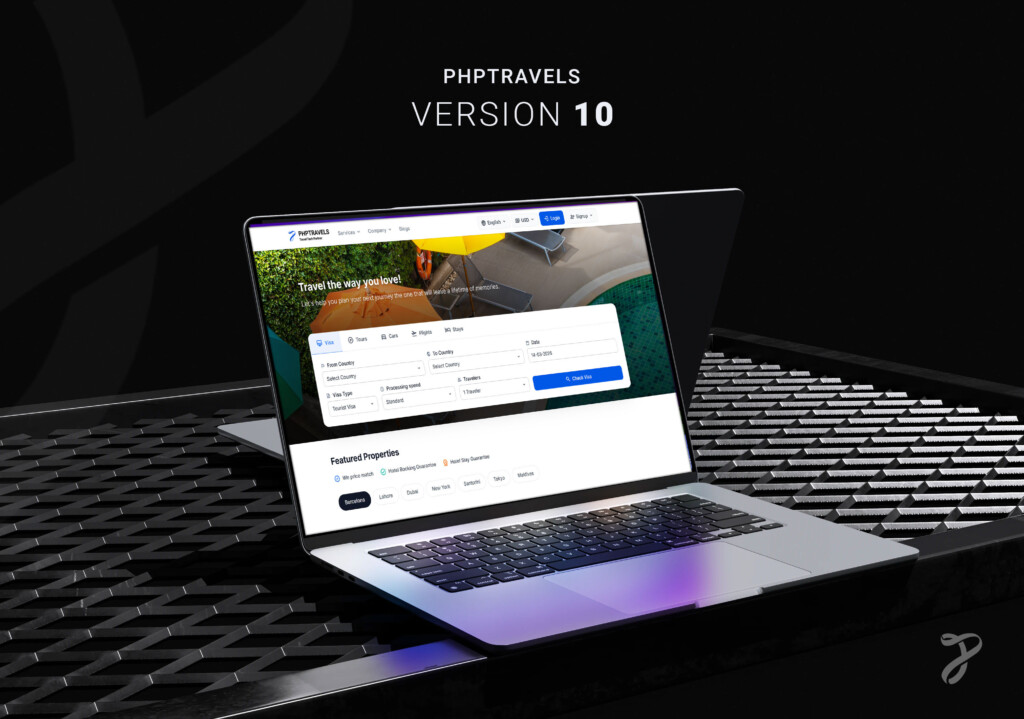
Today, we announce a milestone that redefines the foundation of our platform: PHPTRAVELS Version 10. We are excited to share that the phptravels version 10 released.
This release is not an incremental update. It is a full architectural rewrite engineered to meet the operational realities of modern travel agencies, online travel agencies (OTAs), B2B consolidators, and enterprise travel businesses. Version 10 introduces a modern PHP 8.2+ architecture, a database-driven module engine, expanded API integrations, an advanced pricing and wallet system, structured visa management, event-driven automation, and a performance-first frontend built for conversion. With the phptravels version 10 released, we are taking a significant step forward.
Version 10 represents a structural shift – from a booking platform to a scalable travel commerce infrastructure.
A Ground-Up Architectural Rewrite
At the core of Version 10 is a complete rebuild using PHP 8.4+, paired with a minimalist Routing–Views (RV) architectural pattern. Instead of relying on heavy legacy MVC layers, the platform adopts a clean, modular routing structure designed for performance, clarity, and extensibility.
The frontend has been rebuilt using TailwindCSS and Alpine.js, enabling a responsive, lightweight interface without unnecessary JavaScript overhead. The backend leverages Medoo ORM built on PDO prepared statements, reinforcing secure database operations and eliminating unsafe query handling patterns common in older systems.
Composer is now fully integrated with an optimized autoloader, reducing overhead and improving dependency management. The result is a platform that loads faster, consumes fewer resources, and scales more predictably.
Measured performance improvements include:
- 71 percent reduction in page loader code complexity
- 52 percent faster page transitions
- Approximately 800ms first homepage load
- Approximately 200ms cached load
- ~25MB average memory usage per request
- ~85 percent cache hit rate on routes and translations
This is infrastructure designed not just for today’s traffic volumes, but for long-term growth.
25+ Official Supported API Integrations With Real Booking and PNR Issuance
Travel platforms live and die by their supplier connectivity. Version 10 significantly expands the integration ecosystem while centralizing supplier control under a unified module architecture.
Flights (10 Providers):
Amadeus, Amadeus Enterprise, Duffel, Kiwi, Sabre, Seeru, Travelport, PKFare, Travelpayouts, TBO Holidays, Kayak
Hotels (7+ Providers):
Agoda, Amadeus, Travelport, Hotelbeds, Ratehawk, Hotelston, Stuba
Tours:
Viator, Viator Merchant, Tiqets
Car Rentals:
Discover Cars, CarTrawler, KiwiTaxi
Each integration supports real-time search, booking, and where supported, real PNR issuance directly from supplier APIs. Credentials are centrally managed in the database, allowing agencies to enable sandbox or production environments, activate logging, and configure module-level pricing without editing core code.
The architecture also supports optional supplier-level database isolation for high-volume scenarios, reinforcing scalability and operational separation where needed.
Version 10 positions PHPTRAVELS among the most supplier-rich open-source travel booking platforms available in the market.
Database-Driven Module Management
One of the most significant structural changes in Version 10 is the introduction of a fully database-driven module engine.
Every module – whether flights, stays, tours, cars, or visa – is controlled through a centralized configuration layer that includes:
- Activation and deactivation controls
- Display ordering and UI configuration
- Module-specific icons and branding colors
- B2C markup configuration (percentage or fixed)
- B2B markup configuration (percentage or fixed)
- Tax settings (percentage or fixed)
- Wallet balance enforcement rules
- Developer mode toggles
- Logging control
- Content import flags
This architecture eliminates hardcoded business logic and enables agencies to adjust operational parameters dynamically through the admin interface.
For agencies managing multiple suppliers across multiple verticals, this approach provides operational clarity and pricing flexibility without technical friction.
Advanced B2B and B2C Pricing Engine
Travel businesses rarely operate under a single pricing model. Version 10 introduces a dual-layer pricing engine that separates B2C customer markup from B2B agent markup at the module level.
Each supplier or module can define:
- B2C markup type (percentage or fixed)
- B2C markup value
- B2B markup type (percentage or fixed)
- B2B markup value
- Module-level tax configuration
The system can display original supplier pricing alongside adjusted markup pricing, calculate commissions automatically, and enforce balance checks for agent-based bookings.
This enables hybrid agencies – those serving both end consumers and sub-agents – to operate under distinct margin strategies without duplicating infrastructure.
Integrated Agent Wallet and Credits Ledger
Version 10 includes a structured credits ledger system built specifically for B2B travel operations.
Each wallet transaction is stored as a credit or debit entry, tied to a user account, currency, description, and timestamp. This creates a transparent financial audit trail and supports deposit-based booking workflows common among consolidators and agent networks.
With module-level balance enforcement enabled, agents can only complete bookings if sufficient wallet balance exists. Refunds, adjustments, and manual credits are recorded cleanly within the ledger.
For agencies managing multiple sub-agents, this eliminates the need for external wallet systems and reduces accounting ambiguity.
Reimagined Checkout Experience
The booking experience has been redesigned around conversion optimization principles commonly found in modern eCommerce platforms.
The new booking flow follows a streamlined sequence:
Search → Details → Booking → Invoice
A five-column responsive grid layout, sticky pricing summary sidebar, and distraction-free checkout mode (with hidden navigation elements) focus the user on completion. Guest checkout is supported with automatic account creation post-booking.
The interface is consistent across flights, hotels, tours, cars, and visa services, ensuring users encounter a unified experience regardless of product category.
Performance gains combined with UX refinement directly impact booking completion rates.
Modern Payment Gateway Architecture
Version 10 introduces a flexible, database-managed payment gateway engine supporting a wide spectrum of payment behaviors:
- Credit and debit cards
- Digital wallets
- Bank transfers
- Pay Later flows
- Internal wallet / credits
- Manual payments and invoices
- Optional module-specific gateways
Administrators can configure gateway activation, display order, default status, sandbox or live mode, and currency preferences directly from the admin panel.
This architecture supports global operations while allowing local payment preferences – a critical factor in international markets where card penetration varies.
Visa Module 2.0: Structured, Configurable, Revenue-Ready
The Visa module has been redesigned into a structured product engine rather than a simple inquiry feature.
Each visa record includes:
- Origin and destination country references
- Detailed descriptions
- JSON-validated requirements
- Multi-currency pricing
- Government fee and service fee separation
- Indexed country relationships for search performance
Complementing this is the Visa Settings engine, which standardizes visa attributes:
- Visa type (Tourist, Business, Student, Work, Transit, Medical)
- Processing speed (Standard to Super Rush)
- Entry type (Single, Double, Multiple)
- Duration presets (30 days to 5 years)
- Translation-ready configuration
This structured model allows agencies to create consistent, scalable visa packages and monetize service fees effectively.
Event-Driven Architecture With 43 Webhook Events
Automation is central to modern travel operations. Version 10 introduces 43 webhook events across user lifecycle and booking lifecycle activities.
These include:
- Signup, login, logout
- Email verification
- Password reset
- Profile updates
- Search events
- Booking creation
- Invoice generation
- Payment lifecycle changes
This enables integration with CRM systems, marketing automation platforms, analytics tools, and communication systems such as Salesforce, HubSpot, Zoho, Mailchimp, Google Analytics, Mixpanel, Slack, and others.
Agencies can build automated abandoned booking campaigns, synchronize customer records, and track revenue pipelines in real time.
Enterprise-Grade Security Foundation
Security in Version 10 is implemented at the architectural level rather than layered on as patches.
Key protections include:
- CSRF tokens with timed expiration
- Timing-safe comparison logic
- Rate limiting per IP
- SQL injection detection
- XSS filtering
- Path traversal prevention
- Secure HTTP headers
- Credential masking in admin views
- Admin protection rules
All database interactions are handled through prepared statements, significantly reducing attack surfaces.
Mobile-First and SEO-Optimized
Version 10 is designed for mobile-first indexing and organic visibility.
Features include:
- Responsive design across all major breakpoints
- Full-screen mobile filter overlays
- Optimized mobile checkout
- SEO-friendly URLs
- Structured data (JSON-LD)
- Open Graph and Twitter Cards
- Canonical URL handling
- Robots configuration
Combined with performance optimization, this positions agencies for improved search rankings and organic traffic growth.
Foundation for the Future
Version 10 establishes the structural base for upcoming advancements, including:
- Redis and Memcached caching layers
- WebSocket-based real-time notifications
- Dedicated mobile applications
- AI-powered recommendation systems
- GraphQL API layer
- Progressive Web App enhancements
- Advanced reporting dashboards
- Loyalty and rewards modules
The architecture is designed to accommodate expansion without fundamental rewrites.
Conclusion
PHPTRAVELS Version 10 marks a decisive shift in the platform’s evolution – from a feature-based booking system to a scalable, enterprise-ready travel commerce infrastructure.
For travel agencies navigating increasing competition, tighter margins, and growing customer expectations, technology is no longer optional. It is foundational.
Version 10 delivers speed, modular control, pricing flexibility, automation capabilities, structured visa management, expanded supplier integrations, and a hardened security core – all built on a modern PHP 8.2+ stack.