
Learning how to grow a travel agency in 2026 requires more than adding new destinations or posting occasional offers on social media. Sustainable growth comes from combining a clear market position, strong digital visibility, an efficient sales process, excellent customer service, and technology that helps your team convert and retain more travelers.
Travelers now compare agencies across Google, social media, review platforms, and booking websites before making contact. Whether you run a local agency, tour company, B2C online travel agency, or B2B travel business, your goal is to attract the right customers, convert more inquiries into bookings, increase repeat business, and expand without making operations harder to manage.
How to Grow a Travel Agency: What Works Best?
The best approach to how to grow a travel agency is to combine niche specialization, strong digital visibility, fast lead follow-up, personalized service, diversified inventory, referrals, partnerships, and scalable travel technology. Instead of depending on one marketing channel, build a repeatable system that attracts travelers, converts inquiries efficiently, and keeps customers coming back.
Here are 12 practical ways to do it.
1. Choose a Profitable Niche and Ideal Customer
Trying to sell every type of trip to every traveler makes your agency difficult to remember. A clearer niche makes your marketing, content, supplier choices, and sales conversations more relevant.
You might specialize in luxury travel, corporate trips, adventure tours, family holidays, religious travel, destination weddings, student travel, cruises, or a particular destination. Your niche does not have to limit your business permanently; it gives you a strong position from which to grow.
Define your ideal customer by asking what type of trip they buy, their usual budget, the problems they need help solving, and the services that matter most. Then create packages and messages for that audience instead of marketing to “everyone.”
2. Study Competitors and Find Gaps You Can Own
Competitive research should go beyond checking prices. Review how other agencies position themselves, which destinations they promote, how quickly they respond, what customers praise or complain about, and how easy their websites make it to search, inquire, or book.
Look for gaps. A competitor may have strong prices but weak support. Another may dominate flights but offer few complete packages. Your advantage could be specialist knowledge, flexible packages, multilingual service, faster quotations, local expertise, or a smoother booking experience.
The goal is not to copy competitors. It is to give travelers a clear reason to choose you.
3. Turn Your Website Into a 24/7 Sales Channel
A modern travel website should do more than display a phone number and several packages. It should help visitors discover products, compare options, build trust, submit an inquiry, or complete a booking.
As your agency grows, scalable travel booking software can bring flights, hotels, tours, transfers, cars, and other products into a more consistent booking journey. This reduces dependence on manual quotations and lets customers interact with your business outside office hours.
Keep the experience simple with clear navigation, mobile-friendly pages, useful destination information, visible support options, genuine reviews, and obvious calls to action. Every important page should answer the visitor’s next question and make the next step easy.
4. How to Grow a Travel Agency With SEO and Content
Search visibility can bring qualified demand to your agency long after an advertising campaign ends. Instead of publishing random travel articles, create content around questions your ideal customers ask before booking.
A family-travel agency could publish destination comparisons, visa guidance, seasonal advice, hotel-area guides, and itinerary ideas. A corporate agency could focus on travel policy, expense management, negotiated rates, approvals, and traveler support.
Build topic clusters rather than isolated posts. Link useful guides to relevant service, destination, and booking pages. Keep facts updated and use clear headings, concise answers, comparison tables where useful, original examples, and first-hand business knowledge.
SEO is not keyword repetition. The goal is to become the most useful source for the travel problems your business is qualified to solve.
5. Respond to Leads Faster and Manage Follow-Up With a CRM
Many agencies generate inquiries but lose potential bookings during follow-up. Travelers may contact several providers, so speed and organization matter.
A travel agency CRM can centralize inquiries, customer details, communication history, reminders, and sales stages. Your team can quickly see who needs a quotation, follow-up, or final booking push.
Create a simple response standard: acknowledge inquiries quickly, collect the information needed to qualify the trip, provide a clear next step, and schedule follow-ups instead of relying on memory. Automation should remove repetitive admin while agents keep the conversation personal.
6. Personalize the Customer Experience
Personal service remains one of the strongest advantages a travel agency can offer. Record useful preferences such as destination interests, hotel type, room requirements, trip purpose, preferred airline, budget range, and previous bookings.
Use that context to recommend relevant options rather than sending identical packages to everyone. Continue the experience after payment with pre-departure information, clear support during the trip, and a post-trip follow-up.
Customers who feel remembered and supported are more likely to book again, leave a positive review, and recommend your agency.
7. Expand Inventory and Create More Ways to Earn
Growth does not always require finding more customers. You can also increase revenue by offering more relevant products to existing customers.
If you mainly sell flights and hotels, consider whether customers also need tours, airport transfers, car rentals, ferries, activities, or other destination services. Connecting suppliers through travel API integrations can help an online agency broaden inventory without manually maintaining every product.
Add services because they solve a customer need, then track which add-ons improve booking value, margin, and satisfaction.
8. Improve Pricing, Conversion, and Profit Not Just Traffic
More visitors do not automatically mean more business. Track what happens after someone lands on your site or sends an inquiry.
Monitor conversion rate, average booking value, gross margin, lead response time, quotation-to-booking rate, repeat-booking rate, and customer acquisition cost. These numbers reveal where growth is being lost.
If traffic rises but inquiries do not, improve your offer or website. If inquiries are strong but bookings are weak, review pricing, trust, response speed, quotation quality, and payment options. If bookings are healthy but profit is low, examine supplier terms, markups, costs, and product mix.
Sometimes a small conversion or margin improvement creates more profit than a large increase in traffic.
9. Create a Referral, Review, and Repeat-Booking Engine
Satisfied customers can become a low-cost growth channel, but referrals should not be left to chance.
After a successful trip, ask for feedback and make it easy to leave a genuine review or recommend your agency. Stay in touch with useful travel ideas and relevant offers rather than contacting past clients only when you want to sell.
Segment previous customers by destination, trip type, corporate account, or interests so future communication feels relevant. Repeat bookings reduce your dependence on constantly acquiring new customers.
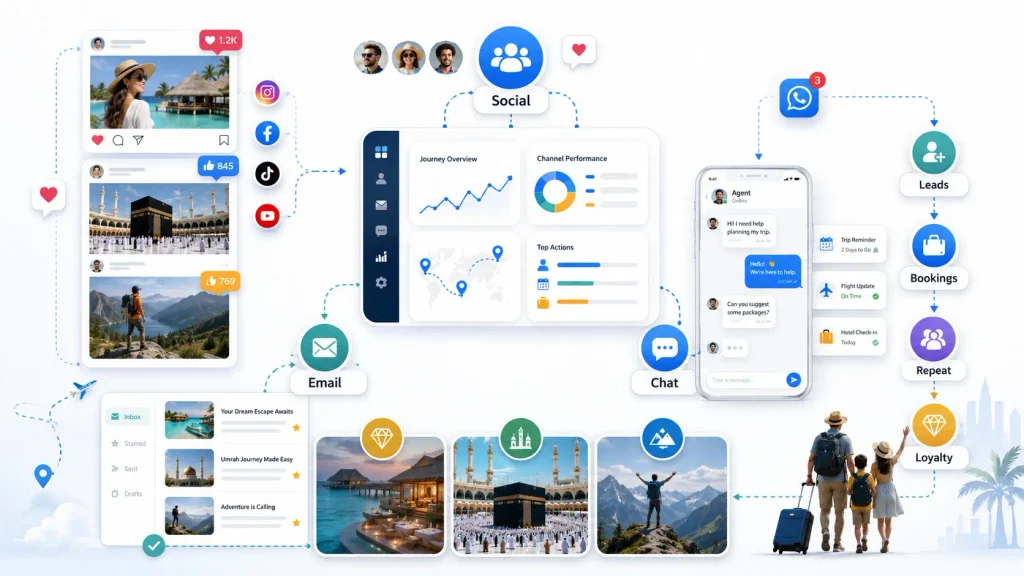
10. Use Social Media, Email, and Messaging as One System
Social media works best when connected to a broader customer journey. Use visual content to showcase destinations, itineraries, customer experiences, expertise, and timely offers. Use email to nurture people who are not ready to book, and messaging channels for qualified conversations, reminders, and support.
Do not measure success only by followers or likes. Track inquiries, email sign-ups, assisted conversions, booked revenue, and repeat customers.
Most importantly, make the content fit your niche. A luxury agency, an Umrah specialist, and an adventure-tour operator should not sound or look identical.
11. Build Partnerships and B2B Distribution
Partnerships can expand reach faster than opening new offices. Consider relationships with hotels, DMCs, tour operators, corporate clients, event planners, wedding businesses, schools, community organizations, or agencies serving complementary markets.
If your model includes sub-agents or reseller partners, a B2B travel portal can give approved agents controlled access to inventory, pricing, markups, and booking capabilities.
Set clear commercial terms, service standards, and payment processes. A partnership is valuable when it creates qualified distribution or improves the customer offer.
12. Expand Geographically With a Digital-First Model
The traditional approach was to open an office first. Today, many agencies can validate demand before taking on that cost.
Analyze where inquiries and bookings already come from. Test localized landing pages, regional partnerships, local payment preferences, language support, and dedicated representatives. If the market proves sustainable, consider a branch or larger local team.
A centralized travel agency management software platform can help manage bookings, agents, customers, inventory, and workflows as activity expands across markets. If mobile demand is important, mobile travel apps can also support booking, account access, notifications, and service.
How to Grow a Travel Agency in 90 Days
You do not need to execute every strategy at once. Focus first on the bottleneck limiting growth.
In the first 30 days, define your niche, review competitors, audit your website, document your sales process, and establish baseline metrics. Identify the pages, products, and customer segments already generating the best results.
During days 31 to 60, improve your highest-value landing pages, publish or refresh content around important customer questions, organize lead follow-up, request reviews, and test one new acquisition channel or partnership.
During days 61 to 90, analyze results. Double down on channels and products producing qualified bookings, remove friction from the sales process, automate repeatable tasks, and decide which inventory, market, or partnership deserves the next investment.
Growth becomes easier when you treat it as a measurable system rather than a collection of unrelated activities.
Final Thoughts
If you are learning how to grow a travel agency sustainably, focus on becoming easier to find, easier to trust, easier to book with, and easier to return to.
Specialization helps you stand out. Useful content brings the right people to you. Strong sales processes turn more inquiries into customers. Personal service, referrals, and retention increase lifetime value. Technology allows all of this to scale without unnecessary operational complexity.
Do not try to win every market at once. Choose the strongest opportunity, measure the result, improve the process, and then expand. That is how a travel agency builds sustainable growth instead of temporary spikes in bookings.