
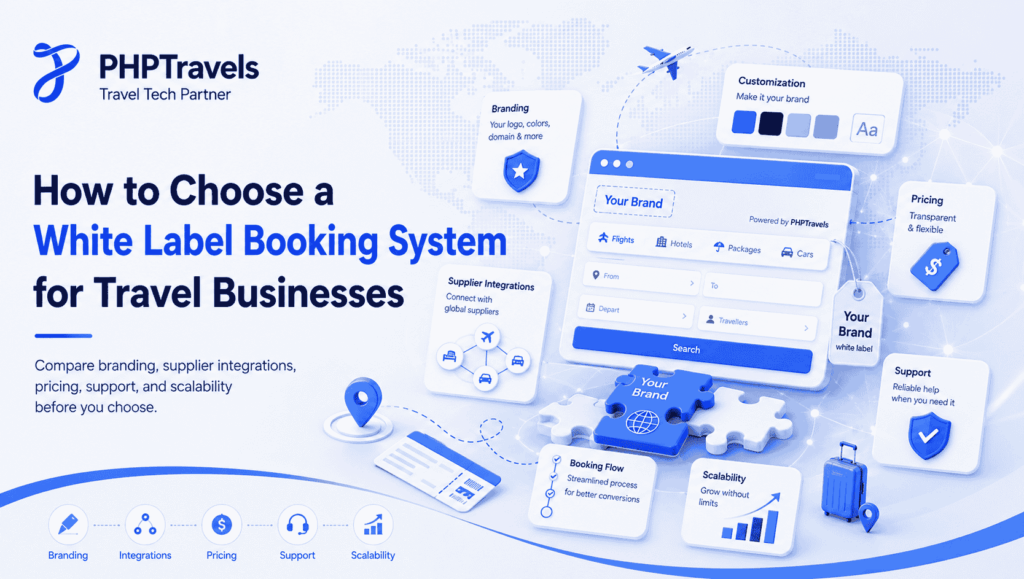
Launching a travel business today does not always require building a complete booking platform from scratch. A travel agency, tour operator, startup, or online travel agency can launch faster by using a ready-made system and presenting it under its own brand.
This is where a white label booking system becomes valuable.
However, not every white label platform is suitable for a travel business.
Some systems are basic appointment or scheduling tools that have been adapted for bookings. They may work for fixed time slots, but they often struggle with live travel inventory, supplier APIs, changing prices, cancellation policies, multiple currencies, and complex reservation workflows.
Choosing the right platform therefore requires more than comparing designs and prices. You need to evaluate how the system performs in real travel operations.
What Is a White Label Booking System?
A white label booking system is a ready-made reservation platform that can be customized and operated under another company’s brand.
Your customers see your logo, domain, colors, content, and booking experience. Behind the scenes, the platform connects with travel suppliers, retrieves availability, applies pricing rules, processes bookings, and stores transaction records.
A typical customer journey may look like this:
- A customer searches for a hotel, flight, tour, car, or transfer.
- The system sends the search request to connected suppliers.
- Live results are returned with prices and availability.
- Your markup or commission rules are applied.
- The customer selects an option and enters traveler details.
- Payment is processed through your chosen payment gateway.
- The reservation is confirmed and stored in the back office.
- The customer receives an invoice or booking confirmation.
The customer completes the entire process through your branded website without needing to know which technology provider powers the platform.
Why Travel Booking Technology Is More Complex
Travel booking is different from basic appointment scheduling.
A salon or consultation booking system may work with fixed time slots and prices. Travel inventory is dynamic. Prices can change within seconds, availability may come from several suppliers, and each booking may have different rules.
For example, two suppliers may offer the same hotel but with different room names, meal plans, prices, cancellation conditions, and payment requirements. A travel platform must collect this information, normalize it, and display it clearly to the customer.
Flight reservations can be even more complex because fares may include baggage rules, ticketing deadlines, passenger categories, airline restrictions, and route-specific conditions.
This is why businesses should choose a dedicated travel booking platform rather than a generic scheduling application.
A travel-focused system should be able to manage:
- Real-time supplier searches
- Multiple travel products
- Dynamic pricing and availability
- Booking modifications and cancellations
- Supplier references and confirmation numbers
- Passenger and guest details
- Markups, discounts, and commissions
- Multi-currency transactions
- Agent and customer accounts
- Reports, invoices, and booking histories
Start With Your Business Model
Before comparing platforms, define how your travel business will operate.
A startup travel agency may only need hotel and flight bookings for retail customers. A tour operator may require packages, activities, fixed departures, and custom itineraries. A travel wholesaler may need agent accounts, credit limits, negotiated rates, and B2B pricing.
An OTA may require high search performance, several supplier integrations, automated bookings, and advanced reporting.
Check the Travel Products and Modules
The first major evaluation point is product coverage.
A suitable white label platform should support the products you plan to sell today and provide room for future expansion.
Common travel modules include:
- Flights
- Hotels
- Tours and activities
- Car rentals
- Airport transfers
- Buses
- Trains
- Ferries
- Travel packages
- Visa or insurance services
A business may begin with a hotel booking engine and later introduce flights, activities, or transfers. Choosing a modular platform can prevent the need to replace the entire system during expansion.
For flight sales, review whether the platform includes a proper flight booking engine that can manage fare rules, passenger information, ticketing data, and airline search results.
For accommodation businesses, examine the available hotel booking software features, including room types, cancellation policies, supplier mapping, taxes, and meal plans.
Tour operators should also evaluate whether the platform includes a complete tour management system instead of only a basic activity listing page.
Evaluate Supplier and API Connectivity
A booking system is only useful when it can access relevant inventory.
Travel inventory may come from global distribution systems, aggregators, bed banks, airlines, hotel suppliers, activity providers, or direct contracts.
Your supplier strategy should determine which integrations you need.
Include:
- Amadeus
- Sabre
- Travelport
- Hotelbeds
- TBO
- Expedia
- Viator
- Agoda
- Kiwi
- Duffel
- Regional hotel and flight suppliers
Review the provider’s complete list of travel API integrations and confirm whether the suppliers you need are already supported.
A pre-built integration can reduce development time, but you should still ask how it is maintained. Supplier APIs change regularly. Authentication methods, data structures, endpoints, and booking requirements may be updated.
Businesses comparing inventory sources can also review a travel XML API suppliers list before choosing supplier contracts.
Review Branding and White Label Control
The main purpose of white labeling is to build your own customer-facing brand.
A good platform should give you control over:
- Domain name
- Logo and favicon
- Brand colors
- Homepage sections
- Navigation
- Email templates
- Booking confirmations
- Invoices
- Contact details
- Terms and policies
- Languages
- Currencies
Your website should not look like a lightly edited copy of every other customer using the same software.
Ask whether the platform supports layout customization and whether deeper changes require paid development. Some providers allow logo and color changes but restrict page structure, checkout design, or content management.
Check whether “Powered by” branding can be removed and whether supplier names remain hidden throughout the customer journey.
For businesses that need greater design control, compare the white label product with a customizable travel website builder.
Test the Booking Experience
Features alone do not create a good booking experience.
A platform must make it easy for customers to search, compare, select, and pay.
Test the platform from a customer’s perspective.
Review:
- Search loading time
- Mobile responsiveness
- Filter accuracy
- Price visibility
- Cancellation policy presentation
- Traveler form length
- Checkout steps
- Payment options
- Error messages
- Confirmation emails
The final price should be clear before payment. Unexpected taxes or fees at checkout can increase abandonment and damage customer trust.
The platform should also prevent common errors such as expired sessions, unavailable inventory, duplicate payments, and incomplete reservations.
Request access to a working travel software demo rather than relying only on screenshots.
Test several realistic searches and complete a full booking flow before making a decision.
Examine Payment and Transaction Features
Payment handling is one of the most important parts of a booking platform.
The system should support gateways that are available in your target countries and suitable for travel transactions.
Important capabilities include:
- Credit and debit card payments
- Local payment methods
- Multiple currencies
- Secure checkout
- Payment status tracking
- Automated receipts
- Refund records
- Partial payments
- Offline payment options
- Agent deposits or wallet balances
Ask whether payment gateway charges are separate from software costs. You should also confirm how failed, pending, refunded, and cancelled transactions appear in the administrative dashboard.
Businesses operating internationally should review the available travel payment gateway integrations.
The platform should never store sensitive payment information in an insecure manner. It should use recognized payment providers and follow appropriate security practices.
Check Pricing and Markup Controls
Travel businesses make money through commissions, service fees, negotiated rates, and markups.
Your white label booking system should allow you to control pricing without manually editing every booking.
Useful pricing features include:
- Fixed markups
- Percentage markups
- Supplier-specific markups
- Destination-based pricing
- Module-specific pricing
- Agent-level pricing
- Customer group pricing
- Promotional discounts
- Service fees
- Currency conversion rules
A business serving both direct customers and travel agents may need separate prices for each channel.
A strong booking inventory system should also help you manage your own inventory alongside third-party supplier content.
Avoid systems that give you little visibility into the original supplier price, final selling price, taxes, and profit. Your team should be able to understand the financial value of every reservation.
Review Back-Office and CRM Capabilities
The customer-facing website is only one part of a travel operation.
Your staff also need tools to manage bookings, customers, agents, suppliers, payments, and reports.
A useful back office should include:
- Booking dashboard
- Customer profiles
- Booking status management
- Invoice generation
- Staff roles and permissions
- Supplier references
- Payment records
- Commission reports
- Sales reports
- Email notifications
- Cancellation management
- Export options
CRM functionality can help staff review customer history, respond to enquiries, manage leads, and improve repeat bookings.
Businesses that need more advanced customer management should examine whether the platform connects with a dedicated travel agency CRM.
Role-based access is especially important. A support employee should not automatically receive the same financial or administrative permissions as the business owner.
Confirm B2B and B2C Support
Many travel companies sell through more than one channel.
A B2C booking system serves travelers directly. It focuses on public search, customer registration, online payments, promotions, and a simple checkout experience.
A B2B platform serves travel agents, corporate partners, or resellers. It may require:
- Agent registration
- Account approval
- Credit limits
- Deposits and wallets
- Agent-specific pricing
- Commission controls
- Sub-agent accounts
- Booking reports
- Outstanding balance tracking
Businesses planning to serve both markets should select a system that supports both models in one administration area.
Review the platform’s B2B booking engine and B2C booking system separately. Do not assume that a strong retail booking experience automatically includes proper agent management.
Evaluate Scalability and Performance
Travel search can generate a large number of API requests.
During holidays, marketing campaigns, or peak travel seasons, search volume may increase quickly. A slow system can lead to abandoned bookings and supplier timeouts.
Review the technical system requirements and available hosting options before launch.
Compare Total Cost, Not Only License Price
The cheapest platform is not always the least expensive solution.
Calculate the total cost of ownership, including:
- Software license or subscription
- Setup charges
- Hosting
- Supplier integrations
- Payment gateway integrations
- Custom design
- Mobile applications
- Maintenance
- Updates
- Technical support
- Staff training
- Future customization
A custom-built system may offer complete control but usually requires more time, development resources, testing, and long-term maintenance.
A white label platform can reduce launch time because the core booking infrastructure already exists. However, the actual value depends on its reliability and suitability for your business.
Review the provider’s pricing plans carefully and ask for a written explanation of what is included.
Assess Support, Documentation, and Ownership
Support quality can become critical after launch.
A booking problem involving a live customer, payment, or supplier confirmation may require immediate investigation.
Before selecting a provider, review:
- Support channels
- Response times
- Documentation
- Training resources
- Update policy
- Bug-fix process
- Customization support
- Data backup options
- Hosting responsibilities
- Source-code access
You should also understand who owns your customer data, content, domain, and booking records.
Ask how data can be exported if you later move to another platform. Avoid becoming completely dependent on a provider without a clear exit process.
Practical Business Scenarios
Startup Travel Agency
A startup usually needs a fast launch, manageable costs, and essential hotel or flight functionality. A white label platform can reduce development time and provide a tested foundation.
Growing Online Travel Agency
An expanding OTA may need multiple supplier connections, faster searches, automated pricing, additional payment gateways, and better reporting. Scalability and API management become more important than the initial setup cost.
B2B Travel Company
A B2B business needs agent accounts, credit controls, deposits, custom markups, and financial reporting. A basic consumer booking website will not be sufficient.
Tour Operator
A tour operator may require scheduled departures, availability limits, package pricing, itineraries, add-ons, and offline booking management. The platform should support operational workflows beyond API-based inventory.
Affiliate Travel Brand
An affiliate business may need a branded portal that redirects or connects to external inventory. It should confirm whether bookings remain on its own website and how commissions are tracked.
PHPTRAVELS White Label Booking System
PHPTRAVELS provides travel technology for agencies, OTAs, tour operators, and other travel businesses that want to launch a branded booking platform.
Its travel platform can support multiple services, supplier integrations, pricing controls, customer and agent accounts, and administrative workflows.
Businesses evaluating PHPTRAVELS should review the available travel booking software, explore the live demo, confirm required integrations, and compare the platform’s functionality with their business model.
Customization requirements should be documented before purchase. This makes it easier to separate included features from additional development work.
Final Checklist Before You Choose
Before signing an agreement, confirm that the platform:
- Supports your travel products.
- Works with your required suppliers.
- Gives you sufficient branding control.
- Provides a smooth mobile booking flow.
- Supports your target currencies and payment gateways.
- Includes suitable markup and commission controls.
- Manages both customer and operational workflows.
- Can support future growth.
- Has clear pricing and support terms.
- Allows access to your business data.
Conclusion
Choosing a white label booking system is not simply a software purchase. It is a decision that affects your launch speed, customer experience, daily operations, revenue control, and future growth.
Do not evaluate a platform only by its homepage design or starting price.
Test the booking flow, review supplier integrations, examine the back office, confirm payment support, and understand all ongoing costs. Most importantly, choose a platform designed for real travel workflows rather than a generic scheduling system with travel branding added on top.