The travel market has never been bigger, and that is exactly the problem. When everyone is selling the same flights, the same city-break hotels and the same generic packages, price becomes the only thing customers compare. Margins shrink, loyalty disappears, and you spend your days competing with global platforms that will always undercut you on volume.
The agencies and tour operators growing fastest right now are the ones that stopped trying to sell everything to everyone. A clearly defined travel niche lets you charge for expertise instead of discounting on price, attract travellers who already trust your focus, and build repeat business an aggregator cannot replicate.
This guide covers the travel niches gaining real momentum in 2026, how to judge whether one fits your business, and what it takes to run a niche operation profitably.
Quick Summary
- Specialising in a travel niche raises margins, deepens customer loyalty and reduces head-to-head price competition with large OTAs.
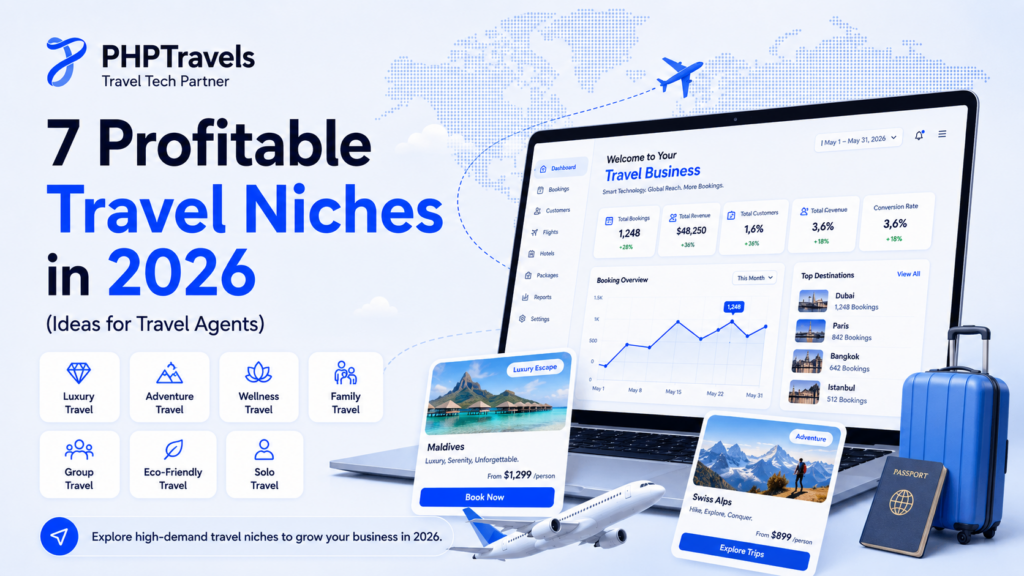
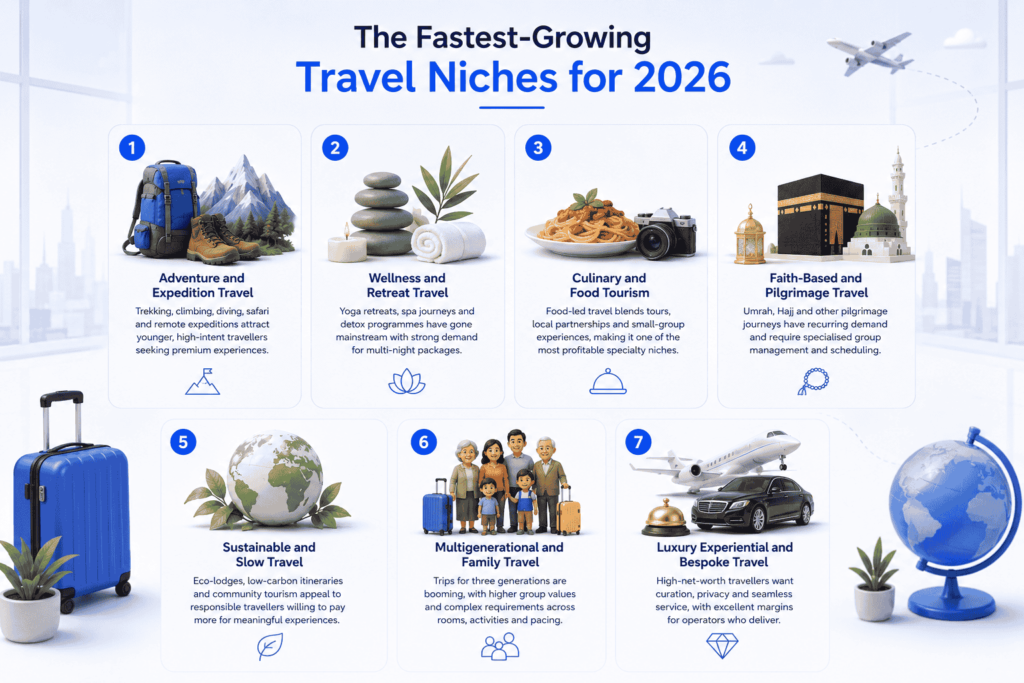
- The strongest 2026 niches include adventure and expedition travel, wellness retreats, culinary tourism, faith-based travel, sustainable and slow travel, multigenerational trips, and luxury experiential travel.
- A niche is only viable if it has steady demand, healthy spend per traveller, reachable suppliers and operations you can repeat without burning out.
- The businesses that win automate the boring parts: supplier connectivity, quoting, payments and follow-up, so the team can focus on curating the experience.
- Software choice is an operational decision, not a branding one. The right platform should handle tours, accommodation, transfers, payments and customer records in one place.
Why Niche Travel Is Winning in 2026
A niche travel business sells a focused type of experience to a clearly defined audience, rather than offering a bit of everything. The advantage is structural. When you are the obvious choice for, say, women’s solo trekking holidays or food tours through Southeast Asia, you no longer compete on price alone. You compete on credibility, and credibility is far harder for a competitor to copy than a discount.
Specialised travellers also spend more and book earlier. Someone planning a guided expedition or a multi-week wellness retreat expects to invest several thousand dollars and values guidance over self-service. That higher average order value means a healthy business can run on far fewer bookings than thin-margin volume.
Niches also compound. A satisfied adventure traveller comes back for the next trip and brings friends, and word of mouth inside a tight community does the marketing a generalist brand has to pay for. That is why so many operators now use a focused tour management system to package and resell a tight range of experiences instead of stretching across every product category.
7 Profitable Travel Niches and Ideas for Travel Agents
1. Adventure and Expedition Travel
Trekking, climbing, diving, safari and remote expeditions continue to draw younger, higher-intent travellers who plan around the activity, not the destination. These trips carry premium price points and strong repeat rates, but they demand reliable on-the-ground partners and clear logistics. An activity booking software layer helps you sell guided experiences, gear add-ons and transfers alongside the core itinerary.
2. Wellness and Retreat Travel
Yoga retreats, spa journeys, detox programmes and longevity-focused stays have moved from fringe to mainstream. Travellers book multi-night packages with fixed inclusions, which makes them ideal for productised selling. The operational challenge is managing capacity, deposits and instalment payments, all of which sit naturally inside a structured booking flow.
3. Culinary and Food Tourism
Food-led travel, from cooking classes in Tuscany to street-food crawls in Bangkok, ranks among the most profitable specialty categories. It blends tours, local partnerships and small-group experiences. Operators here lean heavily on supplier connectivity to combine activities, accommodation and transfers into one bookable product.
4. Faith-Based and Pilgrimage Travel
Umrah, Hajj and other pilgrimage journeys represent enormous, recurring demand with very specific operational requirements: group management, visa handling, accommodation tiers and strict scheduling. A dedicated Umrah module lets agencies in this space manage complex group packages without rebuilding everything by hand each season.
5. Sustainable and Slow Travel
Eco-lodges, low-carbon itineraries, rail journeys and community-based tourism appeal to a growing segment willing to pay more for responsible travel. The margins are good, but transparency matters, so these operators need clean itineraries, clear pricing and trustworthy suppliers.
6. Multigenerational and Family Travel
Trips designed for three generations travelling together are booming, with higher group values and complex requirements across rooms, activities and pacing. Coordinating this profitably depends on quoting tools and a customer record that remembers the family’s preferences, which is where a travel CRM earns its keep.
7. Luxury Experiential and Bespoke Travel
High-net-worth travellers want curation, privacy and seamless service rather than off-the-shelf packages. Margins are excellent, but the bar for delivery is high. These operators typically run a private B2C booking system for direct clients alongside a B2B channel for partner advisors.
Niche Comparison
| Travel Niche | Demand Signal | Typical Spend per Traveller | Margin Profile | Best Suited To |
|---|---|---|---|---|
| Adventure & Expedition | Strong, growing | $2,000–$6,000 | High | Operators with local guide networks |
| Wellness & Retreats | Strong, steady | $1,500–$5,000 | High | Curated package sellers |
| Culinary Tourism | Growing | $800–$3,000 | Medium-High | Small-group specialists |
| Faith-Based / Umrah | Very high, recurring | $1,500–$8,000 | Medium-High | Group travel agencies |
| Sustainable / Slow | Growing | $1,500–$5,000 | Medium-High | Values-led brands |
| Multigenerational | Strong | $5,000–$15,000 (group) | Medium-High | Family travel planners |
| Luxury Experiential | Steady, premium | $10,000+ | Very High | Bespoke advisors |
How to Choose the Right Niche Before You Commit
Picking a niche is a business decision, not a passion project. Before you build anything, pressure-test the idea against five questions. Is there consistent, year-round demand, or is it a single seasonal spike? Does the average spend leave room for a real margin after supplier and acquisition costs? Can you actually reach reliable suppliers, hotels, guides, transfers and activity providers, at workable rates? Can the operation be repeated without your personal involvement in every booking? And finally, does it fit your existing relationships and knowledge, so you start with an unfair advantage rather than from zero?
A niche that scores well on demand and margin but poorly on repeatability will trap you in manual work. A niche with great suppliers but thin spend will keep you busy and broke. The sweet spot is a focused audience, healthy economics and operations you can systematise.
The Operational Reality: Suppliers, APIs and Booking Flows
This is where most niche dreams meet friction. Selling a curated experience still requires the same plumbing as any travel business, just pointed at a narrower product set.
You need supply: contracted local partners plus connectivity to wider inventory through travel APIs, accommodation feeds, activity suppliers such as Viator, and transfer or car options when itineraries require them. Connecting to a tours and activities source through a Viator API integration lets a small operator offer a deep catalogue without negotiating every product individually, while a car rental system covers self-drive and road-trip niches.
You need a booking flow that converts. Travellers expect to see availability, pricing and inclusions, then pay securely, often as a deposit followed by a balance. Manual quoting by email leaks bookings; a proper travel booking software engine turns a curated package into something a customer can book in minutes.
You need to handle money across borders. Niche audiences are frequently international, so multi-currency pricing and markup control are not optional. This overview of multi-currency travel software explains why showing prices in the traveller’s own currency lifts conversion.
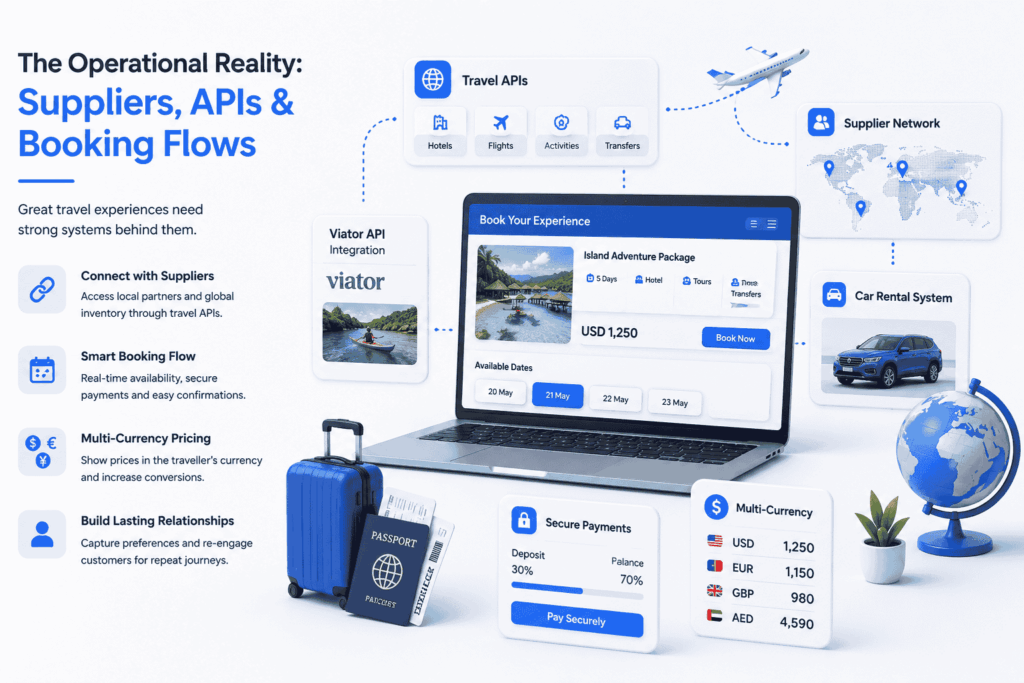
And you need to keep the relationship. The lifetime value of a niche customer is the whole point, so a system that records preferences and surfaces the next trip at the right moment is what turns one booking into a decade of repeat business.
How Most Businesses Approach Niches, and Where They Go Wrong
The typical path looks reasonable on day one. An operator builds a website, lists a handful of packages, and manages enquiries through email, spreadsheets and instant messaging. It works for the first few clients.
Then it breaks. Quotes take hours to assemble, availability is checked by hand and sometimes oversold, payments arrive in fragments with no clear record, and supplier rates live in someone’s inbox. The moment demand grows, the founder becomes the bottleneck, and the loyalty that makes niches profitable erodes under slow, inconsistent service.
The common mistakes are predictable: selling too many niches at once, relying on manual processes, ignoring supplier connectivity, and treating software as an afterthought. What works is the opposite order. Productise a tight set of packages, automate availability and booking, connect to supplier inventory through proper integrations, and put every customer into a system that drives repeat sales. Operators running on a dedicated tour operators solution reach this stage far faster because the workflows are already built.
Where PHPTRAVELS Fits
Once you have chosen a niche and proven there is demand, the question becomes how to run it without rebuilding your operation every season. PHPTRAVELS exists for exactly that point.
It is a travel platform that lets you sell tours, hotels, transfers, car rentals and faith-based packages from one system, whether you operate B2C for direct travellers, B2B through partner agents, or both. The tours module handles itineraries, inclusions and add-ons; supplier APIs bring in inventory you do not contract directly; multi-currency and markup tools price products for international audiences; and built-in customer records keep the follow-up niche businesses depend on. For a quick launch, a ready travel website builder gets a branded storefront live without a development project.
The point is fit, not features for their own sake. A wellness retreat business and a pilgrimage agency look different on the surface but share the same foundation: reliable booking, clean payments, connected supply and a memory of every customer. That foundation is what lets a focused operator behave like a much larger one.
Name Confusion and Common Searches
A few brand names come up constantly when people research niche travel businesses, and they are easy to mix up with the idea of building your own brand.
Fora Travel is a modern host agency and advisor network, not a software platform or a niche in itself; searches for “Fora Travel reviews” or “is Fora Travel legit” usually come from people deciding whether to join as an advisor.
InteleTravel is another host agency model, often discussed alongside PlanNet Marketing, which is the network-marketing arm associated with it.
These are membership and host-agency models, distinct from launching your own niche travel brand on your own platform. Both routes are valid, but they answer different questions: whether to operate under someone else’s agency, or to build and own your business directly.