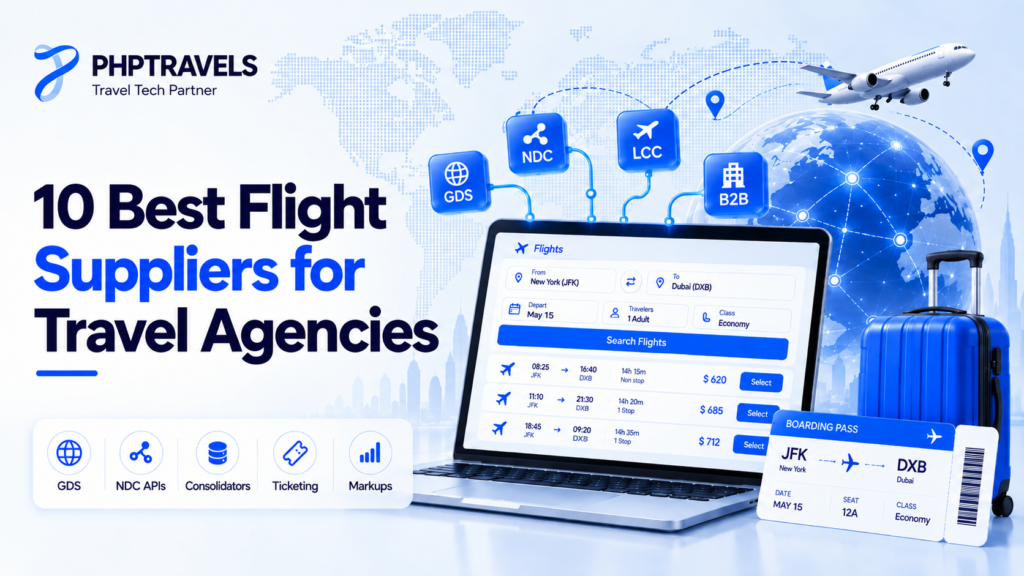
Search for the best flight suppliers and you will find plenty of “top 10” lists. Many of them still send you to the Amadeus Self-Service portal, which Amadeus decommissioned on 17 July 2026. This guide only covers suppliers that are operating today. For each one you get what it sells, who it suits, what onboarding really involves and where the catch is. After that we cover how to work with them: contracts, money, testing and markups.
We build booking software that connects to many of these suppliers, so we see the same questions from agencies every week. Our list of the best flight suppliers below is based on each supplier’s own published information, checked in September 2026. Where a number comes from the supplier itself, we say so.
Quick answer: the best flight suppliers by situation
- Already have a GDS contract? Start with the Amadeus, Sabre or Travelport account you already hold.
- Developer or startup? Duffel is the most self-serve option. It publishes its fees and can ticket under its own accreditation.
- Need wide LCC, NDC and multisource coverage? Shortlist Mystifly, PKFARE, Travelfusion and Verteil, then test them on your real routes.
- No accreditation of your own? Look at a consolidator or ticketing platform such as TBO or IATA.co, where the partner issues the ticket.
What a Flight Supplier Actually Gives Your Agency
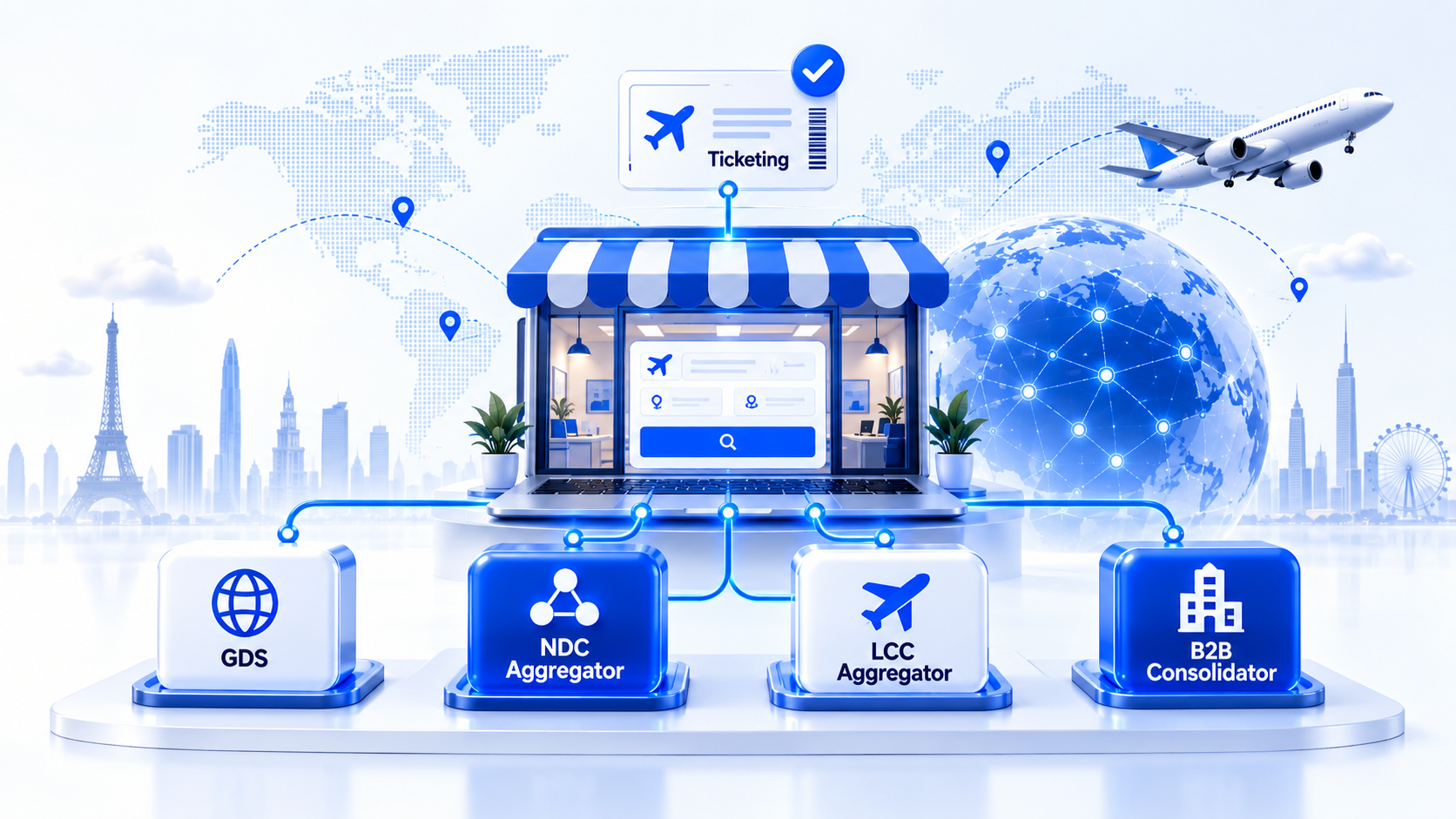
A flight API is not the same thing as airline inventory, and neither one gives you ticketing authority. Before comparing names, work out which of these four supplier types you need. The real question is who issues the ticket and who gets paid first.
GDS (Global Distribution System). Amadeus, Sabre and Travelport connect agencies to airline fares, availability and ticketing through long-standing distribution networks. All three now add NDC and low-cost content as well. You usually need a commercial contract with them, plus accreditation or a ticketing arrangement, before you can issue tickets in production.
NDC aggregator. Airlines publish their own offers through IATA’s New Distribution Capability (NDC) standard. An aggregator connects many of these airline NDC APIs behind one normalized connection, so you do not have to integrate each carrier separately. Depending on the commercial model, you ticket under your own accreditation or the provider’s.
LCC aggregator. Low-cost carriers often book and take payment differently from GDS content. An LCC aggregator puts them behind one interface, and some also handle payment and settlement. Check the contract to see who takes the customer’s card and who handles fulfilment.
B2B consolidator or booking portal. A consolidator uses its own airline and ticketing relationships to issue tickets for other agencies. For a new agency without accreditation, this is usually the fastest legitimate way to start. The partner issues the ticket, and you own the customer, the markup and the service.
For a deeper look at the first two models, see our NDC vs GDS guide and our breakdown of flight aggregator APIs vs GDS and NDC.
The 10 Best Flight Suppliers for Travel Agencies in 2026

No single flight supplier suits every agency, and the best flight suppliers for a two-person agency are rarely the best for a high-volume OTA. The right shortlist depends on your accreditation, markets, volume, developer time and how much ticketing you want to handle yourself. The order below runs from GDS to aggregators to B2B platforms. It is not a quality ranking.
1. Amadeus (Enterprise APIs)
Amadeus is one of the three global GDS networks. For developers, the self-service tier is gone. The Amadeus for Developers site now serves only as the Enterprise API Portal.
- Content: Access on request to 100+ Enterprise APIs, with an Enterprise sandbox for testing.
- Best for: Established agencies, OTAs and TMCs with scale requirements, or those already on Amadeus.
- Access reality: Access is granted on request, and requirements vary by market. Amadeus says Enterprise includes an implementation fee plus monthly fees, and it shares pricing only after an NDA.
- Pros: Very broad API catalogue, a sandbox, and consultants who guide the setup.
- Cons: No self-service route any more, a commercial process before you can build, and it suits companies that are already operating.
More detail: Amadeus Self-Service vs Enterprise APIs.
2. Sabre
Sabre is a GDS that offers REST and SOAP APIs through its Developer Hub. It now also lists agentic APIs and an MCP server for AI use cases.
- Content: Air shopping, booking and servicing APIs. What you can use depends on the products on your Sabre account.
- Best for: Agencies already in the Sabre ecosystem, and developers building for a “Sabre Connected” agency.
- Access reality: A free Developer Hub account gives you test credentials for some REST APIs. According to Sabre’s quick-start checklist, production requires signed commercial terms, an SC code and PCC from your account manager, and OAuth v3 credentials.
- Pros: You can test before you sign, the documentation is mature, and it ships new AI-ready APIs.
- Cons: Production is contract-led rather than open sign-up.
3. Travelport
Travelport runs Travelport+, its retailing platform for agencies, and TripServices, its cloud-native travel API platform.
- Content: TripServices Flights covers search, price, book, ticket and exchange. Travelport says it offers air content from 400+ airlines, including NDC and low-cost.
- Best for: OTAs, TMCs, consolidators and leisure agencies. Travelport names all four as core users.
- Access reality: Access goes through Travelport’s sales team and a commercial agreement.
- Pros: Full air workflow from search to exchange, with NDC and LCC alongside classic GDS content.
- Cons: You cannot start selling in production instantly. Plan for a sales cycle.
Choosing between the three GDSs? Read Amadeus vs Sabre vs Travelport.
4. Duffel
Duffel is an API-first flight API that puts NDC, GDS and LCC content behind one integration.
- Content: Duffel says it covers 300+ airlines, plus ancillaries (bags, seats), changes and cancellations.
- Best for: Developers, startups and online sellers who want to launch quickly.
- Access reality: On pay-as-you-go you can start selling with no upfront fees. With “Managed Content”, Duffel tickets under its own accreditations (it cites five IATA numbers worldwide). Enterprise customers can use their own IATA number instead.
- Pros: Genuinely self-serve, handles ticketing for you, supports ancillaries and servicing, and publishes its fees.
- Cons: Per-order and percentage fees add up at volume. An excess-search fee applies above a 1,500:1 search-to-book ratio, so cache sensibly. Support on the entry plan is by email.
5. Mystifly
Mystifly is a Singapore-headquartered air distribution platform built on “multisource air” content.
- Content: NDC, LCC, GDS and a consolidator marketplace, normalized in one API.
- Best for: OTAs and agencies that want multisource content with ticketing and post-booking automation handled in one place.
- Access reality: You can integrate through the API or use Mystifly’s agent portal. Pricing is not published, so terms are agreed commercially.
- Pros: Integrated ticketing, automated markups, fees and rebates, automated void, reissue and refund, and 24/7 support.
- Cons: Pricing is not public, and the broad scope means you must test servicing and accounting flows carefully.
More: what the Mystifly API does for agencies.
6. TBO
TBO (tbo.com) is a publicly listed global B2B travel distribution platform covering air, hotels, packages and ancillaries.
- Content: Flight inventory for retail agencies and API buyers. TBO says it serves 159K+ buyers across 100+ countries.
- Best for: B2B agencies that want flights and hotels from one wholesale partner.
- Access reality: Agencies can register for free on the portal. API access and terms are set per account.
- Pros: Local-currency settlement, post-booking services (amendments, refunds), and round-the-clock support in local languages.
- Cons: API terms are not published, and coverage and fares vary by market, so confirm both during onboarding.
7. PKFARE
PKFARE is a B2B sourcing and distribution platform for air tickets and hotels.
- Content: PKFARE says it offers 600+ bookable airlines (400+ full-service, 200+ LCC) from 100+ points of sale, across GDS, LCC, NDC and China content.
- Best for: OTAs and B2B distributors that want wide multisource air coverage, including China content.
- Access reality: Access is through a commercial agreement and API integration.
- Pros: Ancillaries via API, post-booking automation, and a “multi-supplier bidding” pricing model.
- Cons: Headline airline counts do not guarantee good fares on your routes. Test them before you commit.
8. Travelfusion
Travelfusion is a content aggregator best known for low-cost carriers, and it is growing its NDC connectivity.
- Content: Through the tfFlight API, Travelfusion says it offers 400+ low-cost carriers and 70+ NDC carrier integrations. tfPay handles payment and settlement.
- Best for: OTAs, online booking tools, TMCs and metasearch businesses with heavy LCC demand.
- Access reality: Enterprise-style commercial onboarding.
- Pros: Deep LCC focus, certified NDC, and a built-in payments layer.
- Cons: Built for companies ready for enterprise contracts, so a small agency may be too early for it.
9. Verteil
Verteil is a specialist NDC aggregator. It lists a presence in India, Japan, China, Singapore, the Middle East, Africa, the UK, Europe and the US.
- Content: Verteil says it aggregates NDC content from 50+ airlines. Its airline list includes Emirates, Qatar Airways, Singapore Airlines, British Airways and Lufthansa.
- Best for: Agencies that want direct NDC offers and ancillaries without building airline-by-airline connections.
- Access reality: Agents can register on Verteil’s NDC web portal or integrate its VDC API.
- Pros: Seats, bags and ancillaries, hold-and-issue-later, and automated reissue, cancellation, void and refund.
- Cons: NDC-only, so you will still need another source for GDS-only or low-cost content.
10. IATA.co: best for agencies and developers without their own accreditation
IATA.co’s flights API and B2B booking portal target a specific problem: selling flights before you hold your own IATA accreditation. You book through the platform, and IATA.co handles the ticketing.
- Content: A browser-based B2B portal (one-way and round-trip, economy to first, adults, children and infants) plus a REST/JSON API with one search endpoint and one booking endpoint. Fares come live from its connected flight suppliers.
- Best for: New agencies, sub-agents and developers who want to start selling without their own accreditation or a credit line.
- Access reality: The account is free. API access is reviewed manually after you request it, keys work only from server IPs you whitelist, and each plan sets a monthly search quota and a per-minute rate limit.
- Pros: No accreditation of your own is needed, the portal and API share one prepaid balance with a full statement, and rate-limit headers appear on every response.
- Cons: No public pricing, the supplier mix is not disclosed, it is prepaid only (no credit line), and API access is not instant. Contact: info@iata.co.
IATA.co is operated by the team behind PHPTRAVELS and is not affiliated with the International Air Transport Association.
Flight API Providers Compared at a Glance
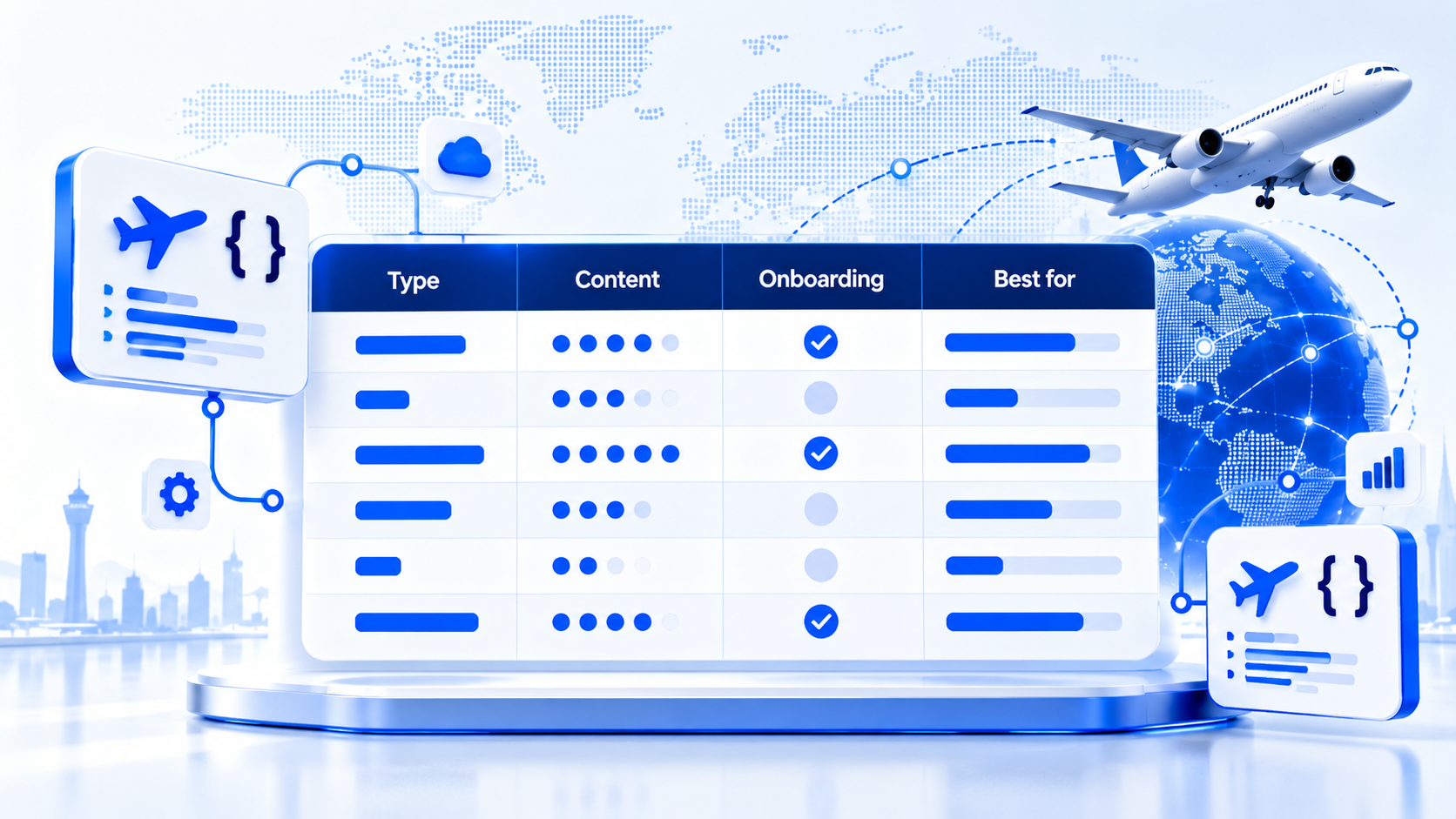
Here are the 10 best flight suppliers side by side. “Content” reflects what each supplier publishes about itself, not independent testing.
| Supplier | Type | Content (per its site) | Onboarding | Best for |
|---|---|---|---|---|
| Amadeus | GDS (Enterprise APIs) | 100+ Enterprise APIs | Request + contract, NDA pricing | Established agencies, OTAs |
| Sabre | GDS | Air APIs per account | Free test creds; contract for production | Sabre-connected agencies |
| Travelport | GDS + TripServices API | 400+ airlines incl. NDC and LCC | Sales team | OTAs, TMCs, consolidators |
| Duffel | NDC/GDS/LCC aggregator | 300+ airlines | Self-serve; enterprise option | Developers, startups |
| Mystifly | Multisource aggregator | NDC, LCC, GDS, consolidator marketplace | Commercial; API or portal | Multisource OTAs |
| TBO | B2B distributor | Air + hotels + packages | Free agency registration | B2B agencies |
| PKFARE | B2B aggregator | 600+ airlines, China content | Commercial | B2B distributors, OTAs |
| Travelfusion | LCC/NDC aggregator | 400+ LCCs, 70+ NDC carriers | Enterprise | LCC-heavy OTAs, OBTs |
| Verteil | NDC aggregator | 50+ NDC airlines | Portal or API registration | NDC-focused agencies |
| IATA.co | B2B portal + flights API | Supplier mix not disclosed | Free account; manual API approval | Sellers without own accreditation |
Do not compare flight API providers on airline counts alone. What matters is whether a supplier returns bookable fares on your routes, with correct baggage, fare rules and servicing, under a ticketing model you can actually operate. For a scoring checklist, see how to evaluate a flights API supplier.
How to Work With Flight Suppliers: Onboarding, Money and Testing

Picking from the flight suppliers for travel agencies above is the easy part. Most of the pain starts after the sales call. Here is how onboarding with a flight supplier usually goes, and where agencies get caught.
Contracts and credentials
The flight supplier contract is always yours. Booking software cannot give you inventory. The supplier approves your business, signs commercial terms with you and issues production credentials (API keys, PCCs, office IDs or whitelisted IPs). Ask early for a sandbox, a named integration contact and the certification steps, because some suppliers review your booking flow before switching on production.
BSP settlement vs a consolidator or ticketing partner
Accredited agencies settle airline sales through IATA’s Billing and Settlement Plan (BSP). In the US the equivalent is ARC. You report sales and pay one consolidated amount on a fixed cycle. Getting there takes financial criteria, guarantees in many markets, and fees. Our guide to IATA travel agency accreditation covers the process.
Without accreditation, you settle with your flight supplier or ticketing partner instead: a consolidator, a host or sub-agent agreement, or a platform that tickets for you, such as Duffel Managed Content, TBO or IATA.co. The partner issues the ticket, and you still own the customer, the fare rules you explain and the refunds you pass back.
Deposits, wallets and credit lines
Ask each flight supplier how money moves before you write any code. Prepaid models (a deposit or wallet you top up) are easy to get and cap your risk, but a busy weekend can drain the float. Credit lines help cash flow but usually need trading history and a guarantee. Map out refunds too. When the airline refunds, who receives the money first, and how long until it reaches your customer?
Test before you go live
A successful search proves very little. Before launch, run these tests on every flight supplier or flight API you connect:
- Search → price re-check → book → ticket, on at least one low-cost and one full-service route.
- Fare rules and baggage display match what the airline actually sells.
- Void inside the void window, then cancel and refund outside it.
- A schedule change or involuntary reissue, and how you get notified.
- Your search-to-book ratio against the supplier’s limits (quotas, excess-search fees or per-minute caps).
- Name-length, infant and multi-passenger edge cases.
Markups and service fees
Keep the supplier’s net price and your selling price separate. Decide where markup rules live (per supplier, route, cabin, channel or B2B agent) and show service fees clearly on invoices. Keep that logic in your booking platform, not hard-coded into each supplier connector. When you add a second flight supplier, your pricing then stays consistent.
Which Flight Supplier Should You Start With?

Forget generic rankings of the best flight suppliers and start from your own situation:
- New agency, no accreditation: Start with a partner that tickets for you. TBO suits portal-first B2B selling. If you also want an API from day one on a prepaid balance, read IATA.co‘s guide to selling flights without accreditation and compare it with Duffel Managed Content.
- Accredited agency with a GDS contract: Get full use out of the GDS you already pay for (Amadeus Enterprise, Sabre or Travelport) before adding anything else.
- Developer or startup building an app: Start with self-serve flight API providers. Duffel is the most open. IATA.co also works if you can accept a manual API review and prepaid funding.
- High-volume OTA needing LCC + NDC: Run Mystifly, PKFARE, Travelfusion and Verteil side by side on your top 50 routes and compare price, bookability and servicing.
- B2B consolidator: Combine a GDS with a multisource aggregator, and control markups and sub-agent wallets in your own platform.
A new agency rarely needs more than one supplier on day one. Launch with one source your team fully understands, and add a second only when you have a specific reason, such as missing routes, better fares on a corridor or content your customers ask for.
Connecting More Than One Supplier With PHPTRAVELS
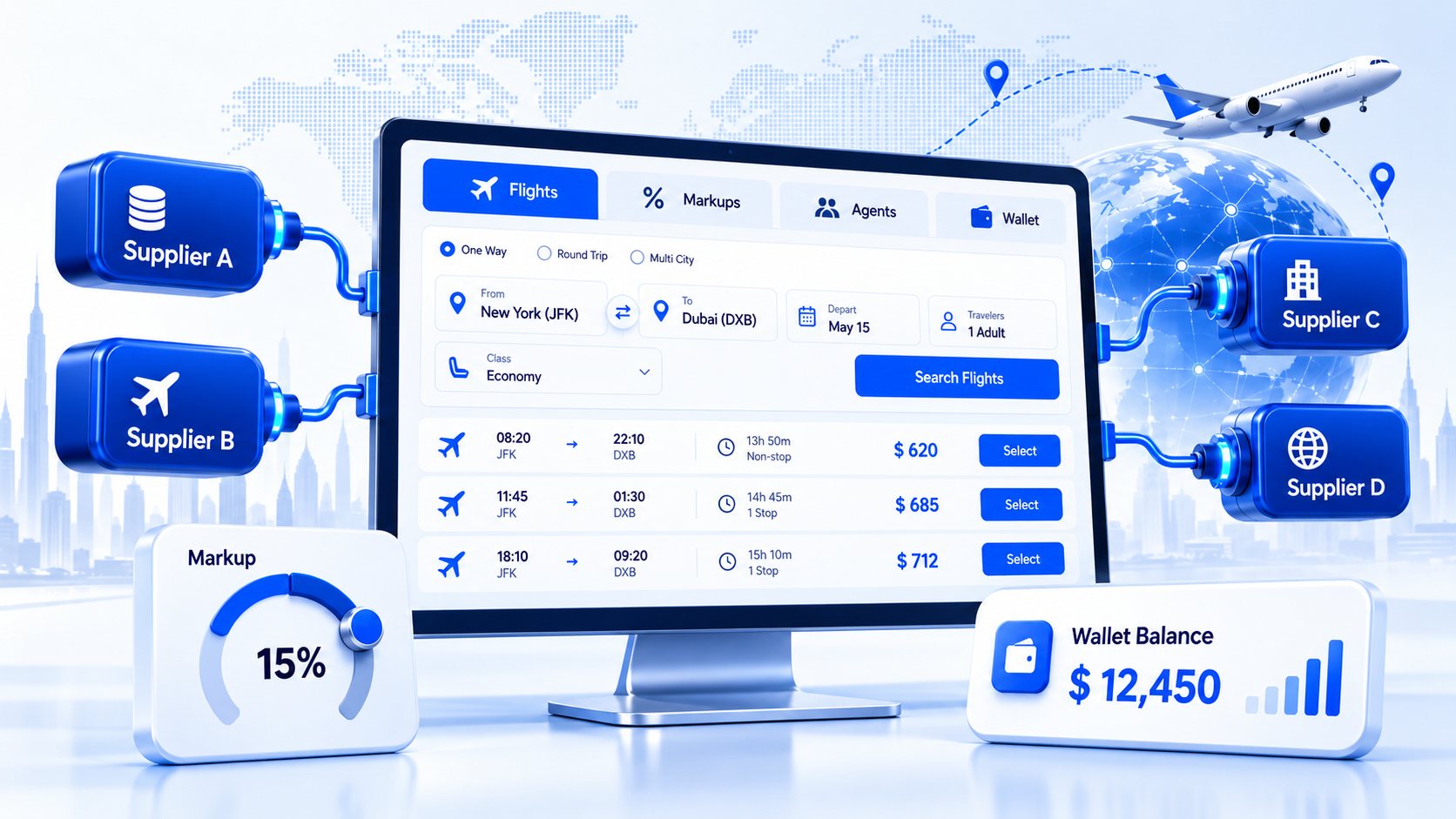
Even the best flight suppliers will not keep your search results, markups and agent balances consistent once you use more than one. That is the problem PHPTRAVELS solves. It does not replace your supplier contracts. You bring your own approved accounts and credentials, and the platform connects them.
- Flight connectors listed today on our integrations page: Amadeus, Sabre, Travelport, Duffel, Mystifly, TBO Holidays, PKFare, Kiwi and Seeru. Suppliers not on that list, such as Travelfusion, Verteil or IATA.co, can be scoped as a custom integration.
- Booking operations: The flights module covers fare rules, markups, hold-then-ticket flows, PNR and ticket-number storage, and changes and refunds, depending on what each supplier contract allows.
- B2B money control: agent wallets run on prepaid deposits that you approve, and every booking is written to a per-agent ledger. It mirrors the prepaid model many suppliers use with you.
- Ownership: Self-hosted with source code included under a commercial licence. It is not a per-booking SaaS rental, and PHPTRAVELS takes no cut of your bookings.
To see how supplier mixes compare on cost, our round-up of travel API providers and integration platforms covers hotels and other verticals too.
FAQ: Best Flight Suppliers for Travel Agencies

Is Amadeus Self-Service still available?
No. Amadeus decommissioned the Self-Service portal on 17 July 2026 and disabled its API keys. Only the Amadeus Enterprise API portal remains, and access to it is by request and commercial agreement.
Can I sell flights without IATA accreditation?
Yes. Work through a partner that holds ticketing authority, such as a consolidator, host agency, sub-agent agreement or a platform that tickets for you. You remain responsible for your customers, local business rules and explaining fare rules.
What is the difference between a GDS and an NDC aggregator?
A GDS (Amadeus, Sabre, Travelport) is a long-established multi-airline distribution network. An NDC aggregator (for example Verteil or Duffel) connects airlines’ own NDC APIs behind one integration, which often gives richer offers and ancillaries.
How many flight suppliers should a new agency start with?
Usually one. Get search, booking, ticketing, servicing and reconciliation working properly before adding a second source for a clear commercial reason.
Do flight APIs include ticketing?
Not always. Some providers ticket for you under their own accreditation. Others expect your own IATA or ARC number, or a GDS ticketing setup. Confirm who issues the ticket before you sign.
The best flight suppliers for your agency are the ones whose content, ticketing model and money flow fit how you actually sell, not the ones with the biggest airline count. Pick one or two flight suppliers, test them properly, and keep pricing logic in a platform you control. When you are ready to connect them, book a PHPTRAVELS demo or configure your PHPTRAVELS pricing.