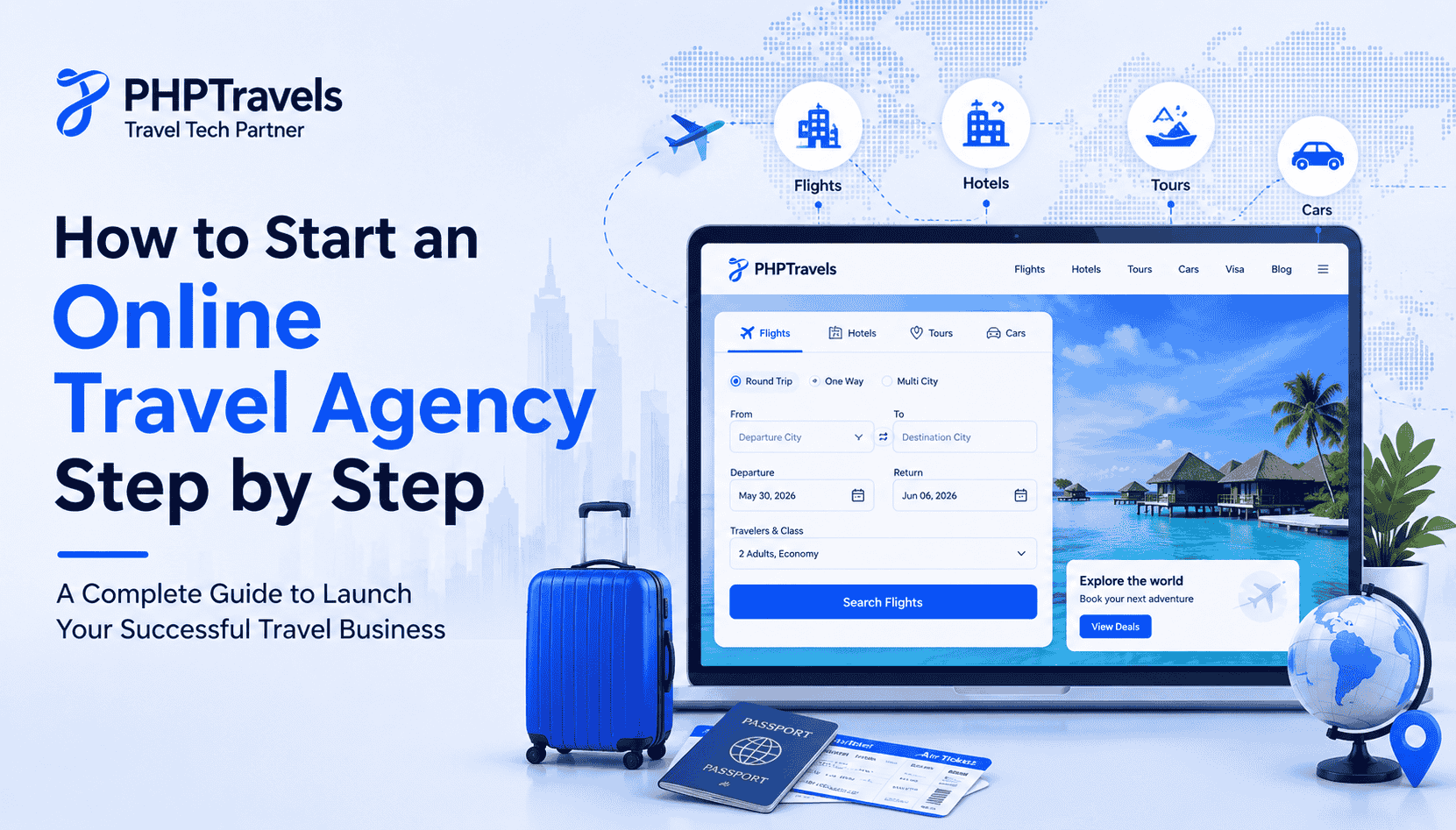
Most people who set out to start an online travel business underestimate one thing: the hard part is not the idea, it’s the plumbing. Anyone can register a domain and list a few destinations. The business only becomes real when a customer can search live availability, get an accurate price, pay, and receive a confirmation without a human touching the booking. That gap between a travel website and a working travel business is where most launches stall.
These 10 tips are ordered the way operators who survive their first year actually work: decide what you are building, sort out where inventory comes from, get the booking flow right, then market on top of it. It’s written for agency owners, OTA founders, tour operators, and DMCs who intend to sell trips at scale not book one for themselves.
Quick Summary
- A travel website displays trips. A travel business processes bookings end to end. Build for the second.
- Your inventory model API resale, contracted rates, or a mix decides your margins, tech, and risk. Choose it deliberately.
- Travel margins are thin, so the cost that kills you is operational: manual reconciliation, payment failures, rebooking chaos. Automate early.
- Most failures launch too broad, own no inventory advantage, and treat the booking engine as an afterthought.
1. Decide which kind of online travel business you are building
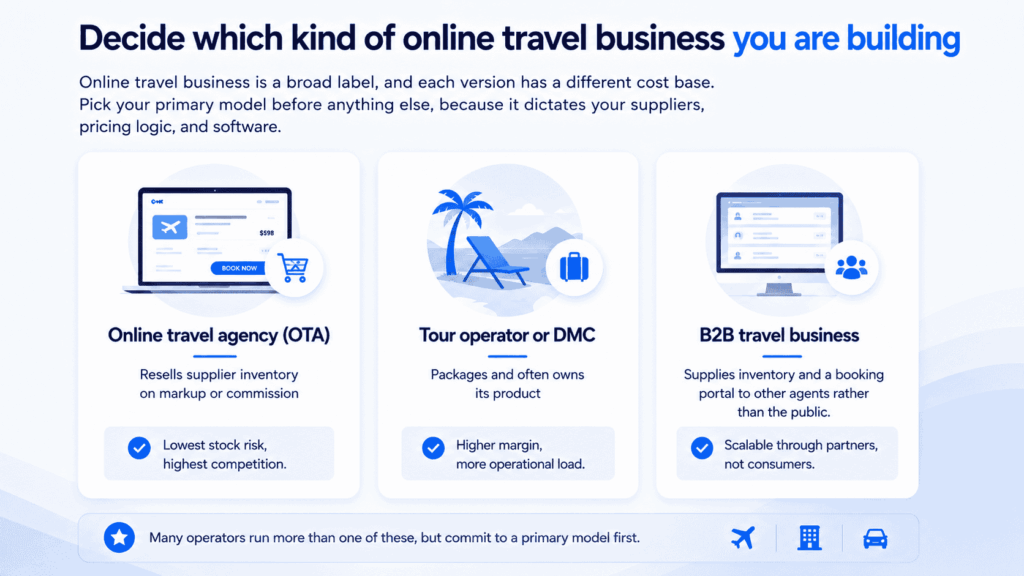
Online travel business is a broad label, and each version has a different cost base. Pick your primary model before anything else, because it dictates your suppliers, pricing logic, and software.
- Online travel agency (OTA): resells supplier inventory on markup or commission lowest stock risk, highest competition.
- Tour operator or DMC: packages and often owns its product higher margin, more operational load.
- B2B travel business: supplies inventory and a booking portal to other agents rather than the public.
- Many operators run more than one of these, but commit to a primary model first.
2. Define a niche you can actually defend
Pick a niche usually stops at type of travel adventure, luxury, budget which are categories anyone can claim, not advantages. A defensible niche is something a generalist can’t easily copy, and it also makes your platform simpler to configure.
- A corridor or route you know better than competitors.
- A supplier relationship that secures rates others can’t get.
- An audience you already reach an existing community or B2B base.
- Avoid category-only “niches” that give you no real edge.
3. Write a plan with real unit economics
A plan that lists a mission statement and skips the math is a brochure. The number that matters is your margin per booking, and every later decision about pricing and marketing depends on knowing it.
- Customer price minus supplier cost, payment fees, and refund/chargeback risk equals real margin.
- Know your average booking value and realistic monthly volume.
- Separate one-off setup costs from recurring per-booking costs.
- If you can’t state margin per booking, the plan isn’t finished.
4. Choose your inventory model the decision everything depends on
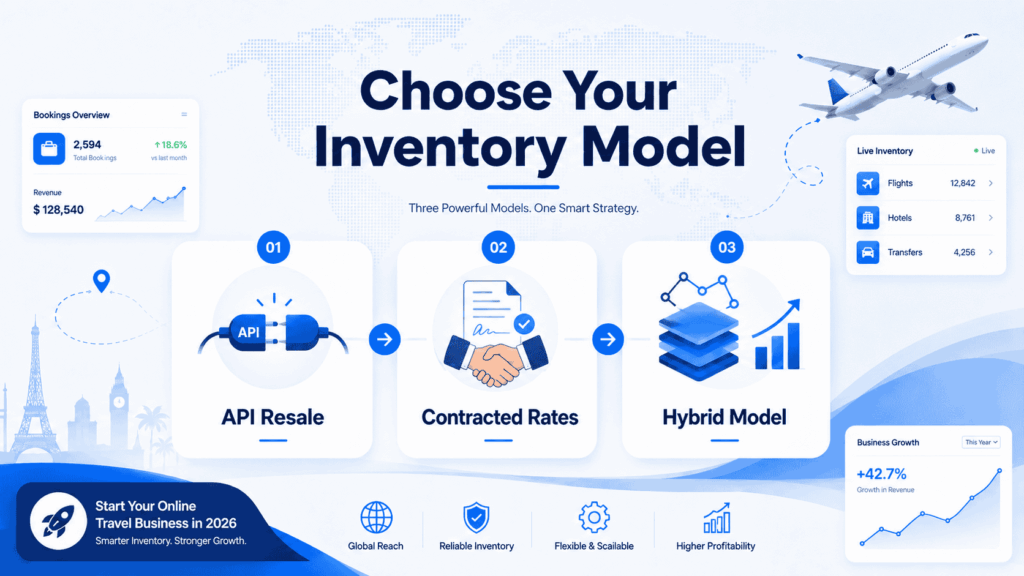
This is the part casual guides skip, and it’s the most important. Your inventory model changes your margins, your tech, and your risk, so decide before you build.
- API resale: live third-party inventory, low stock risk, price-driven competition.
- Contracted rates: higher margin and differentiation, but more contracting and overhead.
- Hybrid: API inventory for breadth, contracted product for margin where most serious operators land.
- The model you pick determines your cash needs and the software you’ll need.
5. Map and connect your suppliers before you build
Your inventory comes from somewhere specific, and a broken or slow travel API integration means empty search results and lost sales. Map what you’ll connect to first the list of available XML and API suppliers is a useful reality check.
- Flights: Amadeus, Travelport, Sabre, Duffel.
- Hotels: Hotelbeds, TBO, and other bed banks.
- Activities and transfers: Viator and similar providers.
- Confirm coverage for your target regions before committing to any one source.
6. Build the booking flow, not just the website
A site that looks good but can’t take a live booking is the most common expensive mistake. The booking flow is the product, and a travel booking engine is what stitches its jobs together.
- Search live availability across every connected source.
- Price in real time with markup, taxes, and currency applied.
- Take payment securely and confirm the booking back to the supplier automatically.
- Issue vouchers or tickets and handle changes and refunds without manual work.
7. Set up payments for travel’s reality
Payment is its own discipline high-value transactions, fraud risk, and multi-currency demand. Plan your payment gateway setup early rather than bolting it on after launch.
- Support the local payment methods your market actually uses.
- Plan for multi-currency pricing and settlement from day one.
- Build in fraud and chargeback handling for high-value bookings.
- Test checkout on mobile, where most last-step drop-off happens.
8. Run B2C and B2B from one system
If you sell direct and through sub-agents, the same inventory and pricing rules have to apply across both, or you’ll oversell and erode trust. Running a public site and a B2B travel portal on disconnected tools is how that breaks.
- Apply the same inventory and rate rules across both channels.
- Manage agent-specific pricing, credit, and markups centrally.
- Run one back office instead of reconciling two separate systems.
- Avoid overselling when channels draw on shared stock.
9. Automate the operational layer
Travel margins are slim, so the threat is rarely the headline cost it’s operational leakage. This is why a travel agency CRM and proper back-office accounting matter more than they sound.
- Reconcile customer price, supplier cost, commission, and fees on every booking.
- Centralize customer and booking records instead of scattering them across inboxes.
- Handle cancellations and refunds through defined workflows, not ad hoc scrambles.
- Track supplier payables and agent receivables in one back office.
10. Promote only once the funnel converts
Content, email, and partnerships all work but only after the booking flow converts cleanly. Sending paid traffic to a site that can not complete a booking just burns budget faster. Marketing is the layer on top of a working business, not a substitute for one.
- Destination and niche content that matches what you actually sell.
- Email and remarketing to past customers and abandoned bookings.
- Partnerships with businesses that already reach your audience.
- Scale paid traffic only once checkout converts reliably.
How businesses usually solve this and what actually works
There are three common routes to launch, and they fail in predictable ways. The common thread among the ones that survive: they treat the booking and operational layer as the foundation, not as something to figure out after the homepage looks nice.
- Build everything custom: full control, but slow and expensive you become a software company before making a sale.
- Stitch generic tools together: cheap to start, but pieces don’t talk, so reconciliation stays manual and it collapses at scale.
- Use a purpose-built travel platform: faster launch and lower operational cost, in exchange for some bespoke control.
- Survivors invest in the booking engine first; failures spend the budget on a beautiful homepage.
Where PHPTRAVELS fits
If you have decided to start an online travel business and do not want to spend a year and a six-figure budget building infrastructure first, that’s the gap PHPTRAVELS is built for. It’s a travel booking platform that agencies, OTAs, tour operators, and DMCs run as their own, and it does not replace strategy your niche, suppliers, and margins are still your job. It removes the part where the technology is why you can not launch.
- Flights, hotels, tours, and cars managed in one platform.
- 32+ supplier and GDS integrations so you launch with live inventory.
- B2C and B2B agent channels from a single back office.
- White-label, so it carries your brand, not ours.
The fastest way to judge whether the booking flow fits your model is a live demo.