
Choosing the right global distribution system is an important decision for a travel agency, OTA, tour operator, corporate travel company, or B2B travel network.
Your GDS affects inventory access, fares, agent workflows, ticketing, cancellations, refunds, and schedule changes. The right choice depends on your target market, business model, supplier needs, ticketing setup, technology, and growth plan.
This guide explains how to choose a GDS using practical criteria that travel businesses can apply before signing a contract or starting an integration.
Quick Summary
Choose a GDS by evaluating:
- Your business model and target customers
- Airlines, routes, fares, and suppliers available in your market
- Ticketing and accreditation requirements
- API and booking system compatibility
- Post-booking servicing capabilities
- NDC and low-cost carrier content
- Agent usability and training
- Total operating cost
- Technical support and scalability
Do not choose a provider only because it is well known. Choose the system that supports your real booking, ticketing, and customer service workflows.
What Is a Global Distribution System?
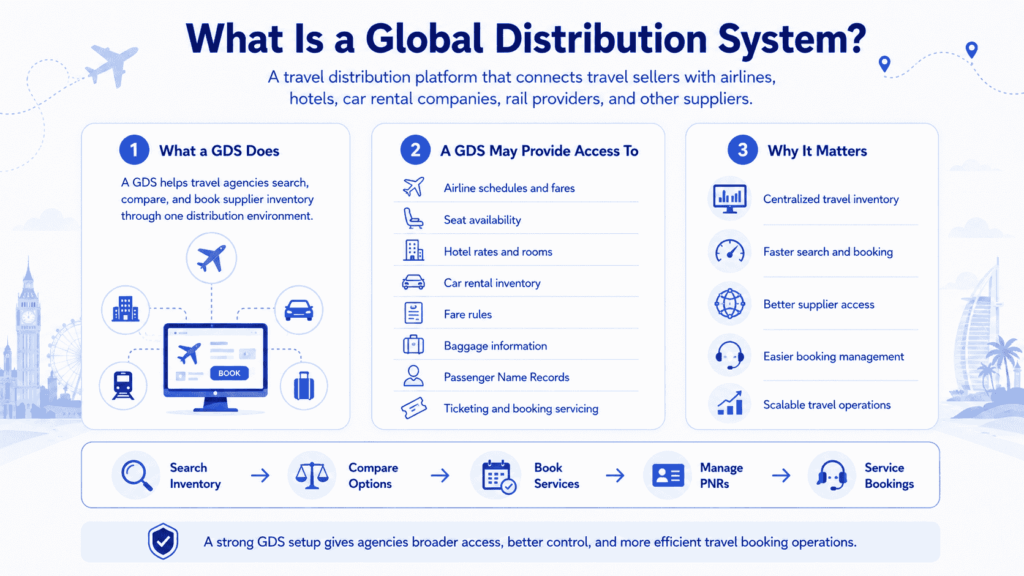
A global distribution system, or GDS, is a travel distribution platform that connects travel sellers with airlines, hotels, car rental companies, rail providers, and other suppliers.
A GDS may provide access to:
- Airline schedules and fares
- Seat availability
- Hotel rates and rooms
- Car rental inventory
- Fare rules
- Baggage information
- Passenger Name Records
- Ticketing and booking servicing
It lets an agency search and manage inventory through one distribution environment. For a broader explanation, read the complete guide to global distribution systems.
Do You Actually Need a GDS?
A GDS is often useful when your business needs:
- Access to several airlines
- International or multi-city bookings
- Corporate travel management
- Airline ticket issuance
- Fare rules and branded fares
- Refund, exchange, and cancellation workflows
- PNR and queue management
- API connectivity for an online booking website
A GDS may not be your first requirement if you mainly sell tours, transfers, local activities, directly contracted hotels, or one narrow group of routes.
In those cases, a direct supplier API, consolidator, flight aggregator, or specialist supplier may be more practical.
Many travel businesses combine GDS content with direct APIs, NDC, low-cost carriers, and specialist suppliers.
How to Choose a GDS for Your Travel Business
1. Define Your Business Model
Start by documenting how your business operates.
Start by documenting your business model, including whether you serve B2C, B2B, corporate, or multiple segments. Define your main products, target markets, booking process, customer journey, and expected monthly volume. A retail agency may focus on ticket servicing, an OTA on API speed and automation, while corporate or B2B businesses may require approvals, negotiated fares, credit limits, commissions, and reporting. Your business model should guide every other decision.
A retail agency may prioritize ticket servicing, an OTA may focus on API speed and automation, and a corporate or B2B business may need approvals, negotiated fares, credit limits, commissions, and reporting.
Your business model should guide every other decision.
2. Check Inventory and Market Coverage
Not every GDS offers the same inventory in every country.
Create a list of the routes and suppliers your customers are most likely to book.
Include:
- Domestic and international airlines
- Full-service and low-cost carriers
- Popular origin and destination pairs
- Public and negotiated fares
- Student, marine, corporate, or group fares if relevant
- Branded fares
- Baggage and seat options
- Hotel, car, or rail content
Confirm that your required airlines, routes, and fares are available for your country and point of sale. Request a demonstration using real routes.
3. Confirm Ticketing and Accreditation
Access to flight inventory does not always include ticket issuance.
Your business may need:
- IATA accreditation
- BSP participation
- ARC accreditation in the United States
- A host agency
- An airline consolidator
- A ticketing partner
Before choosing a GDS, confirm:
- Who will issue the ticket?
- Who manages settlement?
- Who handles refunds and voids?
- Who is responsible for debit memos?
- Are minimum booking volumes required?
- Can the setup support all your target countries?
New agencies often begin with a consolidator. For more detail, read how to become an IATA travel agency.
4. Test Post-Booking Servicing
Search and booking are only part of the workflow.
Your team must also manage:
- Schedule changes
- Cancellations
- Refunds
- Exchanges and reissues
- Seat selection
- Additional baggage
- Fare penalties
- Special service requests
- Airline queues
- Booking history
Ask the provider to demonstrate real post-booking scenarios. Good fares have limited value if changes, refunds, and schedule updates require expensive manual work.
5. Agent Workspace vs GDS API Connectivity
| Evaluation Area | Agent Workspace | GDS API Connectivity |
|---|---|---|
| Primary Use | Manual search, booking, ticketing, and reservation management by travel agents | Automated search, booking, ticketing, and servicing through a website, mobile app, or internal system |
| Ease of Use | Check interface clarity, navigation, filters, and daily usability | Check how easily developers can integrate and maintain the API |
| Search Performance | Evaluate search speed and result accuracy | Evaluate API response time, availability, and search limits |
| Fare Comparison | Confirm agents can compare airlines, routes, fare families, and pricing | Confirm the API returns complete and structured fare comparison data |
| Fare Rules | Check whether penalties, restrictions, and ticket conditions are clearly displayed | Confirm fare rules are available through API responses |
| PNR Management | Evaluate PNR creation, retrieval, updates, queues, and servicing tools | Confirm support for PNR creation, retrieval, modification, and synchronization |
| Booking Confirmation | Agents should be able to confirm bookings directly from the workspace | The API should return reliable booking confirmation and status responses |
| Ticketing | Check ticket issuance, voiding, revalidation, and ticket history | Confirm the API supports automated or controlled ticket issuance |
| Cancellations | Evaluate how easily agents can cancel bookings | Confirm cancellation endpoints, rules, and response handling |
| Refunds | Check refund calculation, submission, and tracking tools | Confirm refund requests, status checks, and error responses are supported |
| Exchanges | Evaluate tools for fare recalculation and ticket exchange | Confirm the API supports exchanges, repricing, and additional collection |
| Seats and Baggage | Check seat maps, seat selection, baggage allowances, and paid baggage | Confirm seat and baggage content is available through the API |
| NDC Content | Check access to airline offers, bundles, and ancillary services | Confirm the API can return and manage relevant NDC content |
| Queue Management | Evaluate queues, task assignment, follow-ups, and booking alerts | Check whether queue data and booking updates can be synchronized |
| Role Permissions | Confirm access can be controlled by agent role, office, or department | Confirm API credentials and permissions can be restricted securely |
| Training Requirements | Review onboarding time, training materials, and certification needs | Review technical documentation, developer training, and implementation support |
| Documentation | User guides and operational manuals should be available | Complete API documentation, examples, status codes, and workflows should be provided |
| Sandbox Access | Training or test environments may be available for agents | A reliable sandbox should be available for development and testing |
| Certification | Agents may require platform or ticketing training | The integration may require testing and certification before production access |
| Error Handling | The workspace should display clear booking and ticketing errors | The API should return clear error codes, messages, retry guidance, and logs |
| Technical Support | Check availability of agent help desks and operational support | Check access to developer support, escalation channels, and incident assistance |
| Best Fit | Agencies that depend on trained agents and manual booking workflows | Agencies that need online booking, automation, scalability, and system integration |
The GDS should connect properly with your flight booking software, payment gateway, CRM, accounting tools, and customer notifications.
6. Calculate the Total Cost
Do not compare providers using one setup fee.
Your full cost may include:
- Setup and contract fees
- Agent workspace charges
- API access
- Development and certification
- Transaction or segment fees
- Training
- Support
- Ticketing partner fees
- Accreditation
- Payment processing
- Accounting and reconciliation tools
- Internal staff time
- Minimum booking commitments
Ask for all fees and conditions in writing. A low initial price can become expensive when servicing is manual or content is limited.
7. Review NDC and Low-Cost Carrier Content
Airline distribution now includes more than traditional GDS fares.
NDC may provide richer airline offers, including:
- Branded fares
- Seats
- Baggage
- Meals
- Bundled services
- Airline-specific products
Low-cost carrier content may come through direct APIs, aggregators, or selected GDS connections.
Read NDC vs GDS airline distribution for a detailed comparison.
8. Evaluate Support and Training
Support quality matters because booking problems affect customers immediately.
Check:
- Support hours and time zone
- Emergency escalation
- API support
- Ticketing support
- Training programs
- Documentation
- Account management
- Production issue response times
Your team should know who handles booking failures, ticketing errors, refunds, API outages, and production issues. Training also reduces mistakes and handling time.
9. Compare Major Providers Using the Same Test Cases
Amadeus, Sabre, and Travelport are major travel distribution platforms, but none is automatically best for every business.
Their suitability varies by country, point of sale, airline agreements, routes, ticketing setup, NDC access, commercial terms, support, and integration requirements.
Use the same routes, dates, passenger types, fare rules, baggage options, and refund scenarios when comparing providers.
For a separate overview, read Amadeus vs Sabre vs Travelport.
You can also review:
10. Run a Pilot Before Full Launch
Do not move directly from a sales demo to a full rollout.
Run a controlled pilot using real routes, test bookings, ticketing, cancellations, refunds, schedule changes, payments, and reports.
Track:
- Search-to-price success
- Price-to-booking success
- Booking-to-ticket success
- Failed bookings
- Average handling time
- Manual steps
- Refund and exchange time
- Support response time
- Displayed price versus final price
Approve the full rollout only after the system performs well in real operating conditions.
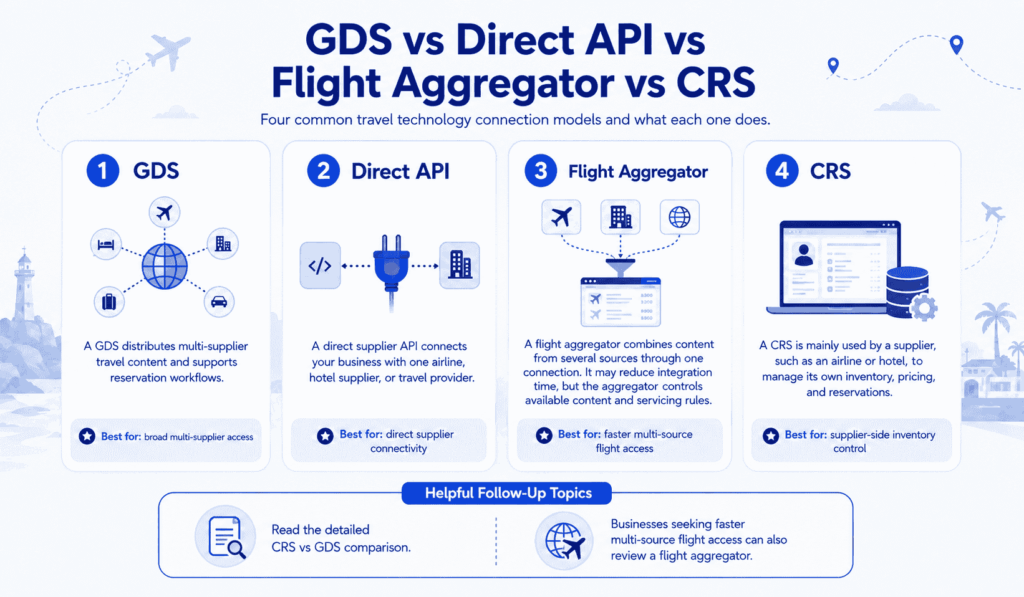
GDS vs Direct API vs Flight Aggregator vs CRS
A GDS distributes multi-supplier travel content and supports reservation workflows.
A direct supplier API connects your business with one airline, hotel supplier, or travel provider.
A flight aggregator combines content from several sources through one connection. It may reduce integration time, but the aggregator controls available content and servicing rules.
A CRS is mainly used by a supplier, such as an airline or hotel, to manage its own inventory, pricing, and reservations.
Read the detailed CRS vs GDS comparison.
Businesses seeking faster multi-source flight access can also review a flight aggregator.
Common Mistakes When Choosing a GDS
Avoid these mistakes:
- Choosing by brand name alone
- Comparing only flight search results
- Ignoring point-of-sale restrictions
- Ignoring NDC and low-cost carriers
- Underestimating agent training
- Focusing only on setup cost
- Ignoring contract exit terms
- Assuming a GDS is a complete travel platform
A GDS provides content and reservations, but you may still need a booking website, B2B portal, CRM, payments, accounting, reporting, and back-office tools.
GDS Implementation Checklist
Before development starts, confirm:
- Provider contract
- Point-of-sale access
- Ticketing or consolidator setup
- Production credentials
- Required APIs
- Airlines, routes, NDC, and LCC requirements
- Search, booking, ticketing, cancellation, refund, and exchange workflows
- Payment gateway
- Markups and service fees
- CRM and accounting
- Invoices and vouchers
- Customer notifications
- Agent roles and permissions
- Reporting and logs
- Sandbox testing
- Provider certification
- Agent training
- Support and launch plan
Where PHPTRAVELS Fits
A GDS provides inventory and reservation functions, but a travel company still needs an operating platform to manage customers, agents, payments, bookings, markups, documents, and reports.
PHPTRAVELS can connect supplier content with B2C, B2B, corporate, and back-office workflows.
The platform can support:
- Flights, hotels, tours, cars, and transfers
- Customer and agent bookings
- Payment gateways
- CRM
- Markups and commissions
- Invoices and vouchers
- Agent balances
- Reports
- Back-office management
A connected GDS system for travel agents can make GDS inventory easier to sell and manage.
You can also review the GDS travel system or request a PHPTRAVELS live demo.
Final Thoughts
Choosing a GDS is both a technical and business decision.
The right system should match your market, suppliers, customers, ticketing model, team, technology, and growth plan.
Compare providers using real routes and booking scenarios. Test post-booking workflows, calculate total cost, review support quality, and run a controlled pilot before full implementation.