
Implementing tour operator software should make a travel business easier to operate. Bookings should move faster, availability should be easier to control, itineraries should be simpler to manage, and staff should spend less time moving information between spreadsheets and disconnected systems.
Yet a new system can still underperform even when the software itself works correctly.
Tour operator software implementations usually struggle when the technology is introduced without redesigning the workflows, data, responsibilities, integrations, and training around it.
A failed implementation does not necessarily mean that the software stops working. Failure can also mean:
- staff continue using spreadsheets beside the new system;
- booking information has to be entered more than once;
- inventory is inconsistent across sales channels;
- integrations frequently require manual intervention;
- management cannot get reliable operational reports;
- employees avoid important features;
- implementation takes much longer than expected.
For tour operators managing multi-day itineraries, suppliers, guides, transportation, payments, agents, and customer communication, these problems can quickly affect the entire operation.
Quick Answer: Why Does Tour Operator Software Implementation Fail?
The six most common causes are:
- Weak management ownership
- Unclear operational goals
- Software that does not fit real workflows
- Poor data migration and integration planning
- Lack of employee involvement
- Insufficient training and onboarding
The solution is to treat implementation as an operational transformation project, rather than simply installing another booking application.
A suitable tour management system should support the way reservations, operations, inventory, suppliers, payments, agents, and reporting already interact and improve those processes rather than adding more manual work.
What Should Tour Operator Software Actually Manage?
Tour operator software connects activities that are often spread across several departments and tools.
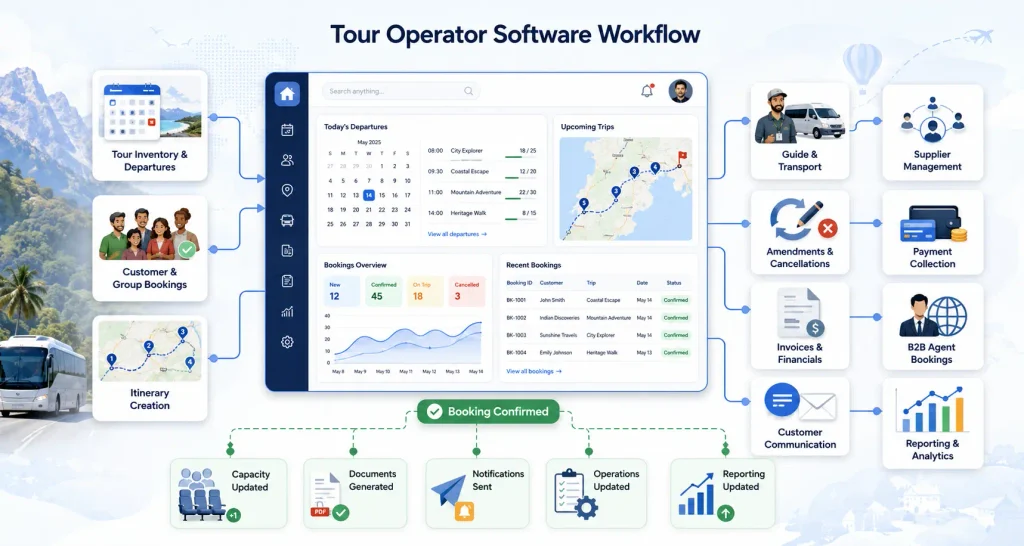
Typical operations include:
- tour inventory and departure availability;
- customer and group bookings;
- multi-day itinerary creation;
- guide and transportation assignments;
- supplier management;
- booking amendments and cancellations;
- payment collection;
- invoices and financial records;
- B2B agent bookings;
- customer communication;
- reporting.
The purpose of a centralized tour operator software platform is not simply to digitize these individual tasks. It should create a consistent flow of information between them.
For example, when a booking is confirmed, the system may need to update available capacity, record payment, add passengers to the correct departure, generate documents, notify operations, and make the information available for reporting.
If those connections are missing, teams eventually create manual workarounds.
Reason 1: Weak Management Ownership
Why does weak management support cause implementation failure?
Software implementation affects more than the IT team.
Reservations may want faster booking workflows. Operations may need better manifests and supplier coordination. Finance needs accurate payments and reporting. Management needs visibility across the business.
Without a clear project owner, departments can make conflicting decisions or continue using previous processes.
The most common result is a hybrid environment in which the new platform exists, but spreadsheets, emails, and older tools remain the real operating system.
How to fix it
Give one person responsibility for the implementation and define who can make final decisions.
Management should establish:
- the business objectives;
- project responsibilities;
- implementation milestones;
- required integrations;
- success measurements;
- the process for resolving workflow disagreements.
Leadership should also review adoption after launch rather than considering the project complete on the go-live date.
Reason 2: Unclear Operational Goals
Why do undefined goals create problems?
“Automate our travel business” is not a measurable implementation objective.
A tour operator needs to identify exactly what should improve.
Useful objectives could include:
- reducing duplicate booking entry;
- improving tour availability accuracy;
- shortening itinerary preparation time;
- centralizing supplier information;
- reducing reservation errors;
- giving agents access to live inventory;
- improving financial reporting.
Without these goals, it becomes difficult to determine whether the implementation is actually succeeding.
How to fix it
Map the existing workflow before configuring the platform.
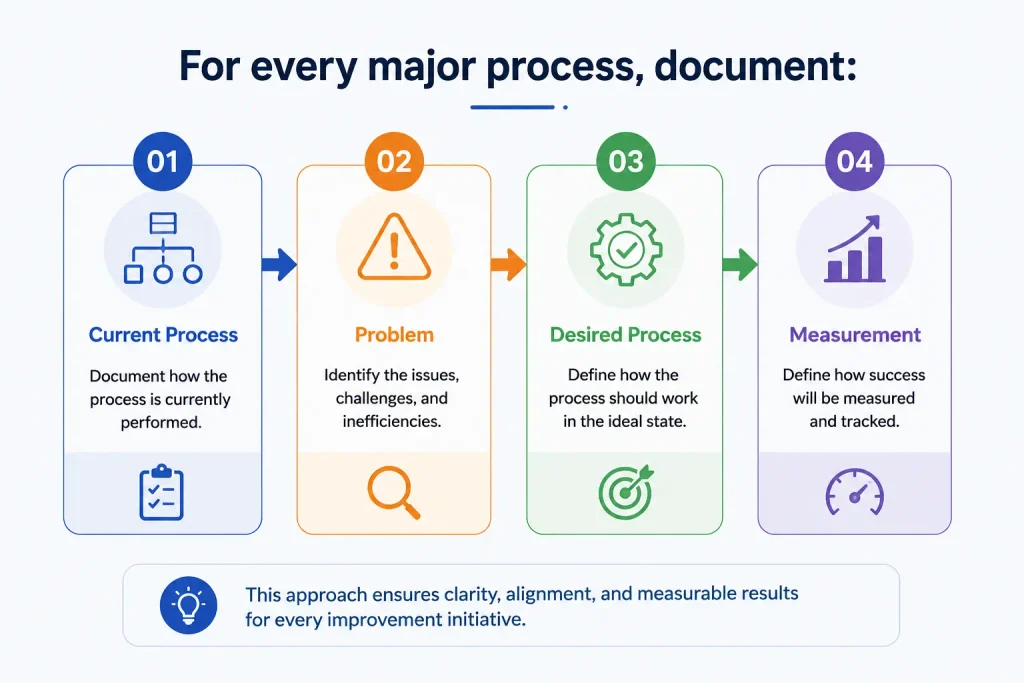
For every major process, document:
Current process → problem → desired process → measurement
For example:
Current: Reservations manually update tour capacity in a spreadsheet.
Problem: Availability can become outdated.
Desired: Confirmed bookings automatically update inventory.
Measurement: No duplicate capacity updates.
A centralized booking inventory system becomes useful when inventory rules are connected directly with the booking workflow rather than maintained separately.
Reason 3: Choosing Software That Does Not Match the Workflow
Why can technically good software still fail?
A system can have hundreds of features and still be wrong for a particular tour operator.
Multi-day tour businesses can require workflows that are very different from simple hotel or activity reservations.
Examples include:
- multiple services inside one itinerary;
- different suppliers for each itinerary component;
- group capacity rules;
- guide scheduling;
- transport coordination;
- staged or partial payments;
- booking amendments after confirmation;
- agent-specific pricing.
If employees constantly have to work around the software, adoption will fall.
How to fix it
Evaluate systems using real booking scenarios, not only feature lists.
During demonstrations, ask the vendor to complete workflows such as:
- create a multi-day itinerary;
- confirm a group reservation;
- change the departure date;
- modify passenger numbers;
- assign a guide;
- update capacity;
- process a partial payment;
- generate the final passenger manifest.
That reveals workflow gaps much faster than a generic sales demonstration.
Reason 4: Poor Data Migration and Integration Planning
Why is our travel booking system integration failing?
A booking system integration often fails because two systems do not agree on data structures, availability rules, pricing logic, authentication, booking statuses, or error-handling procedures.
Tour operators commonly connect software with:
- supplier APIs;
- payment gateways;
- CRM platforms;
- accounting systems;
- B2B portals;
- OTA or reseller channels.
The more systems involved, the more important it becomes to define exactly which platform owns each piece of information.
For businesses using external suppliers, understanding the API integration process before launch can prevent important dependencies from being discovered too late.
Data migration can create the same problem
Legacy information may contain:
- duplicated customer profiles;
- expired supplier contracts;
- inconsistent tour names;
- outdated prices;
- incomplete booking records;
- different date or currency formats.
Moving bad data into a new platform simply creates a newer version of the old problem.
How to fix it
Use a staged migration.
First:
- identify the data that must be migrated;
- remove duplicate or obsolete records;
- map old fields to the new system;
- migrate a test dataset;
- validate pricing, bookings, customers and itineraries;
- test integrations;
- migrate the remaining approved records.
Also define failure handling. If an API does not respond, staff should know whether the booking is pending, failed, confirmed, or requires manual review.
Reason 5: Ignoring Employees Who Use the System
Why does staff involvement matter?
Frontline users understand operational exceptions that may not appear in management requirements.
A reservations agent may know that certain tours require special passenger information. Operations staff may have unusual guide-assignment rules. Finance may need specific invoice fields.
If these teams only see the software after configuration is finished, important problems are discovered too late.
How to fix it
Create a small implementation group representing the departments that use the platform.
Ask them to test:
- normal bookings;
- group bookings;
- cancellations;
- amendments;
- payments;
- itinerary changes;
- supplier changes;
- customer communication.
If customer records and sales activities are part of the project, connecting the booking workflow with a suitable travel CRM system can also reduce duplicate customer data.
Reason 6: Insufficient Training and Onboarding
Why does good software still get abandoned?
Employees usually return to old tools when the new process feels slower or uncertain.
This often happens because training focuses on showing features rather than teaching real tasks.
Knowing where an inventory menu is located is different from knowing what to do when a customer changes a departure after making a partial payment.
How to fix it
Train teams by workflow and role.
Reservations staff should practice booking, amendment, cancellation and payment scenarios.
Operations staff should practice manifests, departures, suppliers, guides and itinerary changes.
Finance teams should understand payments, refunds and reporting.
Training should also continue after launch.
The first few weeks reveal questions that rarely appear during demonstrations. Maintain internal documentation and schedule follow-up sessions based on actual user problems.
Signs Your Tour Operator Software Implementation Is Going Wrong
| Warning sign | Likely cause | Recommended action |
|---|---|---|
| Staff still use spreadsheets | Workflow or training problem | Identify why the system is being bypassed |
| Bookings require duplicate entry | Missing integration | Map where duplicate data is created |
| Availability becomes inconsistent | Inventory configuration problem | Establish one source of inventory truth |
| Reports cannot be trusted | Data or process inconsistency | Audit field usage and reporting rules |
| Employees avoid certain features | Usability or training issue | Test the workflow with real users |
| API bookings frequently need correction | Integration mapping problem | Review statuses, fields and error handling |
| Implementation keeps expanding | Undefined goals or scope | Return to agreed project outcomes |
How Can Tour Operators Reduce Manual Booking Work?
The goal should not be to automate every task. It should be to remove unnecessary repeated work.
Start with processes where staff repeatedly transfer the same information.
Common opportunities include:
- updating inventory after booking;
- sending booking confirmations;
- collecting customer details;
- creating manifests;
- recording payments;
- sharing booking information with operations;
- making inventory available to agents.
For companies selling through trade partners, a B2B booking engine can allow authorized agents to search availability and place reservations without requiring staff to manually recreate every booking.
Automation works best after the underlying workflow is clearly defined.
A Practical Tour Operator Software Implementation Checklist
Before launch, confirm that:
- operational objectives are documented;
- every major workflow has an owner;
- real booking scenarios have been tested;
- legacy data has been cleaned;
- supplier and payment integrations have been tested;
- inventory rules are consistent;
- user permissions are configured;
- staff have completed role-based training;
- failed transactions have a recovery process;
- reporting has been validated;
- responsibilities during go-live are clear;
- post-launch feedback is being collected.
If several of these items are incomplete, postponing full migration may be safer than forcing every department onto the new system at once.
Where PHPTRAVELS Fits
PHPTRAVELS provides travel technology designed around booking and operational workflows, including tour management, inventory, supplier integrations, CRM capabilities, payment connectivity and B2B distribution.
Businesses evaluating a new system should compare these capabilities against their actual operating processes rather than selecting software purely on the number of features available.
Companies can also review how tour booking software supports reservations and tour operations before designing their implementation plan.
Final Thoughts
Tour operator software does not fail only because of technical problems.
Implementation usually becomes difficult when workflows, integrations, data and people are treated as separate issues.
The strongest approach is to define the desired operating model first, test the system against real reservations, migrate clean data, involve frontline teams and train employees around the jobs they actually perform.
When technology follows that process, a tour management platform can replace fragmented manual work with a much more consistent operational system.
Don’t let implementation be the reason your tour business stalls
PHPTRAVELS’ tour management system is built to avoid the exact failure points covered above — flexible workflows, guided onboarding, and support that stays with you past go-live.
See the Tour Management System →