
For many travel agencies, OTAs, DMCs, wholesalers, and tour operators, the term consolid appears when discussing airline fares, travel consolidators, booking APIs, B2B portals, and digital reservation systems. But in real travel operations, consolid is not just a keyword. It connects directly with how agencies access inventory, manage fares, issue tickets, apply markups, control agent credit, and automate bookings.
A travel business may start with manual supplier communication, email-based reservations, or a simple booking website. But once booking volume increases, manual workflows create delays, pricing errors, missed ticketing deadlines, poor reporting, and limited scalability.
Understanding consolid in the travel technology context helps agencies evaluate how consolidator platforms, API integrations, booking engines, GDS systems, payment workflows, and automation fit into daily operations.
Quick Summary
Consolid in travel usually refers to consolidator-based workflows where agencies access negotiated fares, supplier inventory, and booking distribution through portals or APIs.
Key takeaways:
- Travel consolidators help agencies access airline fares and supplier inventory.
- Consolid API integration can automate search, booking, PNR creation, ticketing, and reporting.
- B2B and B2C booking engines need reliable inventory synchronization.
- Dynamic pricing, markups, commissions, and credit limits are critical for profitability.
- Manual workflows may work for small agencies but become difficult to scale.
- PHPTRAVELS can support travel businesses with booking engines, supplier integrations, agent portals, automation, and operational workflows.
What Is Consolid in Travel?
In travel technology, consolid is commonly used around travel consolidator systems, airline fare distribution, booking platforms, and supplier API workflows.
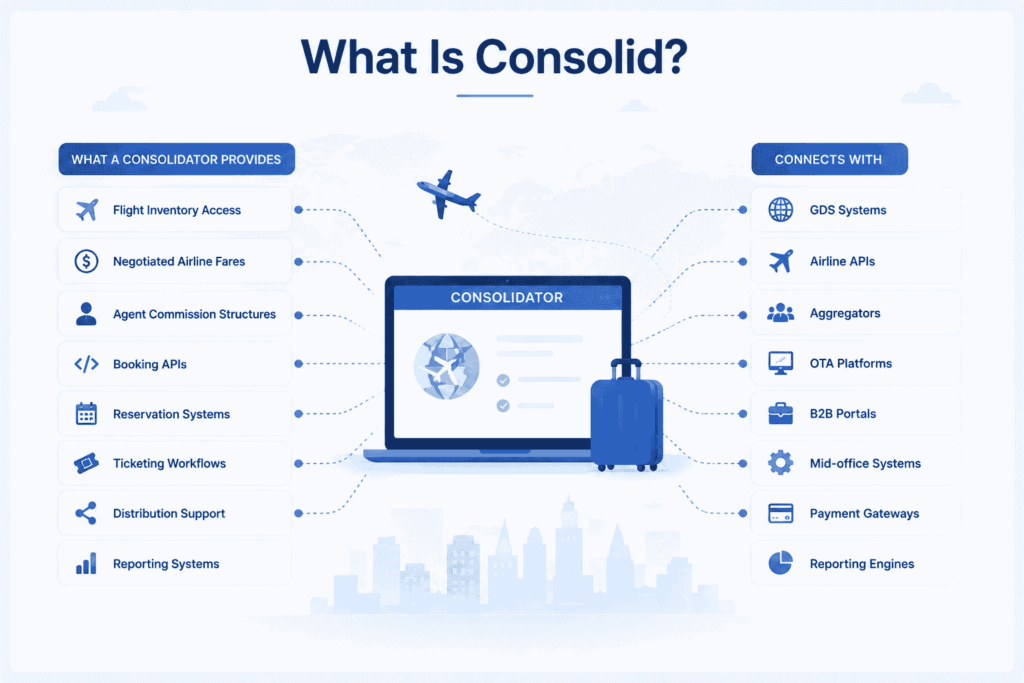
A travel consolidator is a company or platform that provides agencies with access to airline inventory, negotiated fares, wholesale rates, and reservation support. Instead of every small or medium travel agency building direct relationships with multiple airlines, consolidators help distribute travel products through portals, APIs, or agent networks.
A consolidator model may support:
- Flight inventory access
- Negotiated airline fares
- Published and private fares
- Agent commission structures
- Reservation workflows
- PNR generation
- Ticketing support
- Supplier reporting
- B2B travel distribution
- API-based booking automation
For an online travel agency or B2B travel portal, consolidator access can become an important part of the booking operation. It helps agencies increase product coverage, manage pricing, and serve customers without depending only on one supplier source.
How Travel Consolidator Workflows Operate
A consolidator workflow is not only about showing flight prices on a website. It includes several operational layers that work together before and after a booking is completed.
Search and Availability
The process starts when a customer, agent, or corporate user searches for a trip.
The request may come from:
- An OTA website
- A B2B agent portal
- A corporate booking tool
- A mobile booking platform
- A travel management system
The platform sends the search request to connected suppliers, such as a Consolid API, GDS, airline API, or aggregator. The response includes availability, fare options, routes, schedules, taxes, baggage rules, and booking conditions.
Fare Selection and Pricing
Once results are returned, the system must calculate the final selling price.
This may include:
- Base fare
- Taxes
- Supplier fees
- Agency markup
- Agent commission
- Currency conversion
- Payment gateway charges
- Promotional discounts
This stage is important because incorrect pricing can reduce margin or create disputes after booking.
Reservation and PNR Creation
After the customer or agent selects a fare, the booking system creates a reservation.
In flight workflows, this usually involves:
- Passenger information
- Fare validation
- Seat availability confirmation
- PNR creation
- Supplier booking reference
- Time limit tracking
- Ticketing status
The PNR and reservation workflow must be accurate because later steps such as ticketing, cancellation, amendment, refund, and customer support depend on this record.
Payment, Ticketing and Confirmation
After reservation creation, the system moves into payment and ticketing.
Depending on the business model, payment may happen through:
- Customer card payment
- Agent wallet balance
- Credit account
- Bank transfer
- Partial payment
- Corporate billing
After payment approval, the system may trigger ticket issuance, invoice generation, voucher creation, and confirmation email delivery.
Consolid API Integration for Travel Business
A Consolid API integration connects a travel booking system with consolidator inventory and booking services. Instead of checking fares manually through supplier portals, agencies can automate search, pricing, reservation, and ticketing workflows through their own platform.
This is useful for agencies that want to get their travel business online and reduce dependency on manual operations.
A Consolid API may support:
- Flight search
- Fare rules
- Availability checks
- Booking creation
- PNR management
- Ticket issuance
- Cancellation requests
- Refund processing
- Booking status updates
- Supplier reporting
A strong API integration should not only display search results. It should also handle operational reliability, errors, timeouts, fare changes, failed bookings, and supplier response delays.
GDS, Airline APIs and Aggregator Connections
Most travel businesses do not rely on one inventory source. They often combine several supplier connections to improve coverage and pricing.
GDS Systems
Global Distribution Systems such as Amadeus, Sabre, and Travelport are widely used in flight distribution. They help agencies access airline inventory, create PNRs, manage reservations, and support ticketing workflows.
GDS systems are powerful, but they usually require proper configuration, contracts, credentials, and experienced handling.
Airline APIs
Some airlines provide direct API access. This can be useful when a business needs direct fares, NDC content, branded fares, or airline-specific products.
However, direct airline integrations require maintenance. Each airline may have different documentation, authentication rules, booking flows, and ticketing requirements.
Aggregator and Online Consolidator APIs
Aggregators and online consolidator platforms simplify supplier access by connecting multiple sources through one interface.
This can help agencies reduce integration complexity, launch faster, and manage multiple suppliers from a centralized travel reservation system.
B2B and B2C Booking Engine Solutions
A travel business may operate in B2C, B2B, or both models. Each model requires different workflows.
B2C Booking Engine
A B2C booking engine serves direct customers. The focus is on search experience, mobile usability, checkout flow, payment processing, booking confirmation, and customer self-service.
Common B2C features include:
- Flight booking
- Hotel booking
- Tours and activities
- Transfers
- Secure checkout
- Customer dashboard
- Booking history
- Email confirmations
- Online cancellation requests
For B2C travel businesses, user experience and conversion rate matter. But the backend must still support fare validation, supplier confirmation, payment capture, and voucher delivery.
B2B Booking Engine
A B2B booking engine is designed for agents, sub-agents, corporate clients, and reseller networks.
Important B2B features include:
- Agent login
- Sub-agent management
- Credit limits
- Wallet balance
- Markup rules
- Commission settings
- Agent-specific pricing
- Booking approval
- Invoice generation
- Sales reporting
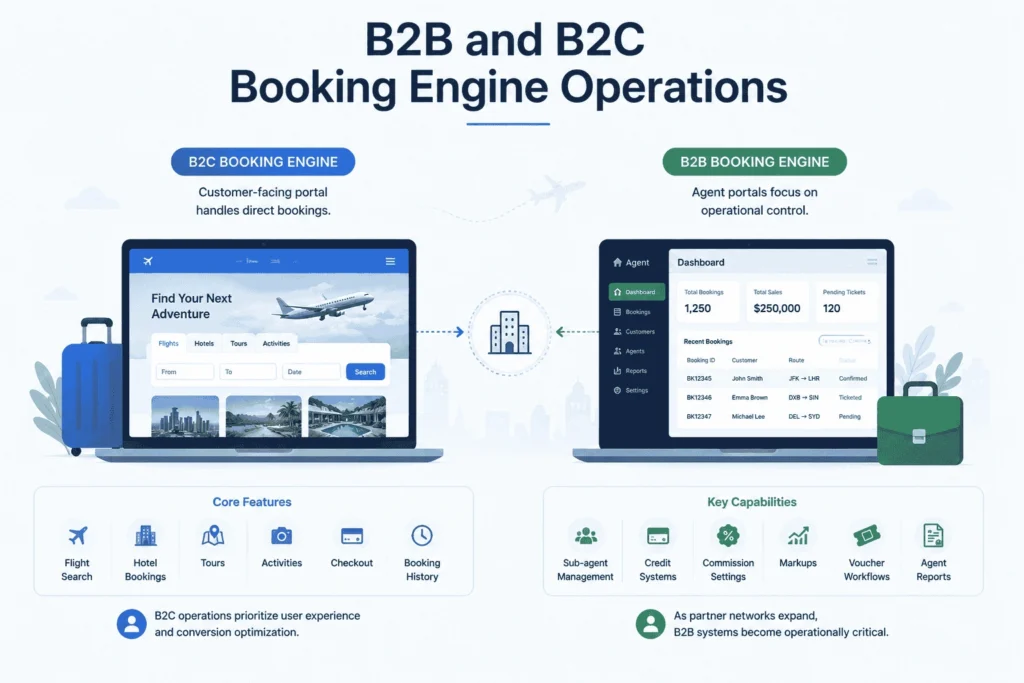
For agencies working with reseller networks, B2B operations are often more complex than B2C because every agent may have different pricing, limits, access rules, and settlement terms.
Inventory Synchronization and Availability Challenges
Inventory synchronization is one of the biggest challenges in travel technology.
Travel inventory changes quickly. Flight seats, fares, taxes, hotel rooms, cancellation rules, and supplier availability can change within seconds. If the system does not refresh data properly, customers may see unavailable prices or failed bookings.
Common inventory issues include:
- Expired fares
- Supplier timeout errors
- Duplicate bookings
- Failed reservation creation
- Price mismatch during checkout
- Outdated hotel availability
- Missing cancellation rules
- Incomplete supplier responses
To manage this, travel platforms need strong backend logic.
Important components include:
- API caching
- Real-time fare validation
- Queue processing
- Retry mechanisms
- Error logging
- Supplier fallback handling
- Background synchronization
- Booking status checks
Without reliable synchronization, travel businesses may face customer complaints, refund pressure, supplier disputes, and revenue loss.
Dynamic Pricing, Markups and Commissions
Pricing is not only about showing the supplier fare. Travel agencies make profit through markups, commissions, service fees, and negotiated margins.
A typical travel pricing structure may include:
Supplier Cost + Taxes + Markup + Service Fee – Discount = Selling Price
For B2B travel portals, pricing may also include:
- Agent commission
- Sub-agent commission
- Corporate rate
- Destination-based markup
- Airline-based markup
- Route-based pricing
- Seasonal pricing rules
- Currency conversion margin
Fixed Markups
A fixed markup adds a specific amount to each booking. For example, an agency may add $15 or $25 per flight booking.
This is simple but may not work well for every destination or fare type.
Percentage Markups
A percentage markup adds a margin based on fare value. For example, 5% markup on selected airlines or destinations.
This is useful when booking values vary.
Dynamic Markup Rules
Dynamic markup rules are more advanced. They may change based on agent type, airline, destination, booking channel, season, cabin class, or supplier.
For growing agencies, automated pricing rules are important because manual pricing is slow and error-prone.
Payments, Invoicing and Credit Control
Travel booking workflows involve more financial control than many businesses expect.
A travel platform may need to manage:
- Customer payments
- Agent wallets
- Credit limits
- Supplier payments
- Refunds
- Partial payments
- Invoices
- Receipts
- Commission settlement
- Currency conversion
B2C Payment Workflows
B2C customers usually pay online through card, wallet, or bank transfer. The system must confirm payment before ticketing or voucher generation.
B2B Credit Workflows
B2B travel portals often allow agents to book using credit. This requires strict control.
The system should manage:
- Available credit
- Used credit
- Booking limits
- Payment due dates
- Agent balances
- Credit suspension rules
- Settlement reports
If credit is not managed properly, agencies may increase bookings but lose control of cash flow.
Mid Office and Back Office Workflows
A travel booking engine is only one part of the operation. Mid office and back office processes decide whether the business can scale profitably.
Mid Office Workflows
Mid office workflows connect booking activity with business control.
They may include:
- Booking review
- Approval workflows
- Agent settlement
- Supplier reconciliation
- Margin tracking
- Customer support notes
- Ticketing follow-up
- Refund request handling
Back Office Workflows
Back office operations focus on accounting, reporting, supplier payments, and business performance.
They may include:
- Invoice management
- Tax reporting
- Revenue reports
- Supplier payable reports
- Agent receivable reports
- Commission reconciliation
- Booking audit logs
- Financial exports
A business may have a strong website but weak operations if mid office and back office workflows are ignored.
Voucher Generation, PNR and Reservation Management
Reservation records are central to travel operations.
For flights, the PNR is critical. It connects passengers, itinerary, airline status, ticketing, schedule changes, cancellations, and support workflows.
For hotels, tours, transfers, and activities, voucher generation is equally important. Customers and agents need proof of booking with correct service details.
A good travel reservation system should support:
- PNR storage
- Supplier booking reference
- Ticket status
- Voucher generation
- Invoice generation
- Customer confirmation
- Agent confirmation
- Amendment history
- Cancellation status
- Refund tracking
Manual handling of these records can work for a small agency, but it becomes difficult when daily booking volume increases.
Manual vs Automated Travel Workflows
Many travel businesses start with manual workflows because they are easy to launch.
A manual process may look like this:
Customer request → Staff checks supplier portal → Price shared by email → Payment collected → Booking confirmed manually → Invoice created separately
This can work for low-volume agencies, but it creates problems as bookings increase.
Common manual workflow problems include:
- Slow response time
- Human pricing errors
- Missed booking deadlines
- Duplicate data entry
- Poor reporting
- Delayed invoices
- Agent disputes
- Weak customer experience
An automated workflow may look like this:
Search → Supplier API → Fare validation → Booking → Payment → PNR → Ticketing → Invoice → Voucher → Report
Automation improves speed, accuracy, and scalability. It also gives business owners better control over revenue, supplier performance, agent activity, and customer service.
Common Mistakes Travel Businesses Make
Focusing Only on Website Design
A good-looking website is not enough. Travel businesses need strong booking workflows, supplier integrations, payment logic, and operational reporting.
Depending on One Supplier
Single supplier dependency can limit inventory, pricing, and availability. Multi-supplier access improves coverage and reduces operational risk.
Ignoring Agent Management
B2B travel businesses need proper agent roles, credit limits, markups, commissions, and reporting. Without this, agent networks become difficult to control.
Not Planning for Fare Changes
Travel fares change quickly. If fare validation is weak, customers may complete checkout with expired pricing.
Handling Reports Manually
Manual reporting creates poor visibility. Business owners need clear data on bookings, revenue, margins, suppliers, agents, and destinations.
Practical Considerations Before Choosing a Consolid Solution
Before choosing a consolidator, API provider, or plataforma consolid, travel businesses should evaluate real operational needs.
Important points to review:
- Supplier coverage
- Airline and route availability
- API documentation quality
- Booking and ticketing support
- Fare validation process
- PNR handling
- Cancellation and refund workflows
- Support response time
- Multi-currency support
- Agent pricing controls
- Reporting capability
- Scalability for future growth
Businesses operating in regions such as consolid Mexico, consolid México, consolid agencias, or international agency networks should also evaluate local market requirements, preferred payment methods, language support, and supplier coverage.
The right solution should support daily operations, not only search results.
How PHPTRAVELS Fits Into Travel Business Automation
After a travel business understands its booking workflows, supplier requirements, and operational challenges, the next step is choosing a travel technology platform that can support those processes.
PHPTRAVELS helps travel agencies, OTAs, DMCs, wholesalers, and tour operators manage online travel operations through booking engines, supplier integrations, B2B portals, B2C portals, and automation features.
PHPTRAVELS can support workflows such as:
- Flight booking engine setup
- Hotel booking workflows
- Tours and activities
- B2B agent portal
- B2C customer portal
- Supplier API integration
- Consolid API integration planning
- Agent management
- Markup and commission control
- Multi-currency booking
- Voucher generation
- Booking automation
- Travel reservation system workflows
For agencies using consolidator-based inventory, PHPTRAVELS can help centralize booking operations so teams are not managing every reservation through separate portals, spreadsheets, and manual emails.
The goal is not only to launch an online booking platform. The goal is to build a travel technology system that supports real business operations, supplier connectivity, pricing control, agent workflows, and long-term scalability.
Real Business Use Cases
Online Travel Agency
An OTA may need a B2C booking engine with flights, hotels, tours, payment gateways, customer accounts, and automated confirmations.
B2B Travel Agency Network
A B2B agency may need agent logins, credit limits, commissions, markups, invoices, and booking reports.
DMC Operations
A DMC may need tours, transfers, packages, vouchers, supplier coordination, and partner booking access.
Travel Wholesaler
A wholesaler may need multi-agent distribution, negotiated rates, credit control, supplier management, and settlement reporting.
Corporate Travel Business
Corporate travel operations may need approval workflows, user roles, reporting, invoice billing, and policy-based booking controls.
Each use case requires different workflows, but all depend on reliable booking technology and operational automation.