Running a vehicle rental business has always been a balancing act. You are managing a fleet that needs to stay on the road and earning, customers who expect to book in minutes, prices that shift with the season, and paperwork that piles up the moment things get busy. For a long time most operators held this together with phone calls, spreadsheets, and a calendar on the wall. That approach can launch a business, but it rarely scales one.
Car rental software is what replaces that patchwork with a single system. Done well, it does not just digitize your bookings; it changes how the whole operation runs, from the moment a customer searches for a vehicle to the day you reconcile the month’s revenue. This guide explains what these platforms actually do, the workflows behind them, the problems they solve, and how to evaluate your options before you commit.
Quick Summary
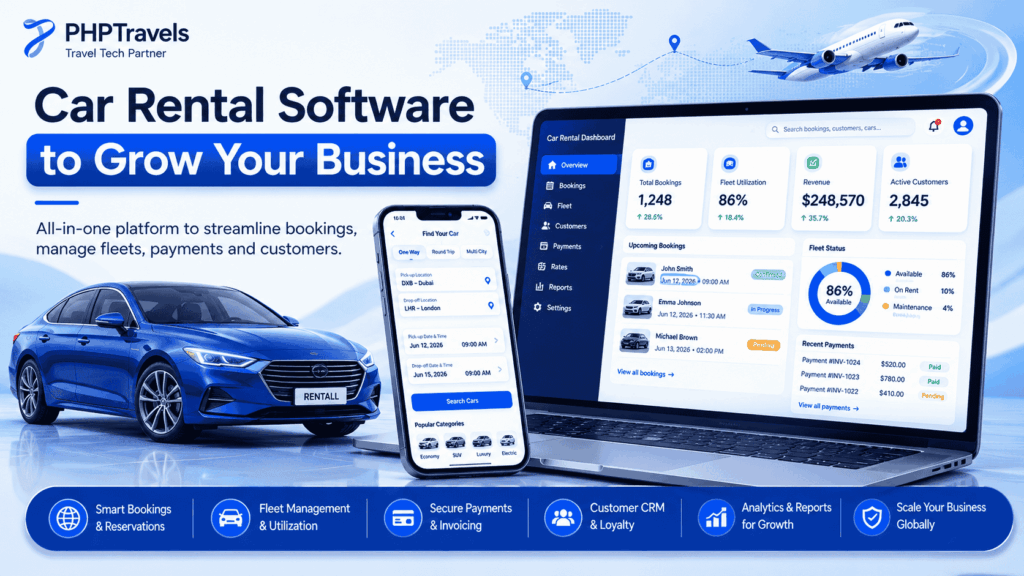
- Car rental software centralizes reservations, fleet and driver management, pricing, payments, and reporting in one place. The biggest operational wins come from real-time availability, dynamic pricing, and automation that removes manual follow-up.
- When choosing a platform, weigh deployment model (cloud vs. self-hosted), how well it handles multi-location operations, and how openly it integrates with your payment, CRM, and accounting tools.
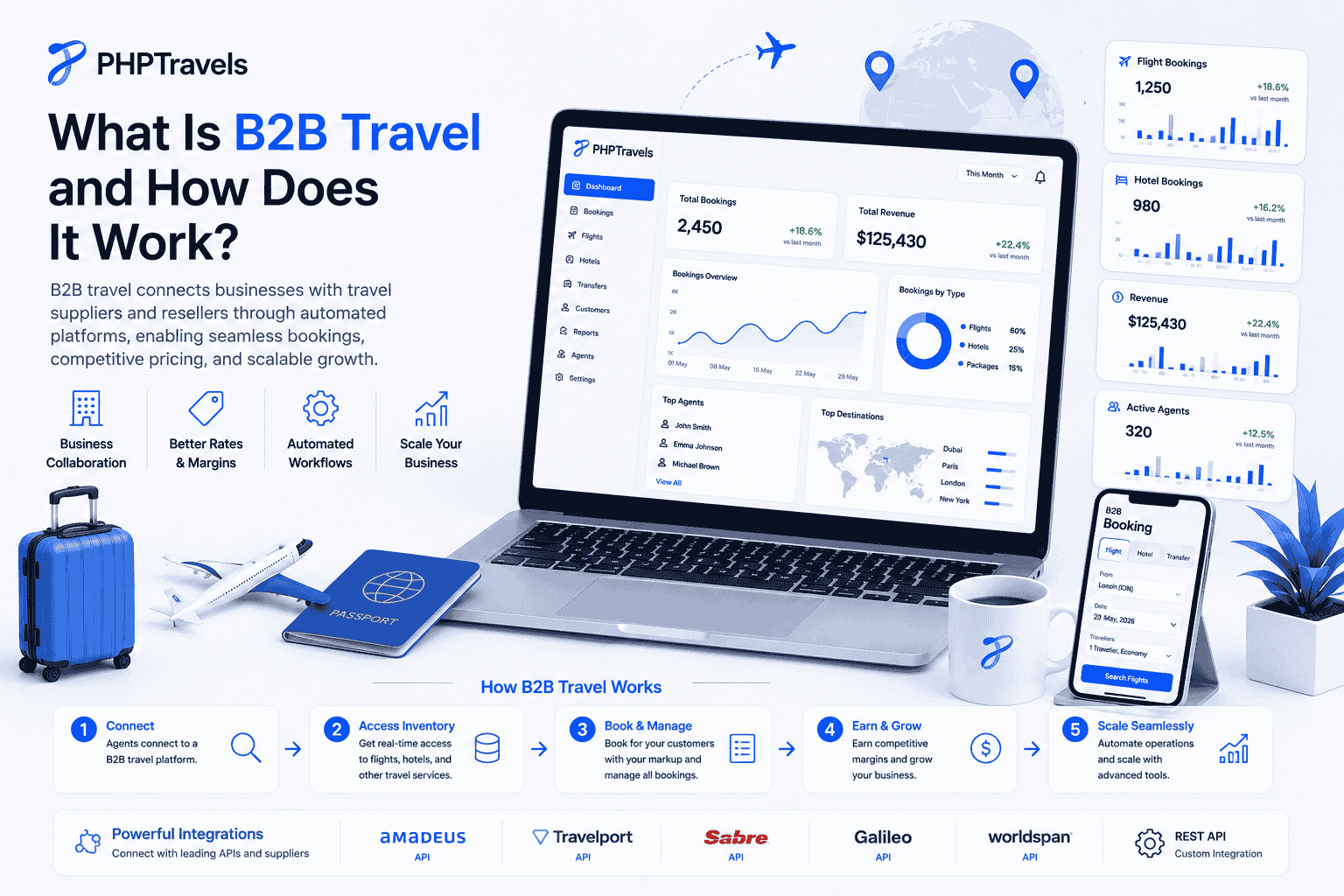
- Operators that sell rentals alongside flights, hotels, or tours benefit from a system that treats cars as one module inside a broader travel platform.
What Car Rental Software Actually Does
A modern rental management platform is built around a few connected jobs. Understanding them separately makes it easier to judge whether a product is genuinely complete or just a booking form with a dashboard attached.
Reservations and availability.
At its core, the system shows live vehicle availability across your locations and lets customers reserve in real time. This prevents the double-bookings and “sorry, that car just went out” calls that quietly erode trust. Good reservation management syncs every channel, your website, your counter staff, and your mobile apps, against the same inventory.
Fleet and driver management.
Every vehicle has a lifecycle: it gets booked, picked up, returned, cleaned, serviced, and eventually retired. Fleet management software tracks where each vehicle is in that cycle, assigns drivers where you offer chauffeured or transfer services, and flags maintenance and insurance dates before they lapse. The payoff is higher fleet utilization, fewer idle assets, and fewer compliance surprises.
Dynamic pricing.
Rental demand is seasonal, day-of-week sensitive, and event-driven. Static price lists leave money on the table. Dynamic pricing lets you set seasonal rates, weekend premiums, length-of-rental discounts, and promotional offers that apply automatically, so your rates respond to demand without someone editing a spreadsheet every Friday.
Payments.
Integrated payment processing means a customer can confirm and pay in the same flow, and you receive funds without manual invoicing. Mature platforms support multiple gateways so you can serve customers in different markets and currencies.
Automation, analytics, and notifications.
This is where time and money are saved at scale. Automated workflows handle confirmations, reminders, and status changes; notifications keep the operator, driver, and customer informed by email, SMS, or push; and analytics turn raw bookings into a clear view of revenue, utilization, and performance. A KPI dashboard that shows utilization and revenue at a glance is often the difference between reacting to problems and seeing them coming.
How a Modern Booking Flow Works
It helps to follow a single reservation through the system, because that journey is where the software either earns its keep or gets in the way.
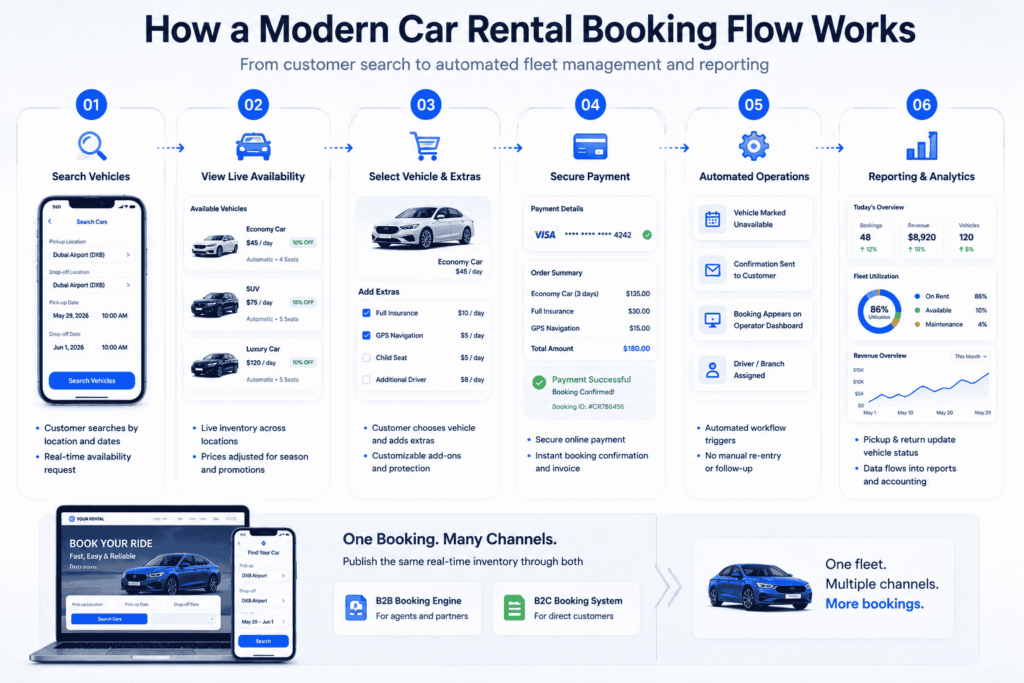
A customer lands on your site or app and searches by location and dates. The system returns only vehicles that are genuinely available for that window, with prices already adjusted for the season and any active promotion. The customer compares options, selects a vehicle, and adds extras such as insurance, GPS, or a child seat. At checkout they pay securely, and the booking is confirmed instantly.
Behind the counter, the same event triggers a chain of automated steps. The vehicle is marked unavailable for those dates, a confirmation goes to the customer, the booking appears on the operator’s dashboard, and, where relevant, a driver or branch is assigned. Pickup and return update the vehicle’s status, and the transaction flows into your reporting and, ideally, your accounting system. The customer experiences a few simple clicks; the operator gets a fully recorded, automated workflow with no rekeying.
When this booking experience is published through both a B2B booking engine for agents and partners and a B2C booking system for direct customers, a single fleet can serve multiple sales channels without duplicating work.
The Operational Problems This Solves
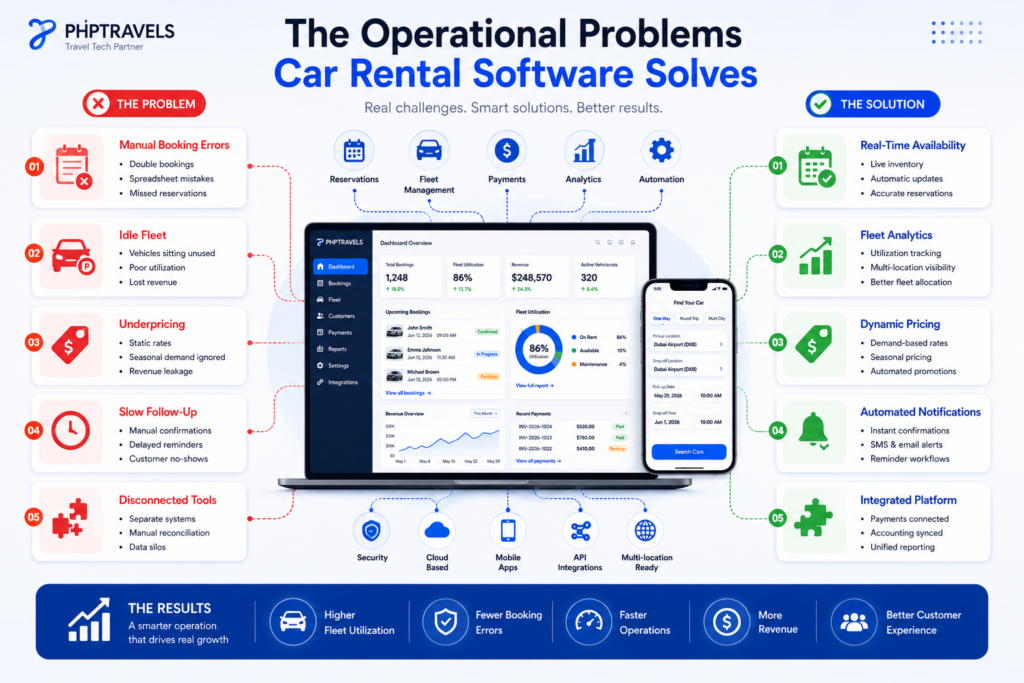
Most operators do not adopt software because they want new technology. They adopt it because specific problems keep costing them money:
- Manual booking errors
Phone and spreadsheet booking leads to double-bookings and missed reservations. Real-time availability removes the guesswork. - Idle fleet
Without utilization data, vehicles sit unbooked while demand exists elsewhere. Analytics and multi-location visibility surface where to move stock. - Underpricing
Flat rates ignore demand. Dynamic pricing captures peak value automatically. - Slow follow-up
Manual confirmations and reminders delay customers and create no-shows. Automated notifications close that gap. - Disconnected tools
When bookings, payments, and accounting live in separate systems, month-end becomes a reconciliation headache. Integrations keep data flowing in one direction.
How to Choose Car Rental Software
This is the part most “best car rental software” lists skip. Naming twenty products tells you little; knowing what to compare tells you everything. Use these criteria to evaluate any platform, whether you are looking at a free tool, an open-source script, or a commercial system.
Deployment model: cloud vs. self-hosted.
Cloud-based rental software is managed for you and quick to launch. A self-hosted option, often distributed as a car rental PHP script, gives you full control of your data and server and can be more economical at scale, but you maintain it. Neither is universally “better”; it depends on your technical capacity and how much you value ownership versus convenience.
Multi-location capability.
If you operate, or plan to operate, from more than one branch, confirm the system handles different pickup and drop-off locations, one-way rentals, and branch-specific pricing. Retrofitting multi-location support later is painful.
Openness and integrations.
A platform that locks your data in becomes a ceiling on growth. Look for open API integration so you can connect a travel CRM, accounting, and marketing tools, and reach customers through dedicated mobile apps.
Standalone vs. part of a travel platform.
A pure fleet tool is fine if cars are your only product. But many operators also sell transfers, tours, hotels, or flights. In that case, running cars as one module inside a broader online booking system avoids juggling several disconnected platforms.
Total cost, not sticker price.
“Free” software often costs more once you add hosting, support, customization, and the staff time to work around missing features. Weigh licensing against the operational time it actually saves.
A quick way to compare candidates side by side:
| What to check | Why it matters | Question to ask the vendor |
|---|---|---|
| Real-time availability | Prevents double-bookings | Does inventory sync across all channels and branches? |
| Dynamic pricing | Captures peak demand | Can I set seasonal, weekend, and promo rules automatically? |
| Multi-location & one-way | Enables expansion | Are branch-specific rates and one-way rentals supported? |
| Integrations & API | Avoids data silos | Is there an open API for CRM, payments, and accounting? |
| Deployment | Control vs. convenience | Is it cloud-hosted, self-hosted, or both? |
| Mobile experience | Where customers book | Are there customer-facing iOS and Android apps? |
Where PHPTRAVELS Fits
PHPTRAVELS approaches car rental as part of a complete travel technology platform rather than a single-purpose tool. The car rental booking system handles live availability, dynamic pricing, fleet and driver management, multi-branch operations, secure payments, automated workflows, and analytics, the full set of jobs described above, in one system.
What tends to matter most to growing operators is that it is open and flexible. It connects to widely used payment gateways and to CRM, accounting, and marketing tools through an open API, ships with customer-facing mobile apps, and can be run cloud-hosted or self-hosted as a production-ready car rental PHP script you control. For businesses that sell more than vehicles, cars sit alongside flights, hotels, and tours in the same platform, so a single back office runs the whole operation. The company has supported more than 4,800 travel agencies and businesses worldwide, which gives a sense of how the platform performs across very different markets and fleet sizes.
The most reliable way to judge fit is to see it working. You can explore a live demo of the booking flow.