A traveler may book a flight, reserve a hotel, arrange an airport transfer, purchase travel insurance, and even apply for a visa before leaving home.
But one important question often remains unanswered:
How will they get internet access when they arrive?
For many international travelers, mobile connectivity becomes a last-minute task. Some rely on expensive international roaming, search for free airport Wi-Fi, or spend time looking for a physical SIM card after landing.
This creates a practical opportunity for travel businesses.
Learning how travel agencies can sell eSIMs online allows agencies to solve a genuine customer problem while adding another product to the booking journey. Instead of ending the relationship after a flight, hotel, or package booking, the agency can also help the traveler prepare for connectivity before departure.
What Is an eSIM?
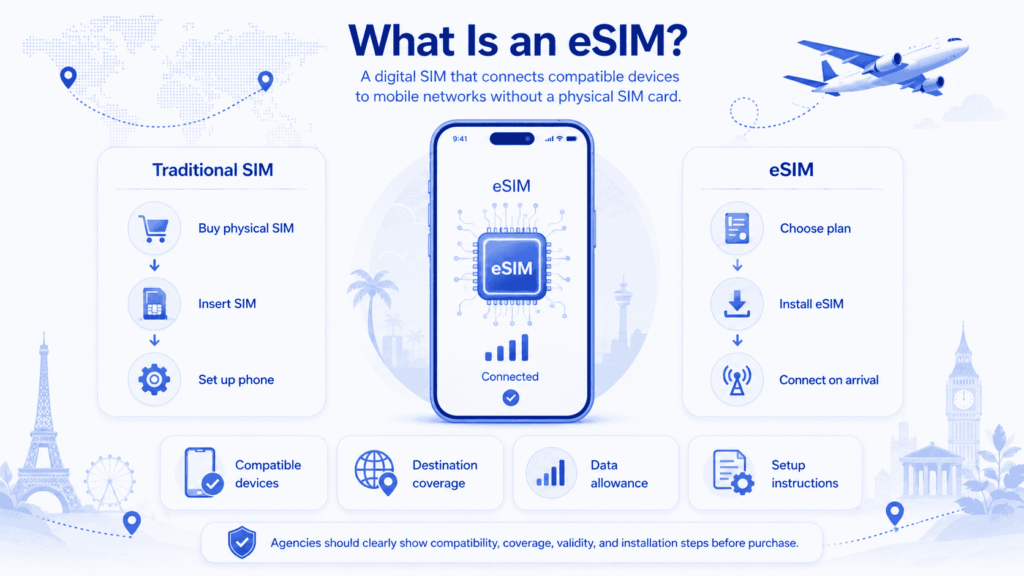
An eSIM is a digital SIM that lets a compatible mobile device connect to a mobile network without inserting a traditional physical SIM card.
In simple terms, the traveler purchases an eligible data plan, installs the eSIM on a compatible device, follows the activation instructions, and uses the connection in the supported destination.
Airalo describes an eSIM as a digital SIM that can connect a user to a mobile network without requiring a physical SIM card. Its partner platform provides eSIM solutions designed for different business use cases, including travel businesses.
For travel agency owners, it is not necessary to understand every technical detail of telecommunications infrastructure. The important point is the customer experience:
Traditional process:
Book the trip → arrive at destination → find a SIM seller → compare local plans → complete registration if required → insert the SIM → configure the phone
eSIM process:
Book the trip → select a suitable eSIM plan → receive setup information → install and configure the eSIM → connect according to the plan instructions
The exact installation and activation process depends on the device and eSIM package. Airalo provides separate setup instructions for supported devices and operating systems, so agencies should avoid giving every traveler one universal activation instruction.
This is an important operational point. An agency selling eSIMs should clearly communicate device compatibility, destination coverage, package validity, data allowance, and installation instructions before purchase.
Why eSIMs Are a Good Add-On for Travel Agencies
Travel agencies already help customers solve problems related to transportation, accommodation, documents, activities, and trip planning.
Mobile connectivity fits naturally into this journey.
Customers already trust the agency
A customer who has already purchased a flight, hotel, visa service, tour, or complete holiday package has an existing relationship with the travel business.
That makes a relevant pre-trip add-on easier to introduce than an unrelated product.
For example, a customer traveling to Dubai may already have:
- a flight booking
- a hotel reservation
- an airport transfer
- a city tour
- travel insurance
eSIMs solve a real travel problem
Travelers increasingly depend on internet access for practical parts of a trip, including:
- opening digital boarding passes
- checking hotel booking details
- using navigation apps
- contacting drivers
- receiving booking updates
- using translation tools
- accessing email
- communicating through messaging apps
- managing online banking and travel apps
A connectivity product therefore has a clear relationship with the trip itself.
Airalo’s business materials position eSIM services as an alternative travel connectivity option and offer local, regional, and global solutions across more than 200 destinations.
eSIMs are suitable for cross-selling
A travel agency does not necessarily need to sell an eSIM as a completely separate transaction.
It can be introduced alongside an existing product, such as:
- flights
- hotels
- holiday packages
- tours
- transfers
- visa services
- travel insurance
This is what makes an eSIM for travel agencies particularly interesting from a commercial perspective. It can sit within an existing booking journey instead of requiring the agency to build a completely separate customer acquisition funnel.
Agencies can increase revenue per customer
Finding a new customer normally requires marketing, sales activity, content, referrals, advertising, or partnerships.
Selling an additional relevant service to an existing traveler creates another potential revenue opportunity from a customer the agency is already serving.
This is where eSIMs can contribute to travel agency ancillary revenue.
The commercial model may vary. For example, Airalo currently presents reseller, partner integration, co-branding, affiliate, and other partnership options. The right approach depends on the agency’s business model, technical requirements, and commercial agreement.
eSIMs can improve the pre-travel experience
A strong travel agency does more than complete transactions.
It helps customers prepare.
A useful pre-departure journey might include:
- Booking confirmation
- Payment confirmation
- Visa or document reminder
- Airport transfer details
- Hotel check-in information
- Connectivity recommendation
- Final departure reminder
The eSIM becomes part of the wider service experience instead of an isolated promotion.
Which Travelers Can Be Offered an eSIM?
Not every customer needs to receive the same promotion.
The best approach is to match the offer with the travel context.
International leisure travelers
Someone booking an international holiday may need mobile data for maps, messaging, ride-hailing, hotel communication, restaurant discovery, and activity bookings.
Business travelers
Business travelers may require reliable access to email, messaging, online meetings, documents, and company systems while traveling internationally.
Airalo also operates a separate business-focused connectivity offering for organizations managing international employee travel.
Students traveling abroad
Students traveling for education may need connectivity immediately after arriving so they can contact family, find accommodation, use navigation, or communicate with an institution.
Families and groups
A family booking can create an opportunity to explain connectivity options before departure, especially where multiple travelers have compatible devices and different data requirements.
Religious travel customers
Agencies serving religious travel markets can include connectivity planning in the wider pre-departure checklist alongside accommodation, transfers, documents, group coordination, and destination guidance.
The important principle is segmentation.
A travel agency should not send the same generic eSIM promotion to every person in its database. The offer should be connected to the destination, departure date, trip purpose, and customer type.
Where Can Travel Agencies Sell eSIMs?
Understanding where to promote the product is just as important as deciding to sell it.
Here are practical sales opportunities inside the travel customer journey.
1. During Checkout
The booking checkout process is one of the most direct places to offer an eSIM.
For example:
Traveling to Thailand? Add a travel data plan for your trip.
The offer should be optional, clear, and relevant to the destination.
Avoid interrupting the main booking process with unnecessary steps. The eSIM should appear as a helpful add-on rather than an obstacle between the customer and payment.
2. On the Booking Confirmation Page
After the customer completes a booking, the confirmation page can show relevant next steps.
For example:
Your flight is confirmed. Prepare for your trip:
- Book airport transfer
- Add travel insurance
- Get mobile data for your destination
- View destination activities
This approach continues the customer journey after the main booking has been completed.
3. Inside the Customer Dashboard
A customer dashboard can display trip-related services based on upcoming travel.
For example, a customer with an upcoming Italy trip might see:
Upcoming trip: Rome
Need mobile data during your stay? View available eSIM options.
This is more relevant than showing the same generic offer to every logged-in customer.
4. Through Pre-Departure Email
Timing can make a major difference.
A customer who ignored an eSIM suggestion three months before departure may become interested seven days before traveling.
A useful email sequence could include:
14 days before departure: Trip preparation checklist
7 days before departure: Connectivity and transfer reminder
2 days before departure: Final travel documents and arrival information
The eSIM can be included naturally inside useful travel preparation content.
5. Through WhatsApp
Many travel agencies already use WhatsApp for customer communication.
Instead of sending a generic sales message, agencies can use a helpful context-based message such as:
Your Dubai trip is coming up soon. Before departure, remember to check your airport transfer details, hotel check-in time, and mobile connectivity options.
The message should provide value before asking the customer to buy anything.
6. On Destination Pages
Destination pages can attract travelers during the research stage.
A page about Japan, for example, may include information about:
- flights
- hotels
- visa requirements
- tours
- transfers
- internet connectivity options
Agencies can also create country-specific eSIM landing pages where there is enough search demand and a clear customer need.
7. Through B2B Agent Portals
An agency operating a B2B model can make eSIM services available to agents or sub-agents alongside other travel products.
This creates a wider distribution opportunity because the agency’s partner network can offer the connectivity product to its own customers.
Commercial controls, access levels, wallet processes, commissions, and markups should be configured according to the actual business model and supplier agreement.
PHPTRAVELS currently provides travel agency workflows involving agents, sub-agents, bookings, payments, and supplier integrations, while its broader platform materials also describe support for agent pricing, markups, and wallet-based workflows.
8. Inside Holiday Packages
An agency can include connectivity as either:
- an optional package upgrade
- a separately priced add-on
- part of a premium package
- a pre-departure recommendation
9. Alongside Visa and Travel Insurance Services
Visa customers are often preparing for international travel.
That makes the period between visa processing and departure an opportunity for useful communication about other travel requirements.
Rather than sending isolated promotions, agencies can create a simple “Before You Travel” checklist covering documents, insurance, accommodation, transfers, and connectivity.
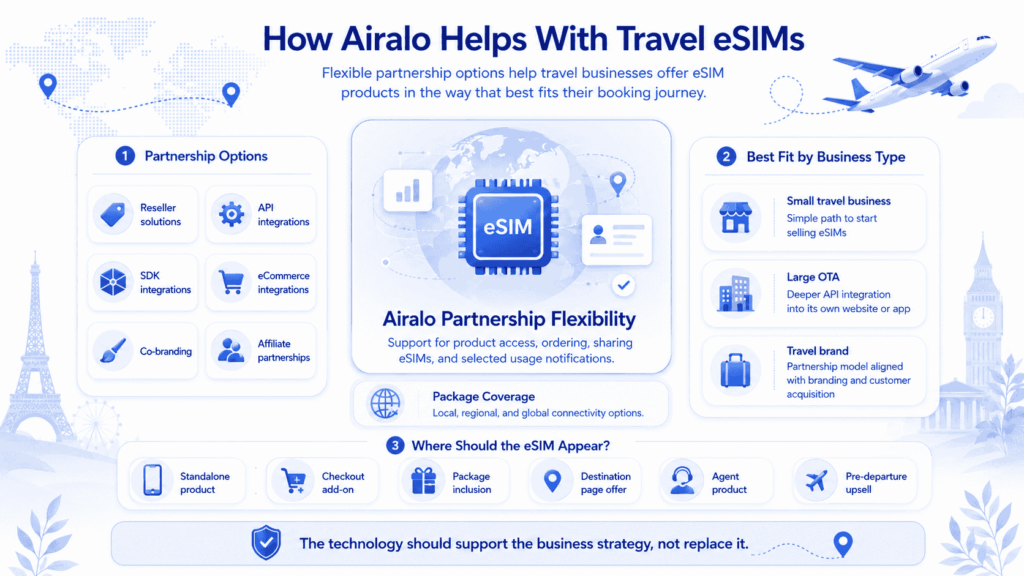
How Airalo Helps With Travel eSIMs
Airalo is a known global eSIM provider offering connectivity products for international travelers.
For travel companies, the important part is that Airalo has developed several partnership approaches rather than offering only one model.
Its current partner materials describe options including:
- reseller solutions
- API integrations
- SDK integrations
- eCommerce integrations
- co-branding
- affiliate partnerships
This flexibility is relevant because different travel businesses operate differently.
A small travel business may want a relatively simple way to begin offering eSIM products.
A larger OTA may want deeper eSIM API integration so the product can become part of its own website or application journey.
A travel brand may prefer a partnership model that better fits its branding and customer acquisition approach.
Airalo’s Partner API documentation describes functionality for accessing eSIM products and supporting processes such as product discovery, ordering, sharing eSIMs with users, and receiving certain usage-related notifications. The exact implementation available to a travel business depends on its integration model and agreement.
Airalo also provides a package catalog covering local and global eSIM packages through its Partner API, while its broader partner materials describe local, regional, and global coverage options.
For agencies exploring Airalo for travel agencies, the important decision is not simply choosing a provider. The agency should first decide how the product should appear within its own business journey.
A Simple eSIM Sales Journey for a Travel Agency
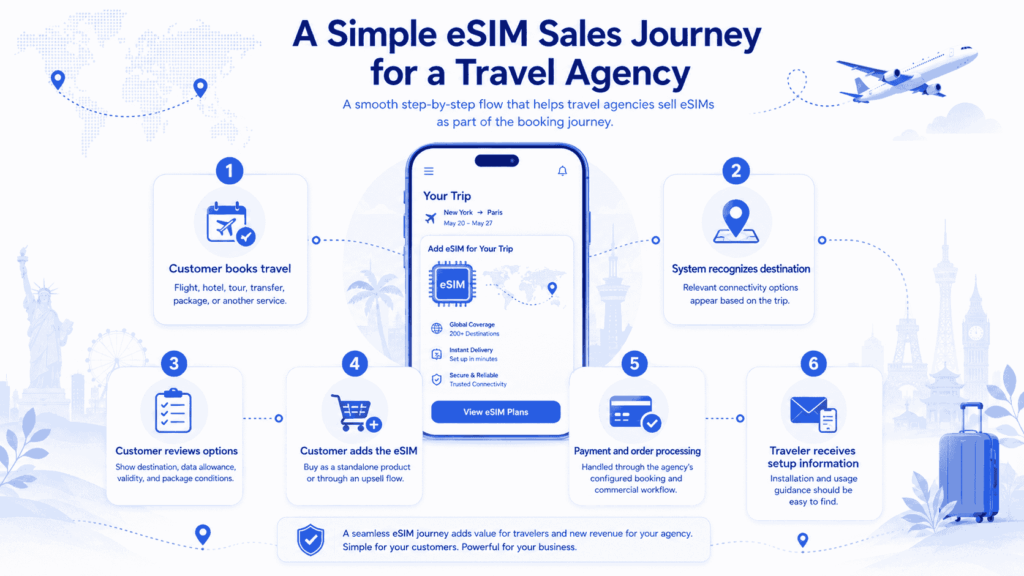
A customer-facing eSIM journey could look like this:
Step 1: The customer books travel
The customer purchases a flight, hotel, tour, transfer, package, or another service.
Step 2: The system recognizes the destination
The agency can use the trip destination to present relevant connectivity options.
Step 3: The customer reviews available options
The traveler should clearly understand important plan information, including the supported destination, data allowance, validity, and other relevant package conditions.
Step 4: The customer adds the eSIM
The eSIM can be purchased as a standalone product or added through a relevant upsell journey, depending on the integration setup.
Step 5: Payment and order processing take place
The purchase is processed according to the agency’s configured supplier, payment, booking, and commercial workflow.
Step 6: The traveler receives clear setup information
Installation and usage guidance should be easy to find.
How PHPTRAVELS Helps Travel Agencies Sell More Travel Products
For a travel business, selling an additional product becomes easier when bookings, integrations, customer accounts, payments, pricing rules, and back-office processes are connected.
PHPTRAVELS is designed as a travel technology platform supporting multiple product and operational workflows.
Depending on the business configuration and connected suppliers, a travel business can work with services and processes involving:
- flights
- hotels
- tours and activities
- transfers
- visa services
- eSIM connectivity
- B2B agents
- wallet workflows
- pricing and markups
- API integrations
- booking management
- payments
- reports and back-office operations
PHPTRAVELS’ current integrations catalog includes Airalo under its eSIM and connectivity category, alongside the platform’s broader travel supplier and payment integration ecosystem.
The value of this approach is the connected customer journey.
Instead of treating every service as a separate business, an agency can think about the complete trip:
Plan → Search → Book → Pay → Prepare → Travel → Manage
For example, the same traveler journey can involve a flight booking, hotel reservation, transfer, activity, visa-related service, and connectivity offer.
PHPTRAVELS also provides B2B travel agency functionality for managing agents, sub-agents, bookings, payments, itineraries, and supplier integrations.
This is particularly useful for businesses looking beyond direct B2C sales.
An agency can consider two distribution paths:
B2C: Sell travel services directly to travelers.
B2B: Allow agents or sub-agents to distribute relevant products through controlled business workflows.
Best Strategy for Travel Agencies Selling eSIMs
Simply adding an eSIM page is not enough. The product should appear at the right stage of the customer journey.
Add eSIMs at Checkout
Offer destination-relevant eSIM plans as an optional add-on. Keep the offer simple and monitor whether it improves revenue without affecting booking completion.
Bundle eSIMs With Travel Packages
Offer eSIMs as a clearly explained optional upgrade for international travel packages.
Sell Through B2B Agents
Agencies with agent networks should define pricing, commissions, support, refunds, and transaction reporting before launching eSIM sales.
Send Relevant Pre-Departure Offers
Use destination and departure dates for timely email or WhatsApp reminders. Personalized offers are more useful than mass promotions.
Mistakes Travel Agencies Should Avoid
Poor Product Explanation
Explain what the customer receives and how the eSIM helps during travel. Avoid unnecessary technical language.
Ignoring Device Compatibility
Encourage travelers to confirm device compatibility before purchase.
Hiding Package Details
Clearly show coverage, data allowance, validity, and important usage conditions.
Sending Irrelevant Promotions
Use destination and travel dates to recommend suitable connectivity options.
Forgetting Post-Purchase Support
Make installation guides, usage instructions, order details, troubleshooting resources, and support information easy to access after purchase.
Conclusion
Travel agencies are no longer limited to selling flights and hotel rooms.
The complete travel journey includes many practical needs, and mobile connectivity is one of them.
A traveler arriving in another country may need internet access to find a hotel, contact a transfer driver, access a booking confirmation, use navigation, communicate with family, or manage work.
That means eSIMs should not be viewed only as a small technical feature.
Want to sell travel eSIMs through your own travel website? Contact PHPTRAVELS and learn how your agency can offer flights, hotels, tours, transfers, eSIMs, and more from one platform.