An affiliate travel agency grows by selling or promoting travel products supplied by other companies and earning a commission, markup, or agreed revenue share from completed bookings. Instead of owning every hotel room, flight seat, tour, or transfer it sells, the agency uses supplier relationships, affiliate programs, booking technology, APIs, white-label systems, and B2B partnerships to expand its inventory and reach.
For a smaller travel company, this model can make expansion much more practical. You can enter additional destinations, add new travel products, reach customers outside your local market, and build several revenue channels without purchasing all the inventory yourself.
However, simply joining affiliate programs is not enough. Sustainable growth depends on choosing the right commercial model, building a reliable booking experience, tracking commissions correctly, attracting qualified traffic, developing partner relationships, and measuring which products and channels actually produce profitable bookings.
This guide explains how the model works and how to build an affiliated travel business that can scale.
Quick Answer:
To expand an affiliate travel agency:
- Choose the right affiliate, commission, B2B, API, or white-label model.
- Build a professional travel website and booking experience.
- Partner with travel suppliers that match your customers.
- Expand inventory through APIs and supplier connections.
- Create affiliate and sub-agent distribution channels.
- Track every booking, commission, cancellation, and payout.
- Use SEO and useful travel content to attract qualified customers.
- Retain travelers through CRM and email marketing.
- Add complementary travel products and revenue streams.
- Measure performance and scale the partnerships that generate profitable bookings.
The objective is not simply to have more partners. It is to build a distribution system in which the right customers can find, compare, and book the right products through your business.
Key Takeaways
- Affiliate travel agencies can expand their inventory without directly owning every travel product they sell.
- Affiliate links, white-label booking systems, APIs, and B2B portals are different distribution models and should not be treated as the same thing.
- A professional booking website becomes the central point connecting customers, suppliers, partners, payments, and reporting.
- Commission tracking and booking attribution become increasingly important as the number of partners grows.
- SEO works best when content answers real traveler and travel-business questions rather than simply targeting keywords.
- CRM, email, and repeat-customer strategies can reduce dependence on continuously acquiring new visitors.
- The strongest travel businesses often combine more than one revenue and distribution model.
What Is an Affiliate Travel Agency?
An affiliate travel agency is a travel business that promotes or sells products supplied by other travel companies and receives compensation when a qualifying booking or transaction takes place.
Depending on the commercial arrangement, the agency may earn through:
- Affiliate commissions
- Booking commissions
- Net-rate markups
- B2B margins
- Service or consultation fees
- Referral fees
- Revenue-sharing agreements
The exact relationship can vary considerably.
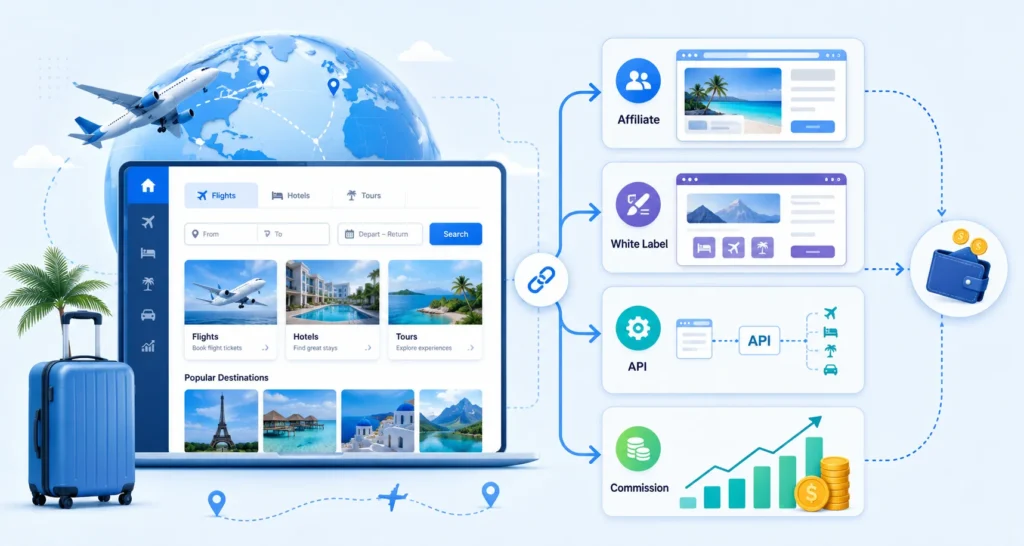
For example, a basic affiliate website may send a traveler to another website to complete the reservation. A white-label business may keep the booking interface under its own branding. An API-connected agency may display supplier inventory directly inside its own booking flow.
Understanding these differences is important before deciding how your agency should grow.
If you are building the business from the beginning, the guide on starting an online travel agency provides additional context on the wider setup process.
Affiliate vs White Label vs API vs B2B Travel Models
These models are related, but they solve different business problems.
| Model | How It Works | Customer Experience | Typical Revenue Model |
|---|---|---|---|
| Affiliate | You refer customers to a partner or track a referred booking. | Booking may finish on the partner website. | Commission or referral fee. |
| White Label | A third-party booking engine operates under your branding. | Customer can remain within a branded experience. | Commission, markup, or agreed commercial model. |
| API Integration | Supplier inventory is connected to your own booking system. | Greater control over search and booking flow. | Markup, commission, or supplier agreement. |
| B2B Portal | Other travel agents book through your platform. | Sub-agents access negotiated inventory or rates. | Margin or commission from agent bookings. |
| Direct Inventory | You contract or manage inventory yourself. | Full control over pricing and sales. | Direct margin. |
A Practical 90-Day Growth Plan
Days 1–30: Build the Foundation
- Define your target customer.
- Select your main destinations.
- Choose the travel products you will sell.
- Decide between affiliate, white label, API, B2B, or a hybrid model.
- Review existing suppliers.
- Fix your website’s booking journey.
- Install analytics and conversion tracking.
- Define commission and reporting rules.
Days 31–60: Expand Distribution
- Add one or two relevant supplier relationships.
- Publish high-intent destination and booking content.
- Build internal links between related content.
- Recruit an initial group of affiliate partners.
- Create partner onboarding material.
- Set up CRM and email follow-up processes.
- Test bookings from search through confirmation.
Days 61–90: Optimize and Scale
- Identify the best-performing suppliers.
- Identify partners producing confirmed bookings.
- Reduce low-quality traffic sources.
- Improve pages with high traffic but low conversion.
- Add complementary travel products.
- Automate commission reporting.
- Expand successful content clusters.
- Increase investment only in channels that demonstrate commercial value.
After the first 90 days, growth should be driven by actual booking and revenue data rather than assumptions.
Common Mistakes Affiliate Travel Agencies Should Avoid
Joining Too Many Programs
More programs create more reporting, tracking, payment, and customer-support complexity.
Start with the ones most relevant to your customers.
Promoting Products Without Search Intent
An affiliate link should solve the reason a visitor came to the page.
Do not insert products simply because a commission is available.
Ignoring Attribution
If you cannot identify which partner produced a booking, you cannot manage commission fairly or optimize performance.
Depending on One Supplier
Commercial terms, inventory, technology, or partner programs can change.
Diversification reduces dependency.
Ignoring Cancellations
Revenue reporting based only on initial bookings can give a misleading view of performance.
Track confirmed and final booking status.
Sending Every Visitor to Another Website
Pure referral models can work, but continually sending customers away limits control over the booking experience.
As your business develops, evaluate whether white-label or API-connected booking options make strategic sense.
Publishing Content Only for Search Engines
A page that repeats “affiliate travel agency” dozens of times will not become more useful.
Answer the reader’s actual questions, explain important differences clearly, and connect them with the next logical resource.
How PHPTRAVELS Can Support an Affiliate Travel Business
As an affiliate travel operation grows, separate tools for customers, suppliers, sub-agents, commissions, reporting, and bookings can become difficult to manage.
PHPTRAVELS provides travel technology that can support areas such as:
- B2C booking
- B2B booking
- Affiliate management
- Supplier integrations
- Travel APIs
- Booking engines
- Partner accounts
- Commission management
- Payment integrations
- Reporting
- CRM-connected workflows
The right configuration depends on your business model and the suppliers you plan to use.
You can explore the broader PHPTRAVELS travel technology platform, review its features, or use the live demo to understand how the booking and administration workflows operate.
Final Thoughts
Growing an affiliate travel agency is not simply about collecting referral links.
The stronger approach is to build an interconnected travel business in which suppliers provide relevant inventory, technology manages bookings and attribution, partners expand distribution, content attracts qualified customers, and reporting shows which channels generate real revenue.
Start with one clear customer segment and a manageable number of suppliers. Build a reliable booking journey. Track every important transaction. Then expand into additional products, partners, destinations, APIs, or B2B channels based on performance.
That creates a more sustainable path to market expansion than trying to become a global travel platform overnight.