If you sell travel for a living, car rental is one of the easiest add-ons to attach to a trip and one of the hardest to manage at scale. Working with Alamo for travel agents looks simple on the surface: book a car, earn commission, move on. In practice, agencies juggle agent portals, GDS bookings, corporate account rates, commission reconciliation, and voucher delivery across dozens of suppliers at once. When that workflow lives in spreadsheets and separate logins, errors and lost commission follow.
This guide explains how Alamo distribution and commissions actually function for the trade, where the operational friction shows up, and how a proper booking platform fits into the picture.
Quick Summary
- Alamo Rent A Car is a leisure-focused brand owned by Enterprise Mobility (formerly Enterprise Holdings), alongside Enterprise Rent-A-Car and National Car Rental.
- Agents typically book Alamo through the GDS, car rental aggregator APIs, or the dedicated Alamo travel agent portal there is no single public “Alamo XML API” you simply plug in.
- Alamo pays roughly 5% commission on qualifying leisure and non-negotiated rentals, settled twice monthly via TACS, and requires a valid ARC, IATA, TRUE, or CLIA number.
- Corporate account rates and negotiated programs usually reduce or void commission, so agencies must track rate types carefully.
- The real operational challenge is not booking one car; it is synchronizing inventory, markups, vouchers, and commission tracking across many suppliers and bookings.
- A unified booking engine consolidates car rental content (including Alamo via GDS or aggregators) with hotels, flights, and tours, automating the mid-office and back-office work.
Who Is Alamo Car Rental Affiliated With?
This is one of the most common questions agents ask before setting up supplier relationships, because it affects rates, commissions, and where inventory comes from.
Alamo is owned by Enterprise Mobility, the privately held parent that also operates Enterprise Rent-A-Car and National Car Rental. The three brands share fleets, locations, and back-end systems but target different segments. Alamo focuses on value-oriented leisure and international inbound travelers, National targets frequent business renters, and Enterprise serves neighborhood and replacement rentals.
For an agency, that structure matters operationally. Negotiated agreements, loyalty programs, and commission policies are administered at the Enterprise Mobility level across all three brands, so a single travel agent agreement can give you access to the full portfolio rather than three separate contracts.
How Travel Agents Actually Book Alamo
There are three practical channels agents use, and most agencies use a mix.
1. The Alamo travel agent portal
Alamo runs a dedicated trade site (the travel agent area of Alamo.com) where agents can pull rates, manage reservations, and access agent-only offers. Registration requires a valid industry credential. This is fine for occasional, manual bookings but does not scale when you are managing hundreds of itineraries.
2. The GDS
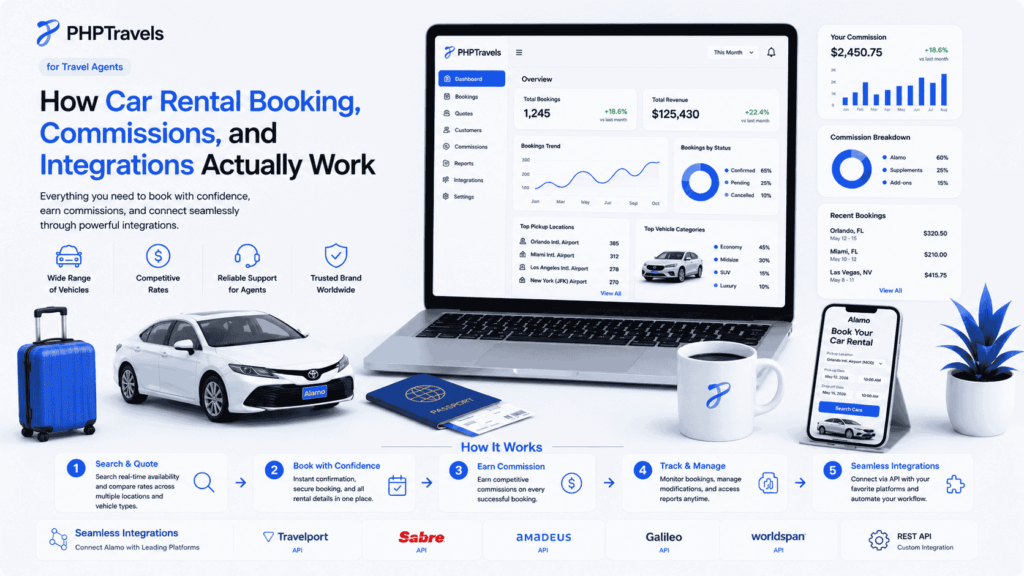
Most agencies still reserve cars through Amadeus API integration, Sabre, or Travelport. Agencies already using GDS workflows often keep car, hotel, and flight segments in the same PNR.
. Car segments sit alongside air and hotel in the same PNR, which keeps the reservation workflow consolidated and makes commission tracking easier because the booking is tied to your IATA number. For agencies already running a GDS desk, this is the default path for Alamo and its sister brands.
3. Aggregator and consolidator APIs
OTAs and online travel portals usually source car rental content through car rental aggregation APIs and consolidators rather than connecting to each rental company individually. These APIs normalize availability, rates, and rules across many suppliers through centralized travel API integrations, reducing the need for individual supplier connections.
including the Enterprise Mobility brands into a single feed your booking engine can consume.
A note on accuracy that competitor pages often get wrong: you generally do not integrate a standalone public Alamo XML API directly into your website. Alamo inventory reaches the trade through the GDS and aggregation layers above. A good travel technology platform connects to those layers so Alamo content appears in your search results without bespoke supplier engineering.
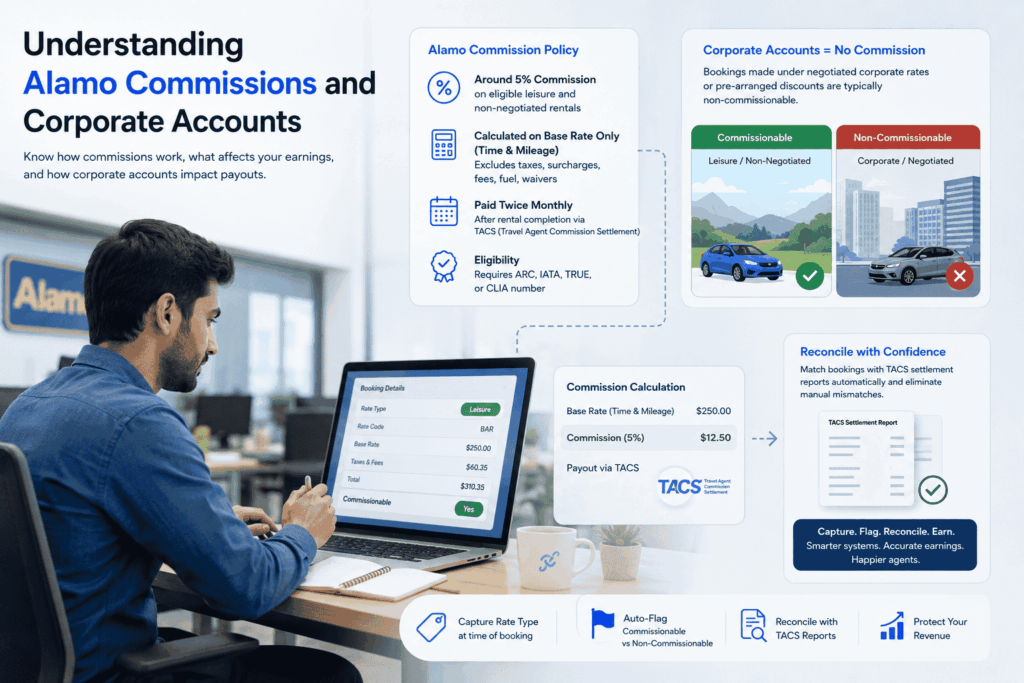
Understanding Alamo Commissions and Corporate Accounts
Commission mechanics are where agencies quietly lose money, so this deserves detail.
Alamo’s published policy pays around 5% commission on certain leisure rentals and non-negotiated rentals, calculated on the base rate (time and mileage) only not taxes, surcharges, fees, fuel, or waivers. Commissions are disbursed twice monthly after the rental completes, processed through the third-party settlement processor TACS (Travel Agent Commission Settlement). Eligibility requires a recognized ARC, IATA, TRUE, or CLIA number.
The trap is the Alamo corporate account. When a client books under a negotiated corporate rate or a pre-arranged discount program, the booking typically falls outside the commissionable categories. Agents who do not distinguish rate types end up forecasting commission they will never receive, then spend hours reconciling shortfalls against statements.
The operational lesson: your system needs to capture the rate type at the point of sale, flag commissionable versus non-commissionable bookings automatically, and reconcile against settlement reports rather than relying on manual matching.
The Real Operational Picture: It Is Never Just One Car
Booking a single Alamo rental is trivial. Running a travel business that sells car rental at volume is not. Here is where the work actually piles up.
Inventory synchronization.
Car availability, rates, and rules change constantly. If your portal shows stale rates, you either lose the sale or eat the difference. Real-time synchronization with the GDS or aggregator feed is essential, especially when operating a car rental booking engine that serves both agents and direct customers.
Dynamic pricing, markups, and commissions.
Agencies rarely sell at net cost. You apply markups for B2C customers and negotiated net rates for B2B sub-agents, while preserving the supplier commission underneath. A pricing engine has to handle markup rules, currency conversion, and commission logic simultaneously without the agent recalculating by hand.
B2B and B2C booking operations.
A B2C booking engine sells directly to travelers with retail pricing and instant payment. A B2B travel portal serves sub-agents with credit limits, wallet balances, and agent-specific markups while preserving supplier logic.
s, wallet balances, and agent-specific markups. The same Alamo inventory needs to surface correctly in both contexts with different pricing and permissions.
Payments and invoicing.
Retail customers pay by card; corporate and sub-agent clients often work on credit, deposits, or wallet systems. Each booking needs an invoice, and each supplier commission needs to be tracked against eventual settlement.
Vouchers and reservation documents.
Once a car is confirmed, the client needs a clear voucher with the confirmation number, pickup location, and rental terms. Generating these manually for every booking is a classic bottleneck.
Mid-office and back-office workflows. Behind the booking sit reconciliation, supplier payment matching, commission tracking, refunds, and reporting. This is where most agencies lose time and money, because manual mid-office work does not scale with booking volume.
Agent management. Multi-branch agencies and consolidators need role-based access, per-agent markups, credit controls, and performance reporting across the team.
How Businesses Usually Solve This and Where They Go Wrong
Most agencies start manually: book on the Alamo portal or GDS, copy details into a spreadsheet, send the client a voucher by email, and reconcile commission at month-end. It works until volume grows.
The common mistakes are predictable:
- Treating car rental as an afterthought
Instead of integrating it into the same search and checkout as flights and hotels, which kills attach rates. - Ignoring rate types
So commissionable and non-commissionable corporate account bookings get mixed together and reconciliation breaks. - Manual voucher and invoice generation
Which introduces errors and slows down high-season operations. - No real-time inventory sync
Leading to failed bookings and rate discrepancies at the counter. - Over-engineering
By trying to build direct supplier connections in-house when GDS and aggregator feeds already provide the content.
Manual workflows give you control but cap your throughput. Automated workflows scale, but only if the platform handles markups, multi-currency, commission logic, and document generation correctly. The practical sweet spot for most agencies is a single platform that automates the repetitive booking, voucher, and reconciliation tasks while leaving rate and markup rules under your control.
Where PHPTRAVELS Fits
Once the workflow is understood, the role of a booking platform becomes clear. PHPTRAVELS is a travel technology platform built around exactly these operations rather than a single product line.
It consolidates car rental alongside flights, hotels, tours, and visas in one online reservation system, so Alamo and other rental content can be searched and booked in the same flow your customers already use. Car rental supplier content is integrated through GDS and aggregator connections the channels that actually carry Alamo inventory instead of relying on a supplier-specific integration that does not exist publicly.
On top of the booking layer, PHPTRAVELS handles the operational work that usually consumes staff time: configurable markups and commission rules for B2B and B2C, multi-currency pricing, wallet and credit systems for sub-agents, automated voucher and invoice generation, and back-office reporting for reconciliation. Role-based agent management supports multi-branch agencies and consolidators, and the platform scales as booking volume grows without adding manual mid-office headcount.
The point is not to replace your supplier relationship with Alamo or your GDS desk. It is to remove the repetitive operational friction around it so your team spends time selling rather than reconciling spreadsheets.