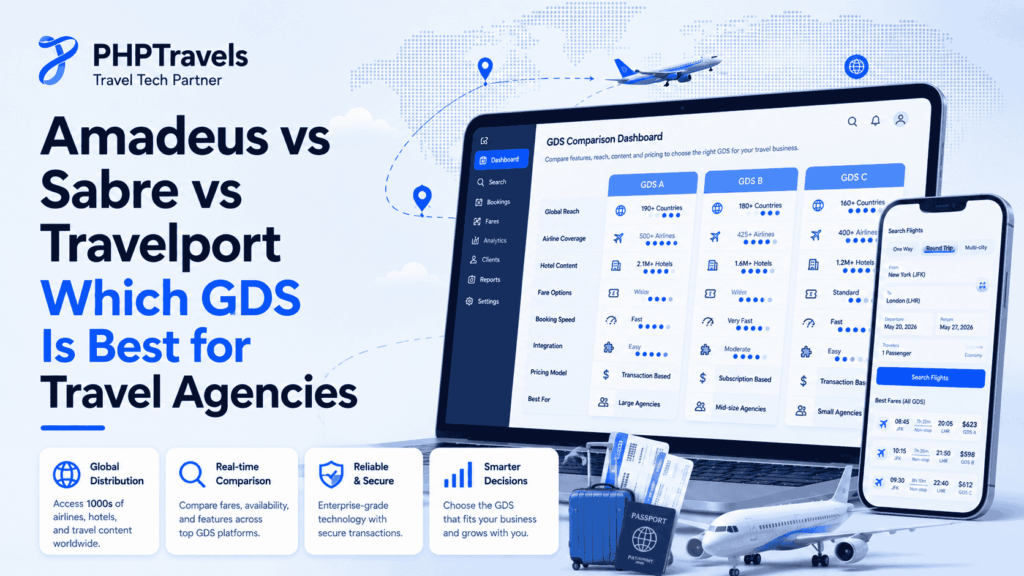
There is no single best GDS for every travel agency. Amadeus, Sabre and Travelport all provide global travel content, modern airline distribution and agency technology, but their content availability, NDC connections, workflows, APIs, servicing capabilities and commercial terms differ by market and agency agreement. The best choice depends on the airlines you sell, your target markets, booking volume, technology stack and support requirements.
Amadeus, Sabre, and Travelport dominate the global GDS landscape, each offering distinct strengths, technologies, and integration capabilities tailored to different types of travel businesses and operational models. Understanding how these systems differ in terms of coverage, cost, flexibility, and technical complexity helps agencies avoid costly integration mistakes, reduce operational risks, and build a more stable and future ready booking infrastructure.
Quick Summary
- Amadeus offers the widest global airline coverage and strong reliability for large agencies.
- Sabre focuses on enterprise level integrations, flexibility, and advanced tools for scaling businesses.
- Travelport is often preferred by smaller agencies due to simpler setup and more flexible cost structures.
- The right choice depends on agency size, technical capability, and long term growth strategy.
What a GDS actually does in travel operations
A Global Distribution System connects travel sellers with airline, hotel, and car rental inventory in real time. It acts as a central layer where availability, pricing, and booking confirmations are processed. Travel agencies rely on these systems to issue tickets, manage reservations, and synchronize data across multiple suppliers. Modern agencies often combine GDS access with travel booking platforms and APIs to automate workflows and reduce manual effort in operations.
The main value of a GDS lies in aggregation. Instead of connecting separately to hundreds of airlines, an agency connects once to a GDS and gains access to a global network of suppliers. This simplifies ticketing, reporting, and fare management across different markets.
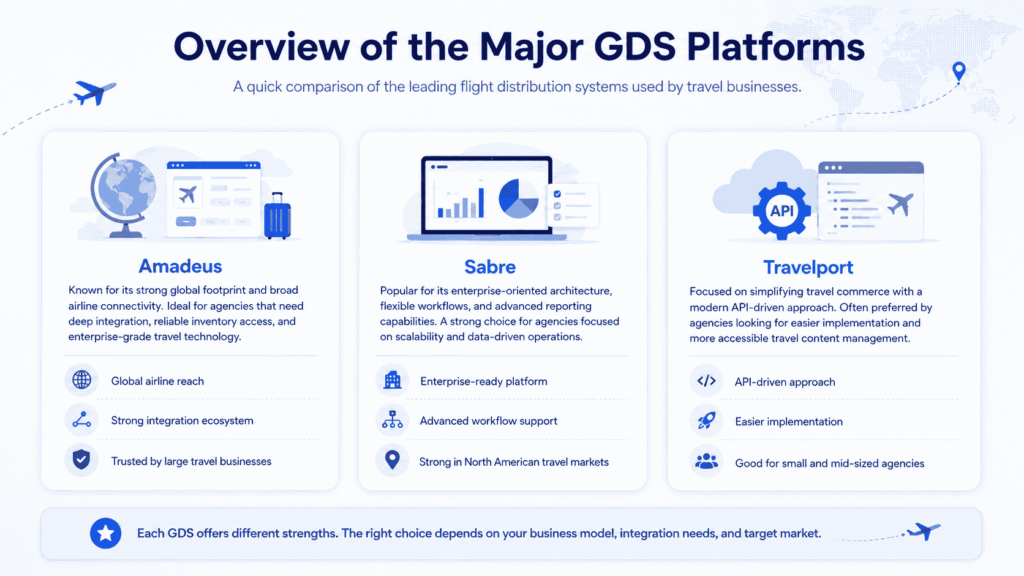
Overview of the major GDS platforms
Amadeus
Amadeus is widely recognized for its strong global footprint and extensive airline connectivity. It supports hundreds of airlines and provides deep integration options for agencies that require advanced distribution capabilities. Many large travel companies rely on Amadeus for its stability and comprehensive inventory access. Its ecosystem is also strong in airport operations, airline systems, and travel agency tools.
Sabre
Sabre is known for its enterprise oriented architecture and advanced integration capabilities. It is widely used by agencies that require custom workflows, reporting tools, and scalable infrastructure. Sabre also places strong emphasis on data driven travel solutions, helping agencies optimize pricing and customer experiences. It is especially popular in North America and among corporate travel providers.
Travelport
Travelport focuses on simplifying travel commerce with a modern API driven approach. It is often seen as more flexible for smaller and mid sized agencies that want easier implementation and lower operational complexity. Travelport’s platform is designed to unify multiple travel content sources in a more accessible interface.
Key differences in real travel workflows
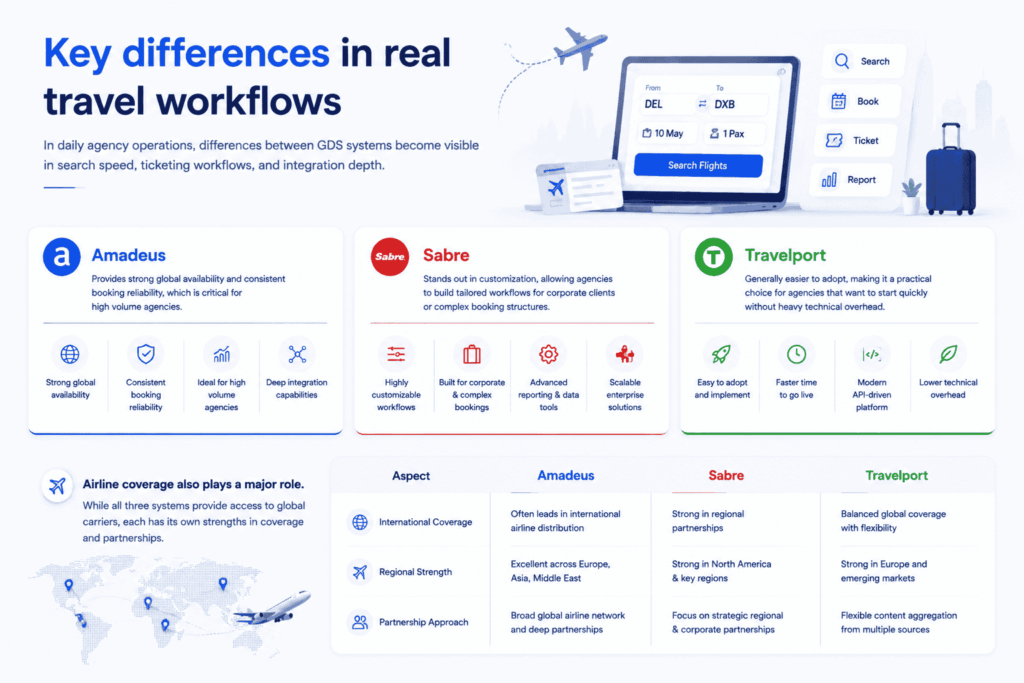
In daily agency operations, differences between GDS systems become visible in search speed, ticketing workflows, and integration depth. Amadeus typically provides strong global availability and consistent booking reliability, which is critical for high volume agencies. Sabre stands out in customization, allowing agencies to build tailored workflows for corporate clients or complex booking structures. Travelport is generally easier to adopt, making it a practical choice for agencies that want to start quickly without heavy technical overhead.
Airline coverage also plays a major role. While all three systems provide access to global carriers, Amadeus often leads in international airline distribution, Sabre performs strongly in regional partnerships, and Travelport balances coverage with flexibility.
Pricing and operational cost considerations
GDS pricing is not fixed and depends on booking volume, contracts, and usage patterns. Larger agencies often negotiate enterprise agreements, while smaller agencies may pay per transaction or through bundled services. Amadeus and Sabre are generally positioned at a higher cost level due to their enterprise capabilities. Travelport tends to be more cost effective for agencies that prioritize affordability and simpler operations.
However, cost should not be evaluated in isolation. Integration effort, training requirements, and long term scalability often have a bigger financial impact than base pricing.
Integration and API ecosystem
Modern travel businesses depend heavily on APIs and integrations. This includes flight search engines, hotel APIs, payment gateways, CRM systems, and reporting tools. Sabre and Amadeus offer strong enterprise grade APIs that support complex workflows and high volume transactions. Travelport provides a more streamlined API experience, which can reduce development time for smaller teams.
Agencies often combine GDS systems with external tools such as booking engines, channel managers, and CRM platforms to create a complete travel tech stack. For example, integrating a GDS with hotel inventory systems or a central reservation system can significantly improve operational efficiency.
3 Key Factors Travel Agencies Use to Choose a GDS
| Factor | Large Agencies | Enterprise Corporate Travel Providers | Small Agencies / Startups |
|---|---|---|---|
| Primary Focus | Reliability and global coverage | Customization and reporting depth | Fast onboarding and simplicity |
| Preferred GDS | Amadeus | Sabre | Travelport |
| Reason for Choice | Strong global inventory and stable performance | Advanced workflows and data-driven insights | Easy setup and lower complexity |
| Key Advantage | Maximum coverage and consistency | Highly customizable enterprise tools | Quick implementation and ease of use |
| Main Risk / Mistake | Overpaying if scale is not required | Complex setup and integration overhead | Limited scalability if business grows |
| Common Pitfall | Choosing based only on brand | Ignoring training and system complexity | Choosing only based on low cost |
PHPTRAVELS positioning in the travel tech ecosystem
A GDS alone does not complete a travel business setup. Agencies also need booking engines, automation layers, and operational dashboards. This is where platforms like PHPTRAVELS help connect multiple systems into a unified workflow.
By combining GDS connectivity with a travel agency software stack, businesses can automate bookings, manage suppliers, and improve customer experience without building everything from scratch. Solutions such as PHPTRAVELS GDS System for Travel Agents and Travel Agency Software support agencies in reducing manual workload while scaling operations across markets.
For agencies expanding into hotel or corporate travel, additional tools like Business Travel System and Hotel Management System can help centralize operations.
Conclusion
Selecting the right GDS is not just a technical decision but a strategic one that influences how a travel business operates and grows. Amadeus, Sabre, and Travelport each serve different business needs, from large global agencies to smaller regional operators. The best choice depends on balancing coverage, cost, and integration capability with long term business goals.