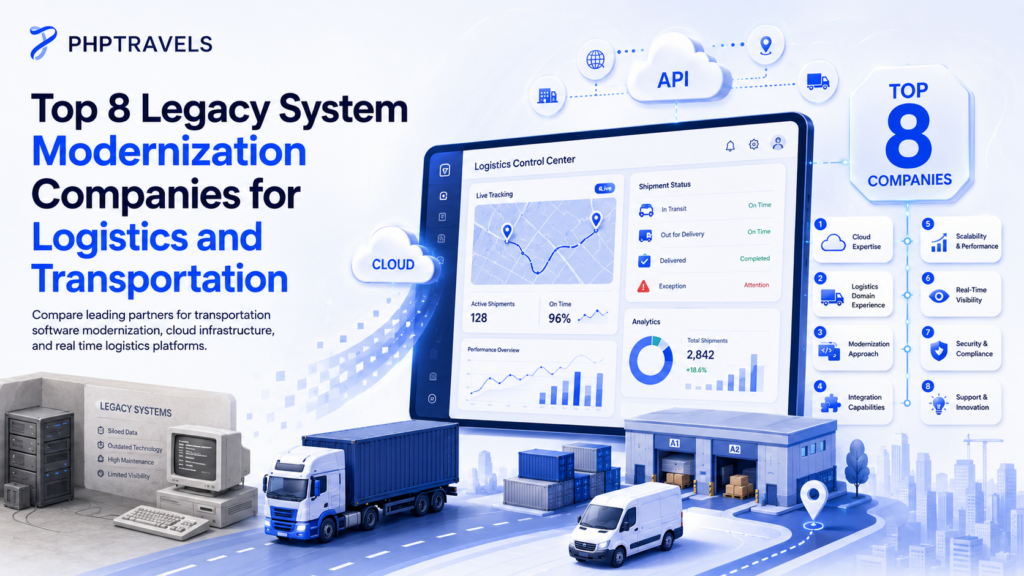
Legacy‐era transportation and warehouse platforms now cap growth, inflate costs, and expose security gaps. This article explains why modernization has become non-negotiable, compares the main technical approaches, details the business traits that distinguish proven partners, profiles eight vendors with verifiable logistics wins, and closes with practical guidance on vendor selection, enabling technologies, benefits, future trends, and real-world FAQs.
Introduction
Transportation firms used to differentiate on fleet size and lane density. In 2026, differentiation lives in software. Instant quote engines, predictive ETAs, and paperless cross-border compliance all depend on cloud scalability and API-ready architectures. The trouble is that most tier-one carriers, 3PLs, and regional LTL operators still rely on 10- to 25-year-old code running in self-hosted data centers. Forbes notes that maintaining legacy logistics systems creates massive technical debt, contributing to a 76 percent enterprise digital transformation failure rate.
That imperative explains the spike in demand for legacy system modernization services for logistics and transportation companies a few years ago and the parallel surge now hitting logistics. Both sectors share always-on requirements, strict compliance regimes, and complex partner networks. The difference is that a missed batch in banking delays a payment; a missed batch in logistics leaves containers on the dock.
The rest of this article dissects modernization through the specific lens of logistics and transportation.
Why Logistics and Transportation Companies Modernize Legacy Systems
Software leaders do not wake up and decide to transform because the tech press says “cloud.” Modernization budgets free up only when executives see unambiguous value. Below, we explore that value in operational, risk, and growth terms.
What Legacy Systems Mean in Logistics & Transportation
A platform turns “legacy” the moment its architecture blocks new revenue or compliance. In practice, that moment arrives earlier than many leaders assume. Routinely, it’s:
- COBOL-based TMSs tied to proprietary mainframes
- WMS stacks written in Visual Basic that refuse to speak REST
- Driver mobile apps hardwired to outdated MDM solutions
- Forklift telematics with only serial RS-232 output
Individually, each works; together, they cripple cross-functional visibility. These stacks cannot stream real-time location, rate shop third-party carriers on demand, or feed AI engines that optimize routes minute by minute. That gap explains the momentum behind legacy logistics software modernization programs.
Why Outdated Transportation Software Creates Operational Risks
Risk surfaces in five intersecting layers: availability, security, cost, compliance, and Legacy code does more than slow feature delivery; it multiplies financial and compliance exposure across the entire network. The five most common risk vectors are:
- Service-level breaches. A four-hour outage during peak season can idle hundreds of drivers and trigger detention fees that erode already-thin margins.
- Cybersecurity gaps. Unsupported operating systems miss critical patches; CrowdStrike’s 2024 report shows transportation ransomware incidents rose 40% year-over-year.
- Escalating run costs. The spend curve is linear with volume, since it is fixed mainframe licensing and on-prem hardware and not elastic.
- Regulatory non-compliance. Near real-time data hand-offs for customs and sustainability reporting are not possible due to manual data hand-offs, resulting in fines and shipment holds.
- Eroding customer experience. Green-screen UI and batch-based tracking contribute to missed ETAs, which, Gartner reports, results in a 12% high-value shipper attrition rate.
Unless they are managed, these dangers morph into high stakes gamble that boards no longer can risk.
Common Challenges With Legacy Logistics Infrastructure
Despite unique lane networks, most operators cite surprisingly similar pain points. The catalog below appears in nearly every diagnostic the authors have led:
- Hard-coded integration logic – EDI 204, 214, and 990 transactions are embedded directly into batch scripts, making partner changes risky and slow.
- No single data model – order, rating, and dispatch entities are different in different systems and hamper enterprise visibility.
- Batch processing cycles – inventory, status, and invoicing gets generated overnight and is stale all the time.
- Limited release automation – many teams deploy quarterly because a rollback requires a full environment restore.
- Talent scarcity – the average RPG or COBOL engineer in surface transport is 57 years old.
Left unchecked, these issues turn routine growth projects, new distribution centers, carrier integration, and sustainability KPIs into multimillion-dollar custom builds. Hence, the surge in legacy modernization in transportation and logistics engagements as firms look to break the cycle.
Legacy Modernization Approaches for Logistics Platforms
Modernization is rarely binary. Transportation operators mix and match approaches based on budget, risk tolerance, and the economic life of existing assets.
Before diving into tactics, remember one governing principle: start with a diagnostic. Techstack’s two-week architecture audit is a textbook example; it quantifies dependency graphs, cost drivers, and code complexity upfront, ensuring the chosen path matches constraints.
Cloud Migration for Transportation Systems
Cloud migration begins where a quick ROI is achievable – non-differentiating workloads like EDI translation, rate caching, or BI reporting. A common pattern is to lift batch rating engines into AWS Fargate, slashing nightly batch duration from two hours to twenty minutes, and then replatform databases onto Amazon Aurora to unlock auto-scaling read replicas.
Key watch-outs:
- Latency – interacting in real time with on-prem WMS over VPN can bottleneck. Hybrid architectures with direct connect links mitigate this.
- Regulatory data boundaries – many carriers must pin PII in regional zones.
Even with these limitations, lift and shift frequently allows for a 15-20% reduction in infrastructure investment in year 1 to support greater refactors in the future.
Refactoring Legacy Logistics Applications
With refactoring, monoliths are broken down along domain lines (rating, tendering, billing), and then containers hold each microservice. A new capacity is launched during peak with the help of Kubernetes/ECS orchestrators. For legacy logistics software modernization efforts, it is critical to:
- Use strangler patterns: new microservices intercept only certain endpoints and the old monolith handles everything else until parity is reached.
- Establish an event bus – Kafka or Amazon MSK – to decouple services without point-to-point spiderwebs.
Result: release cadence moves from quarterly to weekly, and rollback becomes a single container redeploy instead of a weekend outage.
Warehouse & Fleet Management System Modernization
WMS and fleet modernization combine OT and IT. Operators often deploy IoT sensors on forklifts, temperature monitors in reefers, and RFID in warehouses. Software must ingest millions of data points per hour. When legacy Windows CE scanner apps cannot cope, teams rebuild them in React Native connected to GraphQL back-ends.
A proven sequence:
- Use an appropriate database schema for real-time inserts.
- Implement an abstraction layer for telemetry from a variety of hardware.
- Introduce new, modern handheld apps, one aisle or fleet cluster at a time.
Productivity gains can hit double digits, documented sphere-specific case studies alike.
API & Supply Chain Integration Modernization
Few topics ignite boardrooms like partner onboarding delays. Replacing legacy setups with API-driven cloud protocols reduces B2B partner onboarding from months to minutes. API-first initiatives attack that problem head-on.
Required components:
- API gateway enforcing OAuth 2.0, rate limits, and analytics
- Async event streaming (e.g., MQTT) for high-volume telemetry such as GPS pings
- Developer portal with live docs and sandboxes
Firms completing API modernization report partner onboarding time sliced to under two weeks, a critical metric for carrier diversification.
Rebuilding Core Logistics Platforms
Rebuilds are medically necessary when legacy code cannot be salvaged, think PowerBuilder desktop apps with no source control or COBOL programs with undocumented business rules. Rebuilds unfold in phases: quarry business rules via automated code discovery (Infosys Cobalt, Hexaware GenAI), scaffolding microservices, and then migrate user cohorts.
Important to keep the entire program aligned to business outcomes: cost per shipment, revenue per load, or driver utilization. Without that anchor, rebuilds morph into endless technical rewrites. Successful rebuilds, such as Techstack’s phased replacement of an auto-transport TMS, demonstrate a 3× ROI within 24 months.
What Makes a Strong Logistics Modernization Partner
Modernization partners look similar on glossy sites. In practice, their operating models differ greatly.
A partner’s value rests on three pillars: repeatable modernization method, logistics domain fluency, and governance discipline. Miss one and programs overshoot budgets or timelines.
Experience in Logistics & Transportation Technology
Domain experience is visible in pre-built accelerators: carrier compliance templates, driver mobile SDKs, and customs filing connectors. Vendors lacking these assets improvise mid-project, driving change-order churn.
In assessing, seek to find multimodality in one engagement – road, rail, ocean. For example, Infosys re-engineered a mainframe with 110 interfaces for a global shipping leader, which showcased a wide understanding of lane variance knowledge.
Expertise in Scalable Operational Infrastructure
Bad architecture in high season. Multi-AZ deployments, stateless microservices, and event-driven design are scalable infrastructure. A big highlight for them is HCLTech’s DRYiCE AIOps module that can predict incident spikes.
Real-Time Data & Automation Capabilities
In the streams from 15,000 tractors, traditional RDBMS fail to cope. To detect anomalies, partners need to integrate Lambda-like functions for data shaping and ML pipelines. Unisys shines with this Data Transformation solution that converts mainframe transaction logs to analytics-ready data.
Integration With ERP, WMS & TMS Platforms
Legacy ERPs such as SAP or Oracle systems still need to be handshaken with modernized systems. 56% of supply chain leaders point to legacy integration as a key obstacle, which must be addressed with an agile and composable architecture to scale. Inquire with suppliers for connectors that come out of the box.
Cloud, DevOps & Infrastructure Expertise
DevOps is more than CI/CD. It includes infrastructure as code, automated compliance scanning, and immutable artifacts. Hexaware’s Replatforming-as-a-Service bundles these controls into consumption pricing, making it easier for operators to budget sprint-by-sprint.
Top Legacy System Modernization Companies for Logistics and Transportation
Below you will find eight legacy system modernization firms whose logistics credentials withstand scrutiny. Facts derive from publicly available case studies, analyst reports, and certifications.
1. Techstack
Headcount: 100-250
Certifications: ISO 27001/27701, GDPR
Core model: Two-week diagnostic, then one of three tracks – AI Readiness, Cloud Migration, or Full Modernization. This methodology preserves optionality: if the audit shows APIs will suffice, Techstack will not push a rebuild.
Logistics credentials: Scaled a nationwide auto-transport network with a real-time cargo auction engine, automating allocation across 13,000+ carriers. Techstack’s phased migration developed a secure, high-performance web-based bidding system, enabling a 32% reduction in cargo allocation time, significant cost savings through competitive bidding, and 99.9% claim-free deliveries for 2,500+ active customers. Separate WMS redesigns are handled incrementally, ensuring that vital pick, pack, and ship workflows remain fully intact and operational throughout the modernization process.
Why shortlist: Unlike large system integrators that apply a standard playbook regardless of project fit, Techstack’s differentiation lies in how closely they engage with each client’s specific situation. The two-week diagnostic is the first signal: it produces a written output – risks, priorities, and cost estimate tailored to your architecture, not a generic proposal. From there, the engagement model adapts to the client: Techstack operates either as a managed modernization partner owning the full lifecycle, or embeds engineers directly into the client’s existing team with Time & Materials billing so clients pay for actual work delivered, not estimated scope. Techstack also integrates AI copilots without forcing a full rewrite, vital for firms experimenting with GenAI ETAs.
2. Infosys
Headcount: 337,000+
Certifications: ISO 27001, SOC 2, CMMI Level 5
Core model: Infosys Cobalt applies AI-assisted code discovery to map call graphs, complexity, and dead code across mainframes, mid-range servers, and distributed apps. A platform accelerator library – comprising thousands of API stubs, data masks, and automated test harnesses – lets teams prototype migration paths in weeks instead of months.
Logistics credentials: Flagship engagement rewrote 3 million lines of COBOL for a big shipowner that operates in 92 countries in the world. The savings from automated refactoring, phased event gating, and process redesign are: $10 million per year, 35% improvement in booking cycle time, and less than 7 minutes per month of unplanned downtime. Other programs include multimodal rating microservices for an air-cargo consortium and predictive-maintenance analytics to be integrated with feeds from a rail SCADA system.
Why shortlist: Why shortlist: Infosys’ engineering prowess at scale and domain expertise are a good fit for AI solutions, and will be valuable to carriers with modernization agendas aligned with AI plans and high compliance needs. Infosys is a leader in the 2024 Forrester Wave for Application Modernization and Generative AI in Gartner’s quadrant.
3. HCLTech
Headcount: 226,000+
Certifications: ISO 27001, ISO 22301, AWS Premier Tier
Core model: Zero-Downtime Framework is a core model that operates two stacks (legacy and target) side by side while DRYiCE AIOps predicts incident spikes and automates failover. Engagements open with an economic value model that ties each microservice cutover to KPI deltas – cost-per-mile, empty-mile ratio, and on-time delivery.
Logistics credentials: Modernized dispatch, yard, and crew-management systems for North America’s largest freight railroad, a Class 1 operator running 32,500 miles of track, without disrupting active rail operations. Another project saw the migration of legacy Python & Shell Script ETL interfaces to Boomi for a global 3PL, resulting in a massive improvement in ETL interface latency and faster partner onboarding. HCLTech’s proprietary RailTwin platform was applied to a standalone freight rail project to achieve a 15% increase in the utilization of their capacity, a 10% reduction in delays, and ~20% network performance increase via dynamic rescheduling.
Why shortlist: When you need large-system craftsmanship, predictive incident management and process transformation in one engagement, particularly in high-throughput, never-idle rail, parcel and air-cargo environments, shortlist HCLTech.
4. Wipro
Headcount: 242,000+
Certifications: ISO 27001, SOC 2, Oracle Cloud Strategic Partner
Core model: Lift low-risk workloads, replatform core ERP/TMS modules, and re-architect change-heavy domains into microservices. There are business metrics gates at each stage so that work on the technology is only advanced if one or more of the following occurs: fuel cost is improved, trailer utilization is improved, or invoice lead time is improved.
Logistics credentials: Consolidated five legacy systems into Oracle Fusion OTM + CPQ for a U.S. express carrier. Outcomes: 48% faster planning cycles, 15% lower transport spend, 45% quicker quote turns. Other wins include SAP TM replatforming for a pan-EU postal operator and autonomous inventory-count pilots in robot-enabled DCs.
Why shortlist: Deep packaged-application expertise (SAP, Oracle, Blue Yonder) and flexible commercial models – either fixed-price, outcome-based, or consumption-based – makes Wipro a good fit for operators looking for quick cost take-out without compromising functional depth.
5. Unisys
Headcount: 15,000+
Certifications: DISA IL5, FISMA-ready, ISO 27001
Core model: Strangler-fig modernization anchored by ClearPath Forward emulation layers that let mission-critical COBOL services run unchanged while Java or .NET replacements come online. Data Transformation streams transaction logs into governed lakehouse tables, enabling analytics before full cutover.
Logistics credentials: Executed a zero-downtime passenger service system upgrade for a tier-one airline, with no cancelled flights, no missed baggage scans. A postal freight client used Unisys log-stream to launch AI parcel routing in half the forecast time. Strong footprint in defense and aviation freight, where compliance and nonstop operations are hard requirements.
Why shortlist: Turn to Unisys when high-assurance security and zero downtime are critical, particularly in aviation, government freight, and regulated supply chains.
6. Acropolium
Headcount: <200
Certifications: ISO 9001, ISO 27001
Core model: “Value Canvas” workshop – every item in the backlog is quantified in dollars earned or saved, and those with the highest ROI are stabilized/refactored first in an iterative manner. Engineers are great at code hacking and stabilizing PHP, .NET (or classic ASP prior to going microservices), and operations continue through transformation.
Logistics results: Migrated a PHP freight platform to AWS, decreasing hosting costs by $10k/yr, API spending by $5k/month, and page load by 30%. A regional 3PL used BLE beacons in conjunction with predictive slotting as part of its WMS modernization efforts, which reduced its pick-walk distance by 14% and overtime hours by 11%.
Why shortlist: Surgical, budget-conscious legacy logistics software modernization with transparent sprint economics and domain depth makes Acropolium a 3PLs and mid-market freight forwarders’ choice.
7. GlobalLogic (A Hitachi Group Company)
Headcount: 29,000+
Certifications: ISO 27001, NIST SP 800-53 alignment, Google Cloud Partner of the Year (App Modernization)
Core model: VelocityAI cuts the time spent on refactor by 22% by evaluating code and generating unit-test production. The IT/OT convergence framework enables the use of Hitachi Lumada’s IoT stacks with a next generation cloud microservices and sees robotics, sensors, software as a single system.
Logistics credentials: Re-architected a monolithic yard-management application into micro-front-ends and microservices and integrated Lumada sensors, which increased trailer throughput. In smart factories, smart factory gateways deliver production telemetry data directly to route planning engines. In early 2026, Hitachi announced that the combined organization of GlobalLogic and Hitachi Digital Services will be integrated to increase its end-to-end digital transformation capabilities under the ‘Lumada 3.0’ initiative, significantly increasing the logistics and industrial engineering reach of the combined organization.
Why shortlist: It’s a good fit for manufacturers and retailers that want digital-twin visibility from the factory floor to last-mile delivery and who have a good understanding of the cloud and industrial IoT industry.
8. Hexaware Technologies
Headcount: 34,000+
Certifications: Amazon Web Services (AWS) Advanced, Azure Solutions, Google Cloud Platform (GCP) Premier, and ISO 27001.
Core model: Six-dimensional modernization (encapsulate, rehost, replatform, refactor, rebuild, composite) with GenAI-powered discovery tools that map dependencies and generate auto-drafted user stories. RaaS (Replatforming-as-a-Service) turns Capex into Opex charged on a per-container basis, in line with shipments.
Logistics credentials: Hexaware has a proven track record working with travel and transportation clients, with a worldwide logistics organization implementing modernizations to their core systems, and with compliance, security, and quality control in their DevSecOps practices. Hexaware IaC pipelines come built-in with SAST, DAST and policy scan, thereby ensuring that every build complies with SOC 2 and GDPR.
Why shortlist: Select Hexaware where rapid code discovery, consumption-driven pricing and AI-driven testing are key considerations and where the necessity for cloud-native depth, spanning AWS, Azure, and GCP, needs to be complemented by robust security gates.
How to Choose the Right Legacy Modernization Company
The selection of a partner seems very straightforward: put out an RFP and compare rates. In fact, logistics executives face conflicting pressures from the boardroom to change, from operations to take risks, and the need for finance to control costs. Structured evaluation helps to make trade-offs clear.
- Convert business objectives into technical solutions. When it comes to real-time capacity sharing, focus on partners that have experience in the event-stream space and steer clear of partners that promote generic cloud skills.
- Measure domain depth, NOT headcount. A TMS refactor can benefit from the niche knowledge, which can outperform a global SI in this specific case.
- Inspect governance models. Search for clear stage gates, escalation matrices, and documented rollback playbooks.
- Validate cultural fit. Stand-up rhythm and documentation need to be done daily, and they should align with the in-house teams.
Logistics operators that skip these steps risk vendor lock-in or half-finished refactors stranded when budgets tighten.
| Selection Dimension | Why It Matters | Questions to Ask | Red Flags |
| Domain Accelerators | Reduce build time and risk | “Show existing logistics data models you reuse.” | Custom everything |
| Modernization Method | Aligns effort to value | “Describe your phased strangler-fig blueprint.” | Big-bang rewrite proposals |
| Compliance Framework | Avoids fines | “How do you bake ISO 27001 controls into IaC?” | Manual security reviews |
| Commercial Flexibility | Matches cash flow | “Offer consumption-based tiers?” | Rigid T&M only |
The table above helps structure vendor workshops and highlights areas where a firm specializing in legacy system modernization can outshine larger bodies of staff.
Technologies Used in Logistics System Modernization
Logistics modernization blends decades-old hardware with state-of-the-art software. Understanding core technologies helps leaders challenge vendor proposals.
Cloud-Native Infrastructure
Serverless offerings (AWS Lambda, Azure Functions) handle bursty rating calls; containers orchestrated by Kubernetes keep resource use high and costs lean. Multi-region active-active setups satisfy uptime SLAs typical in carrier contracts.
IoT & Fleet Tracking Technologies
The telemetry is based on CAN bus data, encapsulated by edge gateways communicating via MQTT. The ingestion layers in the cloud normalize and store events into a time-series database like InfluxDB. Techstack’s AI Readiness track adds these pipelines regularly on top of existing fleets, a testament to the gradual integration of AI technologies.
AI & Predictive Analytics
Historical lane, weather and telematics are required for demand sensing and route optimization. Hexaware and Infosys are rolling out GenAI accelerators to make unstructured driver notes into structured events to improve prediction accuracy.
Microservices & API-First Architecture
Microservices let teams deploy rating fixes without redeploying dispatch logic. API-first design uses OpenAPI contracts for partner integration. This architecture is the beating heart of legacy modernization in logistics initiatives.
The combination of these technologies often determines program success more than any single vendor’s headcount.
Benefits of Legacy Logistics Modernization
No CFO signs a check for “modernization” alone. The following benefits, pulled from published studies and audit results, justify spend:
- Reduction in cost per shipment. Cloud elasticity and right-sizing dethrone over-provisioned hardware.
- Sub-15-minute partner onboarding. API gateways with self-service docs replace weeks of EDI mapping negotiations.
- Up to 95% inventory accuracy. Real-time WMS telemetry syncs available stock with order management.
- Faster revenue recognition. Automated invoicing triggers on delivery-scan events, shortening DSO.
- Lower compliance exposure. Encryption-at-rest and SOC 2 monitoring are built in to meet contractual audit requirements.
Unmodernized logistics networks lose huge amounts of money, with, on average, a disruption in the supply chain leading to a loss of 45 percent of a company’s annual cash profit.
Future Trends in Transportation Technology Modernization
Modernization is not a finish line. Platforms rebuilt today must absorb tomorrow’s tech shifts.
AI-Powered Supply Chain Optimization
Generative AI copilots suggest consolidation opportunities, merge partial loads, and simulate cost scenarios. Infosys pilots show 8% empty-mile reduction for LTL carriers, translating directly to fuel savings.
Smart Warehousing & Automation
Autonomous forklifts and goods-to-person robots report telemetry on a per-second basis. Post-modernisation data lakes need to be able to scale to billions of events and to power ML models to foresee congestion and re-slot inventory.
Real-Time Logistics Visibility Platforms
Third-party visibility providers monetize aggregated data. Carriers owning modern event streams can turn data into premium services rather than giving it away, increasing ancillary revenue by up to 6%.
Digital Twins in Transportation Operations
Digital twins map yard layouts, gate queues, and fleet maintenance states, letting planners test scenarios. Techstack’s predictive IoT platforms monitor live environmental conditions, successfully eliminating unplanned downtime that costs thousands per hour.
These trends extend the life of modernization investments and validate upfront architectural choices like event-driven design and microservices, the foundations of robust legacy logistics software modernization strategies.
Conclusion
Legacy systems have served logistics well, but their design assumptions no longer match today’s always-connected, API-driven value chain. Modernization, executed deliberately, lowers cost, reduces risk, and unlocks innovation. Whether you pick a global SI such as Infosys or a focused specialist like Techstack depends on your goals, risk tolerance, and internal capacity. What matters most is aligning business outcomes to modernization scope, choosing partners with real logistics pedigree, and investing in architectures that can flex for AI, IoT, and digital-twin evolutions already visible on the horizon.
FAQ
How long does logistics system modernization take?
Targeted cloud migrations can be delivered in six months; phased strangler-fig rewrites of multi-module monoliths often span 24-36 months, with value released incrementally per quarter.
What are the biggest risks of outdated transportation software?
Major concerns are security leaks, an increase in maintenance costs, a delay in partner integration, and penalties for SLA violations. According to Forbes, approximately five years later, keeping legacy systems running will cost more than the original software purchase.
Which technologies are commonly used in logistics modernization?
The usual stack is cloud IaaS/PaaS, container orchestration, event streaming, microservices, IoT telemetry pipelines, and AI prediction services.
Should logistics companies rebuild or modernize legacy systems?
Start with a diagnostic. Often, an encapsulate-and-refactor path delivers 70% of benefits at 50% of the risk. A firm specializing in legacy system modernization will model cost, timeline, and ROI for both scenarios.
How much does transportation software modernization cost?
Mid-market TMSes cost $1-5M, while enterprise multi-system overhauls are in the $10-50M range, depending on the compliance and zero-downtime requirements. One of the ways a legacy system modernization company can offer consumption pricing is to enable cash flow