
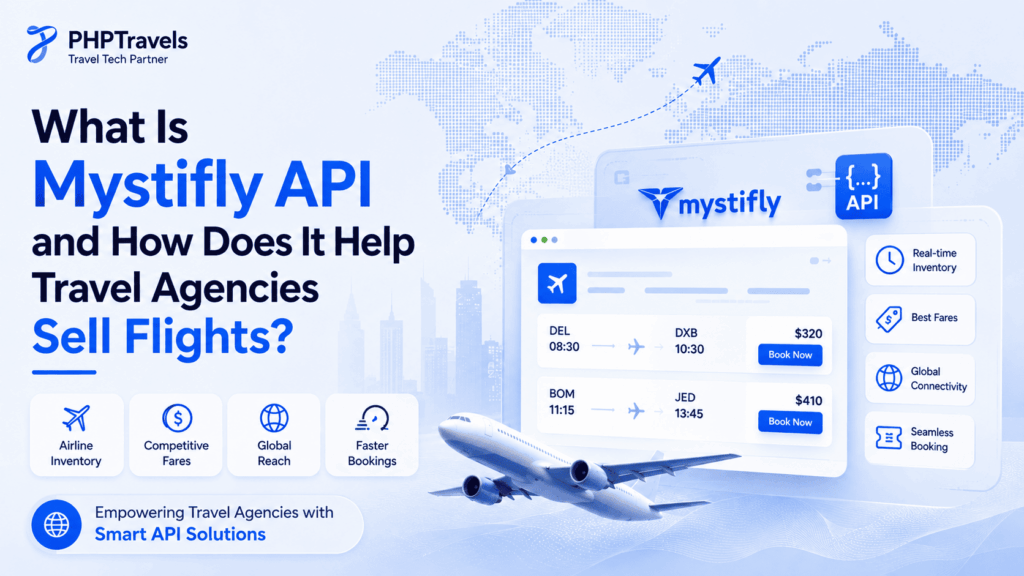
If you run a travel agency, OTA, or a B2B flight desk, sourcing reliable air content is one of the hardest parts of the job. You need real-time fares, dependable ticketing, and clean post-booking handling across many carriers without stitching together a dozen connections by hand. The Mystifly API is one of the options agencies evaluate when they want multi-source airfare content from a single integration point.
This guide explains what the Mystifly API actually does, how it fits into a real flight booking workflow, and the operational details that matter before you commit: airline coverage, documentation, latency, and pricing. It is written for travel businesses making a build-or-integrate decision, not for travellers searching for cheap tickets.
Quick Summary
- Mystifly is a Singapore-based airfare marketplace that aggregates GDS, NDC, LCC, and consolidator content into one normalized API.
- Airline coverage is commonly cited at 700+ airlines across 80+ point-of-sale countries, including full-service and low-cost carriers.
- The Mystifly API handles search, pricing, booking, ticketing, ancillaries, and post-booking actions (void, reissue, refund) through a single connection.
- Documentation, sandbox access, and pricing are shared after onboarding Mystifly does not publish a public price list, so terms are quote-based and tied to volume.
- An API alone is not a booking system. You still need a booking engine, markup control, agent management, and reporting around it which is where a platform layer matters.
What Is the Mystifly API?
Mystifly is an “Anywhere-to-Anywhere” global airfare marketplace. Its core product is a B2B SaaS platform that lets travel businesses search, ticket, sell ancillaries, and manage post-booking processes for air travel from a single place.
The Mystifly API is the technical interface that exposes that content to your booking engine. Instead of integrating each GDS or airline separately, you connect once and receive multi-source air content that has been normalized into a consistent format.
That content typically includes:
- Published, private, and negotiated fares
- GDS-sourced fares (public and market-specific)
- NDC offers from participating airlines
- Low-cost carrier (LCC) content
- Ancillary services such as baggage, seat selection, and fare families
For a travel intermediary, the value is consolidation. One flight API integration can replace several direct connections, which reduces the number of moving parts your team has to maintain.
How the Mystifly API Fits Into a Real Booking Workflow
A flight API is only useful if it maps cleanly onto how agencies actually transact. Here is where the Mystifly API sits in a standard B2B/B2C booking flow.
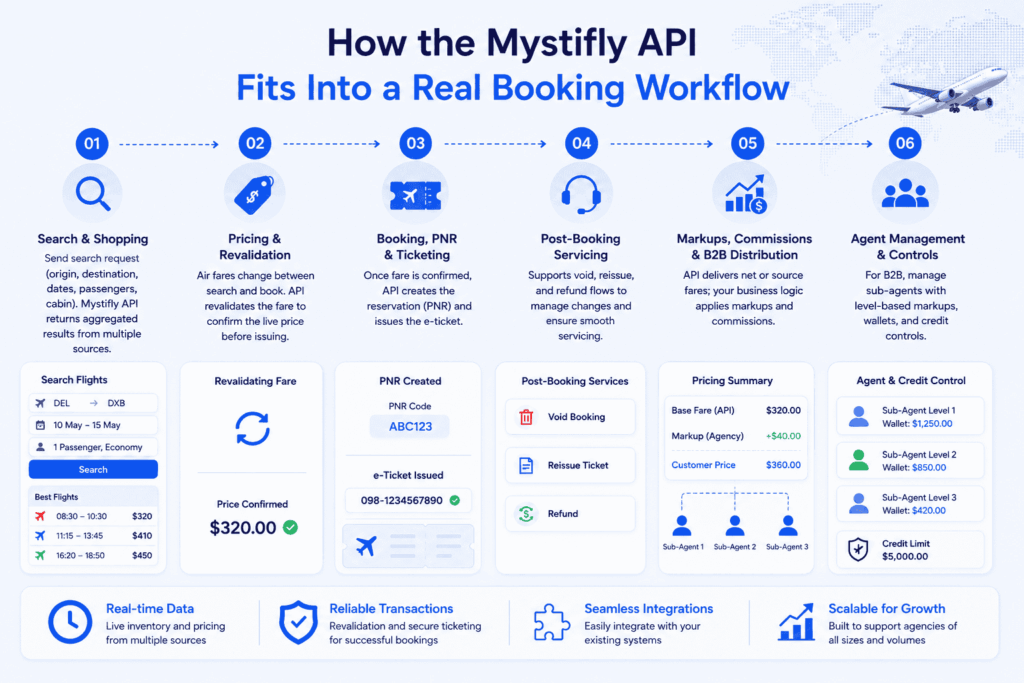
Search and shopping
Your booking engine sends a search request (origin, destination, dates, passengers, cabin). The Mystifly API returns aggregated results from multiple sources. Because content is normalized, your interface does not need separate display logic for each supplier.
Pricing and revalidation
Air fares change between search and book. The API supports a reprice/revalidation step so you confirm the live fare before issuing this is what protects you from price mismatches at checkout, a common cause of failed bookings and margin loss.
Booking, PNR, and ticketing
Once a fare is confirmed, the workflow creates the reservation (PNR) and issues the e-ticket. Storing the PNR and ticket numbers correctly is essential for servicing later, so your platform must capture and persist these fields.
Post-booking servicing
Real operations don’t end at ticket issuance. The Mystifly API supports void, reissue, and refund flows. In a B2B setup, these should run through queues with clear audit logs so your mid-office and back-office teams can track every change.
Markups, commissions, and B2B distribution
The API delivers net or source fares; your business logic applies markups and commissions. If you onboard sub-agents, you need agent-level markup rules, wallets, and credit controls layered on top the API does not handle this for you.
Mystifly API Airline Coverage and Number of Airlines
Airline coverage is usually the first question agencies ask, so it is worth being precise. Mystifly API airline coverage is frequently cited at 700+ airlines, with some partner sources listing 900+, spanning more than 80 point-of-sale countries.
The exact number of airlines matters less than the mix of content. What makes coverage useful operationally is the combination of:
- GDS content for broad, reliable inventory
- NDC offers for richer, airline-direct fares and ancillaries
- LCC content for budget routes that classic GDS often misses
- Consolidator and negotiated fares for competitive pricing
When evaluating coverage, test it against your core routes and markets rather than a headline figure. A provider with strong global numbers may still be thin on the specific regional carriers your customers book most.
Mystifly API Documentation: What to Expect
Teams frequently search for Mystifly API documentation before scoping a project. Like most enterprise air suppliers, Mystifly typically shares full developer documentation, schemas, and sandbox/test credentials after onboarding rather than publishing everything openly.
For your developers, plan for:
- A test environment to validate search, book, ticket, and servicing flows before going live
- Request/response schemas for each operation
- Error handling guidance for timeouts, fare-not-available, and ticketing failures
- Certification or QA steps the supplier may require before production access
A practical tip for team leads: treat documentation review as a formal task with its own checklist. Confirm that void, reissue, and refund are documented and testable in sandbox these post-booking flows are where weak integrations break in production.
Manual Booking vs Automated API Workflows
| Process | Manual Operations | API-Based Operations |
|---|---|---|
| Flight Search | Agent Driven | Real-Time |
| Pricing Updates | Manual | Automated |
| Ticket Issuance | Human Process | Instant |
| PNR Creation | Manual Entry | Automatic |
| Voucher Generation | Manual | Automatic |
| Invoices | Spreadsheet Based | System Generated |
| Reporting | Manual | Dashboard Based |
| Scalability | Limited | High |
Mystifly API Latency and Performance
Mystifly API latency is a fair concern with any multi-source aggregator, because pulling fares from several content sources takes longer than querying a single GDS.
You can manage performance without sacrificing accuracy:
- Smart caching of relatively stable results to speed up repeat searches
- Reasonable timeouts so a single slow source doesn’t stall the whole response
- Asynchronous handling for heavier multi-city or complex itinerary searches
- Always revalidate before booking, so cached search speed never compromises pricing accuracy
The goal is a fast shopping experience that protects conversion, with a live reprice step that protects revenue.
Mystifly API Pricing: How It Usually Works
There is no public price sheet for the Mystifly API pricing model. As with most air content suppliers, commercial terms are quote-based and depend on your transaction volume, markets, and the content sources you need.
Expect pricing and access to be tied to a direct commercial agreement with Mystifly. Your technology partner can prepare the integration, but supplier approval and the contract must be completed with the supplier directly. Budget for this approval timeline in your launch plan it is often the slowest step, not the code.
How Travel Businesses Usually Solve Flight Distribution
Before choosing any flight API, it helps to see the common paths agencies take and where they go wrong.
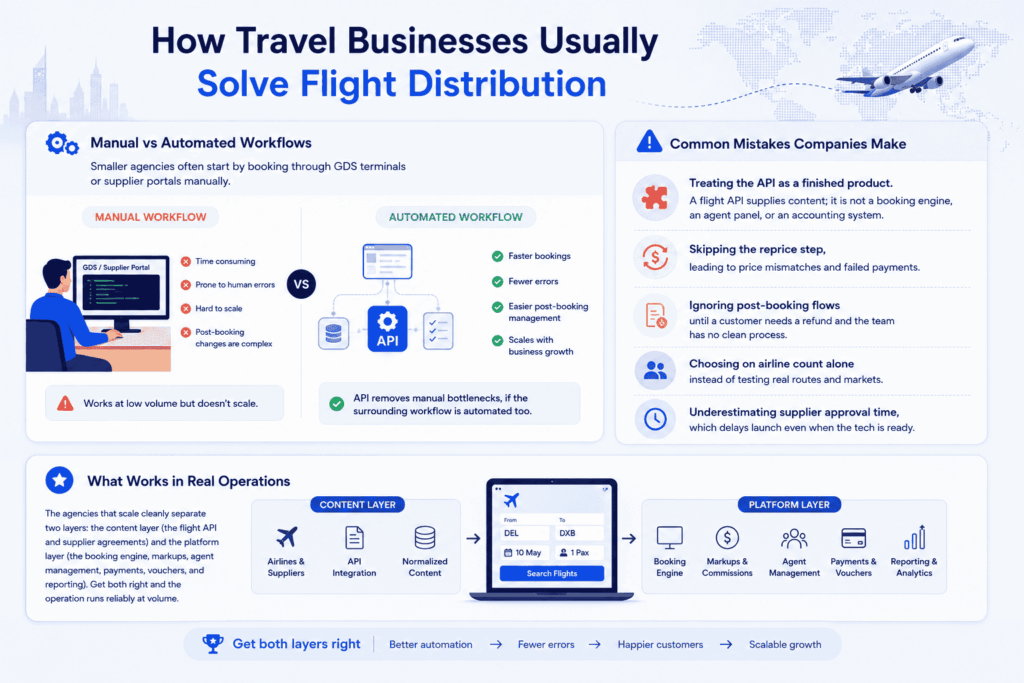
Manual vs automated workflows
Smaller agencies often start by booking through GDS terminals or supplier portals manually. This works at low volume but doesn’t scale every booking consumes staff time, and post-booking changes are error-prone. Travel automation through an API removes the manual bottleneck, but only if the surrounding workflow is automated too.
Common mistakes companies make
- Treating the API as a finished product. A flight API supplies content; it is not a booking engine, an agent panel, or an accounting system.
- Skipping the reprice step, leading to price mismatches and failed payments.
- Ignoring post-booking flows until a customer needs a refund and the team has no clean process.
- Choosing on airline count alone instead of testing real routes and markets.
- Underestimating supplier approval time, which delays launch even when the tech is ready.
What works in real operations
The agencies that scale cleanly separate two layers: the content layer (the flight API and supplier agreements) and the platform layer (the booking engine, markups, agent management, payments, vouchers, and reporting). Get both right and the operation runs reliably at volume.
Where PHPTRAVELS Fits
A common gap in Mystifly projects is the platform around the content. The Mystifly API gives you fares and ticketing; it does not give you the storefront, the B2B agent network, the markup engine, or the back-office reporting your business runs on.
PHPTRAVELS is the travel booking platform that provides exactly that layer. It supports flight API integration across major sources Amadeus, Sabre, Travelport, and selected NDC connections and is built to connect a consolidator or aggregator layer like Mystifly through its flight module and custom API adapters.
In practice, PHPTRAVELS supplies the parts the API leaves out:
- A B2B and B2C flight booking engine with search, reprice, PNR storage, and e-ticketing
- Markup, commission, and wallet controls for sub-agents
- Void, reissue, and refund queues with auditable logs
- Admin dashboards and reporting for revenue, bookings, and operations
- Onboarding support to wire your supplier credentials into a live, production-ready flow
The platform is white-label and open-source, used by 4,800+ agencies with 5M+ bookings processed, so the operational workflows are already proven. Your team handles the Mystifly commercial agreement directly; PHPTRAVELS handles the booking experience and operations around it.
If you are scoping a Mystifly integration, the fastest way to see how the workflow fits together is a live walkthrough of the flight module before you commit to a supplier.