
IATA travel agency accreditation gives eligible agencies a recognized industry identity and access to airline ticketing and settlement workflows under the accreditation option and airline authorities available to them.
However, accreditation is not the only way to operate a travel business. Non-ticketing agencies may use the free TIDS identification program, US businesses follow IATAN requirements, and many newer agencies work through consolidators or API suppliers.
This guide explains the current IATA accreditation options, country-specific requirements, costs, application steps, TIDS, code verification and non-IATA alternatives for travel businesses in 2026.
Quick Summary for Travel Business Owners
- IATA travel agency accreditation provides access to airline direct inventory and BSP billing settlement.
- Full accreditation requires financial audits, premises inspection, and documented IATA verification of your records.
- TIDS (Travel Industry Designator Services) is a lighter alternative for non-ticketing businesses; the TIDS application is simpler than full accreditation.
- What is an IATA certificate? It is the formal document confirming your agency’s Sales Agency Agreement and unique IATA numeric code.
- Total costs range from 165forsoleproprietorsto165forsoleproprietorsto360+ for corporate applicants plus annual fees.
- Many successful OTAs use consolidators or API aggregators instead of direct accreditation.
- Need support? The IATA contact phone number varies by country always start with the IATA Customer Portal.
- IATAN is a separate program for US-based travel businesses only.
What IATA Travel Agency Accreditation Actually Does
IATA (International Air Transport Association) represents approximately 290 airlines across 117 countries. For a travel agency, IATA accreditation creates a formal principal-agent relationship with member airlines. This is not merely a certification or membership badge. It is a legally binding Sales Agency Agreement that defines ticketing authority, settlement terms, and operational responsibilities.
When your travel agency holds IATA accreditation, you receive a unique IATA numeric code. This code identifies your business across global distribution systems (GDS), airline booking platforms, and BSP (Billing and Settlement Plan) transactions. Over 60,000 IATA accredited travel agents worldwide use these codes to process approximately $220 billion in airline ticket sales annually.
Operationally, the IATA code serves as your identity in airline back-office systems. It enables automated reconciliation, direct debit or credit memos, and standardized commission tracking. Without this code, you cannot directly issue airline tickets through GDS platforms like Amadeus, Sabre, or Travelport.
Why Most Travel Agencies Pursue IATA Accreditation
Direct Inventory Access
IATA accredited travel agencies can pull live seat availability and net fares directly from airline systems. This eliminates dependency on consolidators or third-party ticket providers. For high-volume flight sellers, the margin difference between net fares and public fares often justifies the accreditation process.
BSP Settlement Efficiency
The Billing and Settlement Plan standardizes invoicing and payments between travel agencies and airlines. Instead of managing 50 separate airline payment relationships, your agency settles once with your local BSP. This reduces reconciliation work, payment errors, and administrative overhead.
Credibility for Corporate Clients
Corporate travel buyers typically require suppliers to hold IATA accreditation. Large enterprises, government accounts, and multinational companies audit travel partners for IATA status before signing contracts. If your target market includes corporate travel, accreditation is often non-negotiable.
Supplier Discounts Beyond Airlines
IATA accreditation unlocks preferential rates from hotels, car rental companies, tour operators, and travel technology providers. Over 1,000 suppliers offer exclusive IATA agent pricing. In practice, a hotel night might cost 80throughpublicchannelsbut80throughpublicchannelsbut55 through IATA agent rates.
IATA Accreditation, TIDS and IATAN: What Is the Difference?
| Program | Main purpose | BSP airline ticketing | Suitable for |
|---|---|---|---|
| GoLite | Simplified IATA accreditation | Yes, subject to airline authority and applicable workflow | Smaller ticketing agencies |
| GoStandard | Standard accreditation with wider payment options | Yes | Established national agencies |
| GoEurozone | Multi-location Eurozone accreditation | Yes | Eurozone agency groups |
| GoGlobal | Multi-country accreditation | Yes | International agency groups |
| TIDS | Industry identification for non-accredited sellers | No | Tour operators, OTAs, DMCs and non-ticketing sellers |
| IATAN | US travel-agency recognition program | Depends on the selected US program and relationships | US-based businesses |
IATA states that GoLite has simplified requirements and no minimum financial guarantee required to issue air tickets, which directly conflicts with the article’s blanket claim that every accredited agency normally needs a $15,000–$50,000 guarantee.
Real Operational Impact of IATA Accreditation
Booking Workflow Changes
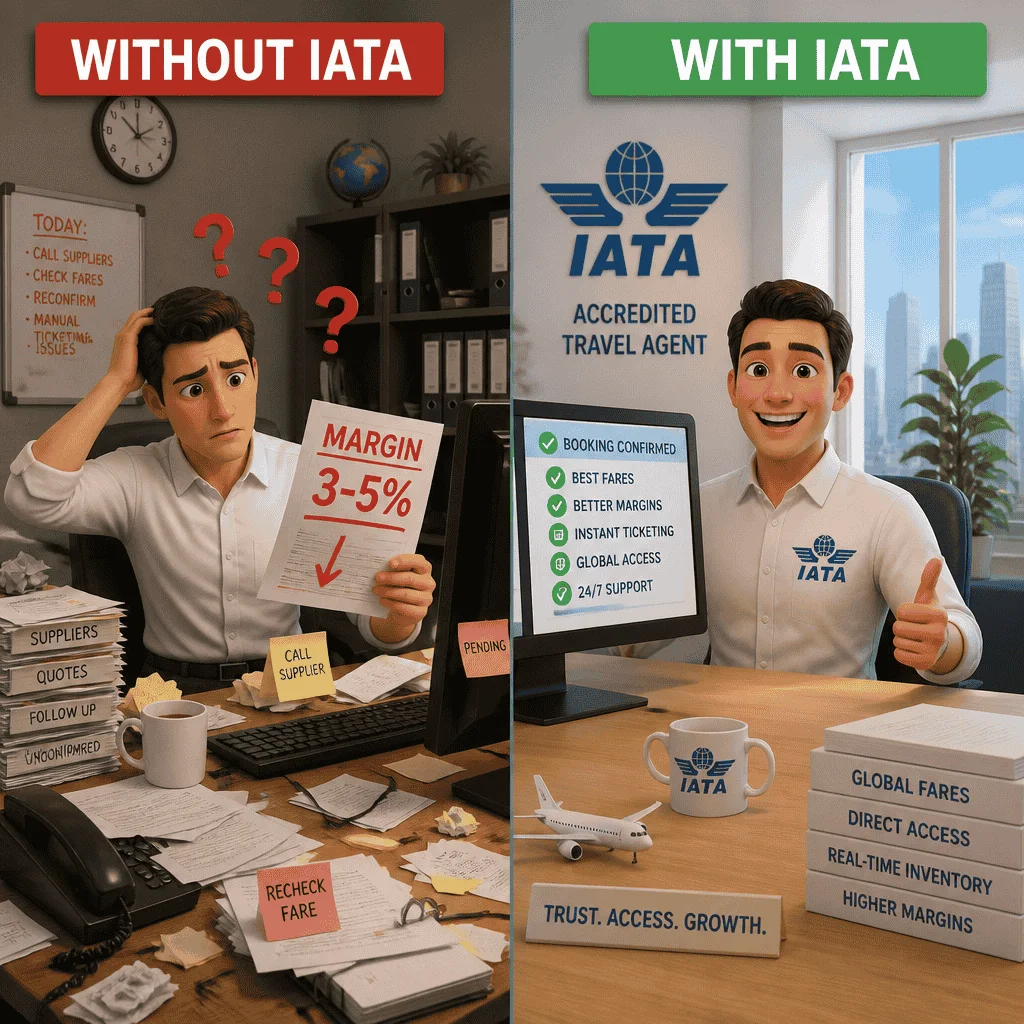
Without IATA accreditation, your flight booking workflow typically uses third-party APIs (Travelport, Amadeus via aggregator) or manual consolidator bookings. You receive markups built into every ticket. Margin control is limited. With IATA accreditation and GDS connection, your workflow changes: you query airline inventory directly, apply your own markups or service fees, and issue tickets under your own IATA numeric code. Gross margins on flights can increase from 3-5% (standard consolidator margin) to 10-15% depending on routing and fare rules.
Inventory Synchronization Complexity
Holding IATA accreditation does not automatically solve inventory synchronization. You still need a mid-office system or booking engine that connects your GDS to your website, back-office accounting, and voucher generation. PHPTRAVELS, for example, includes native GDS integrations with Amadeus, Sabre, and Travelport, plus XML API connectors for non-GDS inventory.
Payment and Settlement Reality
BSP settlement occurs on fixed cycles (typically weekly or bi-weekly). Your agency receives payment from clients, but BSP debits your account for ticket issuance regardless of client payment timing. This creates working capital requirements. Many IATA accredited agencies maintain credit lines or hold client deposits specifically for BSP cash flow timing.
How Non-IATA Travel Agencies Operate Successfully
Thousands of profitable travel agencies operate without IATA travel agency accreditation. Common operational models:
Consolidator Model
The agency books flights through a consolidator or wholesaler that holds IATA accreditation. The consolidator issues tickets under their IATA code. Your agency adds a markup or service fee. Margins are lower, but no accreditation costs, no BSP cash flow requirements, and no financial audits.
API Aggregator Model
Technology platforms provide B2B flight booking APIs and b2b travel portal without requiring IATA accreditation. These platforms hold their own IATA accreditation and BSP relationships. Your agency pays a per-booking fee or rev share.
NDC Direct Model
Some airlines offer NDC (New Distribution Capability) direct APIs to non-IATA agencies. The airline defines commercial terms directly. No BSP involvement. No GDS fees.
Common Mistakes When Pursuing IATA Accreditation
Underestimating IATA verification
IATA requires detailed financial records, often audited by an approved accountant. Many agencies fail the first application due to incomplete profit and loss statements, missing tax filings, or insufficient working capital documentation. The financial review is not a formality.
Applying for full accreditation too early
New travel agencies (under 12 months old) rarely qualify. The better path: operate through consolidators or aggregators, build documented sales history, then apply after 18-24 months.
Ignoring local BSP variations
BSP rules, fees, and settlement cycles vary by country. Always review your country-specific BSP handbook before calculating financial requirements.
Overlooking mid-office automation
Without automated reconciliation, your back-office staff spend 10-15 hours weekly on manual work.
What Actually Works in Real Travel Operations
Based on operational data from active travel agencies, DMCs, and tour operators:
- Under $200K annual flight sales Use consolidator or API aggregator. Avoid IATA accreditation overhead.
- 200Kto200Kto1M annual flight sales Apply for TIDS or full accreditation depending on ticketing volume. Automate GDS connection through a booking engine.
- Over $1M annual flight sales Full IATA accreditation is operationally and financially justified.
- Mixed inventory (flights + hotels + tours) TIDS plus supplier direct contracts often works better than full accreditation.
How PHPTRAVELS Supports IATA and Non-IATA Operations
PHPTRAVELS operates as a travel technology platform rather than an accreditation provider. The software accommodates both IATA accredited agencies and non-accredited operators through flexible workflow configurations.
For IATA accredited travel agencies, PHPTRAVELS provides native GDS XML integrations for Amadeus, Sabre, and Travelport, a BSP reconciliation module matching airline debits to client invoices, automated voucher generation with IATA numeric code inclusion, agent management for sub-agents, and PNR workflows with multi-GDS synchronization.
For non-IATA agencies, PHPTRAVELS supports API aggregator connectors, manual booking entry for consolidator-sourced tickets, markup and commission rules, and payment gateway integrations.
The practical value is workflow automation regardless of accreditation status.
Practical Steps to Become an IATA Travel Agency
- Determine which accreditation type matches your business (Full, TIDS, or IATAN for US)
- Register your travel business legally with all local trade licenses
- Operate for minimum required period (typically 12-24 months) through consolidators
- Document sales records, tax filings, and financial statements prepare for IATA verification
- Secure professional indemnity and public liability insurance
- Obtain bank guarantee or financial security deposit as required by local BSP
- Complete the TIDS application (if not pursuing full accreditation) or full IATA Travel Agent Handbook requirements
- Submit application through IATA Customer Portal with all documentation
- Pay accreditation fee (165individual/165individual/360 corporate plus local BSP fees)
- Upon approval, integrate GDS connection through a travel technology platform like PHPTRAVELS