
The travel industry has never been static, but what is happening now is a structural shift, not just evolution. The traditional commission-based model that the future of travel agencies for decades is rapidly breaking down, forcing agencies to rethink how they earn, operate, and compete.
At the same time, travel suppliers are pushing direct bookings, while large online travel platforms are capturing global demand. This creates a growing pressure on agencies caught in the middle, where margins are shrinking and differentiation is becoming harder.
Inside the business, another shift is happening. Manual workflows that once defined daily operations are being replaced by automation, APIs, and centralized systems. Booking, pricing, customer management, and reporting are no longer manual tasks but system-driven processes.
Modern travel agencies are no longer just intermediaries for bookings. They are becoming technology-driven operators, combining human expertise with automation, data, and global connectivity.
Quick Summary
- Travel agencies are shifting from manual operations to technology-driven platforms
- Online booking systems, APIs, and automation are redefining how agencies operate
- Human expertise remains critical for personalization and complex travel planning
- Revenue models are evolving beyond commissions into services and experiences
- Agencies that adopt technology and improve workflows will dominate the market
How Travel Distribution Actually Works Today
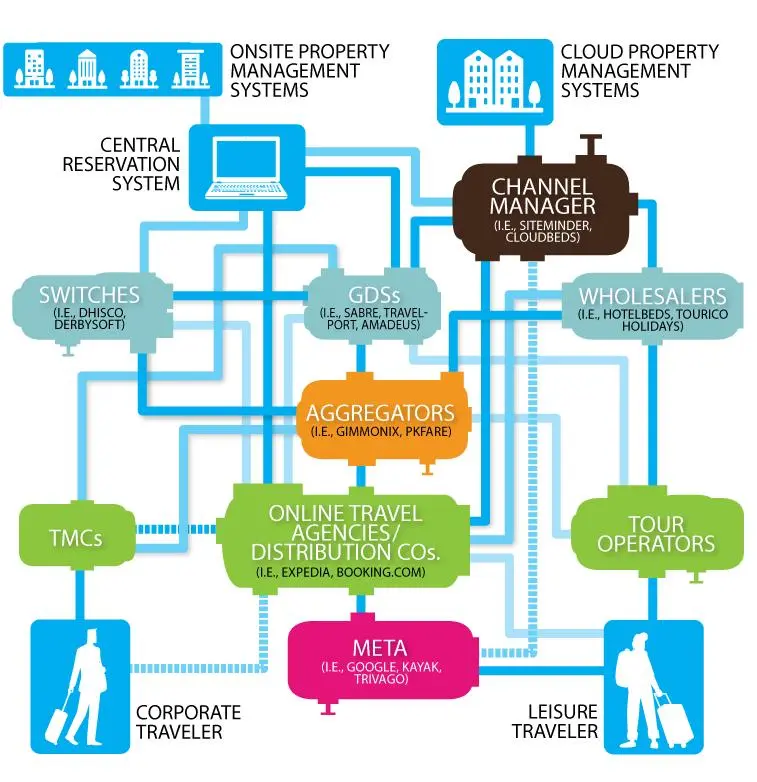
The travel industry runs on a layered distribution system that most end customers never see. Understanding this structure is critical for any agency trying to scale, improve margins, or compete with large platforms.
1. GDS vs APIs vs Direct Contracts
At the core of travel distribution are three main ways to access inventory:
GDS (Global Distribution Systems)
Platforms like Amadeus, Sabre, and Travelport act as centralized networks connecting airlines, hotels, and travel sellers.
- Strong in flight inventory and legacy airline systems
- Reliable, standardized data
- Expensive and often complex to manage
APIs (Supplier and Aggregator APIs)
Modern travel businesses increasingly rely on APIs from suppliers and aggregators such as Hotelbeds, Expedia, and Viator.
- Real-time pricing and availability
- Faster integration for hotels, tours, transfers
- Better control over margins and product mix
Direct Contracts
Agencies also negotiate directly with hotels, DMCs, and local suppliers.
- Higher margins
- Exclusive inventory
- Requires operational effort to manage rates, availability, and updates
2. Aggregators vs Suppliers
There is a clear difference between where inventory comes from and how it is distributed.
Suppliers
- Airlines, hotels, tour operators
- Own the inventory
Aggregators
- Platforms that collect inventory from multiple suppliers
- Normalize and redistribute it through APIs
Aggregators simplify access but come at a cost:
- Lower margins
- Less control over pricing
- Dependency on third-party systems
Direct supplier relationships improve profitability but increase operational complexity.
3. Why Travel Agencies Still Matter
With suppliers selling direct and OTAs dominating online bookings, it is easy to assume agencies are becoming irrelevant. The opposite is happening.
Travel agencies still play a critical role because they:
- Combine inventory from multiple sources into one booking flow
- Handle complex itineraries that suppliers cannot manage alone
- Apply pricing strategies, markups, and business rules
- Provide human support for changes, cancellations, and edge cases
- Build B2B distribution networks with sub-agents and partners
Most importantly, agencies act as orchestrators, not just sellers.
How Travel Agencies Have Evolved
A decade ago, travel agents focused mainly on ticketing and hotel bookings. Today, those tasks are increasingly handled by online platforms and direct supplier systems.
Platforms like Uber, Airbnb, and Skyscanner changed consumer behavior by giving users direct access to travel services.
This shift forced travel agencies to rethink their role.
Instead of competing on basic bookings, modern travel agents now focus on:
- Curated travel experiences
- Complex itinerary planning
- Group and corporate travel management
- Specialized niches such as luxury, adventure, and medical tourism
Real World Use Cases of Modern Travel Agencies
The modern travel agency is not one single model. Different agencies operate in very different ways depending on their market, customers, and business strategy.
Here are real world scenarios that show how travel agencies actually operate today.
1. B2B Agent Network Selling Hotels with Markups
A wholesaler or B2B agency builds a network of sub agents.
How it works:
- Connects hotel inventory using APIs and direct contracts
- Applies markups based on agent level or region
- Agents log into a portal and make bookings for their customers
- The system automatically calculates profit margins
Why this works:
- Scales without hiring more staff
- Generates consistent revenue through volume
- Creates a distribution network instead of relying on direct customers
2. Corporate Travel Desk Managing Policies and Costs
A corporate travel agency manages travel for companies instead of individual customers.
How it works:
- Employees book travel within company policies
- The system enforces budget limits and approvals
- Centralized billing and reporting for the company
- Tracks travel spend, refunds, and unused tickets
Why this works:
- High value contracts
- Recurring business from corporate clients
- Focus on control, reporting, and efficiency
3. Luxury Agency Building Multi Country Itineraries
A high end agency focuses on customized travel experiences.
How it works:
- Combines hotels, flights, transfers, and tours into one itinerary
- Uses a mix of APIs and direct supplier relationships
- Handles complex routing across multiple countries
- Provides personal support before and during the trip
Why this works:
- Higher margins
- Customers pay for expertise and convenience
- Less price competition compared to mass market
4. OTA Using Affiliate vs API vs Own Inventory
An online travel agency can operate using multiple sourcing strategies.
How it works:
- Affiliate model for quick launch with minimal setup
- API integrations for real time control and better margins
- Direct contracts for exclusive deals and higher profits
Most OTAs use a combination of all three.
Why this matters:
- Affiliate is easy but low margin
- APIs give control and scalability
- Direct contracts give maximum profit but require effort
What This Means for the Industry
These examples show one thing clearly:
There is no single way to run a travel agency anymore.
Success depends on:
- Choosing the right business model
- Using the right mix of suppliers and technology
- Building systems that scale operations
Agencies that treat themselves like structured businesses, not just booking offices, are the ones growing.
The Rise of Online Travel Agencies
Online travel agencies have taken over a significant share of global bookings. Customers now expect:
- Instant availability
- Real time pricing
- Seamless checkout
- Mobile friendly experiences
This demand has pushed agencies to adopt digital systems. A strong example is how platforms operate using centralized booking engines and supplier integrations.
If you want to understand how these systems work in depth, explore this guide on travel booking engines for agencies and OTAs.
The shift is clear. Manual booking processes are being replaced by automated systems that connect directly to suppliers.
Technology Is Reshaping the Industry
The future of travel agencies is heavily tied to technology adoption.
1. Booking Engines and APIs
Modern agencies rely on booking engines connected to multiple suppliers. These include:
- Hotel APIs
- Flight APIs
- Cruise booking APIs
- Transfer and tour integrations
Instead of manually confirming availability, agencies now operate through real time systems.
Learn more about how booking engines for agencies work.
2. Automation in Travel Operations
Automation is no longer a luxury. It is a requirement.
Key areas of automation include:
- Booking confirmations
- Invoice and voucher generation
- Customer notifications
- Refund and cancellation workflows
Automation reduces human error and increases operational efficiency.
A deeper look at technology impact.
3. Artificial Intelligence and Data
Artificial intelligence is playing a growing role in travel:
- Personalized recommendations
- Predictive pricing insights
- Customer behavior analysis
- Automated customer support
These systems allow agencies to deliver smarter and faster services.
Changing Revenue Models
Travel agencies used to rely heavily on commissions. That model is no longer enough.
Today’s successful agencies generate revenue through:
- Service fees
- Markups on dynamic pricing
- Subscription based travel services
- Corporate travel contracts
- Affiliate partnerships
The future belongs to agencies that diversify revenue streams instead of relying on a single model.
The Role of the Modern Travel Agent
Despite automation, the human element remains critical.
A modern travel agent is no longer just a seller. They are:
- A travel advisor
- A problem solver
- A planner for complex journeys
- A curator of unique experiences
Customers still value:
- Expert guidance
- Local knowledge
- Personalized recommendations
- Support during disruptions
Technology handles transactions. Humans build trust.
Customer Experience Is the New Competitive Edge
In a crowded market, customer experience is the main differentiator.
Key factors that define a strong travel experience:
- Easy booking process
- Transparent pricing
- Reliable support
- Personalized recommendations
- Smooth post booking service
Even small details matter:
- Internet connectivity advice
- Best travel seasons
- Visa guidance
- Currency tips
Agencies that focus on these details build long term loyalty.
Travel Agency Workflows in the Digital Era
To understand the future, you need to understand how modern workflows operate.
Typical Digital Booking Workflow
- Customer searches travel options
- System fetches real time data from APIs
- Customer selects and books
- Payment is processed through gateway
- System generates vouchers and invoices
- CRM records customer data for future use
Each step is automated, connected, and trackable.
Payment systems are a critical part of this workflow.
Build vs Buy Travel Technology
One of the biggest decisions agencies face is whether to build their own system or use an existing platform.
Build
Pros:
- Full control
- Custom features
Cons:
- High cost
- Long development time
- Ongoing maintenance
Buy
Pros:
- Faster deployment
- Proven systems
- Lower initial cost
Cons:
- Limited customization
- Dependency on provider
Most agencies choose to adopt ready made platforms and customize them as needed.
Comparison: Traditional vs Modern Travel Agencies
| Area | Traditional Agency | Modern Agency |
|---|---|---|
| Revenue Model | Supplier commissions only, fixed margins, low control | Multi-layer revenue: markups, service fees, B2B margins, dynamic pricing |
| Supplier Access | Limited contracts or single GDS | Hybrid: GDS + APIs + direct contracts + aggregators |
| Tech Stack | Email, spreadsheets, basic back-office tools | Integrated platform: booking engine, APIs, CRM, payments, reporting |
| Booking Process | Manual search, quote, confirm | Real-time search, instant booking, auto-confirmation |
| Speed of Operations | Hours to days per booking | Seconds to minutes per booking |
| Error Rates | High due to manual entry and communication gaps | Low due to system validation, automation, and workflows |
| Customer Experience | Reactive, slow response, limited visibility | Instant results, self-service, personalized offers |
| Pricing Control | Fixed supplier pricing | Dynamic pricing with markups, rules, and segmentation |
| Operations | Offline-heavy, human-dependent | System-driven, workflow-based, minimal manual work |
| Scalability | Linear growth, requires more staff | Exponential growth without proportional hiring |
| Reporting & Visibility | Delayed, manual reports | Real-time dashboards, margin tracking, audit trails |
| B2B Capability | Limited or none | Full agent network with credit limits, markups, white label |
| Dependency Risk | High dependency on few suppliers | Diversified supply reduces risk |
| Cost Structure | Hidden inefficiencies, staff-heavy | Higher upfront tech, lower long-term operational cost |
Challenges Facing Travel Agencies
Despite growth opportunities, agencies face real challenges:
- Increasing competition from direct suppliers
- Price transparency reducing margins
- Rapid technology changes
- Customer expectations for instant service
The Future of Travel Agencies
The future is not about replacing travel agents. It is about enhancing them.
Key trends shaping the future:
- Fully digital booking platforms
- AI driven personalization
- Integrated supplier ecosystems
- Mobile first experiences
- Real time customer support
At the same time, there is a strong return to human led services in premium travel segments.
Customers want both efficiency and expertise.
How Technology Driven Platforms Enable Growth
A future ready travel agency operates on a connected system that includes:
- Booking engine
- CRM
- Payment integration
- Supplier APIs
- Reporting dashboard
This is where platforms like PHPTRAVELS come into play.
A complete solution such as the online travel agencies system allows agencies to:
- Launch B2B and B2C portals
- Connect with global suppliers
- Automate bookings and operations
- Manage agents and customers in one place
- Scale without increasing manual workload
Explore the platform online travel agencies system.
The goal is simple. Replace fragmented tools with a unified system.
Building a Future Ready Travel Agency
To stay relevant in the coming years, agencies should focus on:
- Adopting modern booking systems
- Investing in automation
- Building strong supplier partnerships
- Improving customer experience
- Diversifying revenue streams
A good starting point is choosing the right travel software for agencies tour operators.
Growth is no longer about working harder. It is about working smarter.
Final Thoughts
The travel industry will continue to evolve, but one thing remains constant. Businesses that adapt win.
Travel agencies that embrace technology, improve workflows, and focus on customer value will not just survive. They will lead the next phase of the travel industry.