
Looking for the best travel affiliate programs in 2026?
The right platform can decide whether your website earns small commissions or scales into a real booking business.
This guide compares the top travel affiliate websites including Booking.com, Agoda, Skyscanner, Viator, and more based on commissions, conversion rates, API access, and white label capabilities.
If you are building a travel blog, affiliate website, or even an OTA style platform, this breakdown will help you choose the right model and avoid low paying programs.
Quick Summary
- Travel affiliate programs let you earn without owning inventory
- Hotels and tours usually convert better than flights
- Top platforms offer deep links, widgets, and API access
- Beginners should start simple and scale gradually
- Long term growth comes from combining multiple affiliate sources
Travel Affiliate API vs White Label vs Links
Not all travel affiliate models work the same way. Choosing between simple links, white label solutions, or API integrations depends on how serious you are about building a travel business.
Here is a clear breakdown of how each model works:
| Model | Setup Difficulty | Control | Revenue Potential | Best For |
|---|---|---|---|---|
| Affiliate Links | Very Easy | Low | Low to Medium | Beginners, blogs, content websites |
| White Label | Medium | Medium | Medium | Branded websites without heavy development |
| API Integration | Advanced | Full | High | OTA platforms, scalable travel businesses |
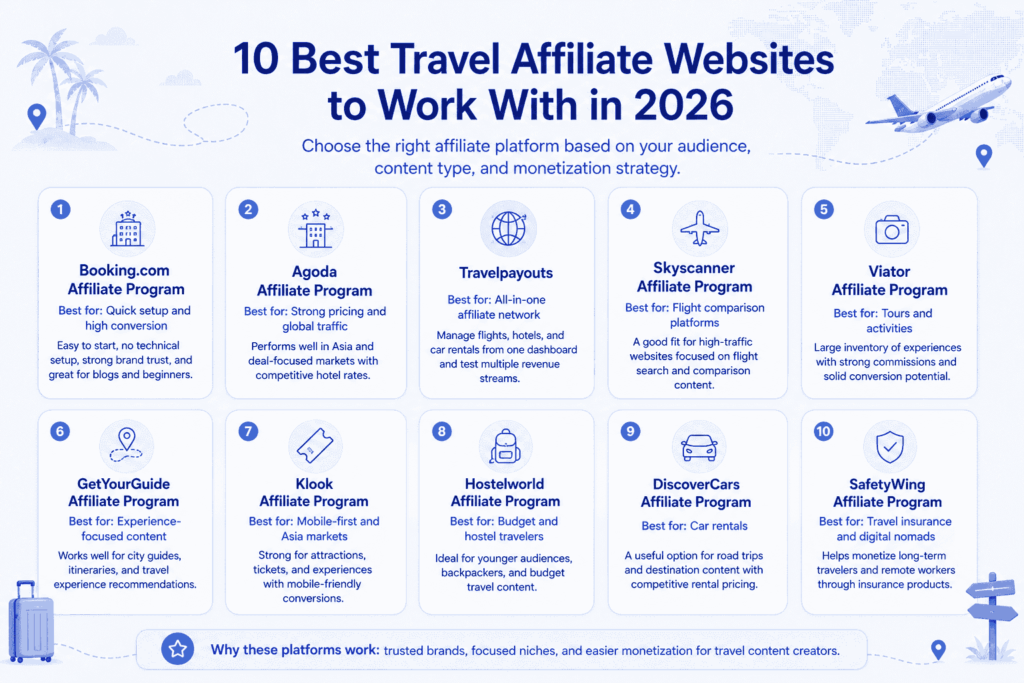
10 Best Travel Affiliate Websites to Work With in 2026
Choosing the right affiliate platforms depends on your business model, audience type, and level of technical setup. Below are the most reliable and widely used travel affiliate websites that consistently deliver results.
1. Booking.com Affiliate Program
Best for: Quick setup and high conversion
Booking.com is one of the easiest affiliate programs to start with. It requires no technical setup, offers global hotel inventory, and benefits from strong brand trust which improves conversions.
Ideal for blogs, niche sites, and beginners testing traffic.
2. Agoda Affiliate Program
Best for: Strong pricing and global traffic
Agoda performs especially well in Asia and price-sensitive markets. Its competitive hotel rates often lead to better conversions compared to other platforms.
Best if your audience includes international or deal-focused travelers.
3. Travelpayouts
Best for: All-in-one affiliate network
Travelpayouts gives access to flights, hotels, and car rentals from one dashboard. Instead of joining multiple programs, beginners can manage everything in one place.
Perfect if you want to test multiple revenue streams quickly.
4. Skyscanner Affiliate Program
Best for: Flight comparison platforms
Skyscanner operates on a meta-search model and is suitable for high-traffic websites focusing on flight searches.
5. Viator Affiliate Program
Best for: Tours and activities
Viator offers a large inventory of experiences with strong commissions and high conversion rates.
6. GetYourGuide Affiliate Program
Best for: Experience-focused content
GetYourGuide is known for curated activities and performs well on city guides and itinerary-based pages.
7. Klook Affiliate Program
Best for: Mobile-first and Asia markets
Klook specializes in experiences, tickets, and attractions with strong mobile conversion.
8. Hostelworld Affiliate Program
Best for: Budget and hostel travelers
Hostelworld is focused on budget accommodations and performs well for younger audiences and backpackers.
9. DiscoverCars Affiliate Program
Best for: Car rentals
DiscoverCars helps monetize road trips and destination-based content with competitive pricing.
10. SafetyWing Affiliate Program
Best for: Travel insurance and digital nomads
SafetyWing allows you to monetize long-term travelers and remote workers with recurring insurance products.
What Are Travel Affiliate Programs
A travel affiliate program allows you to promote travel services and earn a commission when a user completes a booking through your referral. If you want to explore a structured setup with built in tools, you can review a complete travel affiliate platform solution.
In simple terms, you act as the distribution layer while the supplier handles inventory, fulfillment, and support.
How it works in practice
A user lands on your website, interacts with your content or search tools, clicks a booking link or widget, and completes the reservation. Once the booking is confirmed, you receive a commission based on the platform’s structure.
Three core models you need to understand
Redirect based affiliates
This is the simplest model. Users click a link and are redirected to another platform to complete the booking. It is easy to set up but gives you very little control over the user journey or pricing.
White label platforms
These allow you to embed booking tools within your website. The experience looks branded, but the checkout and backend still belong to the provider.
API driven systems
This is where things shift from affiliate marketing to building a real travel business. You control the booking experience, pricing logic, and customer data. It requires more setup but offers significantly higher long term potential.
How These Travel Affiliate Websites Compare by Category
Instead of listing random platforms, it makes more sense to evaluate them based on real use cases and how they perform in different parts of the booking journey.
Best hotel affiliate programs
Hotel bookings remain the easiest entry point for most travel websites. Users searching for accommodation are usually closer to making a decision, which naturally leads to higher conversion rates.
Platforms like Booking.com, Agoda, and Hostelworld dominate this space because of their global inventory and strong brand trust. For example, platforms like Agoda have evolved significantly, and this breakdown of modern hotel affiliate integrations shows how these systems are now production ready.
Instead of relying on a single provider, many successful affiliate websites combine multiple hotel platforms like Booking.com and Agoda to compare pricing and improve conversions. Each platform has slightly different inventory and pricing logic, which can directly impact earnings.
Best flight affiliate platforms
Flights are a core part of travel, but they are significantly harder to monetize compared to hotels or tours.
Platforms like Skyscanner and Travelpayouts operate mostly on a meta search or lead generation model rather than direct booking commissions.
Flight affiliate platforms like Skyscanner and Travelpayouts are better suited for traffic-heavy websites. Since earnings are often based on clicks or leads, success depends more on volume than conversion rate.
Flight affiliate programs work best for comparison tools, high traffic websites, and platforms designed around search aggregation rather than direct conversions.
Airline Affiliate Programs and How They Work
Many people searching for travel monetization expect to find direct airlines affiliate programs. The reality is different.
Unlike hotels or tours, most airlines do not operate open affiliate programs for publishers or small travel websites. Instead, airline distribution is controlled through structured systems such as GDS, consolidators, and approved partners.
Why airline affiliate programs are rare
Airlines operate on thin margins and already distribute inventory through global systems. Because of this, they prioritize partnerships with:
- Online travel agencies
- Corporate travel platforms
- Aggregators and meta search engines
This limits direct access for typical affiliate websites.
Direct airline programs vs indirect models
There are two main ways airline monetization works:
Direct airline partnerships
These are limited and usually require approvals, volume commitments, or industry credentials such as IATA. They are not designed for beginners or content based websites.
Meta search and affiliate platforms
Platforms like Skyscanner and Travelpayouts act as the bridge. Instead of partnering with airlines directly, you monetize through:
- Flight search redirects
- Cost per click or lead models
- Aggregated airline inventory
This is how most affiliate travel websites generate revenue from flights.
The monetization reality for flights
Flight affiliate revenue works very differently compared to hotels or tours.
- Lower margins
- Lower conversion rates
- Often based on clicks instead of bookings
This means flight monetization requires high traffic volume or strong search intent pages to perform well.
Because of this, most successful travel affiliate websites use flights as a supporting channel, not the primary revenue source.
They combine:
- Hotels for consistent conversions
- Tours for higher margins
- Flights for traffic capture
Best tours and activities affiliate programs
Tours and activities are often the most profitable segment for travel affiliates.
Platforms such as Viator, GetYourGuide, and Klook perform exceptionally well because users booking experiences are typically already in the final stage of their travel planning. If you want to understand how to monetize this segment effectively, this guide on earning with experience based affiliate programs breaks it down in detail.
Margins are higher, conversion rates are stronger, and content targeting specific destinations naturally aligns with these offers.
Car rentals and additional travel services
Car rentals and services like insurance are often ignored, but they can significantly increase revenue per user when combined with other offers.
Platforms like DiscoverCars and SafetyWing are commonly used to monetize road trip content, long stay travelers, and digital nomads.
Adding these services creates a more complete booking experience and increases overall earnings without needing additional traffic.
Affiliate program comparison framework that actually matters
Most articles stop at listing platforms, but choosing the right program requires deeper evaluation.
Commission structure
Do not focus only on percentages. What matters is the actual earning per booking.
A lower percentage on a high value booking can outperform a higher percentage on smaller transactions. You should always look at average booking value and how often users complete bookings through your links.
Cookie duration
Short cookie windows limit your earning potential. If a user delays their booking, you may lose the commission entirely.
Programs offering 7 to 30 day cookies give you a better chance of earning from delayed decisions, which is common in travel.
Payout thresholds and frequency
Many beginners overlook payout terms. A high minimum payout or long payment cycle can slow down your cash flow.
Platforms with lower thresholds and consistent payouts are easier to scale, especially in the early stages.
Conversion tools
High performing platforms provide tools that go beyond simple links.
These include deep links, search widgets, booking forms, and analytics dashboards. Deep linking alone can significantly improve performance by sending users directly to relevant results instead of generic pages.
Integration level
Your choice should match your current stage.
Links are fast and easy to implement. Widgets improve user experience. APIs provide full control but require technical setup.
Multi currency and multi language support
If your audience is global, this becomes critical.
Displaying prices in the user’s currency and offering localized content builds trust and increases conversion rates.
How to choose the right program for your business model
Different types of travel websites require different affiliate strategies.
For beginners
Start with simple platforms like Booking.com, Agoda, and Travelpayouts. These allow quick setup and fast monetization without technical complexity.
For content creators
Focus on hotels and tours combined with deep linking. This aligns directly with search intent such as destination guides and activity based content.
If you are planning your structure, understanding how to start a travel affiliate website will help you build a stronger foundation from day one.
For affiliate travel websites
Use a combination of hotels, tours, car rentals, and insurance. Diversification protects your revenue and improves user experience. This becomes even more important when scaling into high value affiliate travel strategies.
For OTA style platforms
At this stage, relying only on affiliate links becomes limiting. Moving toward white label solutions or API integrations allows you to control pricing, booking flow, and customer relationships.
Can You Build an OTA Using Affiliate Programs
Yes, you can start an online travel agency using affiliate programs. Many travel websites begin this way because it is fast and requires no inventory or supplier contracts.
But there are clear limitations you need to understand.
What works with affiliate programs
- You can list hotels, flights, tours, and earn commission
- No need to manage bookings or customer support
- Quick setup using links or widgets
- Good for blogs, niche sites, and early stage websites
This is why most beginners start with affiliate models
Where affiliate models fall short
As your traffic grows, problems start to appear:
- You send users to another website to complete booking
- You don’t control pricing or margins
- You don’t own customer data
- Limited branding and user experience
- Lower revenue compared to direct booking systems
You are building traffic, but not building a real business
When should you move beyond affiliate
You should consider upgrading when:
- You are getting consistent traffic
- Users are clicking but not converting well
- You want to increase revenue per booking
- You want to build your own brand, not promote others
What happens when you switch to a booking system
Instead of sending users away, you:
- Keep users on your website
- Control pricing and add your own markup
- Manage bookings and customers directly
- Increase conversion rates and revenue
This is where your website starts behaving like a real OTA
The practical path most travel businesses follow
- Start with affiliate links
- Add multiple platforms and optimize content
- Introduce white label tools
- Move to API based booking system
This is how small websites grow into full travel platforms
Building a travel affiliate website that actually converts
Traffic alone does not generate revenue. The structure of your website plays a major role in performance.
Match content with user intent
High converting pages are built around real user needs. These include destination guides, itineraries, comparison pages, and booking focused landing pages.
Structure like a booking platform
Successful sites do not behave like blogs. They function more like structured platforms.
This includes search pages, category pages, location based listings, and deal focused sections.
If you look at how to increase your market as an affiliated travel agency, you will notice the shift from content to structured distribution.
Use deep linking strategically
Sending users to generic pages reduces conversions. Linking directly to specific hotels, tours, or filtered results creates a smoother booking journey.
Combine multiple affiliate sources
Relying on a single provider is risky. Combining multiple sources allows you to capture more value from each visitor and create a more complete experience.
Moving beyond basic affiliate models
At some stage, simple links and widgets stop delivering meaningful growth.
White label solutions
These provide better branding and a more integrated experience but still limit your control over backend operations.
API based booking systems
This is where the business model shifts. Instead of acting as a referral source, you begin operating closer to a full travel platform.
You gain control over pricing, can apply markups, improve conversion rates, and build direct relationships with customers.
Where PHPTRAVELS fits in the affiliate journey
There is a clear point where a growing travel business outgrows basic affiliate setups.
If you are consistently generating traffic and bookings, relying purely on redirects starts limiting both revenue and control. You are essentially sending your customers to another platform instead of building your own ecosystem.
This is where solutions like PHPTRAVELS become relevant.
Instead of acting as a simple affiliate layer, you can integrate multiple suppliers, manage bookings directly, apply your own pricing strategies, and retain full control over the customer experience.
Real growth path for travel affiliate businesses
Most successful travel platforms follow a similar progression.
They start with content and basic affiliate links, then move toward structured landing pages and multiple revenue sources. As traffic grows, they introduce widgets and comparison tools to improve conversions.
Eventually, they shift toward API driven systems and build their own branded booking platforms.